CPT code 59618: Cesarean after attempted VBAC billing guide
CPT code 59618 bills a cesarean after a VBAC attempt CPT code 59618 is the globa...

Last Updated: Nov 4, 2026
97154 is the CPT code for group adaptive behavior treatment by protocol, delivered face-to-face by a technician to two or more patients at once. A physician or other qualified health care professional directs the treatment, and the code is reported in 15-minute units.
Each patient in the group is billed separately, based on that patient's own attendance time. The descriptor carries no diagnosis restriction, but most payers require a confirmed autism spectrum disorder (ASD) diagnosis and prior authorization.
Let Pabau's smart automation suggest the right codes, reduce claim denials, and keep your practice compliant—effortlessly.
Automate repetitive tasks and focus on what matters most—your patients.
Reduce coding errors and ensure compliance with the latest regulations.
Clean claims, fewer denials, and faster reimbursements.
Powerful insights and reporting to help your practice thrive.
HIPAA compliant SOC 2 certified GDPR-compliant Trusted by 4,000+ clinics worldwide

CPT code 97154 covers group ABA therapy for two or more patients in 15-minute units, separate from individual therapy code 97153.
Every session needs a qualified supervisor (usually a BCBA), and accepted credentials vary by state and payer.
Units are counted per patient from that patient’s own attendance, and the CPT midpoint rule lets 8 or more minutes count as a unit.
Most payers require prior authorization before billing 97154, and expired or missing authorization is a leading denial reason.
Pabau’s claims management software stores each authorization with its approved sessions and scrubs claims for missing or invalid details before submission.
CPT code 97154 is the code for group adaptive behavior treatment by protocol, delivered face-to-face by a technician to two or more patients at once. A physician or other qualified health care professional directs the treatment, and each unit covers 15 minutes. The table below breaks down the descriptor published by the American Medical Association (AMA).
The code was introduced effective January 1, 2019, as part of the 97151-97158 ABA code family. It replaced the prior 0364T-0373T temporary codes. The CPT descriptor itself carries no diagnosis restriction, but most payers require a confirmed autism spectrum disorder (ASD) diagnosis before they cover it.
CPT code 97154 covers structured, protocol-driven ABA group therapy where each patient has individualized therapeutic goals addressed within the group setting. The treatment must follow a documented behavior intervention plan.
These group formats are billable under 97154:
These sessions are excluded from 97154:
CPT 97154 is implemented by a behavior technician and supervised by a qualified behavior analyst or other qualified health care professional. The distinction matters for billing because the supervising provider’s credentials drive claim acceptance.
Missing or incomplete documentation is a frequent denial trigger for 97154 claims, alongside prior authorization failures. Every session note must capture specific elements to survive a payer audit. Maintaining medical billing compliance for ABA practices starts with standardizing these fields.
Session notes must be completed on the date of service or, at most, by the following business day. Late notes are a red flag in audits and may result in recoupment even when clinical care was appropriate.
CPT 97154 is billed in 15-minute units of technician face-to-face time, counted per patient. Under the CPT time rule, a unit is reportable once the midpoint passes, so 8 minutes of face-to-face time reaches one unit. Some payers override this and require a full 15 minutes per unit. Check each payer contract before you count partial units.
Units are counted per patient, not per group. If a technician runs a 60-minute group with three patients, each patient’s claim shows 4 units of 97154. Document start and end times for each patient, because group membership can change mid-session. The example below shows how one early departure changes a single claim.
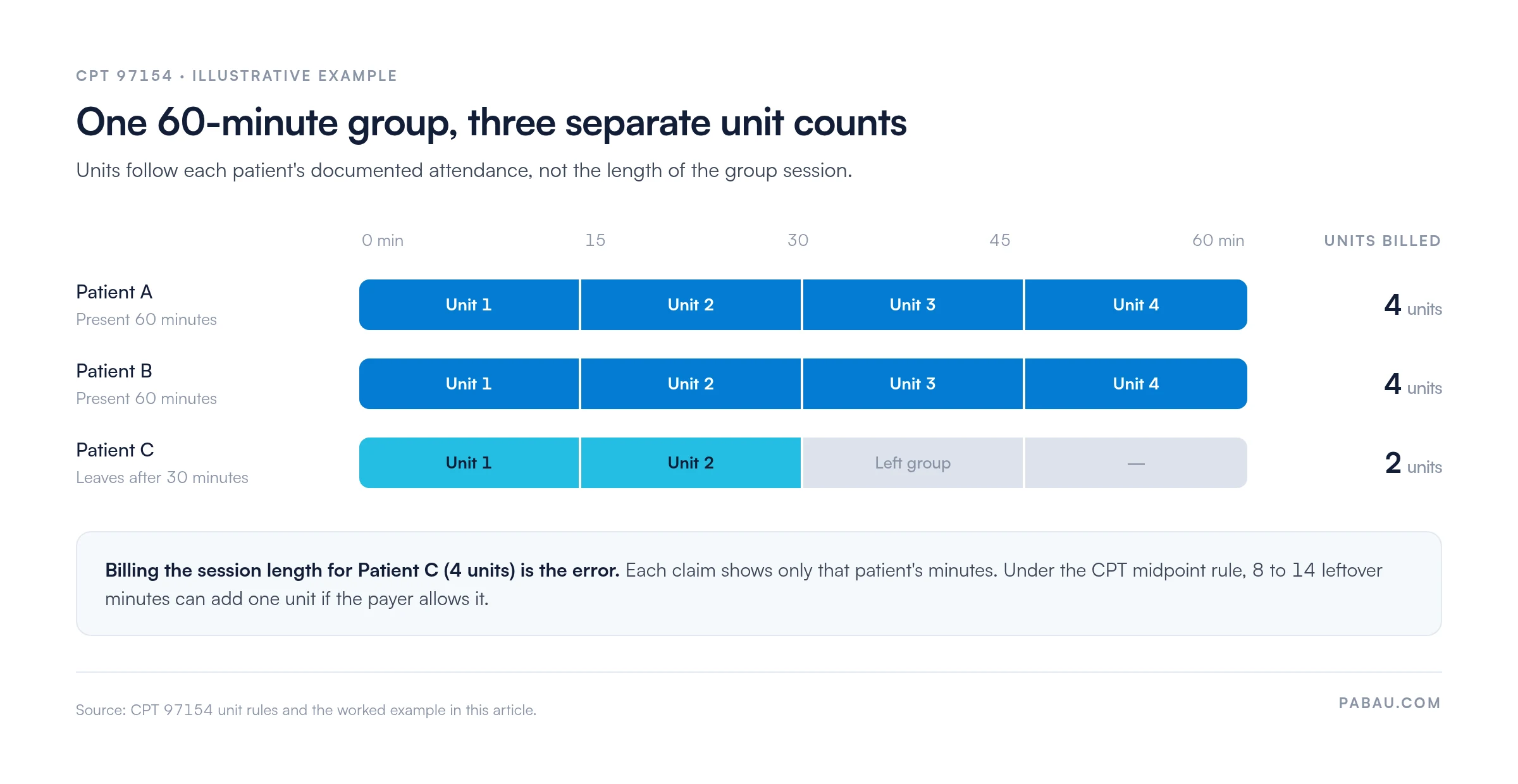
Common unit error: billing 97154 units for the entire group session length rather than per-patient time. If a patient leaves after 30 minutes of a 60-minute session, that patient’s claim should show 2 units, not 4. Always match billed units to documented individual patient attendance times. Leftover time of 8 to 14 minutes can count as one more unit under the CPT midpoint rule, if the payer allows it.
CPT 97153 is the individual therapy code, and CPT 97154 is the group code. They cover the same ABA service type but differ in patient count, supervision intensity, and reimbursement rate. Billing 97153 for a group session, or 97154 for a one-on-one session, is a frequent finding in ABA billing audits.
CPT 97155 covers protocol modification by a BCBA or other qualified health care professional. It can be billed on the same date of service as CPT code 97154 under specific conditions. Payer bundling rules vary, so check them before billing both codes together.
The time for 97155 (protocol modification) and 97154 (group treatment) must be separate and non-overlapping. Sometimes the BCBA modifies the protocol during the same minutes the technician delivers group treatment. Those overlapping minutes cannot be billed under both codes. Document the distinct time blocks in the session note.
CPT code 97154 is one of eight codes introduced in 2019 to replace the temporary ABA codes. Group treatment usually starts only after the assessment billed under 97151 is complete. Knowing where 97154 sits in the family prevents cross-code billing errors.
Coverage for CPT code 97154 varies significantly by payer type. Verifying coverage and completing insurance eligibility verification before scheduling reduces claim rejection at submission.
Medicaid: Medicaid is the primary payer for ABA therapy in the US. It covers ABA for beneficiaries under 21 mainly through the Early and Periodic Screening, Diagnostic and Treatment (EPSDT) benefit. Benefit limits, adult coverage, and accepted codes vary by state. Some states cap annual hours or require re-authorization every 6 months. Verify the applicable state Medicaid provider manual before billing.
Medicare: ABA is not a Medicare-covered benefit, so practices bill 97154 to Medicaid or commercial plans instead.
Commercial insurance: State autism mandate laws require most state-regulated commercial plans to cover ABA, and prior authorization is nearly universal. Payers ask for medical necessity documentation at authorization. That includes the ASD diagnosis (ICD-10-CM F84.0 or a related code) and the functional behavior assessment.
Reimbursement rates: Because Medicare does not cover ABA, the Medicare Physician Fee Schedule is not a reliable rate source for 97154. Check your state Medicaid fee schedule for Medicaid rates and your payer contracts for commercial rates. Rates change, so verify them annually and at each contract renewal.
Most payers require prior authorization before a single session of CPT code 97154 can be billed. Claims submitted without active authorization are a leading cause of ABA denials. Payers also request recoupment when they find unauthorized sessions after payment.
Run a monthly audit of your 97154 authorization expiry dates. Pull every active authorization from your billing system and compare it to the scheduled session calendar for the next 45 days. Any session scheduled after an auth expiry date needs re-authorization started immediately. ABA practices that do this monthly rarely face retroactive recoupment requests.
CPT code 97154 denials cluster around six predictable causes, and a pre-submission check for each one prevents many rejected claims. A structured denial management workflow catches these errors before they reach the payer. When a denial does arrive, the denial codes in billing reference explains what each reason code means.
Some state Medicaid programs cover telehealth delivery of group ABA sessions following post-COVID telehealth expansions, but coverage is far from uniform.
Medicare does not cover ABA, so it does not reimburse virtual group ABA sessions either. Several state Medicaid programs have extended telehealth parity to ABA codes, including through ongoing telehealth waivers. Verify the current status with the applicable state Medicaid agency before scheduling virtual group sessions.
Manual 97154 billing creates four repeatable failure points: unit miscalculation, missed authorization limits, incomplete session notes, and submission without a pre-claim scrub. A single medical billing workflow keeps those checks in one place instead of across spreadsheets and payer portals.
Pabau, the practice management platform we build for clinical teams, handles the authorization and claim side. Its claims management software stores each prior authorization as a case and tracks the approved sessions used against it. Before submission, claims are scrubbed for missing or invalid details.
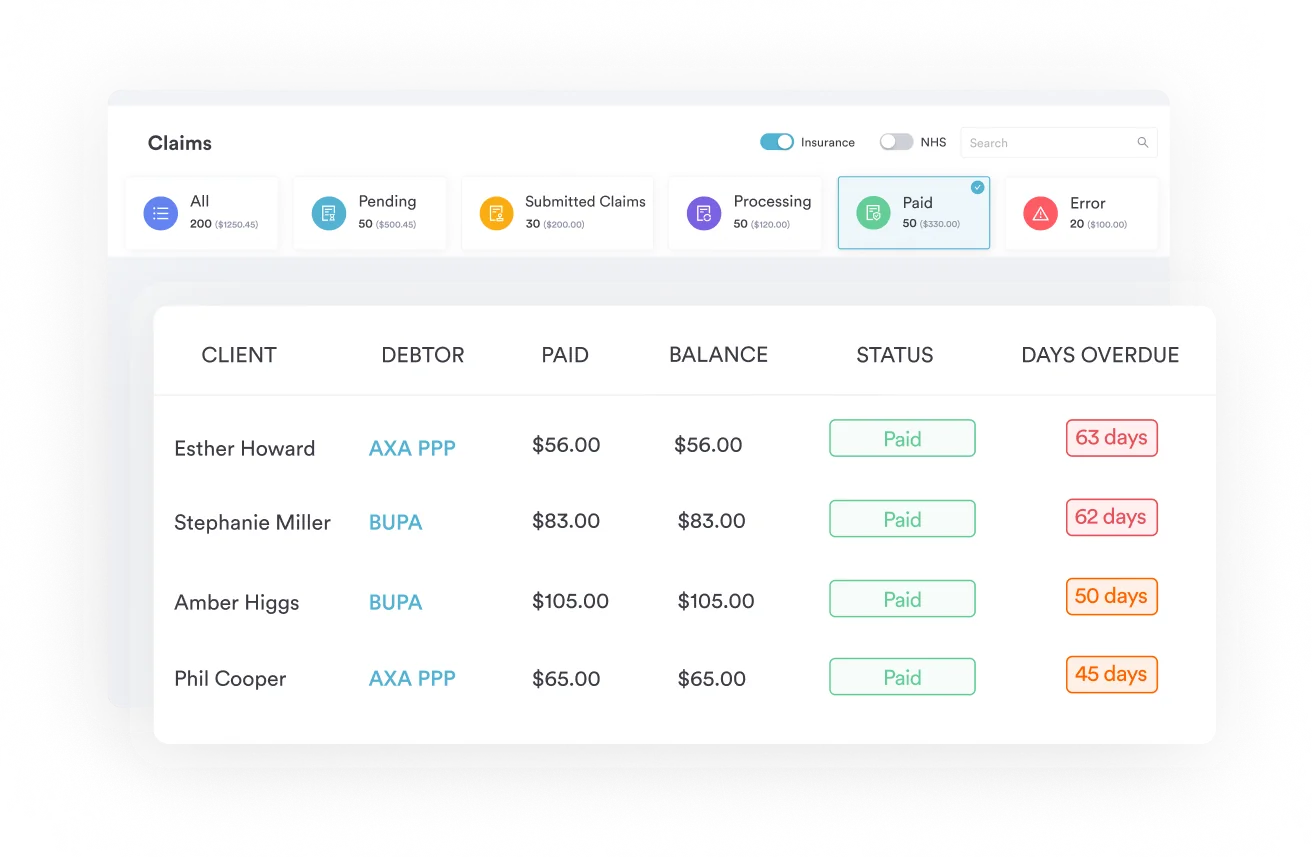
Electronic claims go out through the Claim.MD clearinghouse integration, which connects to thousands of US payers. Pabau then tracks each claim’s status and matches electronic remittance advice (ERA) to the claim. Denied or underpaid 97154 lines show up while the session notes are still fresh.
For practices offering ABA alongside other behavioral health services, the same system holds scheduling, documentation, and billing for every service line.

Pabau stores prior authorizations with the sessions used, scrubs claims for missing or invalid details, and tracks each claim through to payment. See how it supports group therapy billing at your practice.

CPT code 97154 is simple to define and easy to bill wrong. The fixes are procedural: count units from each patient’s attendance, confirm each payer’s rounding rule, and check authorization before a session is scheduled.
Start with the payers behind most of your group sessions. Write down each one’s unit rule, accepted supervisor credentials, and re-authorization cycle, then build your session note template around them. That one page takes the guesswork out of the denials described above.
Pabau keeps authorizations, claim scrubbing, and claim status in one place, so your team spends less time reworking 97154 claims. Book a demo to see how it fits your ABA billing workflow.

Need to understand ABA billing compliance requirements? Medical billing compliance covers documentation standards, payer audit triggers, and how to structure your practice’s billing review process.
Struggling with claim rejections across all code types? Denial management in healthcare outlines the workflows that identify denial patterns and build systematic appeal processes.
Want to understand how clearinghouse submission works? Claim.MD clearinghouse explains how electronic claim routing, real-time eligibility, and ERA processing reduce manual billing overhead.
Billing one-on-one ABA sessions too? CPT code 97153 covers individual adaptive behavior treatment, its units, and its documentation.
Running groups with protocol changes? CPT code 97158 explains group treatment with protocol modification by a qualified professional.
CPT code 97154 is the billing code for group adaptive behavior treatment by protocol. A technician delivers it to two or more patients at once, under the direction of a qualified health care professional, in 15-minute units. The CPT descriptor sets no diagnosis restriction, but most payers require a confirmed ASD diagnosis.
CPT 97153 is individual ABA therapy, with one patient and one technician. CPT code 97154 is group ABA therapy for two or more patients treated simultaneously. Both are billed in 15-minute units by a behavior technician under a qualified supervisor. 97154 reimburses at a lower per-patient rate, reflecting the shared technician time.
Units are counted per patient, at one unit per 15 minutes of technician face-to-face time. Under the CPT midpoint rule, 8 to 14 leftover minutes can count as one more unit, subject to payer policy. The CPT descriptor sets no daily cap, but most payers limit units through prior authorization. A 60-minute group session generates 4 units per patient. A patient who leaves after 30 minutes generates 2 units.
Rates for CPT code 97154 come from state Medicaid fee schedules and commercial payer contracts. ABA is not a Medicare-covered benefit, so the Medicare Physician Fee Schedule is not a reliable rate source. Each state sets its own Medicaid rates. Commercial rates are contract-specific and must be verified with each payer.