



CCSD code G5100: Bypass of duodenum billing guide
CCSD code G5100 bills a bypass that leaves the duodenum in place CCSD code G5100...

Last Updated: Oct 16, 2026

CPT Code 97016 covers the application of a vasopneumatic device, a supervised physical medicine modality that does not require one-on-one patient contact.
97016 is billed per session (not per 15-minute increment), making it a service-based code with distinct rules from timed therapeutic procedure codes.
Medicare requires modifier GP (physical therapy), GO (occupational therapy), or GN (speech-language pathology) on all outpatient therapy claims that include 97016.
Practice management software like Pabau automates code selection, documentation prompts, and claim submission for supervised modality codes such as 97016.
CPT Code 97016 is the billable code for applying a vasopneumatic device, a supervised physical medicine modality. One unit covers the whole session, no matter how long the device runs. Medicare also requires a therapy discipline modifier on every outpatient claim that carries it.
This reference covers the official descriptor, the documentation a payer expects, the modifiers, and the ICD-10 diagnoses that support medical necessity.
CPT Code 97016 appears in the Physical Medicine and Rehabilitation Modalities section of the AMA CPT code set, maintained by the AMA’s CPT Editorial Panel. Its official descriptor reads: Application of a modality to 1 or more areas; vasopneumatic devices.
As a supervised modality, 97016 does not require constant one-on-one attendance. The clinician or a qualified staff member must be in the facility suite while the device runs. Direct contact is not required throughout the session, which is what separates 97016 from the constant-attendance codes billed in 15-minute units.
A vasopneumatic device uses pneumatic compression, typically through a sequential inflatable sleeve or garment, to apply intermittent pressure to a limb or body area.
The pressure gradient promotes venous and lymphatic return, reduces edema, and improves peripheral circulation. Common clinical applications include lymphedema management, post-surgical swelling reduction, and chronic venous insufficiency.
Key facts at a glance:
97016 is used when a patient needs intermittent pneumatic compression to control edema or restore venous and lymphatic return. Payers, including Medicare, deny claims where the therapy is not tied to a qualifying diagnosis and a clinician’s plan of care. The conditions below are the most commonly accepted indications.
The treating clinician must document that vasopneumatic device therapy is medically necessary for this patient’s condition, not merely convenient or routine. Medicare Local Coverage Determinations (LCDs) for physical medicine modalities govern which diagnoses are covered in each jurisdiction.
Three rules govern how 97016 is billed: supervision level, billing units, and place of service. Getting any one of them wrong can trigger a denial. A practice running claims software for therapists can automate these checks before the claim leaves the building.
Real-time claim scrubbing before submission catches most of these errors. A scrubber flags a missing discipline modifier or a supervision-level inconsistency before the claim reaches the payer’s adjudication system.
Medical necessity documentation is where most 97016 claims unravel at audit. The record must establish that vasopneumatic device therapy was a clinically appropriate choice for this diagnosis, at this stage of treatment.
Required documentation elements for each session:
Structured note templates are what make this repeatable. A good template forces the pressure setting, the treated area, and the supervision attestation into every session note. That takes the judgment call away from the clinician at the end of a long day.
Audit your 97016 session notes quarterly. Pull 10 random claims and check each against your documentation checklist: diagnosis coded, order present, treatment parameters recorded, supervision noted, and functional progress updated. If any element is missing in more than 20% of reviewed claims, standardize your note template immediately.
Medicare reimburses 97016 at different rates depending on where the service is performed. The CMS Physician Fee Schedule lookup tool provides current year facility and non-facility rates by locality. Geographic payment localities mean a practice in San Francisco is paid more than one in rural Alabama for the same code.
This page publishes no national average dollar figure for 97016. Pull current rates straight from the CMS Physician Fee Schedule lookup before you use dollar amounts in contract negotiations or financial planning.
Selecting the correct ICD-10 diagnosis code is not optional. Payers match the diagnosis code on the claim against their Local Coverage Determination (LCD).
The LCD is what tells them whether vasopneumatic therapy is an approved treatment for that condition. A diagnosis missing from the LCD for physical medicine modalities triggers an automatic medical-necessity denial, however well the session is documented.
Always verify specific ICD-10 codes against the relevant payer’s LCD before billing. Coverage lists are updated annually and vary by Medicare Administrative Contractor (MAC) jurisdiction. The ICD-10-CM code index is where to look when the record supports something more specific than the codes above.
Medicare requires therapy discipline modifiers on all outpatient therapy claims. Omitting the correct modifier causes the claim to deny immediately. The modifier identifies which therapy discipline is providing the service, so CMS can track therapy spending by discipline and apply the appropriate benefit rules.
Modifier rules change annually and vary by payer. Verify current modifier requirements against each payer’s provider manual before the start of each calendar year. Medicare modifier rules are published by CMS in the annual Physician Fee Schedule final rule.
CPT Code 97016 sits within the supervised modality family of the 97000 series. The nearest neighbor, CPT Code 97018, bills a paraffin bath for superficial heat rather than compression for swelling. Knowing the adjacent codes helps coders select the most accurate code for the service delivered and avoid substitution errors. The AAPC Codify CPT lookup provides the full 97000-series range with crosswalk data.
The key distinction between 97016 and its constant-attendance siblings (97032, 97035) is supervision level. Supervised codes do not count toward Medicare’s 8-minute rule and are billed per session. Constant-attendance codes are timed and require direct one-on-one contact throughout the treatment.
97016 claims fail for predictable reasons. A practice that tracks denial patterns can find the failure point, fix it upstream, and cut future denials. Effective denial management starts with knowing which reason codes show up most often on remittance advices for modality claims.
The most common denial reasons for CPT 97016:
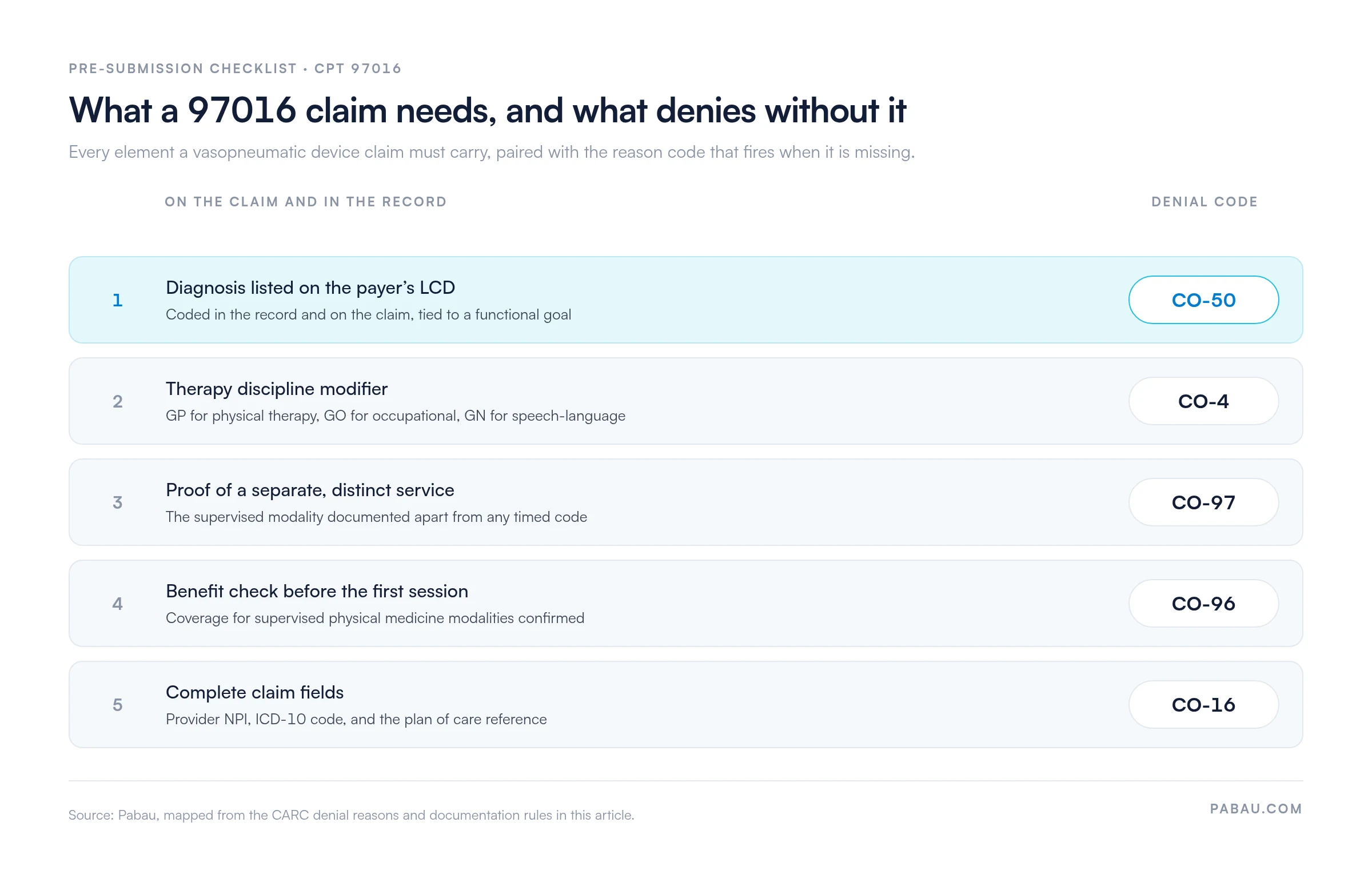
Read that list backwards and it becomes a checklist you can run before submission. The map below pairs each element a 97016 claim has to carry with the code that fires when it goes missing.
When appealing a denied 97016 claim, include the session note, the signed plan of care, and the clinician order. Add a narrative letter explaining why the treatment was medically necessary for this patient. A practice whose records are already organized this way resolves appeals faster, because nothing has to be reconstructed.
Manual code selection and documentation for supervised modalities creates avoidable risk. When a clinician documents a vasopneumatic therapy session away from the billing workflow, coding errors and missing modifiers follow. Connecting clinical documentation to claim submission in one platform removes that separation.
Pabau, our practice management platform, embeds CPT code templates and modifier prompts inside the clinical documentation workflow. When a clinician records a vasopneumatic device session, Pabau surfaces 97016 and prompts for the therapy discipline modifier. It also flags a mismatched ICD-10 pairing before the claim reaches the clearinghouse.
Denial tracking is the other half of the job, and every Pabau subscription includes reporting. Once each claim carries the same coded elements, a report by payer and by provider becomes readable. It shows whether 97016 denials cluster around one payer or one clinician’s notes, which tells you what to fix first.
Run a 97016 payer-specific denial report every 90 days. Filter your remittance data by CARC code (CO-50, CO-97, CO-96) for all claims with CPT 97016. If one payer accounts for more than 60% of denials, review their current LCD and compare it against your documentation template. One template update often fixes months of recurring denials.

Pabau connects clinical documentation to claim submission in one platform, reducing coding errors for supervised modality codes like CPT 97016. See how PT and rehab practices use Pabau to reduce denials and speed up reimbursements.

The hard part of 97016 is not the code. It is proving, session after session, that a supervised modality belonged in the plan of care. Practices that write the supervision attestation and the treatment parameters into every note rarely end up arguing with a payer about this one.
So pick the one element on the checklist above that your note template does not capture yet, and fix that first. Book a demo to see how Pabau keeps modality documentation and claim submission on the same patient record.

Billing the other supervised modality? CPT Code 97014 covers unattended electrical stimulation, which follows the same per-session rules as 97016.
No specific code for the modality you used? CPT Code 97039 explains when the unlisted modality code applies and what report a payer expects with it.
New to the claim lifecycle? What is medical billing walks through each step from the patient encounter to payment posting.
Want fewer claims coming back? What makes a clean claim breaks down the elements payers require to process a claim without manual review.
CPT Code 97016 bills the application of a vasopneumatic device, a supervised physical medicine modality. The device uses intermittent pneumatic compression to reduce edema, promote lymphatic drainage, and improve peripheral circulation. Physical therapists and occupational therapists bill it most often for lymphedema, post-surgical swelling, and chronic venous insufficiency.
No. CPT 97016 is a per-session code, not a timed code. One unit is billed per treatment session regardless of how long the vasopneumatic device runs. It does not follow the 8-minute rule that applies to constant-attendance timed codes like 97032 or 97035.
Both are supervised, per-session physical medicine modalities, but they cover different devices. CPT 97014 covers unattended electrical stimulation (e.g., TENS or interferential current), while CPT 97016 covers vasopneumatic compression devices. The supervision and billing rules are identical, but the device and its clinical application differ.
Yes. Medicare covers CPT 97016 under the outpatient physical and occupational therapy benefit. The service must be medically necessary, ordered as part of a plan of care, and supported by a qualifying ICD-10 diagnosis. That diagnosis has to appear on the applicable Medicare Local Coverage Determination, which varies by MAC jurisdiction.
CPT 97039 is the unlisted physical medicine modality code, used when a modality has no specific CPT descriptor. It may apply where a compression device does not qualify as a vasopneumatic device under 97016. It requires a special report and individual payer review, which makes it slower to process than 97016.
Required documentation starts with a physician or NPP order for vasopneumatic therapy and a signed plan of care with functional goals. Each session note records the device applied, the area treated, the pressure settings and duration, and the patient response. A supervision attestation and periodic functional progress notes complete the record.



