CPT Code 31653: EBUS With 3+ Mediastinal Stations
CPT code 31653: Official descriptor and clinical scope CPT code 31653 is the pro...

Last Updated: Oct 20, 2026
99384 is the CPT code for the initial comprehensive preventive medicine visit for a new patient aged 12 through 17. It covers an age- and gender-appropriate history and exam, counseling and anticipatory guidance, risk factor reduction, and any lab or diagnostic orders.
Practices bill it once, for the well-visit that opens the patient relationship. Returning patients in the same age band bill 99394, and a patient who turns 18 before the visit moves to 99385.
Let Pabau's smart automation suggest the right codes, reduce claim denials, and keep your practice compliant—effortlessly.
Automate repetitive tasks and focus on what matters most—your patients.
Reduce coding errors and ensure compliance with the latest regulations.
Clean claims, fewer denials, and faster reimbursements.
Powerful insights and reporting to help your practice thrive.
HIPAA compliant SOC 2 certified GDPR-compliant Trusted by 4,000+ clinics worldwide

CPT Code 99384 covers the initial preventive visit for new patients aged 12-17 only, and 99394 is its established-patient equivalent.
A new patient has not seen a physician of the same specialty and subspecialty in the same group practice within the past three years.
The patient’s age on the date of service decides the code, so a patient who turns 18 before the visit bills as 99385.
Use a Z00.12x code as the primary diagnosis. Pick Z00.121 when the exam notes abnormal findings and Z00.129 when it is normal.
Practice management software like Pabau runs eligibility and validation checks before a claim reaches the clearinghouse.
CPT Code 99384 is the American Medical Association code for an initial comprehensive preventive medicine evaluation and management (E/M) visit. It applies to new patients aged 12 through 17. The official descriptor names four components:
Three conditions must all hold before the code applies. The patient is new, is aged 12-17 on the date of service, and is there for a preventive rather than a problem-focused visit. Miss any one of them and the claim is denied.
The code belongs to the 99381-99387 initial preventive series, where each code covers the same service for a different age band. After patient-status errors, a code from the wrong age band is the most frequent denial in this family. Billing 99385 for a 17-year-old is the classic example.
The qualifying age is 12 through 17 years, based on the patient’s age on the date of service. A patient who turns 18 the day before the appointment no longer qualifies, so 99385 applies instead. A patient who is still 17 on appointment day but turns 18 the following week is correctly billed under 99384.
The AMA defines a “new patient” with a three-year lookback. In that time, the patient must not have received professional services from the physician. The same applies to any physician of the same specialty and subspecialty in the same group practice. A patient seen 30 months ago by a same-specialty colleague in the group counts as established.
The visit must be comprehensive in scope. Payers audit preventive E/M notes more closely than problem-focused ones, because the service pays well without a diagnosed condition to anchor it. A defensible claim starts with a note that documents each of these components.
The code is chosen by age band and patient status, never by the complexity of medical decision-making. That is the main difference between preventive and problem-focused E/M codes. A biller who applies the 1995 or 1997 documentation guidelines to a 99384 visit is using the wrong framework.
Build a separate note template for CPT 99384 visits. Pre-populate the HEADSS domains, immunization checklist, and age-specific lab fields. When an auditor reviews a preventive note, they are looking for documented evidence of each required component, not clinical complexity. A missing counseling section triggers a downcode request regardless of how thorough the physical examination was.
The primary diagnosis must be a Z-code from the Z00.12x series. Linking the wrong ICD-10 code, or using an adult-encounter code, is a common source of preventable denials.
When the exam finds an additional condition, such as hypertension, scoliosis, or a positive depression screen, its code may also appear on the claim. List it after the Z00.12x primary code. Do not substitute the additional-finding code for the Z-code as the primary diagnosis. Payers expect the encounter type to lead the claim.
CMS publishes no national payment rate or RVUs for CPT Code 99384. Medicare excludes routine preventive physicals by statute, so the code has no Medicare Physician Fee Schedule amount to look up. The values below are third-party estimates, not CMS figures.
Tools such as FastRVU’s RVU lookup show how those estimates split into work, practice expense, and malpractice components.
Payment for 99384 comes from your contracts with Medicaid, CHIP, and commercial payers. Medicaid and CHIP rates vary by state, and commercial rates vary by plan. Check each payer agreement rather than applying one estimate to every claim.
No. Medicare excludes routine preventive physicals by statute, and few adolescents are Medicare beneficiaries in the first place. The rare adolescent who does hold Medicare has no Medicare coverage for 99384 either, so verify each patient’s coverage before the visit.
The Medicare Annual Wellness Visit (G0438 for the initial visit, G0439 for subsequent) is a separate and distinct service. It applies to beneficiaries who have been enrolled in Medicare Part B for at least 12 months. G0438 and 99384 are not interchangeable and serve different patient populations.
For the 12-17 age band, the primary payers are Medicaid, CHIP, and commercial insurance. Medicaid covers preventive visits through the Early and Periodic Screening, Diagnostic, and Treatment (EPSDT) benefit, which mandates preventive services for children under 21. EPSDT coverage rules differ by state, so verify the specific state’s Medicaid plan before assuming coverage aligns with the federal mandate.
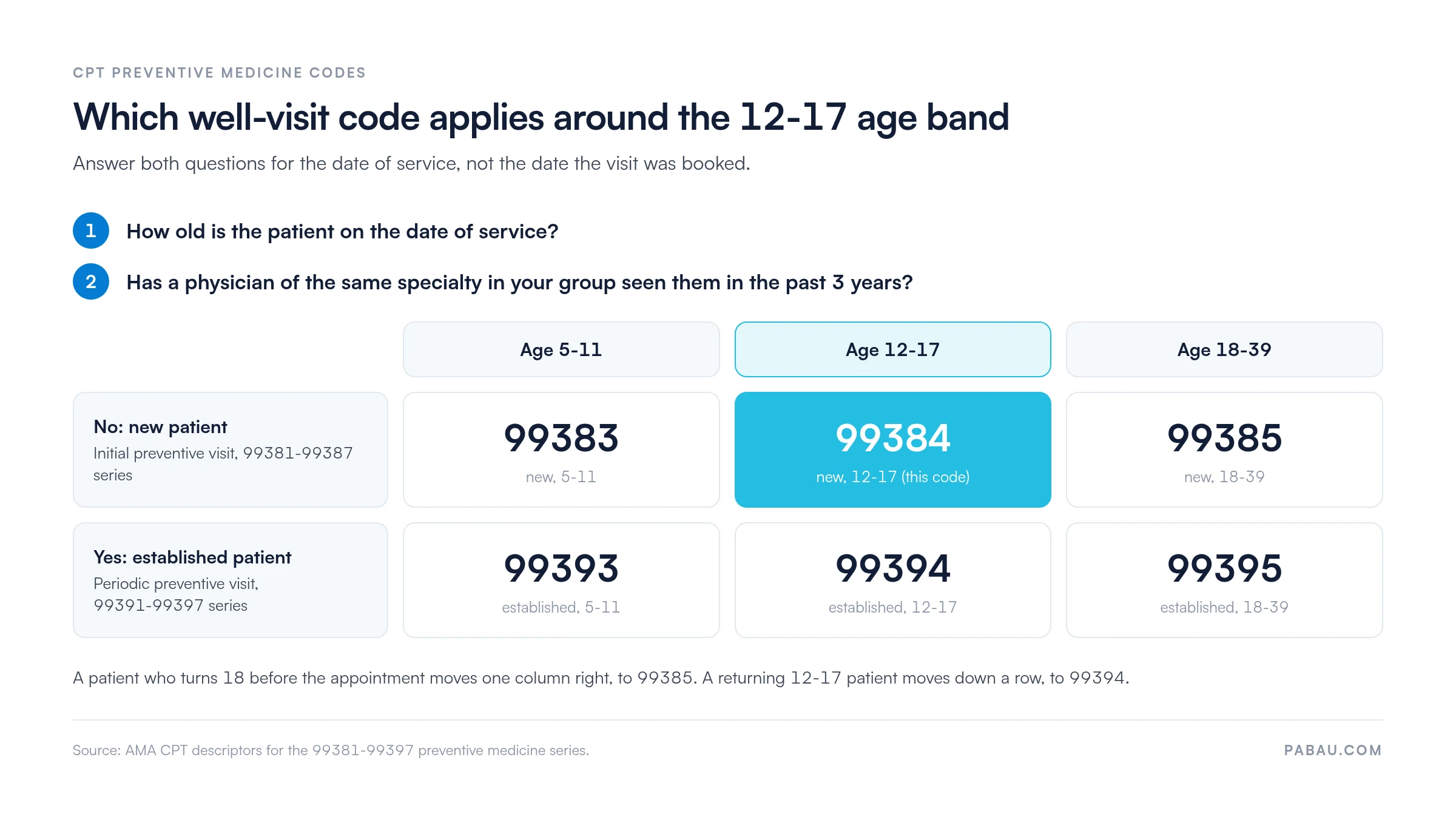
99384 and 99394 cover the same age band and the same service type, separated by one variable: patient status. 99384 applies to a new patient. 99394 applies to an established patient, seen within the prior three years by a physician of the same specialty in the same group.
99384 is an initial code. Once the patient has been seen and becomes established, all subsequent annual preventive visits in the 12-17 range bill under 99394. Attempting to re-bill 99384 for a returning patient will be denied as a duplicate or frequency violation.
99384 covers new patients aged 12-17, and 99385 covers new patients aged 18-39. The boundary is a single birthday. Bill 99385 for a 17-year-old and the payer’s age edit rejects the claim, because the date of birth falls outside the code’s age band.
The birthday edge case trips up practices that schedule weeks in advance. A patient who is 17 at booking and 18 by the appointment date must be coded under 99385. The rule is age on the date of service, not the date of scheduling. The grid below maps both decisions, age and patient status, for the codes on either side of 99384.
A problem-oriented E/M service can be billed on the same day as 99384 when it is significant, separately identifiable, and documented distinctly in the note. Modifier 25 attaches to the problem-oriented E/M code, not to 99384.
Most 99384 denials fall into one of six categories, and each one is fixable before submission with the right front-end check.
Grouping your medical billing denial codes by category shows which front-end check to fix first, instead of treating each rejection as a one-off.
Track your 99384 denial rate separately from your overall preventive E/M denial rate. Age-band errors (patient was 18) and patient-status errors (established billed as new) respond to different fixes. Age-band denials require a scheduling-side check at date-of-service confirmation. Patient-status denials require a group-wide patient history lookup before the appointment is coded. Mixing the two categories makes the root cause invisible.
CPT Code 99384 is an initial code. It is billed once, for the first comprehensive preventive visit with a new patient in the 12-17 age band. It is not an annual code. Once that patient becomes established (as soon as they have been seen), all subsequent annual preventive visits in the age band use 99394.
The confusion arises because 99394, the established-patient counterpart, is billable annually. Practices that conflate the two codes attempt to re-bill 99384 each year. The claim history shows the code was already submitted, and the payer denies it as a frequency violation or duplicate.
The practical workflow: when a returning 14-year-old arrives for their annual physical, the system should already show a prior 99384 claim. If it does, the correct code is 99394. If the system has no prior record, check whether a same-specialty physician in the group saw the patient before selecting 99384.
The denials that make 99384 expensive to bill are almost all front-end errors. The usual culprits are a wrong age on the date of service, an established patient coded as new, and a missing Z-code. Each one can be caught before the claim leaves the practice.
Practice management software like Pabau builds the first safeguards into its claims software for practices. Real-time eligibility checks through the Claim.MD clearinghouse confirm coverage before the visit. Background validation then flags missing membership numbers and authorization codes before the claim is submitted.
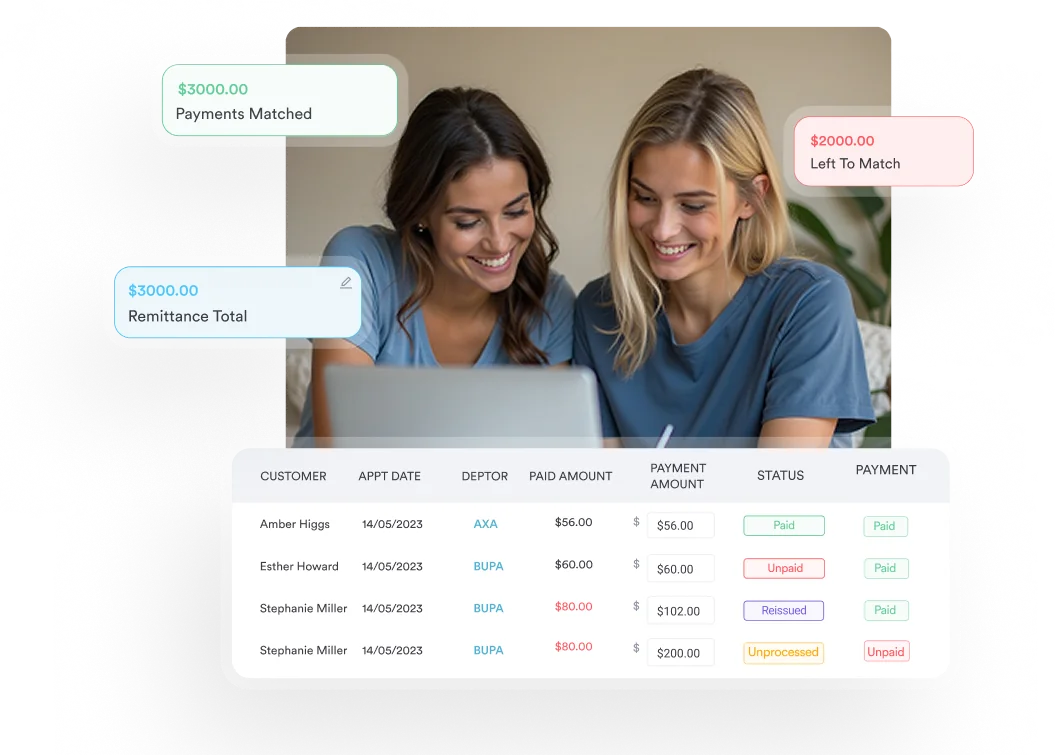
Each claim then moves through five tracked stages, from pending to paid. A claim that lands in the error stage waits for your team to fix and resubmit it, so a rejected 99384 claim never sits unnoticed. When the payer pays, Pabau posts the electronic remittance advice against the claim, which closes the adolescent visit without manual reconciliation.

Pabau checks eligibility in real time and validates each claim before it goes out, so fewer adolescent preventive claims come back denied.

Bill 99384 cleanly by settling two facts before the visit is coded. Run a group-wide history check at booking to confirm the patient is new, then confirm their age again on the day of the appointment.
That small front-desk habit pays off for years. A correct first visit sets up every later well-visit with that patient to bill as 99394. The trade-off is a few extra seconds at check-in against weeks of appeal work.
Book a demo to see how Pabau’s eligibility checks and claim validation keep adolescent preventive claims moving from submission to payment.

Seeing an 18-year-old for the first time? CPT code 99385 covers the new-patient preventive visit for ages 18 through 39.
Pairing the diagnosis for a normal exam? ICD-10 code Z00.129 explains when a routine child health exam has no abnormal findings.
Need to understand how clearinghouse submissions work? Medical claims clearinghouse guide explains how claims are scrubbed, transmitted, and tracked through to payer adjudication.
Tracking denials across your preventive code mix? Electronic remittance advice covers how ERAs carry denial codes and how to map CARC reasons to billing workflow fixes.
Want to understand how credentialing affects preventive billing? Credentialing with insurance companies outlines what payers verify before they accept preventive claims from a new provider.
CPT Code 99384 is the initial comprehensive preventive medicine evaluation for new patients aged 12 through 17. It covers a comprehensive history, multi-system exam, anticipatory guidance, and age-appropriate counseling. It applies only to new patients. That means no physician of the same specialty and subspecialty in the same group practice has seen them in the past three years.
CPT 99384 applies to patients aged 12 through 17, determined by the patient’s age on the date of service, not the scheduling date. A patient who turns 18 before the appointment date must be billed under CPT 99385 instead.
No. Medicare excludes routine preventive physicals by statute, and most adolescents are not Medicare beneficiaries anyway. For most patients aged 12-17, the primary payers are Medicaid, CHIP, or commercial insurance. Always verify benefits before the visit.
99384 is for new patients; 99394 is for established patients. Both cover the same age band (12-17) and the same preventive service type. Once a physician of the same specialty in the same group has seen the patient, later annual visits within three years bill under 99394. Rebilling 99384 for a returning patient will generate a frequency or duplicate denial.
The top three are age mismatches, patient-status errors, and frequency violations. An age mismatch means the patient turned 18 before the date of service. A patient-status error bills an established patient as new, and a frequency violation re-bills the code for an annual return visit. Missing or mismatched ICD-10 Z-code and same-day billing without Modifier 25 are also frequent causes.
99384 covers new patients aged 12-17; 99385 covers new patients aged 18-39. The only difference is the age band. Billing 99385 for a 17-year-old will be denied because the patient’s date of birth falls outside the code’s defined eligibility range. Verify the patient’s age on the date of service before selecting the code.
Yes, if the problem-oriented E/M service is significant and separately identifiable. Bill it alongside 99384 with Modifier 25 on the E/M code. The clinical note must document the preventive service and the problem-oriented service in clearly distinct sections. Some commercial payers restrict same-day billing regardless of modifier; verify the specific payer’s policy first.