CPT Code 70490: CT soft tissue neck without contrast
CPT Code 70490: Official descriptor and clinical scope CPT Code 70490 carries th...

Last Updated: Oct 15, 2026
95812 is the CPT code for electroencephalogram (EEG) extended monitoring, 41-60 minutes. It reports one EEG study whose recording runs longer than a routine EEG but no longer than an hour.
Recording time is the fact that decides the code. A study of 40 minutes or less is a routine EEG, billed as 95816, 95819 or 95822 by study type. A study of 61 to 119 minutes moves to 95813. Count the minutes wrong and the claim is miscoded before a payer reads it. Below, you will find code selection, modifiers, diagnosis pairings, 2026 Medicare payment and the checks that prevent denials.
Let Pabau's smart automation suggest the right codes, reduce claim denials, and keep your practice compliant—effortlessly.
Automate repetitive tasks and focus on what matters most—your patients.
Reduce coding errors and ensure compliance with the latest regulations.
Clean claims, fewer denials, and faster reimbursements.
Powerful insights and reporting to help your practice thrive.
HIPAA compliant SOC 2 certified GDPR-compliant Trusted by 4,000+ clinics worldwide

CPT code 95812 reports EEG extended monitoring when the recording runs 41 to 60 minutes.
Recordings of 61 to 119 minutes use 95813, and studies of 40 minutes or less take a routine EEG code.
Hyperventilation and photic stimulation are included when performed, but the code does not require them.
Bill one unit per date, and never report 95812 and 95813 together for the same study.
Append modifier 26 or TC when the interpretation and the technical work are billed by different parties.
CPT code 95812 is the code for electroencephalogram (EEG) extended monitoring, 41 to 60 minutes. It sits in the Routine Electroencephalography (EEG) Procedures subsection of the AMA CPT code set, alongside 95813 and the routine codes 95816, 95819 and 95822.
The code is time-based. Whatever states the patient passes through, the recording length picks the code. Awake, drowsy and asleep segments all count toward the total, as long as they fall inside one continuous study.
Coders confuse 95812 with two neighbors. The first is 95813, the next duration tier. The second is the routine EEG family, where study type rather than duration drives the choice.
The quickest check is the clock. Read the start and stop times on the technologist report, then find the row the total falls in.
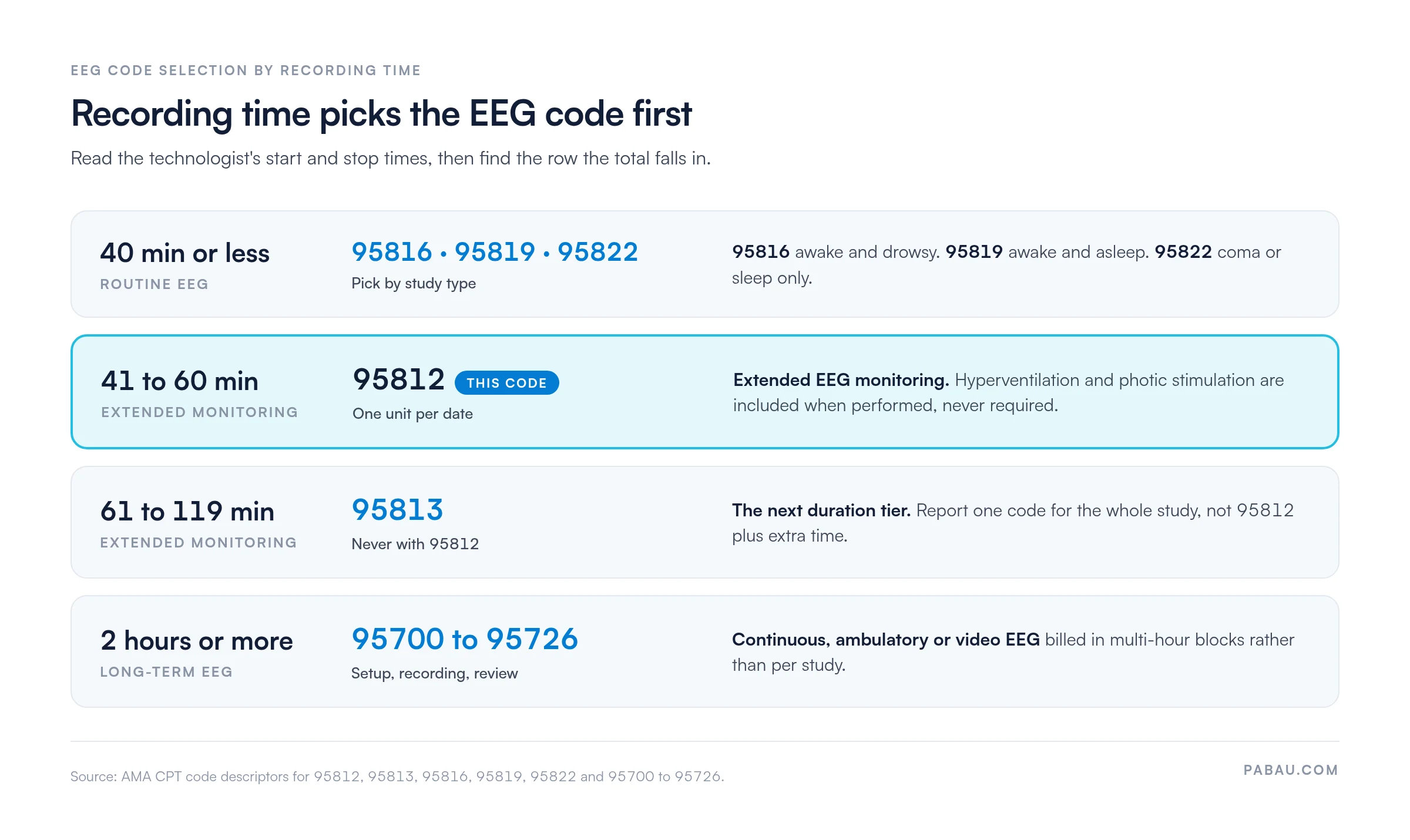
When a short awake and drowsy study lands under 41 minutes, 95816 is the routine code to use instead.
Payers want an ICD-10-CM code that explains why the study was ordered. Coverage rules come from each Medicare Administrative Contractor (MAC) and commercial plan, so a diagnosis one payer accepts may fail at another.
Common indications include epilepsy evaluation, seizure characterization, encephalopathy workup and altered mental status. Code the epilepsy type and intractability as specifically as the notes allow.
Check every ICD-10 pairing against your MAC’s local coverage determination before you submit a 95812 claim. Search the CMS Medicare Coverage Database for EEG in your jurisdiction. A code accepted by one MAC can trigger an automatic denial at another.
Modifiers 26 and TC apply to 95812, plus global billing and occasionally modifier 59. The CMS fee schedule lists 95812 with a PC/TC indicator of 1, so the professional and technical parts can be billed apart.
Two unit rules catch practices out. NCCI treats 95812 and 95813 as mutually exclusive on one date, and the medically unlikely edit (MUE) limits 95812 to one unit. A second unit never extends a study.
The most frequent modifier error is a global claim for a hospital-based study. If the facility owns the equipment, the reading physician appends modifier 26. Otherwise the claim overpays and invites recoupment.
Medicare pays 95812 under the Medicare Physician Fee Schedule (MPFS). For CY2026 the conversion factor is $33.4009 for non-qualifying APM participants and $33.5675 for qualifying APM participants.
Your payment equals the RVUs times the conversion factor, adjusted by your locality’s geographic practice cost indices. Pull current RVUs from the CMS lookup or the FastRVU lookup tool before you plan revenue.
Place of service decides which rate applies, and it often decides the modifier too.
Here is the path a clean claim follows. If you are new to the wider cycle, our overview of medical billing basics explains each stage.
Most rework starts at step three or five. A missing stop time, or minutes added up wrong, sends the claim out with the wrong code.
Original Medicare generally does not require prior authorization for an outpatient EEG. Your MAC’s local coverage rules still apply, so check medical necessity before the study.
Commercial plans vary far more. Some ask for authorization when the indication is epilepsy, or when a neurology specialist orders the study. Check the plan before booking, and keep these on file either way:
A correctly coded claim can still be denied if the chart is thin. Run this checklist before each claim leaves the practice.
Denials on this code tend to follow the same few patterns. Each one has a fix you can build into the workflow.
When a denial comes back, match its reason code against our guide to denial codes. That tells you which row above caused it.
If the same denials keep returning, a structured process for denial management helps you spot whether one payer or one step is behind them.
95812 ends at 60 minutes. A study of 61 to 119 minutes is 95813, still billed once per study.
Once monitoring runs two hours or more, the long-term EEG codes 95700 to 95726 take over. Per the AAPC CPT code reference, they cover setup, recording with or without video, and physician review in multi-hour blocks.
Here is a practical example. A patient placed on continuous monitoring that runs overnight is billed under the long-term codes. The first hour is not split off as 95812.
Audit your 95812 claims monthly against the technologist timestamps. Flag any study that stopped within five minutes of 41 or 60 minutes. These edge cases are where wrong-tier denials cluster.
In many neurology practices, the EEG report sits in one system and the claim gets built in another. Minutes and diagnosis codes are retyped by hand, and that is where errors creep in.
Pabau, the practice management platform we build, includes claims software that pre-fills the CMS-1500 from the patient record. The CPT code on the service lands on the charge line, and ICD-10 slots draw from the recorded problem list. Required fields must be complete before the claim can be sent.
For US practices, claims go out through Claim.MD. That adds real-time eligibility checks, claim status tracking and electronic remittance posting, so a denied 95812 claim surfaces quickly.

Pabau pre-fills each claim from the patient record and checks required fields before it goes out. US claims run through Claim.MD with eligibility checks and remittance posting.

Code 95812 from the clock, not from habit. If the logged recording runs 41 to 60 minutes, it is 95812, whatever states the patient passed through.
The fix that pays off fastest is upstream. Make start and stop times a required field for technologists, and the coding decision becomes a lookup. The trade-off is a little more discipline at the EEG bench in exchange for fewer reworked claims.
Book a demo to see how Pabau carries EEG study details into a clean claim for your neurology practice.

Want to understand the full claims submission process? Our Claim.MD clearinghouse guide explains how electronic claims reach payers and what happens when they are rejected.
Seeing denials you cannot trace to a specific reason? Clean claim submission standards covers the pre-submission checks that prevent the most common rejections.
Need to verify eligibility before the EEG is scheduled? Insurance eligibility verification workflows walks through payer checks before the study takes place.
Billing a sleep-capturing study under 41 minutes? CPT code 95819 covers routine EEG recorded awake and asleep.
No. Count recording time only, from the start time to the stop time the technologist logs. Electrode application, patient preparation and the physician’s reading time do not add minutes. A study with 20 minutes of setup and 45 minutes of recording is still a 45-minute study.
A routine EEG under 95816, 95819 or 95822 typically records for 20 to 40 minutes. Once the recording passes 40 minutes, it moves into the extended monitoring tiers. That means 95812 up to 60 minutes and 95813 up to 119 minutes.
No. 95812 is a single in-office or hospital study of up to an hour. An ambulatory EEG records for hours or days while the patient goes about daily life. It is billed with the long-term codes 95700 to 95726.
Yes. The code is based on recording length, not state. Awake, drowsy and sleep segments all count toward the 41 to 60 minutes, as long as they fall in one continuous recording.