CPT code 93503: Swan-Ganz catheter billing and modifiers
CPT code 93503: Official descriptor and procedure overview In the AMA CPT code s...

Last Updated: Oct 23, 2026
CPT code 92522 covers evaluation of speech sound production only, meaning articulation, phonological process, apraxia, or dysarthria. No language testing is required to support it. It is one of four speech-language pathology evaluation codes that took effect on January 1, 2014. That update to the AMA CPT code set replaced the older SLP evaluation family.
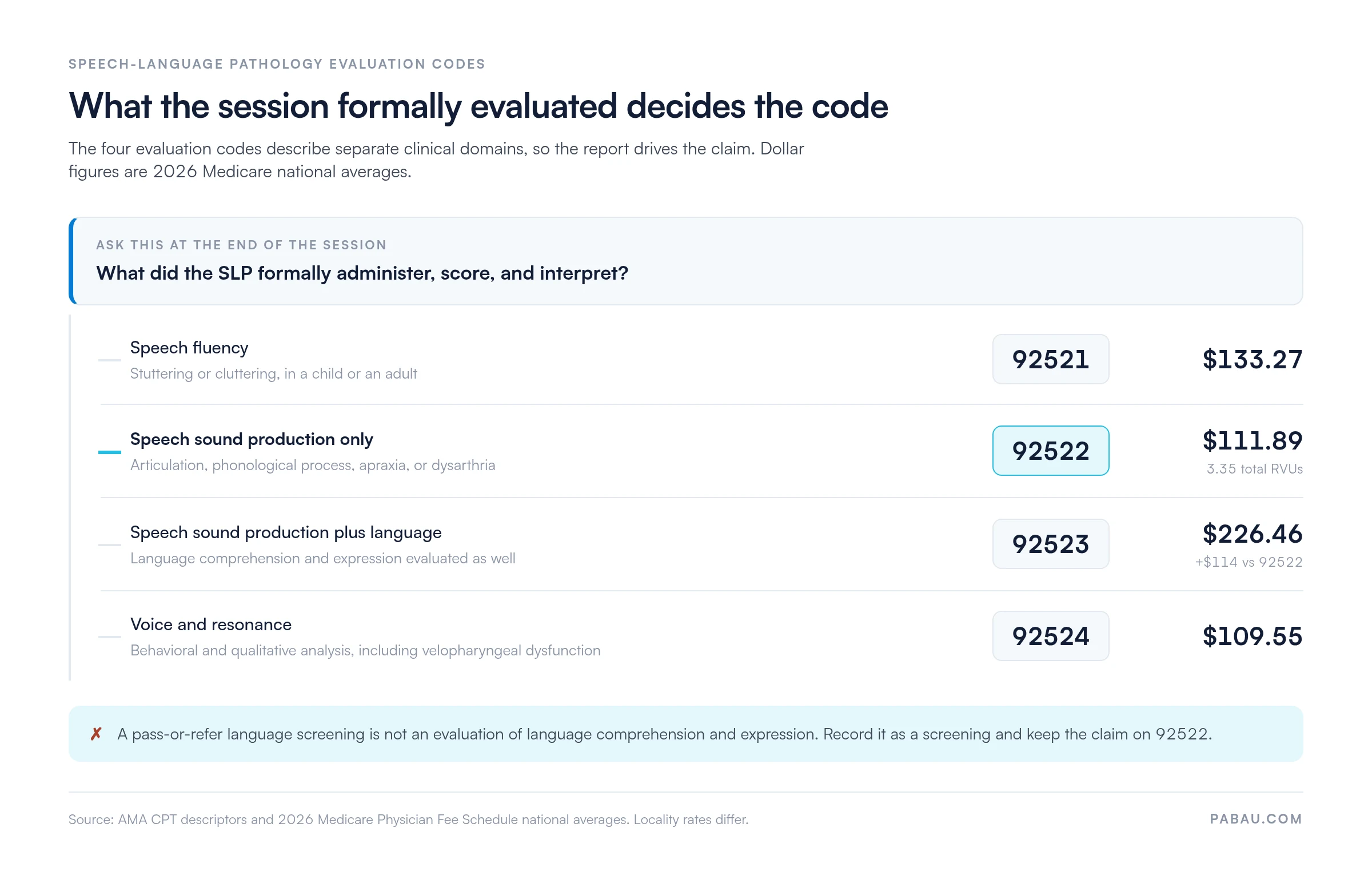
One decision drives almost every 92522 claim. If the same session also includes a formal evaluation of language comprehension and expression, the correct code is 92523. Medicare’s 2026 national average is $111.89 for 92522 and $226.46 for 92523, so the choice is worth about $114 per evaluation. A pass-or-refer language screening does not move the claim to 92523.

CPT code 92522 covers evaluation of speech sound production only, including articulation, phonological process, apraxia, and dysarthria.
Adding a formal evaluation of language comprehension and expression moves the encounter to 92523, which Medicare pays at roughly double the 92522 rate.
No language testing is needed to justify 92522. The chart only has to carry standardized speech sound results, a speech sample, and an oral mechanism exam.
Modifier GN is the one Medicare expects on SLP claims; GP applies only when the service runs under an outpatient physical therapy plan of care.
Pabau’s claims management software lets SLP practices build evaluation note templates, scrub claims before submission, and track 92522 denials by payer.
CPT code 92522 is defined by the AMA as: Evaluation of speech sound production (e.g., articulation, phonological process, apraxia, dysarthria). The code sits in the Otorhinolaryngologic Services section of CPT and is performed by a qualified speech-language pathologist.
The descriptor covers one clinical service. The SLP assesses how the patient produces speech sounds, and no language testing is called for. Receptive and expressive language testing belongs to 92523, which carries the speech sound component inside it.
That narrower scope is what makes 92522 straightforward to defend on audit. The chart needs standardized speech sound findings and a clinical picture that matches them. It does not need language scores, and their absence is not a documentation failure.
The four evaluation codes replaced an older, less granular code set. Each one describes a different clinical domain: fluency, speech sounds, speech sounds plus language, and voice and resonance. Picking the wrong one is a leading source of SLP evaluation billing errors.
Rates above are 2026 national averages under the Medicare Physician Fee Schedule. Your payment depends on locality, so check the figure for your area in the CMS Physician Fee Schedule lookup tool before you quote a rate.
CPT 92522 and 92523 both cover evaluation of speech sound production. The only difference is whether a formal evaluation of language comprehension and expression happened in the same encounter. If it did, bill 92523. If it did not, bill 92522.
A worked example makes the line clear. A 4-year-old referred for unintelligible speech receives the Goldman-Fristoe Test of Articulation (GFTA-3), and the SLP judges language to be age-appropriate from conversation. That encounter supports 92522.
Change one detail and the code changes. If the same SLP also administers the Preschool Language Scales (PLS-5), scores it, and interprets receptive and expressive findings, the encounter becomes 92523. The 2026 difference is about $114 of Medicare payment.
A brief language screening does not cross that line. Screenings are pass-or-refer checks, not evaluations, and they do not produce the scores a 92523 report needs. Record the screening as a screening and keep the claim on 92522.
These two codes describe unrelated domains, which is why they are rarely confused once the descriptors are read side by side. CPT 92521 covers evaluation of speech fluency, meaning stuttering and cluttering. CPT 92522 covers how accurately speech sounds are produced.
A child who repeats syllables and blocks on initial sounds is a fluency referral, so 92521 applies. A child who substitutes /t/ for /k/ across every word position is a speech sound referral, so 92522 applies. When both are formally evaluated in one visit, the two codes may be reported together. Each evaluation has to be complete, distinct, and documented on its own terms.
CPT code 92522 fits an evaluation aimed squarely at how the patient produces speech sounds. These scenarios typically support the code:
The cleft palate scenario raises a second question that 92522 does not answer. An ENT can view velopharyngeal closure directly with a scope, which is reported under CPT code 92511.
The billing test is short. Did the SLP formally evaluate speech sound production, and did the session stop short of a formal language evaluation? Two yes answers point to 92522. The chart below runs the same test across all four evaluation codes.
Every claim for CPT code 92522 needs at least one ICD-10-CM diagnostic code to establish medical necessity. Because the code’s scope is narrow, the diagnosis should describe a speech sound problem rather than a language one. Payers compare the two, and a language diagnosis on a 92522 claim invites a request for records.
Some diagnoses describe a domain that 92522 does not cover. Pairing them with this code creates a mismatch the payer can see on the claim line:
List the primary presenting condition first when several diagnoses apply. The AAPC CPT code lookup shows payer-recognized diagnosis pairings for 92522 by code.
The 2026 Medicare national average for CPT code 92522 is $111.89, built from 3.35 total RVUs. Medicare publishes the same amount for facility and non-facility settings, so the place of service does not change the payment. Rates reset every January 1, and locality adjustments move the figure in both directions.
Set that number against 92523 at $226.46 and the stakes of the coding decision become concrete. An evaluation that included formal language testing but went out as 92522 gives up roughly $114. One that went out as 92523 without language scores in the report is an overpayment waiting to be recouped.
For contract talks with private payers, an RVU-based reference is more persuasive than a single dollar figure. The FastRVU 2026 RVU lookup tool breaks 92522 into its work, practice expense, and malpractice components by geographic adjustment factor.
Medicare Part B covers CPT code 92522 under the therapy benefit when the service is medically necessary and delivered by a qualified SLP. The compliance standards that govern outpatient therapy services apply in full. Key requirements include:
Pull the current year CMS Physician Fee Schedule rate for CPT code 92522 before you submit January claims. Rates reset on January 1, and billing last year’s figure causes underpayment or an adjustment hold. Set a December reminder in your practice management system so the fee schedule update never gets missed.
Modifiers tell the payer which plan of care the service sits under and why it qualifies. Omitting a required one, or reaching for the wrong one, causes a large share of CPT code 92522 denials. The table below covers the modifiers that come up most often on SLP evaluation claims.
Modifier rules differ between Medicare and commercial payers, and between outpatient, skilled nursing, and school settings. Verify yours against the relevant MAC Local Coverage Determination and your payer contracts.
Documentation for CPT code 92522 has to support one clinical component: speech sound production. That makes the report shorter than a 92523 report, not weaker. Language scores are not required, and an auditor cannot deny 92522 for the absence of language testing.
Required documentation elements include:
One habit protects the claim in both directions. If you screened language and it passed, record it explicitly as a screening with a pass result. The note then explains why no language scores appear, and it also shows why the visit was not billed as 92523.
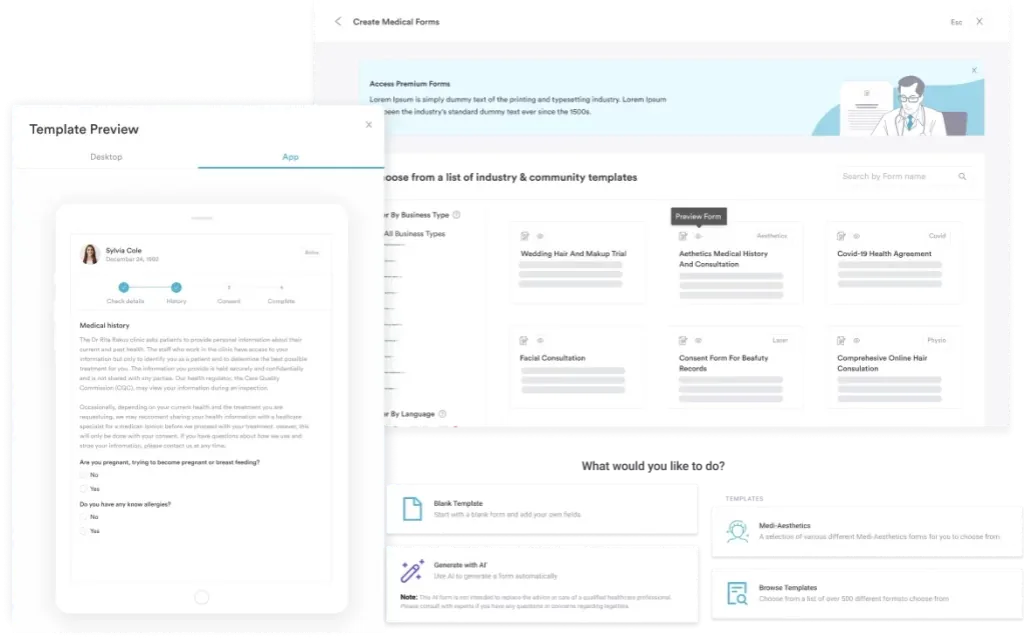
The plan of care must be completed and signed before treatment begins, and certified by a physician or non-physician practitioner for Medicare patients. Digital documentation keeps those fields from slipping through. Pabau’s digital forms can carry an SLP evaluation template that walks the clinician through each required section. The chart then supports 92522 by the time the claim is built. Where several providers bill from the same records, the superbill pulls straight from the completed note.
Denials and recoupments on CPT code 92522 cluster around three failure modes: picking the wrong code in the family, bundling errors, and missing modifiers. Each one has a straightforward fix.
A systematic denial management process with pre-submission scrubbing catches most of these before the payer sees them. Checking each claim against clean-claim rules first prevents the rework that resubmissions create. Pabau’s clearinghouse integration adds real-time eligibility checks, claim validation, and ERA posting inside the practice management platform.
CPT code 92522 is an evaluation code, and treatment that follows is billed separately. The table below lists the evaluation family alongside the treatment and swallowing codes that most often appear near it.
SLP billing errors usually start where the evaluation report and the claim stop agreeing. A clinician documents articulation testing, a biller submits 92523 out of habit, and nobody compares the two until a payer does. Practice management software like Pabau keeps documentation and billing in one workflow, so the code on the claim follows what the note contains.
Pabau’s medical claims management features let SLP practices:
Speech therapy practices handling credentialing or several payer contracts can run the whole revenue cycle in one platform, from scheduling through payment posting.

Pabau brings CPT code templates, claim scrubbing, and denial tracking into one platform. SLP practices using Pabau can configure evaluation code workflows, attach ICD-10 codes, and submit claims through an integrated clearinghouse without leaving the patient record.

Audit your 92522 and 92523 claims together each quarter. Pull 10 to 15 evaluation reports at random and check whether interpreted language scores appear. Reports with language scores billed as 92522 are lost revenue, and reports without them billed as 92523 are a recoupment risk. Record what you find and the corrective step you took.
CPT code 92522 comes down to a single question at the end of the session. If the SLP formally evaluated speech sound production and stopped there, 92522 is correct. Once language comprehension and expression are formally tested, the encounter belongs to 92523 and pays about twice as much.
Keep separate note templates for the two codes, and pair a speech sound diagnosis with each claim. Practices that also append modifier GN by default see far fewer evaluation denials. Pabau’s claims management software supports that workflow end to end, from documentation prompts through denial tracking by CPT code. To see how it handles SLP billing, book a demo.

Need therapy documentation that survives an audit? Our medical billing compliance guide covers the documentation and audit standards that apply to outpatient therapy claims.
Managing claim denials across multiple payers? Our revenue cycle management guide explains how to structure your billing workflow to minimize denials and speed up collections.
Want to understand clearinghouse claim submission? This guide to medical claims clearinghouses explains how electronic claim submission works and what to look for in a clearinghouse partner.
Billing swallowing evaluations too? Our guide to CPT code 92610 covers the oral and pharyngeal swallowing evaluation that SLPs often bill alongside speech work.
CPT code 92522 is used to bill a speech-language pathology evaluation of speech sound production, covering articulation, phonological process, apraxia, and dysarthria. It does not include a language evaluation. If the same session also assesses language comprehension and expression, the correct code is 92523. The code took effect on January 1, 2014 as part of the four-code SLP evaluation family.
Both codes cover evaluation of speech sound production. CPT 92523 adds a formal evaluation of language comprehension and expression, and 92522 does not include one. The deciding factor is whether standardized language testing was administered, scored, and interpreted in the report. A brief language screening does not qualify. Medicare’s 2026 national average is $111.89 for 92522 and $226.46 for 92523.
CPT 92521 covers evaluation of speech fluency, meaning stuttering and cluttering. CPT 92522 covers evaluation of speech sound production, meaning articulation, phonological process, apraxia, and dysarthria. They describe separate clinical domains. When both are formally evaluated in one visit, they may be reported together if each evaluation is complete, distinct, and separately documented.
The 2026 Medicare national average for CPT 92522 is $111.89, based on 3.35 total RVUs. Medicare publishes the same amount for facility and non-facility settings. Your actual payment depends on your locality, and rates change every January 1. Verify the current figure in the CMS Physician Fee Schedule Look-Up Tool before you bill or quote.
No. CMS NCCI edits bundle the pair because 92523 already contains the speech sound production evaluation that 92522 describes. Modifier 59 does not bypass this edit. Report only 92523 when both speech sounds and language were formally evaluated in the same encounter.
Yes, in principle. NCCI does not bundle 92522 with 92521 or 92524. A distinct fluency or voice evaluation performed the same day may be reported alongside it. Each evaluation has to be complete, clinically distinct, and documented on its own terms. Check your payer’s policy, since commercial rules can be stricter than Medicare’s.
The report needs standardized speech sound test results such as the GFTA-3, KLPA-3, or a dysarthria assessment, with raw scores, standard scores, and percentile ranks. Add a speech sample with an intelligibility rating, an oral mechanism examination, and stimulability findings. Relevant history, a diagnostic impression with a specific ICD-10-CM code, and a plan of care complete the report. Language scores are not required.
Common pairings are F80.0 (phonological disorder), R48.2 (apraxia), R47.1 (dysarthria and anarthria), R47.81 (slurred speech), Q35.9 (cleft palate, unspecified), and G80.9 (cerebral palsy, unspecified). Language diagnoses such as F80.1, F80.2, or R47.01 point to 92523 instead. Code to the level of specificity the evaluation findings support.
Modifier GN is the standard requirement on Medicare Part B claims, since it identifies services under an outpatient speech-language pathology plan of care. Modifier GP applies only when the service runs under a physical therapy plan of care. The KX modifier is required once the combined PT and SLP threshold is exceeded, which is $2,480 for 2026. Confirm requirements with your MAC and payer contracts.