

CCSD code G5100: Bypass of duodenum billing guide
CCSD code G5100 bills a bypass that leaves the duodenum in place CCSD code G5100...

Last Updated: Oct 16, 2026
86304 is the CPT code for immunoassay for tumor antigen, quantitative; CA 125. It covers one numeric serum measurement of cancer antigen 125, billed by the laboratory that runs the test.
Medicare covers 86304 under NCD 190.28 to monitor ovarian, fallopian tube, and primary peritoneal cancer. Screening and the workup of a pelvic mass fall outside that policy, and most denials start there. Neighboring codes measure other antigens: 86301 is CA 19-9, 86300 is CA 15-3 or CA 27.29, and 82378 is CEA.
Let Pabau's smart automation suggest the right codes, reduce claim denials, and keep your practice compliant—effortlessly.
Automate repetitive tasks and focus on what matters most—your patients.
Reduce coding errors and ensure compliance with the latest regulations.
Clean claims, fewer denials, and faster reimbursements.
Powerful insights and reporting to help your practice thrive.
HIPAA compliant SOC 2 certified GDPR-compliant Trusted by 4,000+ clinics worldwide

CPT code 86304 bills one quantitative serum CA 125 immunoassay, and Medicare sets its coverage nationally in NCD 190.28.
Covered diagnoses center on ovarian, fallopian tube, primary peritoneal, endometrial and endocervical cancer, plus history codes such as Z85.43.
NCD 190.28 excludes screening and the differential diagnosis of a pelvic mass, so Z12.73 or Z80.41 alone will not support the claim.
CA 19-9 bills as 86301, CA 15-3 or CA 27.29 as 86300, and CEA as 82378. Match the code to the marker on the lab report.
Bill one unit per level, add modifier 91 to a same-day repeat, and collect an ABN before any draw Medicare is likely to deny.
CPT code 86304 is the laboratory code for a quantitative immunoassay of cancer antigen 125 (CA 125) in serum. The official descriptor reads “Immunoassay for tumor antigen, quantitative; CA 125.” The American Medical Association maintains the code in the Immunology subsection of Pathology and Laboratory.
CA 125 is a large glycoprotein that many epithelial ovarian cancers release into the blood. Medicare’s NCD 190.28 notes it is elevated in 80% of patients who present with epithelial ovarian carcinoma. Levels can also rise with fallopian tube, endometrial and endocervical cancers, peritoneal mesothelioma, and primary peritoneal carcinoma.
For billing, 86304 is a monitoring test. Medicare pays for it to set a pre-operative baseline, track treatment response, and watch for recurrence in a patient with one of those cancers. Screening and deciding whether a pelvic mass is malignant fall outside that coverage.
“Quantitative” means the lab reports a numeric concentration, in units/mL. A positive or negative result on its own does not support the code.
NCD 190.28 is a national coverage determination, so the same rules apply in every Medicare Administrative Contractor (MAC) jurisdiction. Your MAC may publish billing articles or an LCD on lab testing. Read those alongside the NCD, which remains the coverage authority for 86304.
The NCD names these covered uses of CA 125:
The limitations are just as specific. CA 125 is not covered to evaluate a patient with signs or symptoms that suggest malignancy. It is also not covered to help with the differential diagnosis of a pelvic mass, because its sensitivity and specificity are not sufficient.
The NCD adds that a single tumor marker will generally suffice to follow a patient with one of these cancers. If the order pairs CA 125 with a second marker for the same malignancy, the chart should say why both are needed.
CMS publishes the full list of covered diagnosis codes in its lab NCD code lists, updated each quarter. The codes below appear on the current NCD 190.28 list. Treat the table as a starting point and confirm each code against the current release before you submit.
The pelvic mass codes need care. They are on the list because of the pre-operative baseline indication, not because CA 125 can tell a benign mass from a malignant one. Document that surgery is planned and that the level is a baseline for post-operative monitoring.
Screening and risk codes do not support 86304 on their own. Z12.73 is the encounter code for ovarian cancer screening. Z80.41 records a family history of ovarian cancer. Neither appears on the NCD 190.28 list. Collect a signed Advance Beneficiary Notice (ABN) before the draw if Medicare is likely to deny the test.
NCD 190.28 does not set a single hard frequency cap. It says the test may be ordered when needed to assess recurrence or response to treatment with later treatment cycles. Its indications section then describes the schedule Medicare treats as typical.
Laid out by phase, the pattern is easy to check against a patient’s claim history.
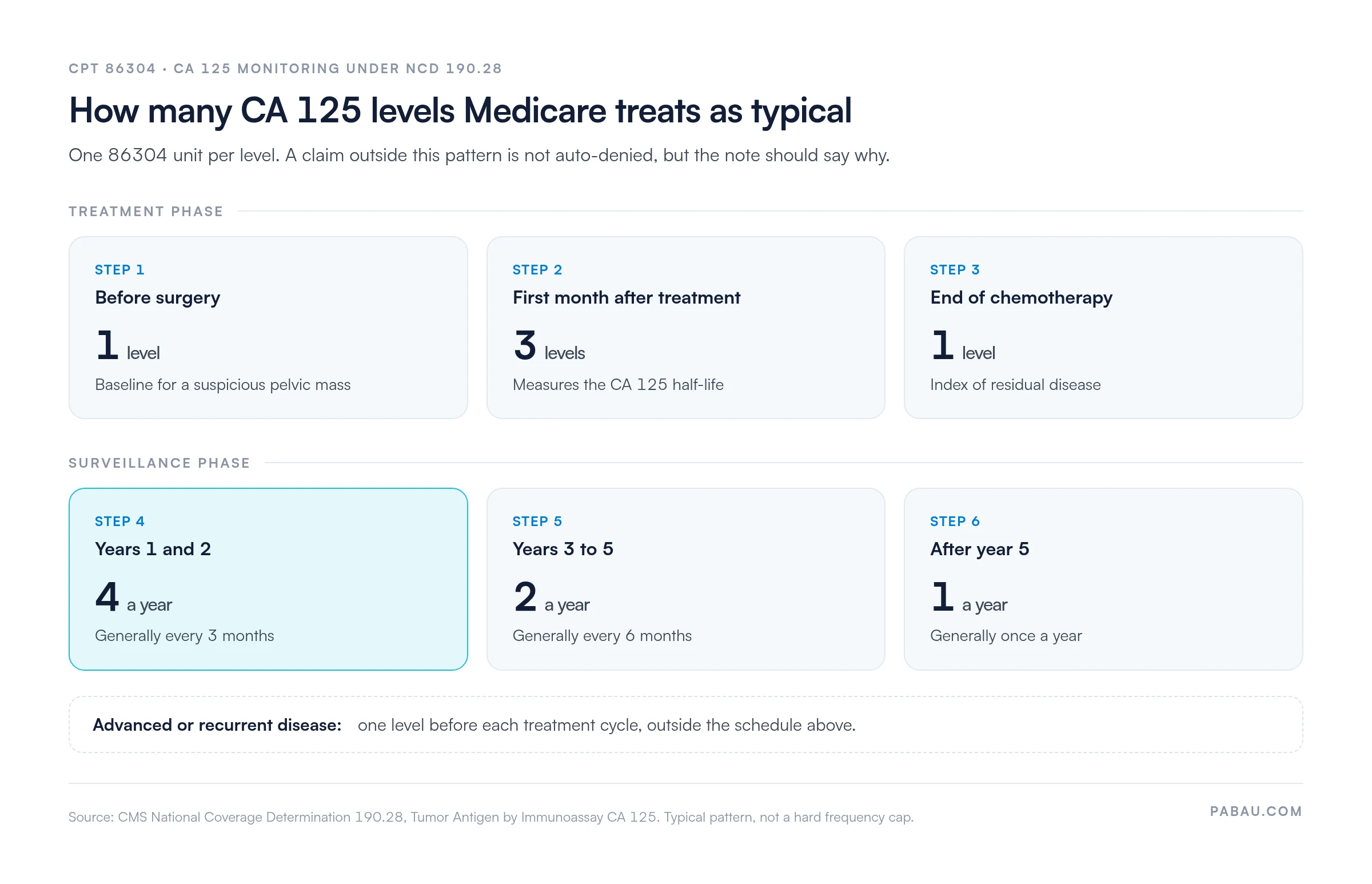
A claim that falls outside this pattern is not automatically denied, but it invites review. When the oncologist orders an extra level, the note should name the reason, such as new symptoms during surveillance or a change in therapy.
Medicare pays CPT 86304 under the Clinical Laboratory Fee Schedule (CLFS), not the Physician Fee Schedule. CMS sets CLFS rates nationally from private payer data reported by laboratories. The schedule is updated each year, with quarterly files in between.
For the current payment amount, download the latest file from the CMS Clinical Laboratory Fee Schedule page and look up 86304. Never quote a rate copied from a third-party site, which may reflect an older year. Commercial payers set their own rates by contract, so check each payer agreement.
Before you bill 86304 to a commercial payer for the first time, confirm the contracted rate in writing. Some contracts pay lab codes as a percentage of the CLFS, while others use a flat fee schedule.
Work through these six decisions on every 86304 claim line. Each one maps to a field the payer checks.
Picture a patient who finished surgery and chemotherapy for left ovarian cancer 14 months ago. She is in her second year of surveillance, so her oncologist orders a CA 125 level every 3 months.
An independent lab draws the sample, runs the immunoassay, and reports a numeric result in units/mL. The oncologist’s note names surveillance as the purpose, which matches an NCD 190.28 indication.
The claim line reads 86304, one unit, POS 81, with the oncologist’s NPI as the ordering provider. While she is still on treatment, the diagnosis pointer is C56.2. Once treatment has ended and no disease remains, Z85.43 takes its place.
Run this check on every 86304 claim before it leaves the practice. Each point heads off one of the denials covered further down.
Pair this workflow with a medical billing compliance review each quarter. A review catches diagnosis and frequency patterns before they attract an audit.
Each quantitative tumor antigen has its own code and its own national coverage policy. A pancreatic cancer patient’s CA 19-9 bills as 86301, while a colorectal patient’s CEA bills as 82378. Billing the wrong marker’s code is a coding error, even when the diagnosis is covered.
HE4 (human epididymis protein 4) is often ordered with CA 125 for ovarian workups. It has its own code, 86305, so never fold it into the 86304 line.
Effective denial management for 86304 starts with the NCD. Most rejections trace to a diagnosis outside the covered list or a purpose the policy excludes. First decode the denial codes on the remittance, then find the matching fix below.
Medicare generally does not require prior authorization for 86304. Some commercial payers do for repeat testing, so check payer policy for patients on long-term maintenance therapy. A clean claim for 86304 carries a covered diagnosis, the ordering NPI, the right POS, and the correct modifiers.
Review your 86304 denials each quarter and group them by reason code. If most cite medical necessity, check the order template first. A template that defaults to a screening code will keep producing the same denial.
Without claims software, staff copy the diagnosis from the chart and key in the CPT code by hand. A coverage or eligibility problem only surfaces when the remittance arrives, weeks after the draw.
Pabau, the practice management and billing platform we build, pre-fills the claim from the patient record. CPT and ICD-10 lookup libraries sit inside the claim form. In the US, claims go out through the Claim.MD clearinghouse after a real-time eligibility check. The Send button stays locked until every required claim field is complete.
After submission, Pabau tracks claim status and posts electronic remittances back to the patient account. Your team sees a denied 86304 line quickly and can correct it while the order is fresh. Pabau’s denial-tracking claims software covers that whole cycle, from pre-fill to remittance.

Pabau pre-fills 86304 claims from the patient record and sends them through the Claim.MD clearinghouse, with an eligibility check before every submission.

CPT code 86304 pays reliably when the claim tells the story NCD 190.28 expects. That means a confirmed gynecologic or peritoneal cancer, or a history of one, and a purpose of baseline, response, or surveillance. Screening and diagnostic workups of a mass fall outside the policy, whatever code sits on the claim.
So start with the order template. Build it around the covered indications, keep the surveillance schedule in front of the team, and reserve an ABN for the uses Medicare excludes. That one change prevents more 86304 denials than any appeal.
Book a demo to see how Pabau gets your CA 125 claims out complete, checked and on time.

Billing CA 19-9 instead of CA 125? Our CPT code 86301 guide covers NCD 190.30 and the pancreatic and biliary diagnoses it accepts.
Need to understand how clearinghouse submission reduces denials? Our Claim.MD clearinghouse guide explains how electronic submission and eligibility checks work.
Want to see how lab claims map to the 837 format? Our 837 file guide covers the transaction set structure and where CPT codes like 86304 sit.
Looking for what a superbill should include for lab testing? Our superbill guide covers the required fields and how diagnosis codes link to each service.
Many labs use 35 U/mL as the upper reference limit. Ranges vary by assay, so read the range printed on the report. The result does not change how 86304 is billed.
Usually not. Medicare Part B covers clinical diagnostic lab tests with no deductible or coinsurance. A test billed under a signed ABN is the exception, because the patient may owe the full charge.
Yes, if your practice draws the sample. Venipuncture bills as 36415, on its own line, separate from the 86304 test. A lab that only receives the specimen does not bill 36415.
Yes, if the lab holds a CLIA certificate that covers the test system’s complexity. A certificate of waiver covers waived tests only. Report an in-office test with POS 11.



