

CCSD code G5100: Bypass of duodenum billing guide
CCSD code G5100 bills a bypass that leaves the duodenum in place CCSD code G5100...

Last Updated: Oct 16, 2026
86301 is the CPT code for immunoassay for tumor antigen, quantitative; CA 19-9. It covers one quantitative serum measurement of carbohydrate antigen 19-9, billed by the laboratory that runs the test.
Medicare covers 86301 under NCD 190.30 to follow patients with an established pancreatic or biliary ductal carcinoma, not to screen or work up symptoms. Neighboring codes measure other antigens: 86300 is CA 15-3, 86304 is CA-125, and 82378 is CEA.
Let Pabau's smart automation suggest the right codes, reduce claim denials, and keep your practice compliant—effortlessly.
Automate repetitive tasks and focus on what matters most—your patients.
Reduce coding errors and ensure compliance with the latest regulations.
Clean claims, fewer denials, and faster reimbursements.
Powerful insights and reporting to help your practice thrive.
HIPAA compliant SOC 2 certified GDPR-compliant Trusted by 4,000+ clinics worldwide

CPT 86301 covers the quantitative CA 19-9 serum immunoassay only. CA 15-3 (86300), CA-125 (86304) and CEA (82378) each have their own code.
Medicare covers CA 19-9 under NCD 190.30 to follow patients with established pancreatic or biliary ductal carcinoma, not to screen or work up symptoms.
The core covered pairings are C25.x, C24.x, C22.1 (intrahepatic bile duct carcinoma) and Z85.07 for a history of pancreatic cancer.
Hepatocellular, colorectal and gastric cancer codes fall outside the NCD, so treat them as payer-specific and issue an ABN for Medicare patients.
Pabau’s claims management software builds CMS-1500 claims from invoices, submits them through Claim.MD and tracks each claim to payment or denial.
CPT code 86301 is the American Medical Association (AMA) code for a quantitative immunoassay for the tumor antigen CA 19-9. CA 19-9 is also called carbohydrate antigen 19-9 or sialyl-Lewis antigen. The test measures serum CA 19-9 in Units/mL, and the clinical or reference laboratory that runs it bills the code.
Medicare also covers it under NCD 190.30 to follow patients with established pancreatic or biliary ductal carcinoma, and pays $20.81 for it in 2026.
Specifically, the code covers only the quantitative serum CA 19-9 measurement. Qualitative tests and urine-based assays, for example, don’t fall under 86301. Nor does CA 19-9 run inside a reflexed panel without a separate order.
Under NCD 190.30, CA 19-9 testing is medically necessary to follow a patient with an established pancreatic or biliary ductal carcinoma. However, CA 19-9 can’t confirm or rule out cancer on its own. As a result, Medicare doesn’t cover it for patients evaluated for signs or symptoms suggestive of malignancy, or as a screen.
Within that diagnosis, the NCD supports these uses:
However, hepatocellular carcinoma, colorectal cancer and gastric cancer fall outside the NCD. Some commercial payers cover CA 19-9 for them under their own policies, so check before treating those indications as covered.
Benign pancreatitis, cholestasis, cirrhosis and other non-malignant conditions don’t support medical necessity, even though CA 19-9 often rises in them. A claim with only a pancreatitis code is denied even if the ordering provider suspected cancer. The NCD excludes the workup of suspected malignancy, so the chart must document the established cancer and the reason for the test.
Every Medicare claim for CPT 86301 also needs an ICD-10-CM code for an established pancreatic or biliary ductal carcinoma, or its history. The table also separates the NCD’s core codes from codes only some commercial payers accept. Verify the current NCD 190.30 covered-code list before billing, because CMS revises the lab NCD code lists.
In contrast, codes from the K80-K87 range (gallstones, cholecystitis, pancreatitis) and R-codes for elevated lab values lead to denial when billed alone. Confirm each code in the CDC/NCHS ICD-10-CM tool, then check it against the NCD 190.30 code list. In addition, for pancreatic tail and overlapping sites, the C25.7 reference covers the “other parts of pancreas” code.
Medicare Part B covers CPT 86301 under NCD 190.30, Tumor Antigen by Immunoassay – CA 19-9, and pays it under the Clinical Laboratory Fee Schedule (CLFS). A national coverage determination applies in every Medicare Administrative Contractor (MAC) jurisdiction, so no local policy changes the rule.
First, the patient must have an established pancreatic or biliary ductal carcinoma. The test can then be repeated as needed to check for recurrence or response to each treatment cycle.
The coverage call comes down to two questions, and both are answered before the specimen is drawn:
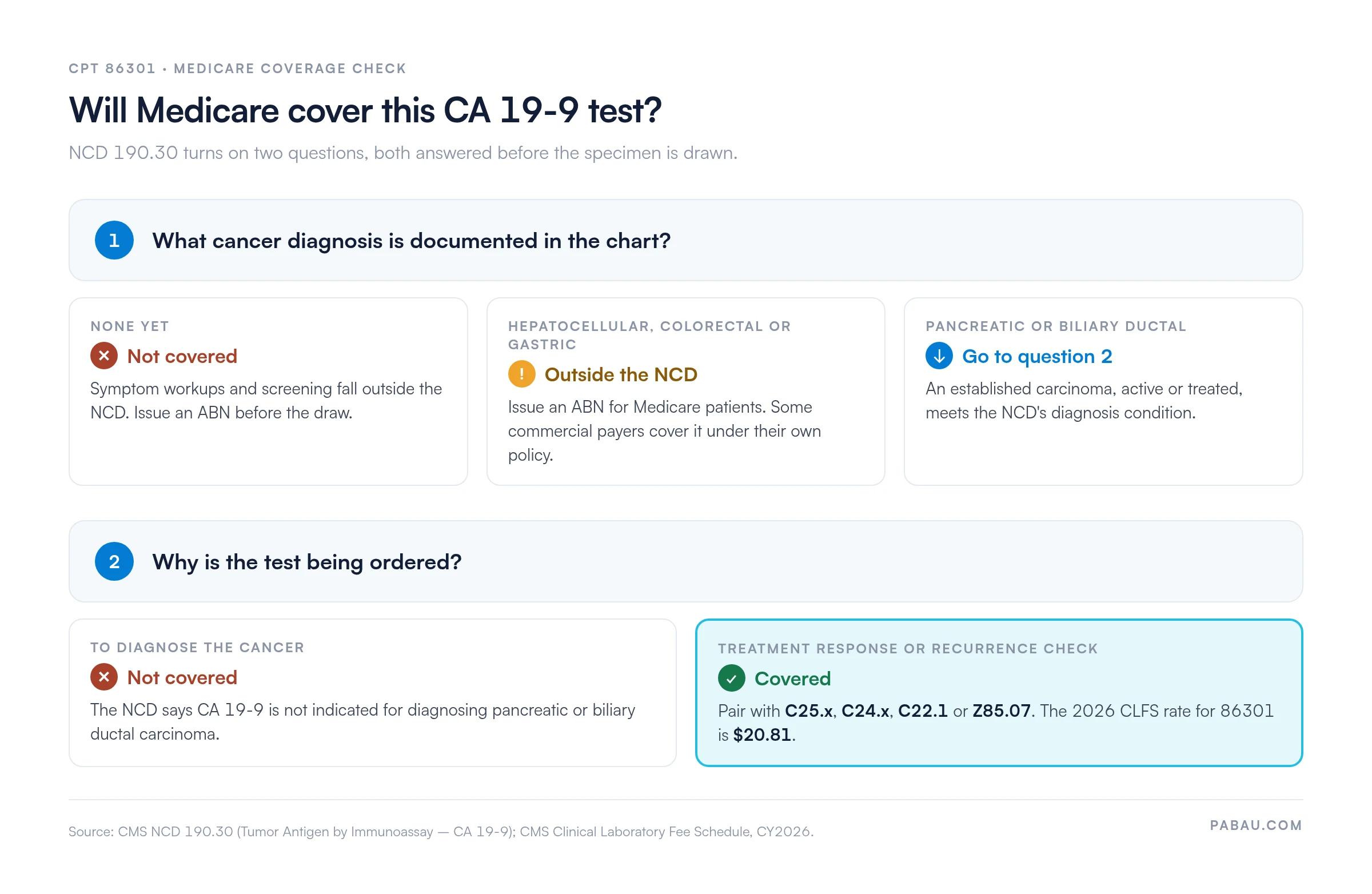
Key Medicare coverage rules for CPT 86301:
Billing CPT 86301 correctly requires attention to who is submitting the claim, where the test is performed, and whether any modifiers apply. For example, a common error is the ordering provider’s office billing a test that an outside laboratory performed.
In contrast, practices that run CA 19-9 in-office under their own CLIA certificate bill 86301 themselves. Pabau, the practice management platform we build, generates CMS-1500 claims from invoices and sends them to thousands of US insurance payers through the Claim.MD clearinghouse. In addition, a real-time eligibility check (270/271) confirms the patient’s coverage before the test is performed.

Medicare pays for CPT 86301 under the Clinical Laboratory Fee Schedule (CLFS). Its rates also come from private payer data reported under the Protecting Access to Medicare Act (PAMA). The 2026 rate for 86301 is $20.81, unchanged from 2025. Check the current figure in the CMS Clinical Laboratory Fee Schedule files before billing.
In contrast, commercial payer rates often use a multiplier of the CLFS rate. Overall, reimbursement can range from 80% to 150% or more of the Medicare allowable depending on the payer contract. Therefore, verify contracted rates directly with each payer; do not assume CLFS figures apply to commercial claims.
The tumor marker codes sit next to each other, but each one maps to a single antigen. Thus, billing the wrong one reports a test the lab didn’t run, which is both a coding error and a compliance issue.
The most consequential confusion is between 86301 (CA 19-9) and 82378 (CEA). Both are also commonly ordered together for colorectal and pancreatic cancer patients. However, billing both on the same date of service is permitted when each has a separately documented clinical indication in the ordering note.
Billing one code when the lab ran the other is a coding error, whatever the dollar impact. Therefore, reference the AAPC CPT code lookup to confirm the correct descriptor before submitting.
Denials for CPT 86301 follow predictable patterns, and most start with the ordering note rather than the claim form. That is why denial management for this code begins before the claim is created.
To begin with, review your medical billing denial codes to see whether CA 19-9 denials cluster around one claim adjustment reason code (CARC). For example, CARC 50 (not medically necessary), CARC 167 (diagnosis not covered) and CARC 96 (non-covered charge) can all apply to 86301.
The ordering provider’s note is the most auditable part of a CA 19-9 claim. In fact, an appeal turns on whether that note names the established pancreatic or biliary ductal carcinoma. It must also give the reason for the test in the terms NCD 190.30 uses.
Required documentation elements for a clean 86301 claim:
In Pabau, the clinical note, the invoice and the claim built from that invoice all sit on the same patient record. When a payer questions an 86301 claim, your billing team finds the ordering rationale right beside it. As a result, nobody has to request notes from a separate EHR. That is also the groundwork for clean claim submission on in-office lab draws.
Practices that draw CA 19-9 in-house often juggle an EHR, a billing spreadsheet and a clearinghouse portal for one $20.81 test. Moreover, each handoff is a chance to drop a diagnosis code or lose track of a denial. Instead, Pabau’s claims management software keeps claim creation, submission and follow-up in one place.
Key workflow capabilities relevant to CPT 86301:
Knowing how medical billing works end to end shows you where CA 19-9 claims fail: documentation, coding or submission. With claims, eligibility and remittances in one system, you can also fix the weak step without adding billing staff.
Billing 86301 well comes down to one check before the draw. Does the patient have an established pancreatic or biliary ductal carcinoma, and is the test following it? If yes, then code the cancer or its history and write the purpose into the order.
Otherwise, issue an ABN or check the commercial payer’s policy before the specimen goes out. The effort is front-loaded on purpose. In short, a minute spent on the ordering note saves an appeal that a $20.81 test rarely justifies.
To see how Pabau takes a CA 19-9 claim from invoice to posted remittance in one system, book a demo.
CPT code 86301 covers the quantitative serum immunoassay for the tumor antigen CA 19-9, used to follow pancreatic and biliary ductal cancers. It applies to one quantitative test per specimen. Qualitative assays, urine-based tests and CA 19-9 run inside a bundled panel without a standalone order don’t bill under 86301 as a separate claim.
Yes. Medicare Part B covers CPT 86301 under NCD 190.30 to follow patients with an established pancreatic or biliary ductal carcinoma. That includes treatment response and recurrence checks. It doesn’t cover CA 19-9 for screening or for patients evaluated for signs or symptoms of cancer. When coverage is uncertain, issue an Advance Beneficiary Notice (ABN) before the test.
The core Medicare pairings for CPT 86301 are C25.x for pancreatic cancer and C24.x for other and unspecified parts of the biliary tract. C22.1 (intrahepatic bile duct carcinoma) and Z85.07 (history of pancreatic cancer) also qualify. Hepatocellular, colorectal and gastric cancer codes fall outside NCD 190.30, so only some commercial payers accept them. Benign codes such as K85.x (acute pancreatitis) or K80.x (cholelithiasis) lead to denial even when CA 19-9 is elevated.
Each code covers a different tumor antigen. 86300 covers the breast cancer markers CA 15-3 and CA 27.29. 86301 covers CA 19-9, the pancreatic and biliary marker, and 86304 covers the ovarian marker CA-125. Billing one in place of another is a coding error, because the CPT code must match the antigen the performing laboratory measured.
Yes. CPT 86301 and CPT 82378 (CEA) can be billed on the same date of service. Each test needs its own documented clinical indication in the ordering note. Oncologists often follow pancreatic cancer with both markers. Billing both without a separate rationale for each risks a duplicate-billing denial under Medicare edit policies.
An Advance Beneficiary Notice (ABN) is required whenever the ordering provider believes Medicare is unlikely to cover the CA 19-9 test for a specific patient. That typically means the only documented diagnosis is benign, or the purpose falls outside NCD 190.30. The patient must sign the ABN before the test. Without a valid ABN, the lab can’t bill the patient if Medicare denies the claim.



