HCPCS code J3471: Hyaluronidase ovine injection billing guide
HCPCS code J3471: Descriptor, code type, and quick-reference data HCPCS code J34...

Last Updated: Oct 14, 2026
CPT code 85730 is the billing code for the partial thromboplastin time (PTT) test, performed on plasma or whole blood. It measures the intrinsic coagulation pathway and is the standard test for monitoring unfractionated heparin. Medicare prices it on the Clinical Laboratory Fee Schedule, at roughly $5 to $8 nationally in 2026.
This guide covers that rate and how the fee schedule sets it, plus the ICD-10-CM codes that carry medical necessity. It also draws the line between 85730 and 85732 and lists the documentation that keeps the claim clean.

CPT code 85730 describes thromboplastin time, partial (PTT); plasma or whole blood, inside the Hematology and Coagulation Procedures section.
Medicare prices 85730 on the Clinical Laboratory Fee Schedule, not the Physician Fee Schedule, so there is no facility or non-facility rate.
The 2026 payment runs roughly $5 to $8, and clinical diagnostic lab tests carry no beneficiary coinsurance or deductible.
Coverage sits under NCD 190.16, so the claim needs a documented indication linked to a supported ICD-10-CM diagnosis.
85732 covers substitution, plasma fractions (mixing study), so it never stands in for a routine single-reagent PTT.
CPT code 85730 has the official AMA descriptor: Thromboplastin time, partial (PTT); plasma or whole blood. It sits within the Hematology and Coagulation Procedures section of the CPT code set. That section covers blood cell counts, coagulation factor activity, and clotting cascade function.
The test measures how long blood takes to clot through the intrinsic and common pathways. A prolonged PTT can point to factor deficiencies (VIII, IX, XI, XII), lupus anticoagulant, or therapeutic heparin levels. Per the AMA’s CPT code set overview, the descriptor names the specimen type because either plasma or whole blood can be tested. Documentation has to state which one the laboratory used.
The PTT test evaluates the intrinsic coagulation pathway, the sequence of reactions involving factors XII, XI, IX, VIII, X, V, II, and fibrinogen. Clinicians order it across four primary scenarios.
AAPC’s CPT code reference lists 85730 as the code for a standard single-reagent PTT across all four indications. The specimen type recorded in the order must match what the laboratory reports back.
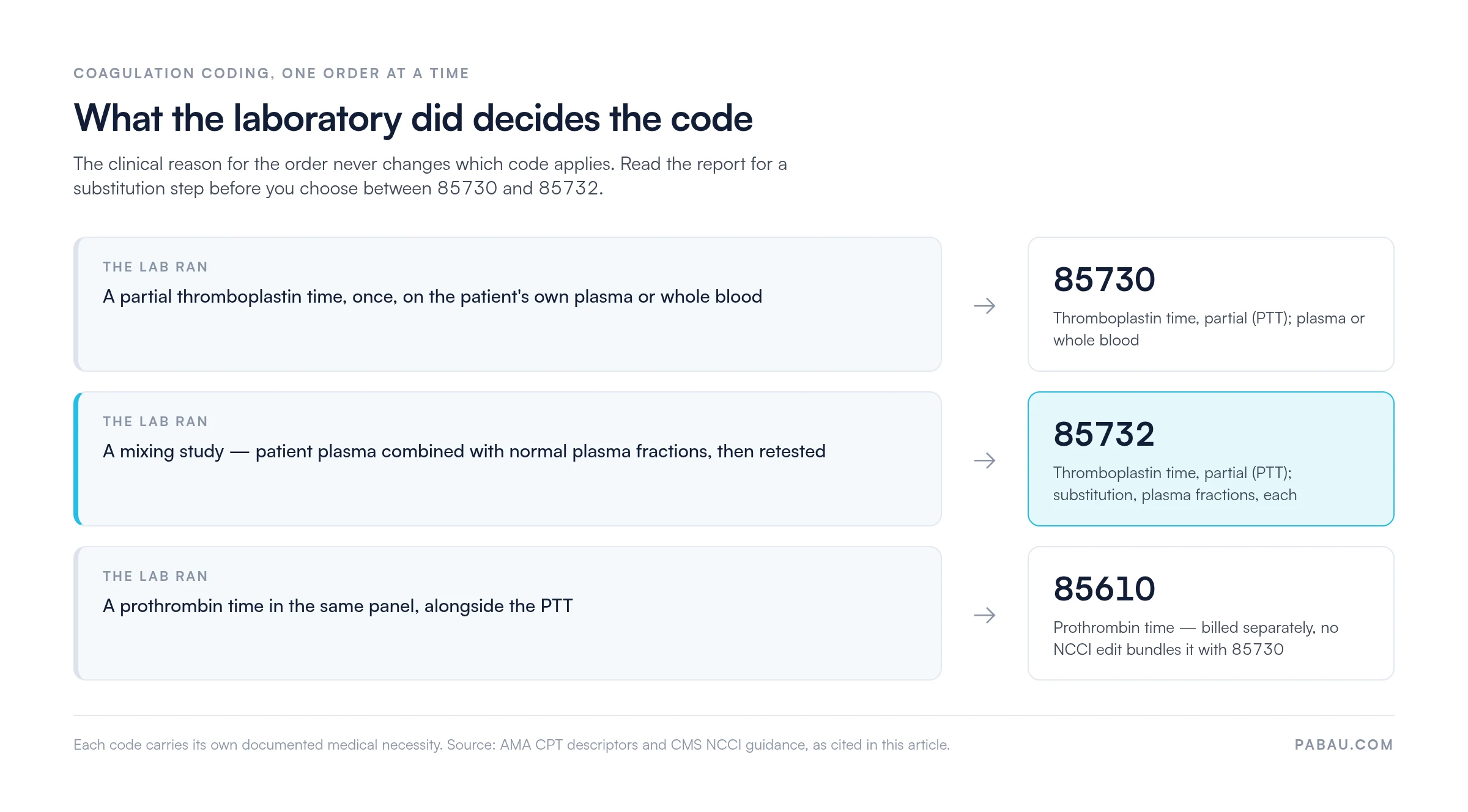
CPT 85730 and CPT 85732 are not interchangeable, and the routing rule is narrow. Use 85730 for a standard PTT run once on the patient’s own specimen. Use 85732 when the laboratory repeats the test after substituting plasma fractions, which is the mixing study.
Assigning 85732 when the laboratory never substituted plasma fractions is a common coding error, and it draws audits. Read the report for a substitution or mixing step before you pick between the two codes.
Medicare covers CPT code 85730 under National Coverage Determination (NCD) 190.16, which governs partial thromboplastin time testing. Coverage turns on medical necessity. The ordering provider has to document a clinical indication in the record that links to a supported ICD-10-CM diagnosis code.
85730 is a clinical diagnostic laboratory test, so Medicare prices it on the Clinical Laboratory Fee Schedule rather than the Physician Fee Schedule. The published CLFS files are the authoritative source for the current amount. Practices running practice management software like Pabau submit 85730 through Claim.MD, its US clearinghouse partner, which reaches thousands of US payers. Remittance advice comes back electronically, so reconciliation never waits on paper.
Treat the published amount as a ceiling rather than a quote. Medicare pays the lower of the billed charge or the fee schedule amount, so a charge set below the schedule is paid at the charge. Verify the figure in the CLFS file for your MAC jurisdiction before submitting, because the amounts change every January.
Local Coverage Determinations issued by your Medicare Administrative Contractor can add medical necessity criteria beyond NCD 190.16. Read your MAC’s LCD for 85730 before billing, and read it again after each annual update.
Check your MAC’s LCD for CPT 85730 before billing. Some contractors restrict coverage to specific ICD-10 diagnosis codes, or require prior authorization for outpatient PTT testing that is not tied to active heparin therapy. A five-minute LCD review prevents the most common 85730 denials.
The ICD-10-CM diagnosis code paired with CPT code 85730 is what establishes medical necessity for the payer. It has to reflect the clinical indication documented in the ordering provider’s notes. The codes below are the ones that pair with 85730 most often.
Use the most specific code the documentation supports. D68.9 is appropriate during an active workup, but once a specific diagnosis is confirmed, move to the precise code. Unspecified codes are a frequent trigger for additional documentation requests. Our ICD-10-CM code library lists the specific alternatives once D68.9 no longer fits the record.
CPT code 85730 rarely stands alone. Knowing the wider coagulation code family helps coders select the right code and anticipate bundling edits.
CPT 85610 and 85730 are among the lab tests most often ordered together. Reference laboratories sell them as a combined PT/PTT panel, which reflects how often the pair is ordered. Bill each code separately when both are performed. NCCI bundling edits do not prohibit billing 85610 with 85730, but each needs its own documented medical necessity. The CMS coding and billing guidance sets out how NCCI edits apply to laboratory panels.
Clean documentation is what separates a paid 85730 claim from a denied one. Under Medicare NCD 190.16 and most commercial payer policies, the medical record must carry all of the following before the claim goes out.
Consistent documentation across lab ordering lowers both audit exposure and the denial rate. A superbill that pulls CPT codes from the encounter note shortens the wait between the order and the claim. It also removes one manual entry step, which is where the wrong code usually gets typed.
Most 85730 denials fall into three categories. Clearing each one before submission removes the bulk of avoidable write-offs.
This is the most common denial for 85730. It lands when the diagnosis code on the claim is absent from the payer’s covered indication list. It also lands when the clinical note never documents why the test was ordered.
Fix: Confirm the ICD-10-CM code appears on your MAC’s LCD for 85730 before billing. Where the LCD lists no code matching the clinical scenario, attach a narrative explaining the indication. Tracking 85730 denial reasons monthly also makes the pattern visible early.
Because CPT 85730 covers both plasma and whole blood, some payers require the specimen type in the claim or the supporting records. A missing specimen type triggers a request for additional documentation, which delays payment.
Fix: Make sure the laboratory report states the specimen type outright. When results arrive from a reference lab, check for that detail before you close the encounter. The remark code on the remittance will tell you whether specimen documentation was the sticking point.
Billing 85732 when the laboratory never substituted plasma fractions produces denials and compliance exposure, and so does the reverse. Code selection follows the laboratory’s method. The clinical reason for ordering the test does not change which code applies.
Fix: Build a coder checklist that requires the report to show a substitution step before 85732 is assigned. If the report is silent on method, call the lab before submitting. Getting the code right the first time is what makes a clean claim, and it avoids the rework cycle entirely.
Practices that order coagulation tests regularly run two systems side by side. The PTT is ordered and resulted in the lab system, while code assignment, diagnosis linkage, and submission happen in billing hours or days later. Errors enter during the handover between the two.
Pabau keeps both in one record. Its claims software for practices links the clinical note, the lab order, and the outgoing claim. The coder sees the documented indication instead of a test name on a worklist. When a provider records heparin monitoring or a coagulation workup, the relevant CPT codes surface against that encounter.
Pabau also tracks ordered tests and their resulting status against the patient record, which builds the audit trail payers expect for serial heparin monitoring. When a denial does come back, the ERA from Claim.MD carries the adjustment and denial reason codes. Billing staff act on the remittance rather than calling the payer for details.
Build a billing rule that flags any 85730 claim whose linked ICD-10 code is missing from your MAC’s LCD list. Catching it before submission costs seconds. Catching it after a denial costs days of rework and puts the timely filing limit at risk.

Pabau connects lab ordering, clinical documentation, and claim submission in one place. See how practices cut 85730 denials with coding support built into the encounter and the Claim.MD clearinghouse integration.

Two decisions carry most of the risk on an 85730 claim. The first is the diagnosis code, because NCD 190.16 coverage rests on it. The second is whether the laboratory substituted plasma fractions, because that step alone moves the claim to 85732.
The payment is small, so the economics only work when the claim goes out clean the first time. At roughly $5 to $8, one round of rework costs more staff time than the test earns. Put the LCD check and the substitution question into the coder’s checklist, and the denial rate looks after itself.
Pabau links the lab order, the encounter note, and the submitted claim in one record. Claim.MD handles eligibility and remittance across thousands of US payers. Book a demo to see how that shortens the path from a PTT order to a paid 85730 claim.

Need guidance on managing claim denials efficiently? Denial management in healthcare covers the systematic approaches practices use to reduce rework and recover revenue.
Unsure how ERA data fits into your payment workflow? Electronic remittance advice explains how 835 files work and how to read denial reason codes.
Working a remittance and stuck on a code? Denial codes in medical billing decodes the adjustment and remark codes that arrive with a rejected lab claim.
New to the billing side of lab ordering? What is medical billing walks through how a coded encounter becomes a submitted claim.
Looking to understand the broader billing picture? Revenue cycle management walks through the end-to-end process from patient encounter to collected payment.
CPT code 85730 is the billing code for the partial thromboplastin time (PTT) test performed on plasma or whole blood. It is used to evaluate the intrinsic coagulation pathway, screen for factor deficiencies, and monitor unfractionated heparin therapy. It falls under the Hematology and Coagulation Procedures section of the AMA CPT code set.
CPT 85730 covers a standard PTT run once on the patient’s own plasma or whole blood. CPT 85732 covers substitution, plasma fractions, which is the mixing study performed after an abnormal baseline PTT. Assign 85732 only when the laboratory report documents that substitution step.
Yes, Medicare covers CPT code 85730 under National Coverage Determination (NCD) 190.16. Coverage requires that the test is medically necessary and that the clinical indication is documented in the medical record. Additional restrictions may apply based on your Medicare Administrative Contractor’s local coverage determination.
The most common ICD-10-CM codes paired with 85730 are Z79.01 (long-term anticoagulant use) for heparin monitoring and D68.9 (coagulation defect, unspecified) during workup. D66 and D67 cover hemophilia A and B, I82.401 covers DVT, and Z01.812 covers pre-procedural lab screening. Use the most specific code supported by the clinical documentation.
Yes, CPT 85730 (PTT) and CPT 85610 (prothrombin time) can be billed together when both tests are medically indicated and independently documented. NCCI edits do not bundle these two codes, but each must have its own clinical justification in the medical record.
Medicare prices CPT 85730 on the Clinical Laboratory Fee Schedule, not the Physician Fee Schedule, so there is no facility or non-facility rate. The 2026 amount is roughly $5 to $8 nationally. Check the CLFS file for your MAC before billing, because the amounts update every January.