CPT code 93503: Swan-Ganz catheter billing and modifiers
CPT code 93503: Official descriptor and procedure overview In the AMA CPT code s...

Last Updated: Oct 23, 2026
Billable Code
85379 is the CPT code for fibrin degradation products, D-dimer; quantitative. It applies to any laboratory assay that reports a numeric D-dimer result, including high-sensitivity quantitative assays.
Two common causes of denials are billing 85378 when the lab ran a quantitative assay, and omitting a paired ICD-10 code that establishes medical necessity.
Let Pabau's smart automation suggest the right codes, reduce claim denials, and keep your practice compliant—effortlessly.
Automate repetitive tasks and focus on what matters most—your patients.
Reduce coding errors and ensure compliance with the latest regulations.
Clean claims, fewer denials, and faster reimbursements.
Powerful insights and reporting to help your practice thrive.
HIPAA compliant SOC 2 certified GDPR-compliant Trusted by 4,000+ clinics worldwide

CPT code 85379 covers quantitative D-dimer testing, meaning any assay that reports a numeric result.
Qualitative or semiquantitative assays take 85378, or 85380 when the assay is ultrasensitive.
Paired ICD-10 codes include R79.1 (abnormal coagulation profile), I26.x (pulmonary embolism) and I82.4x (DVT).
Only one code from the 8537x family belongs on a claim per specimen, and billing two for one specimen is a bundling error.
Pabau’s claims management software flags bundling conflicts and incomplete diagnosis pairings before submission.
CPT code 85379 is a Pathology and Laboratory code published by the American Medical Association (AMA) under the Hematology and Coagulation subsection (codes 85002-85999). Its full official descriptor is: Fibrin degradation products, D-dimer; quantitative.
The code has remained stable across recent code-year updates. It covers any laboratory method that produces a numeric D-dimer result, including high-sensitivity quantitative assays. Common methods are latex-enhanced immunoturbidimetry and ELISA. A qualitative or semiquantitative screen belongs to 85378, or to 85380 when the assay is ultrasensitive.
Payers recognize CPT 85379 as medically necessary when the clinical record documents a specific sign or symptom driving the order. The most common reasons payers accept as medical necessity include:
A symptom-based ICD-10 code is acceptable when PE or DVT has not yet been confirmed. Payers understand that the test is ordered during the diagnostic workup, before a definitive diagnosis exists. What matters is that the ordering rationale appears in the physician’s note.
Selecting the wrong code from the 8537x family is a frequent billing error on D-dimer claims. The correct code depends entirely on the methodology the laboratory used, not on the clinical result or the ordering context.
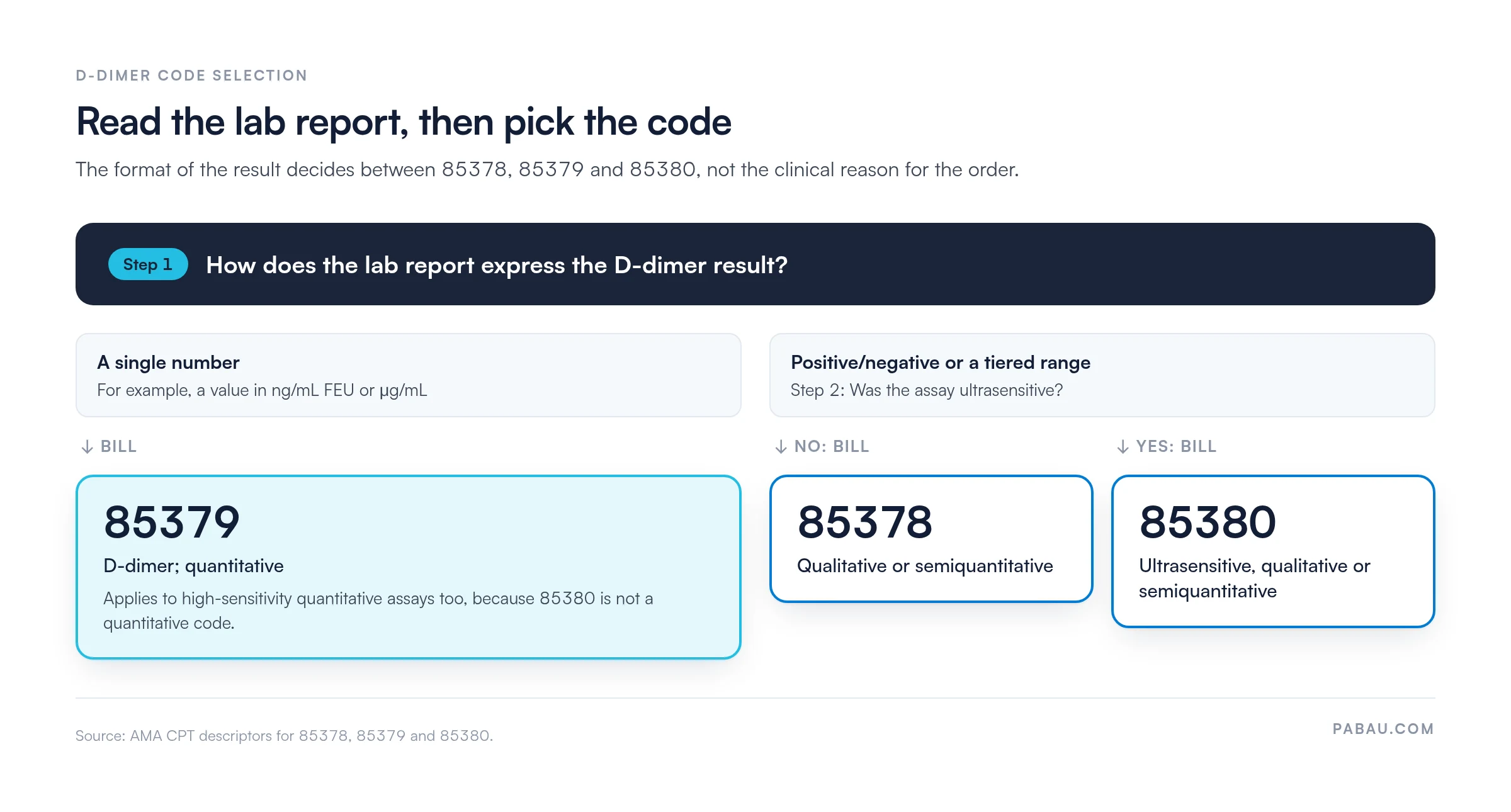
Check the lab report first. If the result is a single number in ng/mL FEU or μg/mL with no tier or range qualifier, CPT code 85379 is correct. That holds for high-sensitivity quantitative assays too, because 85380 is not a quantitative code. Confirm with the laboratory before billing if the report wording is ambiguous. The decision path below shows how the report format settles the code.
Every CPT code 85379 claim requires a paired ICD-10 diagnosis that establishes why the test was ordered. Missing or non-specific diagnoses are another frequent denial driver. Check your Medicare Administrative Contractor (MAC) Local Coverage Determination for D-dimer or coagulation testing, since covered diagnosis lists vary by jurisdiction. You can look up the full descriptor for each diagnosis below in the ICD-10-CM code library.
Code the confirmed diagnosis once it is documented. A sepsis patient with confirmed DIC, for example, is billed with D65 on later serial D-dimer claims rather than R79.1.
CPT code 85379 is reimbursed under the Medicare Clinical Laboratory Fee Schedule (CLFS), not the Physician Fee Schedule (MPFS). Clinical laboratory tests such as 85379 are paid under the CLFS, although some pathology services pay under the MPFS. Check the CMS Clinical Laboratory Fee Schedule files for the current national limitation amount, since CLFS rates are updated each year.
Medicare pays the lower of the CLFS national limitation amount or the billed charge. Commercial payers may reimburse above or below the CLFS rate depending on their contracted schedule. When you submit through a clearinghouse, the electronic remittance advice confirms which CLFS-based rate was applied. Billing teams can then reconcile payment without cross-referencing the CMS fee file by hand.
Check the CMS CLFS files each quarter, and again when the annual file is posted ahead of January. CLFS rates for lab codes sometimes change year over year even when the code itself is stable. Flag CPT 85379 in your fee-schedule audit list alongside PT (85610), PTT (85730), and fibrinogen (85384). That way you catch rate changes before they create underpayment patterns.
A lab order slip alone does not satisfy payer audit requirements for CPT code 85379. The medical record must show the full chain from symptom to result. Follow medical billing compliance best practices and make sure each of these elements appears in the chart before submitting:
For Medicare patients, check whether your MAC has issued a Local Coverage Determination for D-dimer or coagulation testing. LCD criteria vary by jurisdiction, so a diagnosis that satisfies one MAC’s covered-diagnosis list may not satisfy another.
CPT code 85379 denials are predictable. The same five patterns recur across payers, and each has a defined corrective action. Effective denial management workflows catch most of these before the claim leaves the practice.
For systematic denial prevention, your pre-submission workflow should check two points before the claim is batched. One is the code family, with one 8537x code per specimen, and the other is the ICD-10 pairing. A clean claim submission that passes payer edits first time costs far less to process than one that needs an appeal.
Only one code from the 8537x D-dimer family belongs on a claim for a single specimen. Billing 85378 and 85379 for the same specimen is a bundling error under the National Correct Coding Initiative (NCCI). If two separate specimens were genuinely tested, check the pair’s modifier indicator in the current NCCI tables before billing both.
CPT code 85379 can generally be billed on the same day as other coagulation tests when the clinical situation warrants a full coagulation panel. Common partners are 85610 for prothrombin time, 85730 for partial thromboplastin time, and 85384 for fibrinogen. However, NCCI edit tables are updated quarterly. Verify current edit pairs via the CMS NCCI tool before billing any combination. A pairing that was permitted last quarter may become an edit in the next update.
Use the AAPC Codify CPT lookup to check current NCCI edit status for any code pair before billing.
CPT code 85379 does not typically require prior authorization for acute inpatient or emergency presentations. When a patient presents with acute chest pain or leg swelling, most payers process the claim on a standard medical-necessity review after the fact.
Outpatient and repeated testing is a different story. Some commercial payers require prior authorization for serial outpatient D-dimer testing. This applies particularly when the test is ordered more than twice in a 30-day period. Check the specific plan’s coverage policy before submitting a series of claims.
For Medicare patients, an Advance Beneficiary Notice of Noncoverage (ABN) may be required when the clinical indication may not meet your MAC’s LCD coverage criteria. Common triggers include ordering 85379 for a non-covered indication or when repeat testing lacks documented clinical justification.
Consult the CMS ABN instructions or your compliance officer for the specific situations that require an ABN in your jurisdiction. The CMS CLFS files give you the current national limitation amount to quote when issuing an ABN for this code.
Many D-dimer denials start before the claim is built. A coder picks a code without opening the lab report, or the diagnosis in the note never reaches the claim line.
Pabau, the practice management platform we build, catches both before submission. Its claims management software flags incomplete ICD-10 pairings, bundling conflicts within the 8537x family, and duplicate billing.
Clean claims then go out through Pabau’s Claim.MD integration, which reaches thousands of US payers. Remittance advice comes back into the same system, so your team reconciles CLFS payments without a separate spreadsheet.

Pabau’s claims management tools flag incomplete ICD-10 pairings, bundling conflicts, and duplicate billing before a claim leaves your practice. See how it works for laboratory billing teams.

Code CPT 85379 from the lab report, not from the order. A numeric result means 85379, whatever the assay’s sensitivity. A positive/negative or tiered result means 85378, or 85380 when the assay is ultrasensitive.
Build that check into charge entry, and pair every claim with the symptom or diagnosis in the note. Those two habits remove the denial patterns this code is known for. The trade-off is a minute of checking per claim against weeks of appeal work.
Book a demo to see how Pabau checks D-dimer code selection and diagnosis pairing before your lab claims go out.

Need to understand how claims flow through a clearinghouse? Medical claims clearinghouse guide explains how electronic claims are validated and routed to payers.
Want to reduce repeat denials across your lab billing? Medical billing fundamentals covers the full claim lifecycle from charge capture to payment posting.
Got a CARC code back on a D-dimer claim? Denial codes in medical billing maps the most common CARC denial reasons to their corrective actions.
Billing a PTT alongside the D-dimer? CPT code 85730 covers partial thromboplastin time coding, documentation and payment.
Appealing a denied lab claim? Medical appeal form template gives you a structured letter for submitting supporting documentation.
CPT code 85379 is a Pathology and Laboratory code for the quantitative D-dimer test. Its official AMA descriptor is “Fibrin degradation products, D-dimer; quantitative.” It applies when a laboratory produces a numeric result, such as a value in ng/mL FEU, rather than a positive/negative screen. It is reimbursed under the Medicare Clinical Laboratory Fee Schedule.
CPT 85378 covers a qualitative or semiquantitative D-dimer assay that produces a positive/negative or tiered result. CPT 85379 covers a quantitative assay that produces a single numeric value in ng/mL FEU. The distinction is methodological: Use whichever code matches what the laboratory ran, not what result the clinician needed.
Commonly paired ICD-10 codes include R79.1 (abnormal coagulation profile), I26.09 or I26.99 (pulmonary embolism) and I82.401 (acute DVT). Others are D65 (disseminated intravascular coagulation) and Z86.718 (personal history of other venous thrombosis and embolism). A symptom code such as R04.2 (hemoptysis) is acceptable when PE has not yet been confirmed.
CPT 85379 is quantitative. It covers any assay that reports a numeric D-dimer level in ng/mL FEU or μg/mL, including high-sensitivity quantitative assays. Qualitative or semiquantitative assays take CPT 85378, or CPT 85380 when the assay is ultrasensitive. Billing 85379 for a semiquantitative screen is an upcoding error.
Yes, CPT 85379 is generally compatible with prothrombin time (85610) and partial thromboplastin time (85730) on the same date. Billing them together is standard practice in DIC panels and VTE workups. Always verify current NCCI edit tables before billing any combination, as edits are updated quarterly and compatibility can change.
Five denial reasons come up again and again: Using the wrong 8537x code, a missing or non-specific ICD-10 pairing, and thin medical necessity documentation. The other two are duplicate billing without a documented clinical change, and billing 85379 separately from a panel code that already includes it.