

HCPCS code E0198: Water pressure pad billing guide
HCPCS code E0198 is a water pad for a standard mattress HCPCS code E0198 is the ...

Last Updated: Oct 13, 2026
82962 is the CPT code for glucose, blood by glucose monitoring device(s) cleared by the FDA specifically for home use.
The code sits in the Chemistry subsection of CPT Pathology and Laboratory. CLIA-waived complexity applies, so the testing site needs a valid Certificate of Waiver before it bills Medicare. Codes 82947 and 82948 cover the same analyte, and the instrument used decides which of the three applies.
Let Pabau's smart automation suggest the right codes, reduce claim denials, and keep your practice compliant—effortlessly.
Automate repetitive tasks and focus on what matters most—your patients.
Reduce coding errors and ensure compliance with the latest regulations.
Clean claims, fewer denials, and faster reimbursements.
Powerful insights and reporting to help your practice thrive.
HIPAA compliant SOC 2 certified GDPR-compliant Trusted by 4,000+ clinics worldwide

CPT code 82962 covers a glucose reading taken on an FDA-cleared home-use glucometer, and it sits in the Chemistry subsection of CPT.
The practice must hold a valid CLIA Certificate of Waiver for that site before Medicare or a commercial payer will pay the claim.
The instrument used decides the code, so a laboratory analyzer means 82947 and a colorimetric reagent strip means 82948.
Medicare pays 82962 under the Clinical Laboratory Fee Schedule at roughly $3.50, which is far less than a lapsed certificate costs.
Pabau records the device, the result and the diagnosis on the encounter, so the claim leaves with the documentation a payer asks for.
The American Medical Association defines CPT code 82962 as “Glucose, blood by glucose monitoring device(s) cleared by the FDA specifically for home use.” The code belongs to the Pathology and Laboratory section, Chemistry subsection. It applies when the glucose reading comes from an FDA-cleared glucometer built for home patient use, not from a benchtop laboratory analyzer.
The distinction matters clinically and for billing. Home-use glucose monitors produce a capillary whole-blood reading, usually from a fingerstick sample. Laboratory instruments measure venous plasma glucose using enzymatic photometric methods. Because the instrument type determines the code, billing 82962 after a laboratory-grade analyzer was used is a coding error. The office setting does not change that.
CPT 82962 is CLIA-waived complexity. Any practice performing the test must hold a valid CLIA Certificate of Waiver before billing the code. Without one, Medicare denies the claim outright, and most commercial payers follow the same rule. A medical billing compliance program should treat the CLIA renewal date as a billing deadline.
To obtain a Certificate of Waiver, the practice submits Form CMS-116 to its state agency under the CLIA program. CMS assigns a CLIA number, which must appear on every 1500 claim form for a waived-complexity test. Certificates expire every two years. CMS deactivates a lapsed certificate automatically, so a claim submitted after expiration is denied even when the test was performed correctly.
A practice running multiple locations needs a separate CLIA certificate for each physical site performing the test. A certificate covering the main office does not extend to satellite sites.
Payers require specific chart elements to support a claim for 82962. Missing one of the elements below commonly triggers a documentation denial on audit. Capture these fields at the point of care, because reconstructing them weeks later rarely satisfies an auditor.
A physician order is required. CMS does not insist on a separate written order, but the medical record must show that a licensed provider judged the test medically necessary. A standing order for glucose monitoring at every diabetic visit is acceptable when it is documented in the patient’s chart.
The three glucose CPT codes differ by instrument type, CLIA complexity, and typical reimbursement tier. Coders most often go wrong by reading the code off the test result instead of the instrument, per AAPC coding guidance.
Work the decision backwards from the device, as the diagram below does. A portable glucometer with a test strip and an electronic readout bills 82962. A venous sample sent to a laboratory analyzer bills 82947. A colorimetric strip read visually or by a strip reader bills 82948.
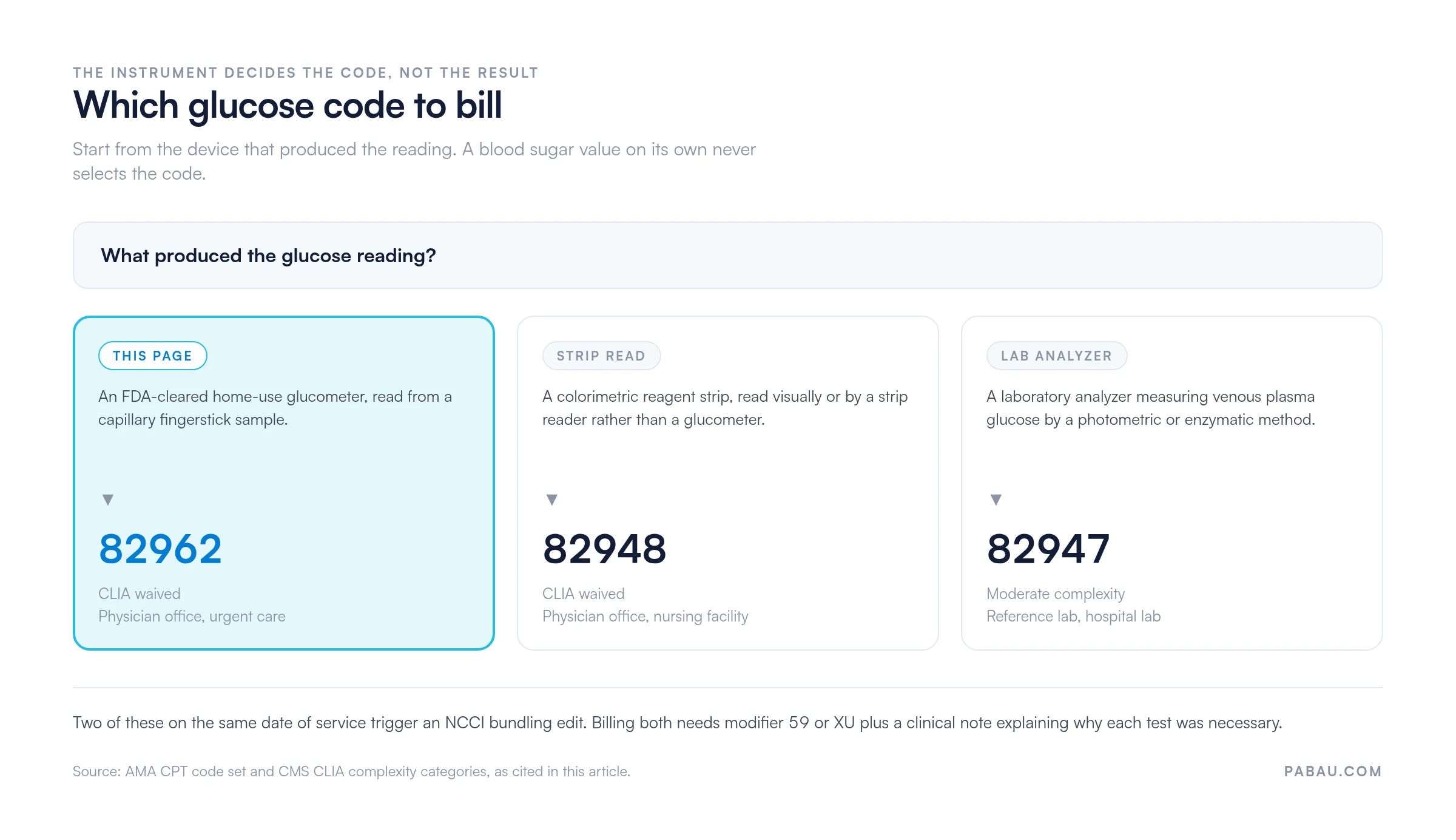
One patient may have both a POC glucometer test and a venous laboratory draw on the same date. With clinical justification, both codes can appear on the claim. Payers will scrutinize the medical necessity closely.
Pairing 82962 with a supported ICD-10-CM code establishes medical necessity and satisfies most payer LCD requirements. Diagnosis selection should reflect the patient’s documented condition, not the handiest entry on the ICD-10-CM code list. The codes below are the ones most commonly accepted across Medicare and commercial LCDs, though policy varies by region. Always verify the applicable LCD through your Medicare Administrative Contractor (MAC).
Z13.1 (diabetes screening) is the code most likely to trigger a denial. Several MAC LCDs do not accept screening diagnoses for 82962. The code is tied to monitoring an established condition, and population screening sits outside that. Check your regional LCD in the Medicare Coverage Database before billing Z13.1 as the only supporting diagnosis.
Screening diagnoses belong on lab tests that carry a preventive benefit. The guaiac fecal occult blood test billed as 82270 is one example, because Medicare covers it as colorectal cancer screening.
Run a batch review of 82962 claims denied for ICD-10 mismatch every 90 days, grouped by the diagnosis code used at billing. A run of Z13.1 or R73.09 denials usually means coders are defaulting to screening or nonspecific codes. The patient’s established diabetes type was documented, but it never reached the claim. Fixing that at the documentation level clears denials upstream of any appeal.
CPT 82962 is paid under the Medicare Clinical Laboratory Fee Schedule (CLFS), not the Physician Fee Schedule. Payment therefore rests on a nationally set laboratory rate rather than an RVU calculation. Verify the current year’s figure against the CMS CLFS published files, since the rate is adjusted annually.
The 2025 national CLFS rate for 82962 was approximately $3.50. The 2026 figure follows the annual CLFS update CMS publishes each November. That payment is small next to the administrative work behind it. Many practices therefore track 82962 volume to confirm that CLIA compliance costs stay below what POC testing collects. Medicare’s remittance advice shows the exact CLFS-paid amount per claim, including any geographic adjustment.
CMS Article A56420 (Billing and Coding: Frequency of Laboratory Tests) governs how often Medicare reimburses glucose testing. The allowed frequency depends on the supporting diagnosis, not on clinical preference alone. Exceeding the documented frequency without a medical necessity narrative triggers an automatic denial.
When a patient needs glucose checks more often than the LCD’s default limit, document the clinical justification in the chart note. A brief statement such as “daily glucose monitoring is medically necessary due to unstable glycemic control despite oral agents” satisfies most payers. It has to appear in the dated encounter note, not only on the claim form.
The place of service (POS) code on the 1500 claim form affects both the payment rate and the billing method for 82962. Pairing the wrong POS with the code is a common source of rejection, especially for practices working across several settings. Confirm before the encounter that the patient’s plan covers POC glucose testing in the setting you will bill.
Federally Qualified Health Centers (FQHCs) paid under the FQHC Prospective Payment System do not usually bill 82962 separately. Ancillary laboratory services are generally bundled into the per-encounter payment rate. A practice operating under an FQHC designation should confirm with its billing team before billing the code on its own.
Most 82962 denials are preventable at the front end of the billing cycle. The patterns below are the ones coders and billers report most often for this code, each with its corrective action.
Tracking denial remark codes by CPT code in your billing system makes the pattern obvious sooner. When CO-B7 denials cluster inside one billing period, a certificate almost always expired without the billing team hearing about it. A calendar reminder set 90 days before each CLIA expiration date is the cheapest prevention measure available.
The National Correct Coding Initiative (NCCI) decides whether 82962 can be billed with 82947 or 82948 on one date of service. Billing a POC glucose and a quantitative laboratory glucose on the same date without justification triggers a bundling edit. The two count as potentially mutually exclusive, because they measure the same analyte.
Some encounters genuinely need both tests on the same date. A discrepant POC result followed by a confirmatory venous laboratory glucose is the usual example. Add modifier 59 (Distinct Procedural Service), or the more specific modifier XU (Unusual Non-Overlapping Service), to the second code billed.
The chart must then carry a narrative explaining why both tests were medically necessary that day. A note such as “POC glucose 48 mg/dL by glucometer; confirmatory venous glucose ordered to rule out device error” supports the separate billing. Check the quarterly NCCI tables before you bill, because edit pairs and modifier indicators change every quarter.
82962 and 82948 on the same date create a bundling conflict too, since both are waived-complexity glucose tests. Billing both needs the same modifier approach and the same clinical documentation. Payers may still deny one code on review, so the safer position is to bill the single code matching the instrument used.
The rules for billing point-of-care glucose tests shift with the practice model. Settings that use their own claim form, or an all-inclusive payment rate, produce wholesale denials when the billing team treats them like a physician office.
Before adding POC glucose testing as a billable service at a new site, confirm three things in writing. The CLIA Certificate of Waiver is active for that exact physical address. The glucometer model is FDA-cleared for home use, not only for professional use. Your top three payers cover 82962 in the POS code you will bill. Five minutes of checking prevents months of retroactive denials.
In most practices the glucose reading and the claim live in different places. A nurse writes the value into the note, and a coder picks the CPT code off a paper superbill a day later. By the time a payer asks which device produced the reading, the model and the ordering provider have gone missing.
Practice management software like Pabau keeps both on one record. The treatment note captures the device, the result and the clinical indication at the point of care. The encounter then carries its CPT and ICD-10 pairing. Our claims software for practices then submits from that same record, so nothing gets retyped between the fingerstick and the payer.
When a denial does arrive, the remark code sits on the claim inside the billing workflow. Staff can group CO-B7 or CO-50 denials by code without cross-referencing a remittance report by hand. Reporting then shows what 82962 actually collected against the certificate and admin time it required.

Pabau records the device, result and diagnosis on the encounter, then submits the claim from that same patient file. Your point-of-care testing revenue stops leaking into the denial queue.

CPT code 82962 has a narrow billing envelope, and three conditions decide whether a claim clears it. The instrument must be an FDA-cleared home-use glucometer. The site must hold a live CLIA Certificate of Waiver. The diagnosis must describe a condition under monitoring rather than a screening encounter.
At roughly $3.50 a claim, no single 82962 denial is worth an appeal. Volume is what makes the code worth getting right, so the work belongs upstream in the chart note and the certificate calendar. A practice that fixes those two rarely sees this code in its denial report again.
Book a demo to see how Pabau keeps point-of-care lab billing documented from the fingerstick through to the remittance.

Want fewer claims bounced back on the first pass? Clean claim submission sets out the fields a payer checks, including the ones 82962 denials turn on.
Need to read the denial codes on your remittances? Denial codes in medical billing covers the CARC and RARC codes that appear on 82962 remittance advice.
Looking for 837 EDI claim file guidance? 837 claim file format explains how CPT lab claims are structured and transmitted electronically.
CPT code 82962 covers glucose testing performed on an FDA-cleared blood glucose monitoring device intended for home use, not on a laboratory analyzer. The AMA descriptor reads “Glucose, blood by glucose monitoring device(s) cleared by the FDA specifically for home use.” The code applies when capillary whole blood is tested in a physician office or another ambulatory setting.
CPT 82962 uses an FDA-cleared home-use glucometer and carries CLIA-waived complexity. CPT 82947 covers quantitative glucose on a laboratory analyzer and requires at least moderate CLIA complexity. The instrument decides the code, and the test result never does. Billing 82962 after a laboratory analyzer was used is a coding error.
Yes, CPT 82962 is classified as CLIA-waived complexity by CMS and the FDA. The practice must hold a valid CLIA Certificate of Waiver for the specific physical location performing the test. Claims submitted without an active CLIA certificate are denied, and retroactive billing after reinstatement is generally not permitted.
The strongest support comes from E11.x (type 2 diabetes mellitus), E10.x (type 1 diabetes mellitus), R73.09 (other abnormal glucose) and R73.01 (impaired fasting glucose). Z13.1 (screening for diabetes) is accepted by some MAC LCDs and denied by others. Verify with your regional Medicare Administrative Contractor before using it as the only supporting diagnosis.
POS 11 (Office) is the most common and covers standard physician office billing on a CMS-1500 form. POS 20 applies to freestanding urgent care facilities. Hospital outpatient departments bill on a UB-04 claim form with revenue code 0301 instead of a professional claim. Emergency department encounters (POS 23) are generally bundled into the facility charge.
Four reasons account for most of them. There is no valid CLIA Certificate of Waiver on file, which returns CO-B7. The ICD-10 diagnosis does not satisfy medical necessity under the applicable LCD, which returns CO-50. Frequency exceeds the LCD’s allowed limit, which returns CO-119. Or 82962 was billed alongside 82947 on the same date without modifier 59 or XU and supporting documentation.



