Pabau Engage inbox

Pabau Engage is here: every patient conversation in one inbox.

Learn more
Book a demo Book a demo
☰
CPT Code

CPT code 81382 – HLA Class II high-resolution typing


Code Definition

81382 is the CPT code for HLA Class II typing at high resolution of one locus, such as HLA-DRB1, -DQB1 or -DQA1. It is reported once for each locus typed.

It is a standalone code, so no other HLA code has to appear on the claim. When only one or two alleles or allele groups are tested at a locus, 81383 applies per allele instead. Medicare pays 81382 under the Clinical Laboratory Fee Schedule.

Section
80047-89398 Pathology and laboratory
Subsection
81105-81383 Tier 1 molecular pathology procedures
Code range
81370-81383 HLA typing
Billable
No
Code also known as
Allele-level HLA Class II typing, high-resolution HLA Class II typing per locus, molecular HLA Class II typing
Save time. Improve accuracy. Get paid faster.
Automate coding with Pabau

Let Pabau's smart automation suggest the right codes, reduce claim denials, and keep your practice compliant—effortlessly.

  • AI-powered code suggestions
  • Real-time compliance checks
  • Faster claims, fewer denials
Why practices choose Pabau
Save hours every week

Automate repetitive tasks and focus on what matters most—your patients.

Improve accuracy

Reduce coding errors and ensure compliance with the latest regulations.

Get paid faster

Clean claims, fewer denials, and faster reimbursements.

Grow with confidence

Powerful insights and reporting to help your practice thrive.

HIPAA compliant SOC 2 certified GDPR-compliant Trusted by 4,000+ clinics worldwide

Key takeaways

Key takeaways

CPT code 81382 reports HLA Class II high-resolution typing of one locus, such as DRB1, DQB1 or DQA1, with one unit per locus typed.

81382 is a standalone code, not an add-on, so no 81381 or other primary HLA code has to appear on the claim.

Use 81382 when the lab tests more than two alleles or allele groups at a locus. Use 81383 per allele when only one or two are tested.

Medicare pays 81382 under the Clinical Laboratory Fee Schedule, and coverage depends on medical necessity under the applicable LCD or NCD.

A celiac DQ2/DQ8 workup that types DQB1 and DQA1 is two units of 81382, or 81383 per allele when only the target alleles are tested.

CPT code 81382: official descriptor and billing rules

CPT code 81382 reports high-resolution typing of one HLA Class II locus, billed once for each locus the lab types. The American Medical Association’s CPT code set defines it as follows.

HLA Class II typing, high resolution (ie, alleles or allele groups); one locus (eg, HLA-DRB1, -DRB3/4/5, -DQB1, -DQA1, -DPB1, or -DPA1), each.

Two parts of that descriptor decide how the code is billed. High resolution means the lab reports alleles or allele groups, not only the broad antigen. One locus, each means one unit of 81382 for every Class II locus typed at that level. You can confirm the descriptor in the AAPC CPT lookup for 81382.

  • Standalone code: 81382 is not an add-on code. It is billed on its own, and no 81381 or other primary HLA code has to appear on the claim.
  • Units: report one unit per Class II locus typed at high resolution. Typing DRB1, DQB1 and DPB1 is three units of 81382.
  • Locus or allele: use 81382 for a locus when the lab tests more than two alleles or allele groups there. When only one or two are tested at a locus, report 81383 for each allele or allele group instead.
  • Class II only: high-resolution Class I typing has its own codes. Use 81379 for complete Class I typing (HLA-A, -B and -C), 81380 per Class I locus, or 81381 per Class I allele.
  • Low resolution: low-resolution Class II typing of one locus is 81376, a separate code. Check the NCCI procedure-to-procedure edits before you report low- and high-resolution codes on the same specimen.

The six Class II loci that CPT code 81382 covers

The 81382 descriptor names six HLA Class II loci as examples. Each one typed at high resolution counts as its own unit. The table below maps each locus to the clinical work that usually calls for it.

LocusGene namePrimary clinical useUnits of 81382
DRB1HLA-DRB1 (DR beta 1)Transplant matching, autoimmune susceptibilityOne
DRB3/4/5HLA-DRB3, -DRB4, -DRB5 (DR beta 3, 4 and 5)Extended transplant matching alongside DRB1One
DQB1HLA-DQB1 (DQ beta 1)Celiac disease (DQ2/DQ8), type 1 diabetes susceptibility, transplant matchingOne
DQA1HLA-DQA1 (DQ alpha 1)Celiac disease panels alongside DQB1, extended stem cell transplant matchingOne
DPB1HLA-DPB1 (DP beta 1)Hematopoietic stem cell transplant extended panelsOne
DPA1HLA-DPA1 (DP alpha 1)Hematopoietic stem cell transplant extended panelsOne

A transplant workup that types DRB1 and DQB1 at high resolution is two units of 81382. Neither locus is a “primary” that another code has to cover first.

Celiac disease testing follows the same logic. A DQ2/DQ8 workup that types DQB1 and DQA1 is two units of 81382. That holds when the lab resolves more than two alleles or allele groups at each locus. When the lab tests only for the specific DQ2 and DQ8 alleles, report 81383 once per allele or allele group tested.

When HLA Class II typing is ordered

Coverage depends on documented medical necessity tied to a specific clinical scenario. Payers without an applicable Local Coverage Determination (LCD) often follow guidance from the American Society for Histocompatibility and Immunogenetics (ASHI). The main indications are these.

  • Solid organ transplantation: pre-transplant recipient and donor typing for kidney, liver, heart, and lung transplants. A program that types DRB1 and DQB1 bills two units of 81382.
  • Hematopoietic stem cell transplant (HSCT): donor-recipient matching for bone marrow or stem cell transplant. Extended panels often add DPB1, DQA1 or DPA1, and each locus typed is its own unit of 81382.
  • Celiac disease genetic susceptibility: testing for HLA-DQ2 (DQB1*02 with DQA1*05) and HLA-DQ8 (DQB1*03:02 with DQA1*03). It is used when serology is equivocal, or to rule out celiac disease in first-degree relatives.
  • Selected autoimmune conditions: rheumatoid arthritis susceptibility (the DRB1 shared epitope) and type 1 diabetes genetic risk panels. Coverage for these indications is payer-specific and usually needs supporting clinical notes.

The ordering provider should document the clinical indication in the note, not only the loci ordered. A transplant program referral letter carries far more weight on audit than a bare lab order. So does a gastroenterologist’s note describing equivocal serology.

Pro Tip

Link every 81382 order to a transplant program case number or a specific clinical note. The lab report should state the clinical indication, the loci tested, and the resolution level. A report that shows only allele calls without that context is hard to defend on appeal.

CPT 81382 vs 81380 vs 81381 vs 81383: choosing the right code

Five high-resolution HLA typing codes sit side by side, and none of them is an add-on code. The choice comes down to two questions. Is the typing Class I or Class II? And is the lab typing a whole locus or a named allele?

CPT codeDescriptor (summary)Add-on?Use when
81379HLA Class I, high resolution, complete (HLA-A, -B and -C)NoAll three Class I loci are typed at high resolution
81380HLA Class I, high resolution, one locus, eachNoOne or two Class I loci are typed, not the complete set
81381HLA Class I, high resolution, one allele or allele group (eg, B*57:01P), eachNoA named Class I allele is tested, such as B*57:01 before abacavir
81382HLA Class II, high resolution, one locus, eachNoMore than two alleles or allele groups are tested at a Class II locus; one unit per locus
81383HLA Class II, high resolution, one allele or allele group (eg, HLA-DQB1*06:02P), eachNoOnly one or two alleles or allele groups are tested at a Class II locus; one unit per allele

The common mix-up is 81381 and 81382. 81381 is a Class I code for a single named allele, so it never pairs with 81382 as a “primary” locus. A Class II locus typing claim can carry 81382 alone.

The second decision is 81382 against 81383 for each Class II locus. Count the alleles or allele groups the lab tested at that locus. More than two means one unit of 81382, while one or two means 81383 for each allele. Don’t report both codes for the same locus. The panel below puts both decisions, class and locus, in one view.
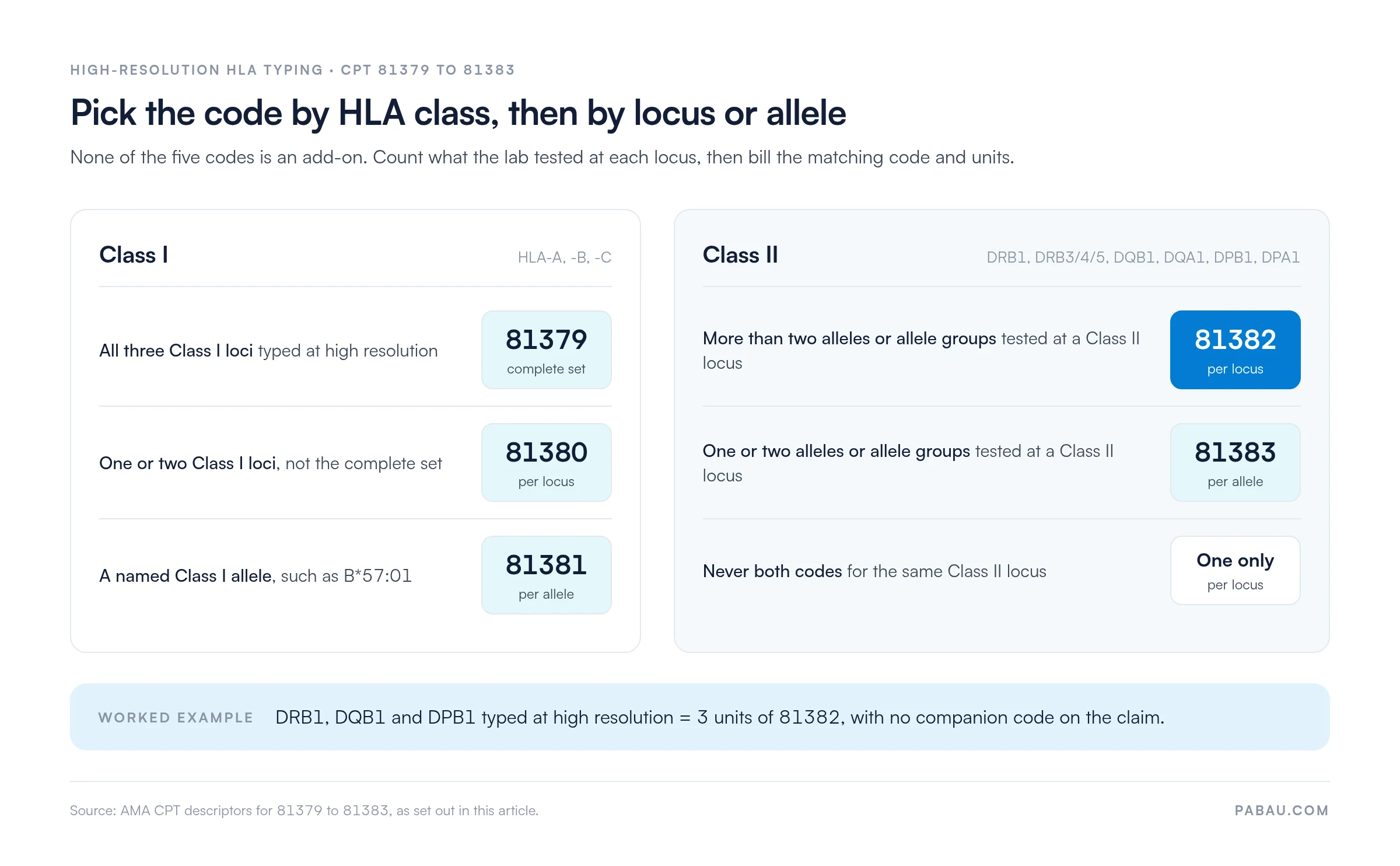
Decision panel for high-resolution HLA typing codes.
HLA class picks the code family, and the allele count at each locus picks 81382 or 81383. Based on the AMA CPT descriptors for 81379 to 81383.

ICD-10 codes commonly paired with 81382

The diagnosis code has to reflect the clinical scenario behind the order, not a generic genetic testing code. The pairings below are common examples rather than a guaranteed crosswalk. Check each payer’s coverage policy, because accepted diagnoses vary by payer and change over time.

ICD-10-CM codeDescriptionClinical scenario
K90.0Celiac diseaseHLA-DQ2/DQ8 typing for celiac genetic susceptibility
Z94.0Kidney transplant statusPost-transplant HLA typing (payer-specific acceptance)
Z94.1Heart transplant statusPost-transplant HLA typing (payer-specific acceptance)
T86.10Unspecified complication of kidney transplantRetyping during a transplant complication workup (payer-specific acceptance)
D89.9Disorder involving the immune mechanism, unspecifiedUse only when a more specific immune disorder code does not apply
M05.79Rheumatoid arthritis with rheumatoid factor of multiple sites without organ or systems involvementDRB1 shared epitope testing in confirmed RA (payer-specific coverage)

Medicare and payer coverage for HLA Class II typing

Medicare pays CPT 81382 under the Clinical Laboratory Fee Schedule (CLFS), not the Physician Fee Schedule. Download the current rate from the CMS Clinical Laboratory Fee Schedule files, which update each January.

Whether Medicare pays a given claim depends on medical necessity. The test has to meet the criteria in any applicable National Coverage Determination (NCD) or the LCD of the lab’s Medicare Administrative Contractor (MAC). Review the HLA typing policy for your MAC jurisdiction before the first 81382 claim goes out.

  • Medicare: paid under the CLFS when the indication meets the applicable LCD or NCD. Verify the current year’s rate in the CLFS file.
  • Commercial payers: many classify HLA typing as specialty molecular testing and require prior authorization. Coverage varies significantly by plan.
  • Medicaid: coverage is state-determined. Some states carve molecular pathology out to managed care organizations with their own policies.
  • Self-funded plans (ERISA): these may follow the sponsor’s internal guidelines rather than any published LCD. Request written coverage confirmation before testing.

Prior authorization for HLA typing

A missing authorization is a common and avoidable denial on 81382 claims. The requirement is not universal, but many commercial payers impose it, so check it for every non-Medicare claim. Insurance eligibility verification at the time of the order is the simplest way to surface it before the specimen is sent.

When a payer requires it, a prior authorization form usually asks for the items below.

  1. Ordering physician’s clinical note stating the specific indication (transplant program, celiac workup, autoimmune evaluation) with history that supports medical necessity.
  2. The loci requested and why each one is clinically necessary, plus whether the lab will type the whole locus or named alleles.
  3. Lab accreditation documentation: many payers require the testing lab to hold CAP (College of American Pathologists) or ASHI accreditation for HLA typing.
  4. ICD-10 diagnosis codes that match the clinical indication, checked against the payer’s coverage policy.
  5. Ordering provider’s NPI and specialty, which shows the test is ordered in a recognized clinical context such as transplant surgery, gastroenterology or rheumatology.

Common 81382 denials and how to avoid them

The denial patterns below come up most often on 81382, and each has a clear fix. Effective denial management workflows catch them before they become write-offs. The guide to denial reason codes lists each code with its resolution path.

Denial reasonRoot causeResolution
Units don’t match the reportThe units of 81382 differ from the number of Class II loci on the lab reportBill one unit per Class II locus the report shows at high resolution
Locus and allele codes for one locus81382 and 81383 both reported for the same Class II locusUse 81382 when more than two alleles are tested at the locus, or 81383 per allele when one or two are
Class I code on Class II typing81381 billed as if it were a “primary” Class II codeRemove 81381 unless a named Class I allele was tested; 81382 needs no companion code
No prior authorizationCommercial payer requires authorization and the claim went out without itObtain authorization before testing; appeal with retrospective authorization where the payer allows it
ICD-10 mismatchThe diagnosis is not a supported indication under the payer’s policyCheck the payer’s policy; update the ordering note to state the clinical scenario behind the order
Insufficient medical necessity documentationThe lab report shows allele calls but no indication or methodology statementResubmit with the physician’s note and a report stating the indication, loci tested and resolution level
Lab not credentialedThe testing lab lacks the CAP or ASHI accreditation the payer requiresSend accreditation documents up front; enroll the lab in the payer’s specialty lab program

Pro Tip

Run a quarterly audit of all 81382 claims against the prior authorization log. A paid claim without a recorded authorization number is a compliance risk. A denied claim with a valid authorization number is an appeal opportunity.

Documentation that supports an 81382 claim

Medical billing compliance for molecular pathology codes needs a record that runs from clinical indication through methodology to result. Without that record, an 81382 claim is hard to defend on audit. Meeting the standard for clean claim submission means every element below is present before the claim is filed.

  • Ordering physician’s note: the clinical indication (transplant evaluation, celiac rule-out, named autoimmune condition), the loci requested, and why each locus is needed. A note that only says “HLA typing ordered” is not enough.
  • Lab requisition: patient demographics, the ordering provider’s NPI, the loci requested, the resolution level, and the CPT codes to be billed.
  • Lab report: the method used (such as sequence-based typing or next-generation sequencing) and a statement that results are high resolution. It should list the allele calls for each locus and the clinical indication.
  • Unit count: the number of Class II loci on the report should equal the units of 81382 on the claim. Where only one or two alleles were tested at a locus, the report should show them for 81383.
  • Transplant program documentation (if applicable): the program’s case number and the referral letter linking the patient to an active transplant evaluation.
  • Prior authorization reference number: recorded on the case and on the claim if the payer required authorization.

81382 reimbursement under the Clinical Laboratory Fee Schedule

Medicare pays 81382 per unit, at the CLFS rate for one locus. Each locus typed is a separate unit, so typing DRB1, DQB1 and DPB1 pays three units of 81382. The payment does not depend on any other HLA code on the claim.

The CLFS sets one national limitation amount per code, and CMS revises it each year. Pull the current figure from the CLFS files rather than quoting a rate from a prior year.

  • Per-locus units: each unit of 81382 pays the one-locus rate. The unit count on the claim has to match the loci on the lab report.
  • 81382 or 81383: when only one or two alleles are tested at a locus, 81383 per allele is the correct code. Choose by what the lab tested, never by which code pays more.
  • Commercial payer rates: these are often negotiated as a percentage of the Medicare CLFS rate. Use a tool such as PGM Billing’s CPT lookup to benchmark current rate expectations.

How Pabau supports HLA typing claims for your practice

Practices that order HLA typing for transplant, celiac or autoimmune workups carry the authorization and claim follow-up. That work usually lives in spreadsheets, payer portals and email threads. Pabau, a practice management platform with built-in claims tools, keeps it on the patient’s case instead.

Pabau’s claims management software submits CMS-1500 (837P) claims electronically through the Claim.MD clearinghouse. Your team records the authorization code on the case and runs insurance eligibility checks from the same record.

ERA remittances come back against the claim they pay. When an 81382 line is paid short or denied, your billers can see the remittance beside the authorization code and decide what to correct.
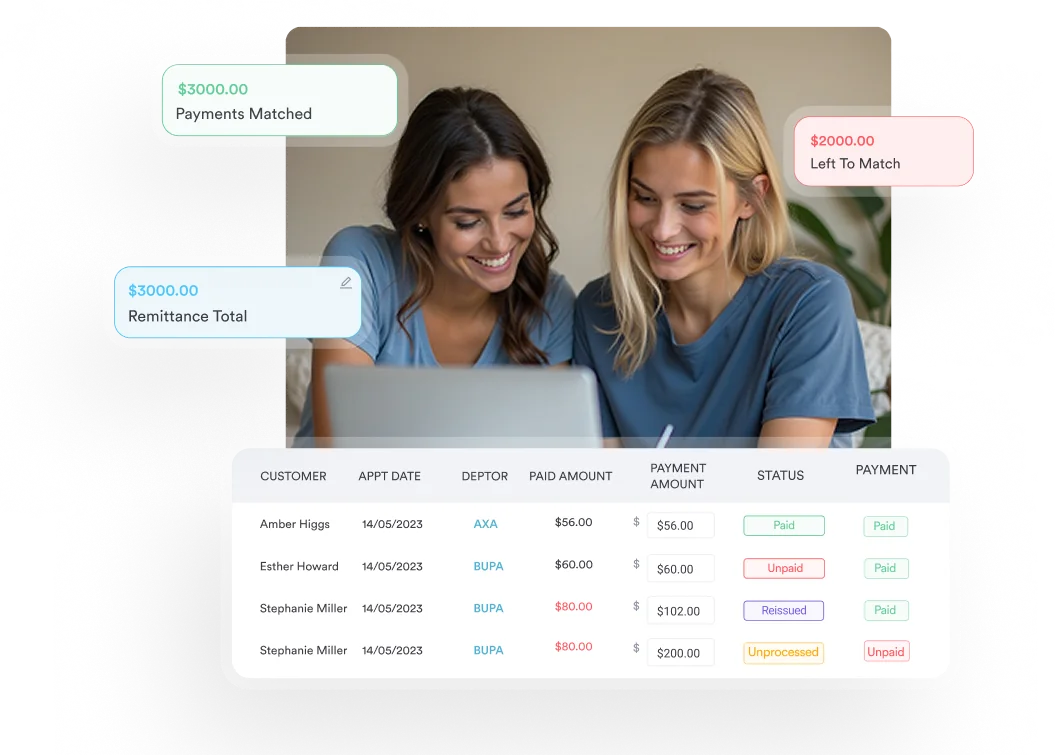
Pabau remittance matching screen showing payments matched
Pabau’s remittance matching shows what each payer paid and what is left to match, so your team can spot an underpaid HLA typing claim quickly.

Keep HLA typing claims and authorizations together

Pabau submits CMS-1500 claims through Claim.MD, tracks authorization codes on the case, and brings ERA remittances back to the claim. Your billers see an underpaid 81382 line without digging through payer portals.

Pabau claims management dashboard

Conclusion

CPT code 81382 is a standalone, per-locus code, and that settles most of the confusion around it. The claim doesn’t need 81381 or any other companion code. It needs the right unit count and the right choice between locus and allele coding.

Count the Class II loci the lab typed at high resolution. Switch to 81383 where only one or two alleles were tested at a locus. Then back the claim with a documented indication and any authorization the payer requires. What remains is the payer’s coverage policy, which you can check before the specimen is drawn.

To see how Pabau keeps claims, authorization codes and remittances on one patient record, book a demo.

Continue your research

Continue your research

Need a full picture of clearinghouse submission for lab codes? Pabau’s Claim.MD clearinghouse guide explains how electronic claim submission works from lab order through ERA reconciliation.

Want to understand the 837P file your lab submits? The 837 file guide covers the HIPAA-standard electronic claim format used to transmit CPT codes to payers.

Looking to benchmark your denial rate against industry standards? Pabau’s revenue cycle management guide covers the end-to-end workflow from order through collected payment.

Frequently asked questions

What does CPT code 81382 cover?

CPT code 81382 covers HLA Class II high-resolution typing of one locus, such as HLA-DRB1, -DRB3/4/5, -DQB1, -DQA1, -DPB1 or -DPA1. It is billed once for each locus typed. It is a standalone code, not an add-on.

What is the difference between CPT 81381, 81382, and 81383?

81381 is a Class I code for one named allele or allele group, such as B*57:01. 81382 is a Class II code for one whole locus, billed per locus. 81383 is a Class II code for one allele or allele group, used when only one or two are tested at a locus. None of them is an add-on.

Does CPT 81382 require prior authorization?

Many commercial payers require prior authorization for HLA typing, while Medicare generally does not. Requirements vary by plan. Check the requirement through an eligibility and benefits check when the test is ordered, and get written confirmation before testing.

Can CPT 81382 be billed for celiac disease testing?

Yes. A DQ2/DQ8 workup that types DQB1 and DQA1 at high resolution is two units of 81382. When the lab tests only one or two specific alleles at each locus, report 81383 per allele instead. Use K90.0 for confirmed celiac disease, or a code for the symptom or family history behind the workup.

What are the most common reasons CPT 81382 claims are denied?

The usual causes are a unit count that does not match the loci on the lab report, or 81382 and 81383 on one locus. Missing prior authorization for commercial claims is another. So are an unsupported ICD-10 code and a lab report without the indication or resolution level.
Avatar photo
Despina Petrushevska
Content Writer

Despina Petrushevska is a content writer covering aesthetics, dermatology, and clinic operations, known for making detailed clinical concepts clear and engaging. Outside of work, she enjoys photography, weekend getaways, and finding inspiration in everyday experiences.
×