
Pabau Engage inbox

Pabau Engage is here: every patient conversation in one inbox.

Learn more
Book a demo Book a demo
☰
CPT Code

CPT code 78459 – Myocardial PET metabolic evaluation, single study


Code Definition

78459 is the CPT code for a myocardial PET metabolic evaluation study, single study. It includes ventricular wall motion and ejection fraction when performed. In practice it bills the FDG PET scan that shows whether weak heart muscle is still viable before revascularization.

It is not a perfusion code. Rest and stress PET perfusion goes to 78491 or 78492, and a metabolic scan with a concurrent CT goes to 78429.

Section
70010-79999 Radiology
Subsection
78012-79999 Nuclear Medicine
Code range
78414-78499 Diagnostic Nuclear Medicine Procedures on the Cardiovascular System
Billable
No
Code also known as
cardiac FDG PET viability study, myocardial viability PET, FDG PET metabolic heart scan
Save time. Improve accuracy. Get paid faster.
Automate coding with Pabau

Let Pabau's smart automation suggest the right codes, reduce claim denials, and keep your practice compliant—effortlessly.

  • AI-powered code suggestions
  • Real-time compliance checks
  • Faster claims, fewer denials
Why practices choose Pabau
Save hours every week

Automate repetitive tasks and focus on what matters most—your patients.

Improve accuracy

Reduce coding errors and ensure compliance with the latest regulations.

Get paid faster

Clean claims, fewer denials, and faster reimbursements.

Grow with confidence

Powerful insights and reporting to help your practice thrive.

HIPAA compliant SOC 2 certified GDPR-compliant Trusted by 4,000+ clinics worldwide

Key takeaways

Key takeaways

CPT code 78459 reports one myocardial PET metabolic study, the FDG viability scan, and it has no rest or stress version.

Bill the FDG tracer on its own line as HCPCS A9552; rubidium-82 and N-13 ammonia belong to the perfusion codes.

Perfusion PET is 78491 or 78492, a metabolic scan with a concurrent CT is 78429, and a combined study is 78432 or 78433.

Medicare covers FDG viability PET under NCD 220.6.8, before revascularization or after an inconclusive SPECT.

Pabau tracks prior authorization on the case and warns your team when the auth code is missing.

CPT code 78459 bills one FDG viability scan, not a perfusion study

CPT code 78459 is the single-study code for myocardial PET metabolic imaging, the FDG scan that shows whether weak heart muscle is still alive.

Cardiologists order it when revascularization is on the table, and Medicare frames it the same way in its FDG PET viability coverage policy. Viable muscle may recover after bypass or stenting. Scar will not.

Since 2020 the descriptor reads: Myocardial imaging, positron emission tomography (PET), metabolic evaluation study (including ventricular wall motion[s] and/or ejection fraction[s], when performed), single study.

Two words in that descriptor do most of the coding work. “Metabolic” means the scan measures glucose uptake in the heart muscle, not blood flow. “Single study” means one metabolic acquisition, and there is no multiple-study version of 78459 to upgrade to.

Blood flow is a separate question with separate codes. PET perfusion is 78491 for a single study at rest or stress, and 78492 for multiple studies at rest and stress. Its SPECT counterparts are 78451 and CPT code 78452.

FDG is the only tracer that belongs on a 78459 claim

The radiopharmaceutical is billed on its own line, and the tracer has to match the study type. Payers check that pairing, so a perfusion tracer next to 78459 is an easy edit to fail.

  • Fludeoxyglucose F-18 (FDG): The metabolic tracer for a viability study. Report it as HCPCS A9552, one per study dose.
  • Rubidium-82 (A9555) and N-13 ammonia (A9526): Perfusion tracers. CMS instructions limit them to the PET perfusion codes, so they never ride with 78459 on its own.

If the report names Rb-82 or ammonia and no FDG, the study was a perfusion scan. Code it from the perfusion family instead.

What 78459 includes, and what goes on its own line

The code covers the imaging episode from tracer injection to the signed report. A few items sit outside it, and two situations swap 78459 for a different code entirely.

ComponentHow it is reported
FDG radiotracerSeparate line, HCPCS A9552
Tracer administration and PET acquisitionIncluded in 78459
Wall motion and ejection fractionIncluded when performed; no add-on code, and no modifier 52 when skipped
Physician interpretation and reportIncluded in the global service; split with modifiers 26 and TC
CT acquired concurrently for attenuation correctionReport 78429 instead of 78459, not 78459 plus a CT code
Perfusion study in the same sessionReport the combined code 78432 or 78433, not 78459 plus 78491 or 78492

The CT row catches the most claims. Many cardiac PET units are hybrid PET/CT scanners, so check how the CT was used before you pick the code. The grid below maps both swaps away from 78459.
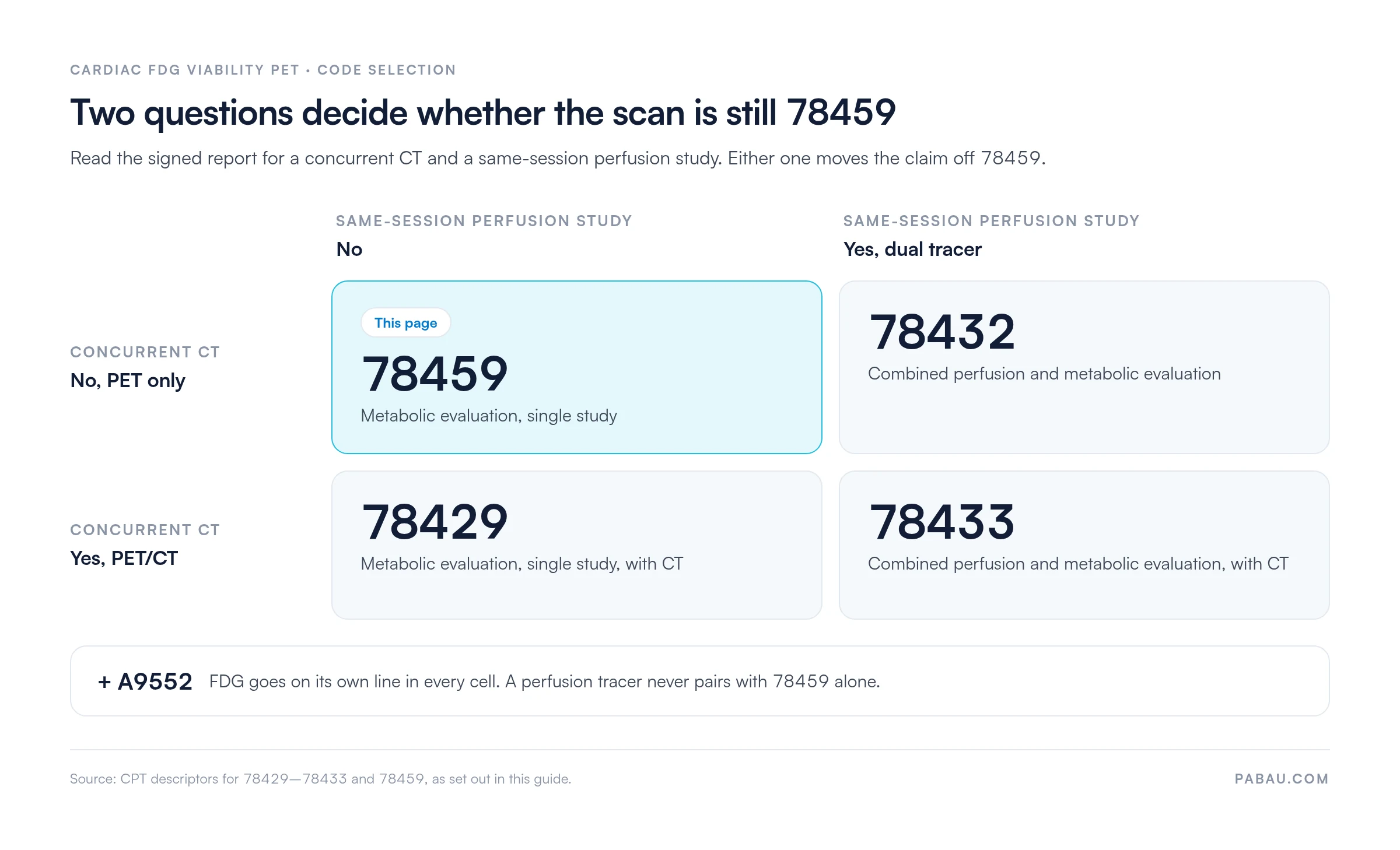
Two-by-two grid for cardiac FDG viability PET coding
Only a PET-only scan with no same-session perfusion study stays on 78459, and FDG goes on A9552 in all four cases. Codes follow the CPT descriptors quoted in this guide.

Metabolic PET, perfusion SPECT and perfusion PET answer different questions

The old habit of comparing 78459 with 78452 hides the real difference. Perfusion imaging asks whether blood reaches the muscle. Metabolic imaging asks whether the muscle is still alive when blood flow is poor.

AttributeMetabolic PET (78459)Perfusion SPECT (78451/78452)Perfusion PET (78491/78492)
Clinical questionIs dysfunctional muscle viable?Is there ischemia or infarct?Is there ischemia or infarct?
ModalityPETSPECTPET
Study countSingle study only78451 single, 78452 multiple78491 single, 78492 multiple
Rest or stressNeither; no stress componentRest, stress, or bothRest, stress, or both
Typical tracer and HCPCSFDG, A9552Technetium-99m agents, such as sestamibi (A9500)Rb-82 (A9555) or N-13 ammonia (A9526)
Version with concurrent CT78429No separate CT code in the family78430 single, 78431 multiple

The PET/CT and combined codes added in 2020

The 2020 revision gave cardiac PET a CT-inclusive code for each study type, plus combined and blood-flow codes. Know them, because each one replaces a pairing coders used to build by hand.

CPT codeWhat it reports
78429Metabolic evaluation, single study, with concurrently acquired CT
78430Perfusion, single study at rest or stress, with concurrently acquired CT
78431Perfusion, multiple studies at rest and stress, with concurrently acquired CT
78432Combined perfusion and metabolic evaluation, dual radiotracer
78433Combined perfusion and metabolic evaluation, dual radiotracer, with concurrently acquired CT
+78434Absolute quantitation of myocardial blood flow, an add-on to multiple-study perfusion codes 78431 and 78492

Read the report before you code. It tells you the tracer, whether a CT was acquired with the PET, and whether a perfusion study ran in the same session.

A worked example shows how one report becomes a claim

Take an illustrative patient with ischemic cardiomyopathy and a poor ejection fraction. The surgeon wants to know which territories are worth bypassing, so the cardiologist orders an FDG viability study.

  • PET-only scanner: 78459, plus A9552 for the FDG dose, with I25.5 as the primary diagnosis.
  • PET/CT with a concurrent CT for attenuation correction: 78429 replaces 78459. The A9552 line and the diagnosis stay the same.
  • Rest perfusion added in the same session: the combined code 78432, or 78433 with the CT. Report each tracer on its own line, and confirm which perfusion-tracer pairings your payer’s edits accept.

Same patient, same clinical question, three different procedure codes. The report decides which one is right, so the coder needs the final signed version, not the order.

Viability diagnoses, not chest pain, support 78459

Medicare covers FDG PET for myocardial viability as a primary study before revascularization, or after an inconclusive SPECT. The policy also works in reverse. A SPECT ordered after an inconclusive FDG PET viability study is not covered.

ICD-10-CM codeDescriptionNotes
I25.5Ischemic cardiomyopathyThe core viability indication when revascularization is being weighed
I25.10Atherosclerotic heart disease of native coronary artery without angina pectorisPair with the cardiomyopathy or dysfunction that prompted the study
I42.0Dilated cardiomyopathyViability work-up where an ischemic cause is suspected
I42.9Cardiomyopathy, unspecifiedCode the specific type when the record supports it

Lead with I25.5 when the record supports ischemic cardiomyopathy, since it is the core viability indication. Chest pain codes such as R07.9 point to a perfusion question, so they rarely support a viability study on their own. Check your MAC’s current billing article and claim edits before you rely on any diagnosis list, including this one.

Modifiers 26 and TC decide who gets paid

78459 has a professional component and a technical component. Whether you bill one, the other or both depends on who owns the scanner and who reads the scan.

ModifierWhat it signalsWhen to use it
26Professional component onlyThe physician bills the interpretation while a hospital or imaging center bills the equipment and staff
TCTechnical component onlyThe facility bills the scanner, tracer administration and technologist time
None (global)Both componentsOne entity owns the equipment and employs or contracts the reading physician

The classic error is a global claim from a hospital-employed cardiologist when the hospital is already billing the technical side. Settle the billing relationship once per site, then build it into your charge setup.

Medicare payment for 78459 comes from the fee schedule lookup

Medicare pays 78459 under the Physician Fee Schedule, adjusted by locality and split by component. Rates reset every January, so pull the current figures from the CMS Physician Fee Schedule lookup tool for your MAC and locality.

  • Professional component (26): covers the interpretation and report.
  • Technical component (TC): covers the scanner, tracer administration and technologist time, and it is the larger share.
  • FDG (A9552): reported on its own line. Under the hospital outpatient system, diagnostic radiopharmaceuticals are packaged into the procedure payment, so report the line even when it pays nothing separately.

A superbill that lists 78459, 78429 and A9552 side by side helps the coder pick the right code. It also stops the tracer line from going missing.

Prior authorization is where most 78459 claims are won or lost

  • Traditional Medicare: no prior authorization step for cardiac PET. Coverage rests on NCD 220.6.8 and a record that shows the viability question.
  • Medicare Advantage: most plans require authorization for cardiac PET. Check the specific plan before you schedule.
  • Commercial payers: nearly all require authorization, often through an imaging benefit manager. Send the clinical notes, the ejection fraction and the revascularization question.

Authorizations are often issued for a specific CPT code. If the order says 78459 and the scan runs on a PET/CT as 78429, check whether the authorization still matches before the claim goes out. Front-end insurance eligibility verification catches plan changes before the patient arrives.

Follow a 78459 claim from order to payment

  1. Order. The referring cardiologist documents the viability question and the planned revascularization decision.
  2. Eligibility and authorization. The front desk confirms coverage and records the auth number, dates and approved code on the case.
  3. Scan and report. The report names FDG, states whether a CT was acquired with the PET, and notes any perfusion study.
  4. Code selection. The coder picks 78459, 78429, 78432 or 78433 from the report, then adds A9552.
  5. Claim build. The diagnosis, modifiers, auth number and tracer line go on the claim.
  6. Submission. The claim goes out through the clearinghouse, and any rejection comes back before it reaches the payer.
  7. Remittance. The ERA posts against each line, so a denied tracer line gets worked separately from the procedure.

Before you submit: a 78459 checklist

  • The report confirms an FDG metabolic study, not a perfusion study
  • No concurrent CT was acquired, or the code is 78429 instead
  • No same-session perfusion study, or the code is 78432 or 78433 instead
  • A9552 is on its own line, with no Rb-82 or ammonia line beside 78459
  • The diagnosis describes the cardiomyopathy or dysfunction behind the viability question
  • The record shows the scan is a primary study before revascularization, or follows an inconclusive SPECT
  • Modifier 26 or TC matches who owns the scanner and who read the scan
  • The authorization number is on the claim and matches the code billed
  • The report is signed, with findings, impression and the reader’s credentials

Common mistakes that get 78459 denied

  • Coding a perfusion scan as 78459. An Rb-82 rest and stress study is 78492, or 78431 with the CT.
  • Billing 78459 on a PET/CT. A concurrent CT for attenuation correction moves the study to 78429.
  • Building the combined study by hand. 78459 plus 78491 for a same-session dual-tracer scan should be 78432 or 78433.
  • Pairing the wrong tracer. A9555 or A9526 next to 78459 fails the tracer edit.
  • Leaning on chest pain codes. They support a perfusion question, not a viability one.
  • Ordering SPECT after an inconclusive FDG PET. Medicare does not cover that follow-up study.
  • Missing or mismatched authorization. An approval for 78459 may not cover a scan billed as 78429.

A structured denial management workflow sorts these by cause instead of working each one alone. The CARC on the remittance names the cause, and our guide to medical billing denial codes explains each one.

For a medical necessity appeal, send the ordering notes, the ejection fraction, the revascularization question and any prior SPECT result.

How Pabau keeps 78459 claims moving through authorization and payment

Cardiac PET claims tend to stall at three points. An authorization goes unrecorded, a coverage change goes unchecked, or a remittance never gets matched to the right line. Each one usually means a phone call after the scan.

Pabau, the practice management platform we build, keeps those steps on the patient’s case. The auth code, dates and approved sessions are tracked there, and Pabau warns your team when an authorization is missing. In the US, claims are submitted through our Claim.MD integration.

Our claims management software builds the CMS-1500/837P claim and checks eligibility before it goes out. When the payer responds, ERA remittances post back against the claim. A denied A9552 line then sits in plain view next to the paid 78459 line.
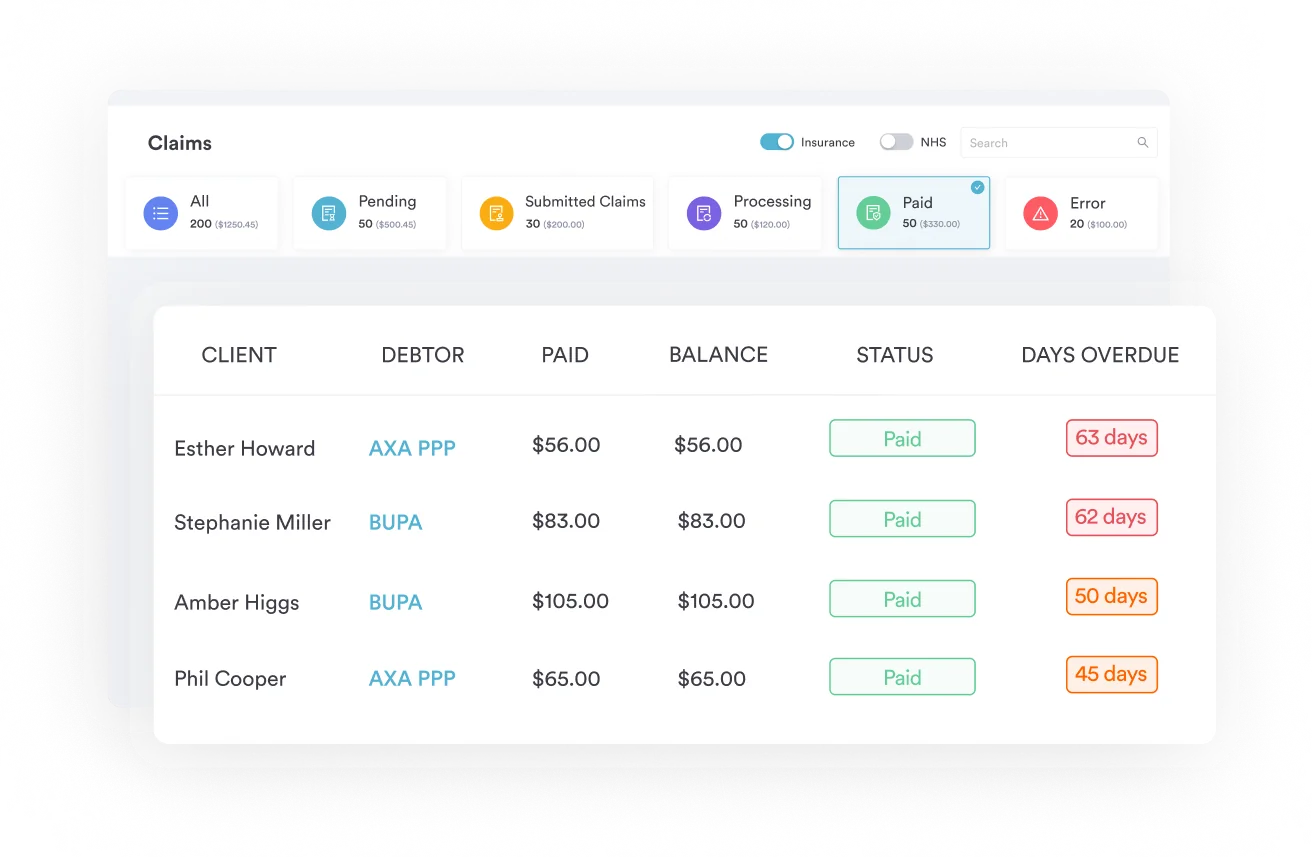
Pabau claim tracking screen showing claim status from submission to payment
Pabau’s claim tracking shows where each 78459 claim sits, so your team can chase a stuck tracer line before the filing deadline.

Keep cardiac PET authorizations and claims on track

Pabau tracks prior authorizations on the case, warns when an auth code is missing, and sends US claims with eligibility checks through Claim.MD.

Pabau claims management dashboard

Conclusion

Treat 78459 as a viability code and most of its billing problems disappear. If the report shows FDG and a single metabolic acquisition on a PET-only scanner, the code is right. Any other combination points to a different code.

The trade-off is speed for certainty. Coding from the signed report takes a little longer than coding from the order. In return, it catches the PET/CT and combined-study cases before a payer does.

Book a demo to see how Pabau tracks cardiac PET authorizations and sends your claims through Claim.MD.

Continue your research

Continue your research

Need a denial management system for nuclear cardiology? Denial codes in medical billing explains CARC codes and how to build a structured appeal workflow.

Submitting claims through a US clearinghouse? Claim.MD clearinghouse overview covers payer connectivity, 837P formatting, and ERA matching for high-value imaging claims.

Confused about 837P file structure for radiology claims? 837 file guide walks through loop and segment requirements relevant to nuclear cardiology billing.

Frequently asked questions

Is CPT 78459 a stress test?

No. 78459 is a metabolic study with no stress component. If the record describes exercise or pharmacologic stress imaging, the study is a perfusion scan and belongs to a different code.

Is 78459 an add-on code?

No, 78459 is a standalone code. The add-on in this family is +78434, which reports absolute myocardial blood flow alongside multiple-study perfusion codes 78431 and 78492.

Can 78459 and 78452 be billed on the same day?

It is unusual, because the two answer different questions. Check the current quarter’s NCCI procedure-to-procedure table before billing both, and document why each study was needed.

Does Medicare require a SPECT before a viability PET?

No. Medicare covers FDG viability PET as a primary study before revascularization, or after an inconclusive SPECT. A SPECT after an inconclusive FDG PET is not covered.

Is cardiac FDG PET billed the same in a hospital and a physician office?

The CPT and HCPCS codes are the same. Payment differs, because hospital outpatient rates package the FDG tracer into the procedure payment.


Avatar photo
Monika Lazarevska
Content Writer

Monika Lazarevska writes content for owners and healthcare professionals who want clear, no-fluff content that actually helps them run their practice better. With a background in storytelling and SEO, she knows how to make even the driest topics worth reading. Off the clock, you'll find her in a café somewhere in Europe, probably with a good book and an even better coffee.
×

