CPT Code 52352: Ureteroscopic stone removal billing guide
CPT Code 52352: Official descriptor and procedure overview CPT Code 52352 descri...

Last Updated: Oct 30, 2026
77401 is the deleted CPT code for radiation treatment delivery, superficial and/or ortho voltage, per day. The AMA deleted it effective January 1, 2026, so it applies only to dates of service in 2025 or earlier.
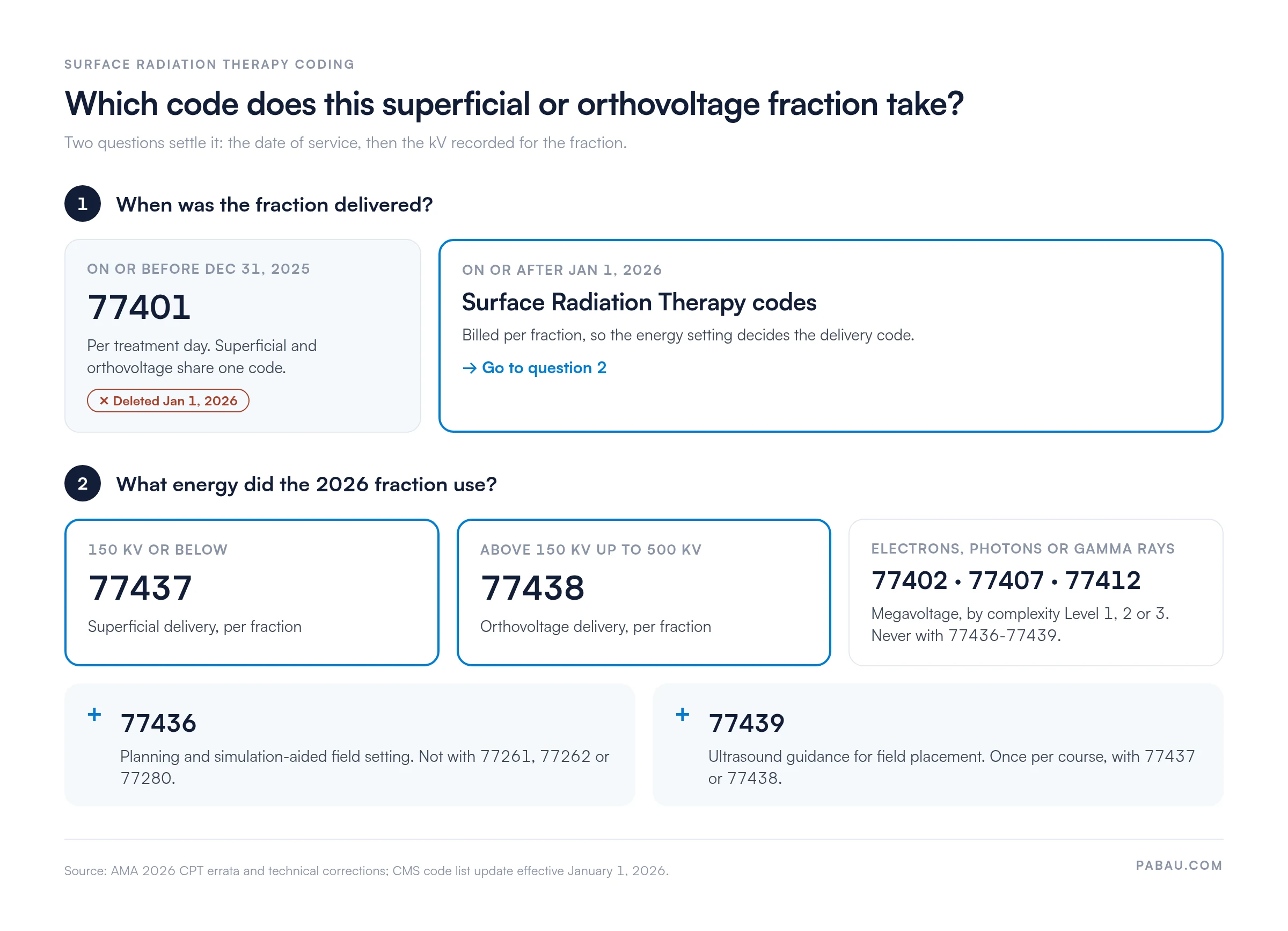
For 2026 dates of service, superficial and orthovoltage radiation is reported with the Surface Radiation Therapy codes. 77436 covers planning and simulation-aided field setting. 77437 covers superficial delivery at 150 kV or below, and 77438 covers orthovoltage delivery above 150 kV up to 500 kV. Add-on 77439 covers ultrasound image guidance for field placement.
Let Pabau's smart automation suggest the right codes, reduce claim denials, and keep your practice compliant—effortlessly.
Automate repetitive tasks and focus on what matters most—your patients.
Reduce coding errors and ensure compliance with the latest regulations.
Clean claims, fewer denials, and faster reimbursements.
Powerful insights and reporting to help your practice thrive.
HIPAA compliant SOC 2 certified GDPR-compliant Trusted by 4,000+ clinics worldwide

CPT code 77401 was deleted on January 1, 2026, so it is valid only for superficial or orthovoltage fractions delivered in 2025 or earlier.
From 2026, surface radiation therapy is reported with 77436 for planning, 77437 or 77438 for each delivery fraction, and add-on 77439 for ultrasound guidance.
The kV recorded for each fraction now decides the delivery code: 77437 at 150 kV or below, 77438 above 150 kV up to 500 kV.
The AMA bars planning, simulation, dosimetry, weekly management and megavoltage delivery codes alongside 77436-77439, so 2025 billing habits now cause bundling denials.
Pabau, the practice software we build, sends the claims your team codes to payers through Claim.MD. It tracks each response, so rejected 77401 lines are caught early.
CPT code 77401 described radiation treatment delivery, superficial and/or ortho voltage, per day, and it is no longer valid for current dates of service. The AMA deleted it effective January 1, 2026. Its 2026 CPT errata and technical corrections carry the instruction to see 77436, 77437, 77438 and 77439 for surface radiation therapy instead.
CMS made the same change on the same date. Its code list update effective January 1, 2026 deletes 77401 from the radiation therapy services list. It also deletes Category III code 0394T, the code for high dose rate electronic brachytherapy applied to the skin surface.
The code is now historical. Use it only on claims for fractions delivered on or before December 31, 2025. Every superficial or orthovoltage fraction from January 1, 2026 onward is reported with the Surface Radiation Therapy codes below.
For those older claims, 77401 worked like this:
The AMA added a Surface Radiation Therapy subsection to Radiation Oncology for 2026. It defines surface radiation therapy as external radiation below 500 kV that limits penetration beyond the skin. Four codes now cover the delivery 77401 used to report, plus the planning around it.
Three changes matter most for coders. Delivery is counted per fraction rather than per day. Superficial and orthovoltage work now splits into two codes at 150 kV. Planning and field setting move into one code, 77436, built for this modality.
Older guidance that treats 77436-77439 as a separate device category billed alongside 77401 is out of date. The AMA instruction sends users from 77401 straight to these four codes, so they replace it outright.
The new family carries a long exclusion note, and it changes how a skin radiation course is billed. Under 77401, practices typically reported planning, simulation, dosimetry and weekly management with their own codes. The AMA parenthetical note now bars every code in the table below alongside 77436-77439.
Two pointers close the note. High-energy treatment of skin cancer with electrons, photons or gamma rays goes to 77402, 77407 or 77412. High dose rate radionuclide surface brachytherapy goes to 77767 or 77768.
The megavoltage codes changed for 2026 as well. The AMA now assigns 77402, 77407 and 77412 by treatment-delivery complexity, Level 1, 2 or 3, rather than by beam energy. 77406 is not a current delivery code, so any crosswalk that still lists it needs replacing.
The date of service decides which code set applies, not the date the course was planned or the claim was sent. Courses that crossed the new year are where most coding questions come from. The chart below follows a single fraction from its date of service to the code it takes.
Run a one-time sweep of every open superficial or orthovoltage course that started in 2025. Check that each claim line uses the code set for its own date of service. Then confirm the authorization on file names the code you are about to bill.
The 150 kV split between 77437 and 77438 makes the energy setting the first field a coder reads. Each fraction’s treatment record should show these elements.
A record that says only SRT or superficial cannot show which delivery code applies. Fix it in the treatment note template with a required numeric kV field.
Each payer sets the diagnoses it accepts in its own coverage policy, which is a core part of medical billing for radiation services. The codes below are the diagnoses most often documented for superficial and orthovoltage treatment of skin cancer.
Check the MAC’s local coverage documents and each commercial payer’s radiation oncology guideline before the first fraction. A benign lesion code, such as D23.- for other benign neoplasms of skin, needs explicit support in that policy before radiation is billed.
Medicare pays surface radiation therapy under the Physician Fee Schedule. CMS valued the new codes in the CY 2026 final rule. It then updated the practice expense values for 77436, 77437 and 77438 in a March 2026 correction notice.
Look up current payment amounts and RVUs in the CMS Physician Fee Schedule lookup tool. Rates vary by locality and by site of service, and they change with each annual update.
Most denials on superficial and orthovoltage claims in 2026 trace back to 2025 habits carried into the new codes. Each one has a fix you can build into your denial management workflow and pre-submission checks.
Knowing the billing denial codes behind each rejection lets the appeals team send the right documentation the first time. A clean claim also needs the fraction count, date of service and treating provider to match across the treatment record and the claim form.
After a code deletion, billing teams mostly fight two problems: claims built from old templates, and rejections nobody notices for weeks. Pabau keeps each claim and its payer response next to the patient record, so both problems show up in one place.
Your team enters the codes for each fraction, and Pabau’s claims management sends those claims to payers through Claim.MD, our US clearinghouse integration. It then tracks claim status and payer responses. A 2026 line still carrying 77401 comes back as a rejection your team can correct and resend.
Code selection stays with your coders. Pabau submits and tracks the claim data your team enters, which keeps corrected claims moving well inside the payer’s filing limit.

Pabau sends the claims your team codes to payers through Claim.MD and tracks each response, so rejected 77401 lines get corrected quickly. See how it works for radiation oncology practices.

Treat 77401 as a code for 2025 dates of service only. The quickest protection is a hard stop in your charge entry or claim templates for any 2026 date of service that carries it. Follow it with a review of every course that crossed the new year.
The larger shift is financial. Planning, simulation, dosimetry and weekly management codes no longer sit alongside surface radiation delivery. A skin radiation course therefore produces fewer billable lines than it did in 2025. Update fee forecasts to reflect that, and settle split-course and authorization questions with each payer before you bill.
Book a demo to see how Pabau submits and tracks radiation oncology claims through Claim.MD, so corrected 2026 claims go out fast.

Want to understand how clearinghouse submissions work? Medical claims clearinghouse guide explains how claims move from practice to payer and where rejected surface radiation claims typically surface.
Need to reduce denial rates across your radiation oncology claims? Electronic remittance advice explained covers how to read ERA files and identify denial patterns by CARC code before they repeat.
Credentialing with payers before first billing? Getting credentialed with insurance companies walks through the enrollment steps required before surface radiation therapy claims will process for new radiation oncology providers.
No. The AMA deleted CPT 77401 effective January 1, 2026. Use it only for dates of service on or before December 31, 2025. From 2026 onward, report surface radiation therapy with 77436, 77437, 77438 and 77439.
The Surface Radiation Therapy family replaced it. 77436 covers planning and simulation-aided field setting. 77437 covers superficial delivery at 150 kV or below, and 77438 covers orthovoltage delivery above 150 kV up to 500 kV. Add-on 77439 covers ultrasound image guidance for field placement, per course, with 77437 or 77438.
Electron, photon or gamma ray treatment of skin cancer is reported with 77402, 77407 or 77412. Since 2026 those codes are chosen by treatment-delivery complexity, Level 1, 2 or 3, rather than by beam energy. 77406 is not a current delivery code.
The payer rejects or denies the line because the code was invalid on that date of service, often with CARC 181. Recode it to 77437 or 77438 based on the documented kV, and resubmit within the payer’s filing limit.
Malignant skin neoplasm codes in category C44, including basal cell and squamous cell carcinoma, and carcinoma in situ codes in D04 are the usual diagnoses. Each payer sets covered diagnoses in its own policy, so check the MAC’s coverage documents and the commercial payer’s guideline before the first fraction.