



CCSD code G5100: Bypass of duodenum billing guide
CCSD code G5100 bills a bypass that leaves the duodenum in place CCSD code G5100...

Last Updated: Oct 16, 2026

Specifically, CPT Code 76775 describes a limited retroperitoneal ultrasound performed in real time with image documentation.
Medicare pays $60.79 nationally for the global service in 2026. In fact, that splits into $27.05 under modifier 26 and $33.73 under modifier TC.
Billing and Coding Article A55336 (companion to LCD L34577) sets the covered diagnoses. Indeed, a diagnosis outside that list is the leading denial trigger.
Bill 76775 only when the exam stayed inside the retroperitoneum. A study that expands past it becomes an abdominal ultrasound instead.
Pabau blocks a claim from being sent until its required details are complete, so fewer 76775 claims bounce on missing information.
CPT Code 76775 covers a limited retroperitoneal ultrasound study. The AMA’s CPT code set describes it as: “Ultrasound, retroperitoneal (eg, renal, aorta, nodes), real time with image documentation; limited.” In fact, that parenthetical does real work. Specifically, it tells payers the study targets the retroperitoneal space, which holds the kidneys, aorta, and regional lymph nodes. However, it does not oblige the sonographer to survey every one of those structures.
The word “limited” is what separates 76775 from CPT 76770, which pays for a complete evaluation of the retroperitoneum. Specifically, a limited study fits when the clinical question points at one structure, or at a small subset of them. Notably, radiology practices, urology offices, and nephrology groups bill this code most often. Indeed, most of that volume is follow-up imaging of known pathology rather than a first diagnostic workup.
Every payment above is the national amount, before geographic adjustment. Specifically, each one is the code’s total RVU multiplied by the 2026 non-QP conversion factor of $33.4009, taken from the CMS relative value files.
The complete versus limited distinction is where most 76775 denials start. For example, billing 76775 when the report describes a full survey invites a downcode to 76770. In contrast, billing 76770 when only one kidney was imaged invites an overpayment audit. In short, a complete study evaluates the kidneys, the aorta, and the other retroperitoneal structures together.
The sonographer’s report settles which code applies. For instance, a report addressing one kidney for a known mass is 76775. In contrast, a report documenting both kidneys, the aorta, and the surrounding nodes is 76770. Therefore, moving between the two without the documentation to match is a standing audit target under the NCCI program.
Medicare coverage for CPT Code 76775 runs through Billing and Coding Article A55336 (companion to LCD L34577), published by Palmetto GBA. Specifically, that policy covers Jurisdictions J and M. Those span Alabama, Georgia, Tennessee, South Carolina, Virginia, West Virginia, and North Carolina. Instead, practices elsewhere follow their own MAC’s policy, and general medical necessity rules where no local policy exists. Coverage applies when the study evaluates one of these conditions:
Non-covered scenarios include screening studies with no clinical indication, and repeat imaging at an interval the utilization guidelines do not support. A study ordered purely for patient reassurance is also not covered. In addition, check the revision date on Article A55336 before billing, because the covered diagnosis list is updated periodically.
Article A55336 draws a line the code descriptors leave out, and it is the one most billing guides skip. Specifically, the retroperitoneal codes 76770, 76775, and 76776 are expected only where the exam stayed inside the retroperitoneum. Consequently, once findings push the study out to the gallbladder, liver, or spleen, the correct code becomes a limited or complete abdominal ultrasound.
Billing both a retroperitoneal study and an abdominal study for that one expanded exam is not appropriate. In addition, there is a matching rule at the ordering end. Specifically, where the physical exam points primarily at non-retroperitoneal organs, a full abdominal ultrasound is what should be performed and billed. That holds even though retroperitoneal structures get visualized along the way.
Pairing CPT Code 76775 with a diagnosis outside the Article A55336 support list is the most common reason for denial. In fact, that list runs to nearly 800 codes. The table below covers the families carrying most of the volume, and our ICD-10-CM codes index covers the rest.
Code to the highest specificity the record supports. For example, N18.32 for stage 3b chronic kidney disease beats the unspecified N18.9, because specificity reduces the chance of a medical necessity query. Note that N18.3 itself is no longer billable. Specifically, CMS split stage 3 into N18.31 and N18.32 in October 2022, leaving N18.3 as a parent category only.
Three modifiers apply to CPT Code 76775 in regular practice. Indeed, choosing the wrong one, or omitting one the billing arrangement requires, accounts for a meaningful share of technical denials on imaging claims.
When a physician owns the equipment and reads the study in their own office, bill 76775 with no modifier at all. In other words, that is the global service, and it collects both components on one claim. However, modifier 59 needs documentation showing the two studies answered separate clinical questions. Indeed, two procedures landing on the same calendar date is not enough on its own.
Medicare pays $60.79 for the global CPT Code 76775 service in 2026, before any geographic adjustment. Specifically, that figure is 1.82 total RVUs multiplied by the $33.4009 non-QP conversion factor. Consequently, where the read and the equipment sit with different parties, the two halves of the claim are worth very different amounts. The chart below shows the split, and how it changes for the complete study.
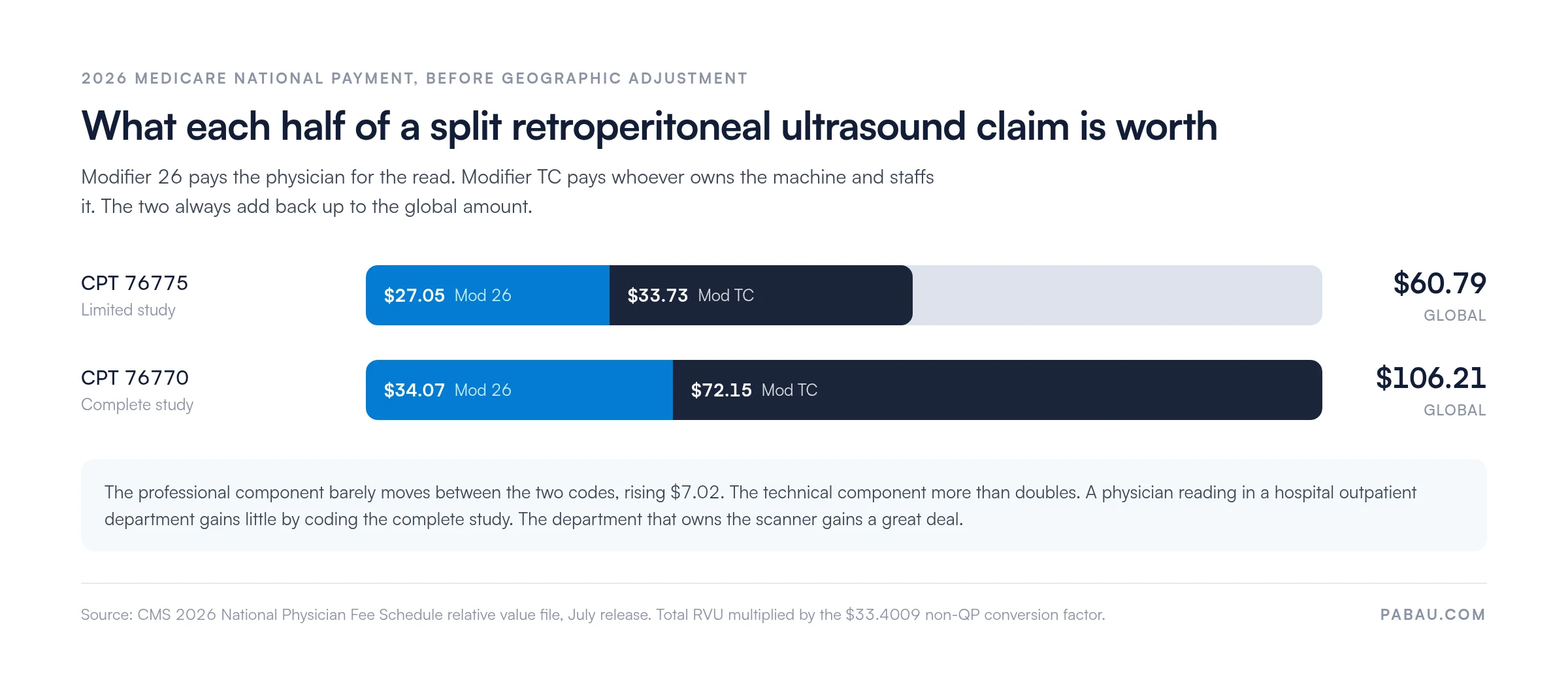
One point catches people out. Specifically, CPT 76775 carries the same 1.82 total RVU in a facility and in an office. Therefore, there is no separate facility rate to look up on the fee schedule. What changes with the setting is who bills which component.
In a hospital outpatient department, place of service 22, the physician bills 76775-26 and collects $27.05. Meanwhile, the department bills its own charge under the Outpatient Prospective Payment System rather than the fee schedule. In contrast, the $33.73 TC amount applies to a non-hospital setting, such as an imaging center that owns the scanner but does not read the study. An office doing both bills one global claim for $60.79.
Commercial payers negotiate their own rates against these values, so treat the national figures as a floor for modeling rather than a forecast. Therefore, confirm your contracted amounts before using any of this for revenue projections. The CMS fee schedule lookup tool returns locality-adjusted figures for a specific MAC jurisdiction.
Check your geographic price index before projecting revenue. The same CPT Code 76775 claim pays more in San Francisco than in rural Mississippi. GPCI adjusts the work, practice expense, and malpractice components by locality. The CMS fee schedule lookup filters by MAC jurisdiction and year, so run it for your own locality rather than the national average.
Thin documentation is the second most common denial trigger, behind an unsupported ICD-10 code. Specifically, Article A55336 and its parent LCD set what the medical record has to contain to survive a pre-payment or post-payment review. Consequently, structured imaging templates put these elements into the note as it is written, rather than leaving them to be reconstructed after a denial.
For aortic aneurysm surveillance, some MACs also expect the measurement recorded at this visit and at prior visits, to justify the follow-up interval. Keep earlier reports reachable from the current encounter so the interpreting physician can cite them.
Most 76775 denials fall into five categories. Instead, work them at the code level rather than waiting for remittance reports to surface a pattern. That is what stops an imaging claim backlog from building in the first place.
CPT 93975 is a complete duplex scan of arterial inflow and venous outflow for abdominal, pelvic, or scrotal contents and retroperitoneal organs. Indeed, it is often ordered alongside CPT Code 76775 in aortic aneurysm or renal artery stenosis workups. Whether both can be billed on one date turns on whether a current procedure-to-procedure edit pairs them. Those edits change quarterly, so check the current NCCI edits file before advising on same-day billing.
Where an edit does apply, modifier 59 goes on the column two code of the pair. It is only defensible when the record shows each study answered a separate clinical question. For example, a 76775 for a known renal cyst alongside a 93975 for renal artery stenosis can meet that standard. In contrast, two studies both ordered to evaluate the aorta will not. The distinction lives in what the physician wrote down.
The requirements above create friction at three points in the billing cycle. First, the clinical question and the structures imaged have to be documented at the point of care. Second, the code and modifier have to be assigned from what that note actually says. Then the claim has to leave the practice with every payer-required field populated.
Practice management software like Pabau, which includes claims management software, joins those three points into one workflow. Specifically, encounter documentation, the invoice, and the claim share a single patient record. The coder reads the imaging report itself rather than a summary of it. Pabau then runs an automatic check for required claim details, such as membership numbers and authorization codes. As a result, the send button stays disabled until the claim is complete.
US practices submit through the Claim.MD integration. Specifically, that route sends claims electronically to thousands of payers, runs real-time eligibility checks, and posts remittance advice back against the invoice. Every claim sits in one dashboard as pending, submitted, processing, paid, or in error, filterable by date, insurer, or invoice ID. For a urology or radiology practice running steady retroperitoneal imaging volume, a rejected 76775 surfaces the same week instead of a month later.

Pabau checks that required claim details are filled in before a claim can be sent. Claims then submit through Claim.MD and track to payment in the same dashboard, so imaging denials surface in days rather than weeks.

CPT Code 76775 is a small claim that generates an outsized share of denials. Nearly all of them come from three places. The diagnosis sits outside the covered list. The scope of the report does not match the code billed. Or the component modifier is missing. In short, none of those needs clinical judgment to catch, only someone looking before the claim goes out.
The scope question is the one worth building a habit around, because it fails in two directions at once. Read the report before assigning the code, and ask first whether the exam stayed inside the retroperitoneum at all. As a result, that single check heads off the downcode to 76770 and the audit on an upcode. It also catches the abdominal-ultrasound reassignment Article A55336 calls for.
The rates are the easy part, and they are the part most practices already have wrong. Specifically, pull them from the CMS relative value file each January, and carry the professional and technical amounts separately. Book a demo to see how Pabau moves a retroperitoneal imaging claim from the treatment note to a tracked submission without a second system.

Want to know how clearinghouse submission actually works? Claim.MD clearinghouse overview walks through what happens to a claim between your practice and the payer.
New to the claim lifecycle? Medical billing fundamentals covers the path from encounter to payment in plain language.
Building encounter forms for imaging? Superbill documentation guide shows how to structure a form that supports 76775 and any co-billed imaging codes.
Reading a denial you have not seen before? Denial codes in medical billing decodes the CO and PR reason codes that land on imaging claims.
Posting payments back against invoices? Electronic remittance advice explains how an ERA tells you what a payer actually allowed.
CPT Code 76775 is a limited retroperitoneal ultrasound performed in real time with image documentation. Specifically, it targets one or more retroperitoneal structures, such as a single kidney, the aorta, or regional lymph nodes, without a complete survey. Medicare covers it where a qualifying diagnosis from Billing and Coding Article A55336 (companion to LCD L34577) supports the study.
Modifier 26 applies when the physician interprets the study but does not own the equipment. In contrast, modifier TC applies when a facility or imaging center bills for performing the study. In addition, modifier 59 applies when 76775 and another imaging code, such as 93975, are performed as clinically distinct services on the same date. The record has to support that distinctness.
The most commonly paired families are N18.x for chronic kidney disease, N13.x for hydronephrosis, and I71.x for aortic aneurysm. In addition, others include R31.x for hematuria, N28.1 for a renal cyst, and N40.x for benign prostatic hyperplasia. Each one has to appear on the support list in Billing and Coding Article A55336, the companion to LCD L34577. Otherwise the claim fails medical necessity review.
Five triggers cover most denials. Specifically, the diagnosis is not on the Billing and Coding Article A55336 (companion to LCD L34577) list. In addition, the documentation describes a complete study warranting 76770. A modifier is missing in a split-billing arrangement. An NCCI edit conflicts with a code billed the same day. Or the exam expanded past the retroperitoneum and should have been coded as an abdominal ultrasound.



