

CCSD code G5100: Bypass of duodenum billing guide
CCSD code G5100 bills a bypass that leaves the duodenum in place CCSD code G5100...

Last Updated: Oct 16, 2026
74420 is the CPT code for urography, retrograde, with or without KUB. It covers a retrograde contrast study of the ureters and renal collecting system, including the radiologist's supervision and interpretation.
The phrase "with or without KUB" sets the scope of the code, not a documentation choice. The code holds whether or not a plain-film KUB was acquired. Denials usually follow a missing modifier on a split urologist-radiologist service, or a clinical indication documented too vaguely for medical necessity review.
Let Pabau's smart automation suggest the right codes, reduce claim denials, and keep your practice compliant—effortlessly.
Automate repetitive tasks and focus on what matters most—your patients.
Reduce coding errors and ensure compliance with the latest regulations.
Clean claims, fewer denials, and faster reimbursements.
Powerful insights and reporting to help your practice thrive.
HIPAA compliant SOC 2 certified GDPR-compliant Trusted by 4,000+ clinics worldwide

CPT code 74420 covers retrograde urography with or without KUB, inside the Diagnostic Radiology range 70010-79999.
Radiological supervision and interpretation is included in the global service and is never billed separately.
Modifier 26 covers the radiologist’s professional component, and Modifier TC covers the facility’s technical component.
74420 and CPT 52005 are separately billable, so the urologist bills 52005 while the radiologist bills 74420-26.
Practice management software like Pabau tracks modifiers and payer rules, which cuts manual entry errors on split-billing claims.
CPT code 74420 is published by the American Medical Association under the Diagnostic Radiology section of the CPT code set (range 70010-79999). The complete official descriptor reads: Urography, retrograde, with or without KUB. The neighboring colon study, CPT 74270, uses the same with or without KUB construction for a contrast enema.
The procedure involves a urologist placing a ureteral catheter during cystoscopy and injecting radiopaque contrast in a retrograde direction, up toward the kidneys. A radiologist then supervises the imaging and interprets the study. That supervision and interpretation component is bundled into the global service, so it is never billed as a separate add-on.
Payers require documented clinical indications before approving a retrograde urography claim. A vague order note does not satisfy medical necessity review. The indication must be specific enough that an auditor can confirm the procedure was clinically appropriate for that patient on that date.
Payers routinely audit high-cost radiology imaging, and retrograde urography without a clear clinical trigger is a common prepayment review target. Accepted indications include:
Each of these requires a corresponding ICD-10-CM diagnosis code on the claim. Mismatches between the stated indication and the diagnosis code trigger automated denials before a human reviewer ever sees the chart.
The most consequential billing decision for CPT code 74420 is how to handle the split service. The urologist places the catheter and injects the contrast. The radiologist supervises the imaging and interprets the results. Getting the split wrong produces denials that are hard to correct after the fact.
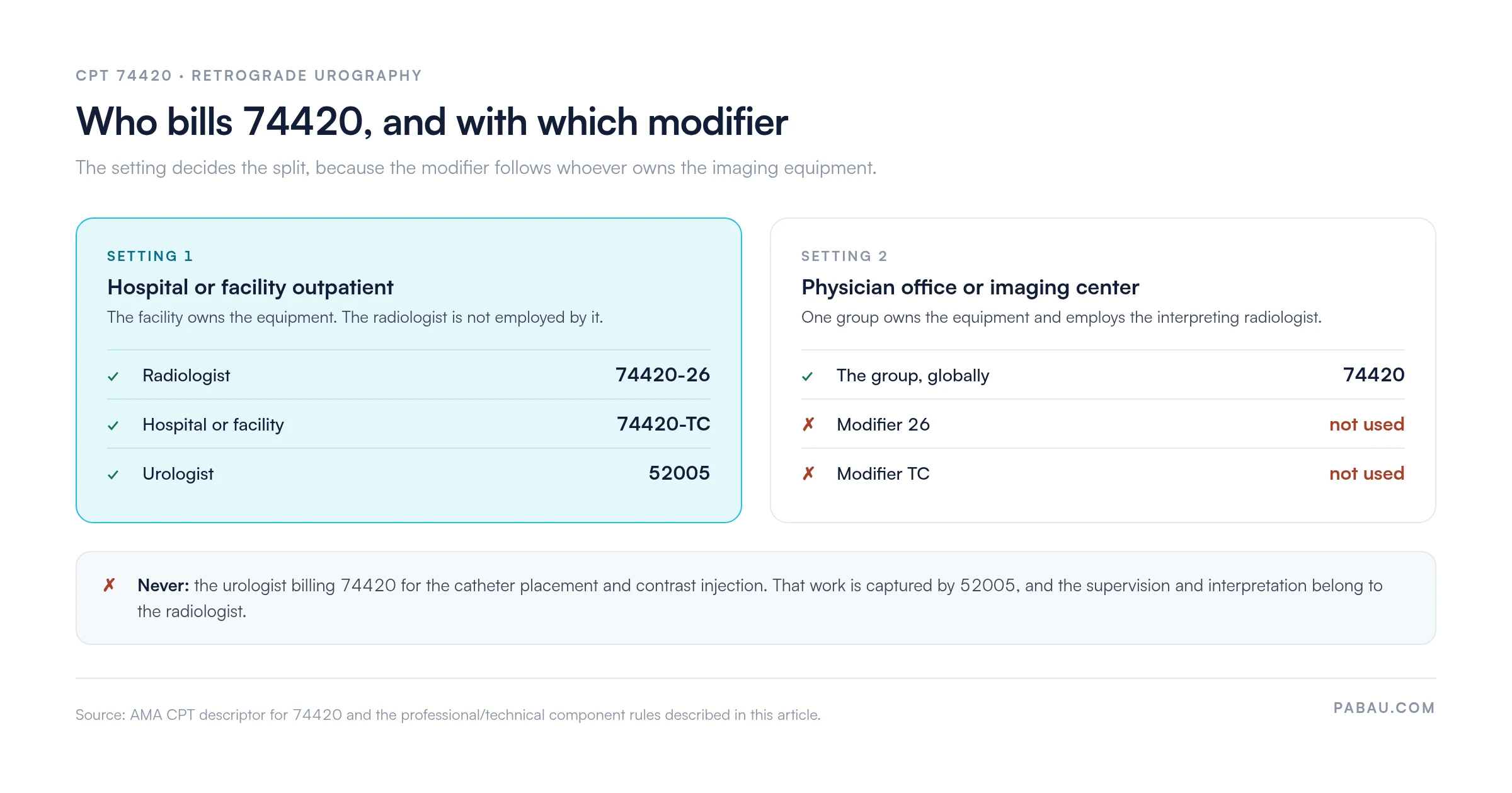
In a hospital outpatient setting, the radiologist bills 74420-26 and the hospital bills 74420-TC. A freestanding radiology group that owns the equipment and employs the interpreting radiologist bills 74420 globally, with no modifier. The urologist never bills 74420 directly, because the catheter placement and contrast injection are captured by the cystoscopy code.
The routing below follows from a single question, which is who owns the imaging equipment.
Medicare reimburses CPT code 74420 through the Medicare Physician Fee Schedule (MPFS), which CMS updates annually each January. Rates vary by geographic payment locality. Verify the national averages below against the CMS Physician Fee Schedule lookup tool for the locality where services are rendered.
Billing teams submit CPT code 74420 claims electronically and reconcile payment from the 835 remittance advice. Practice management software like Pabau routes those transactions through Claim.MD, our clearinghouse partner, which reaches thousands of US payers and returns real-time eligibility checks.
The 2026 rates have to come from the MPFS search tool itself, because third-party fee schedule aggregators may not carry final locality adjustments. The FastRVU 2026 RVU lookup is useful for the national work, practice expense, and malpractice RVU values, which are not locality-adjusted. Cross-check the payment rate against the CMS source before you bill.
The most common billing scenario for CPT code 74420 pairs it with CPT 52005, cystoscopy with ureteral catheterization. The urologist performs the cystoscopy and the catheter insertion, which 52005 covers. The radiologist supervises the imaging and interprets the retrograde urogram, billed as 74420-26 in a facility setting.
These two codes are separately billable because they represent distinct services performed by different providers. CPT 52005 is not bundled with CPT code 74420 under National Correct Coding Initiative edits. Both can appear on the same date of service without a modifier override.
Occasionally one physician performs the catheterization and also interprets the images, which happens in some outpatient surgery centers. The global 74420 applies in that case. When the roles are split, verify which entity owns the imaging equipment before assigning modifiers.
Selecting the wrong ICD-10-CM code is the second most common cause of CPT code 74420 claim failure. The diagnosis must directly support the clinical indication documented in the procedure report.
Our ICD-10-CM code reference carries the full descriptor and chapter placement for each of these diagnoses. Verify every code against the current fiscal year code set published by CDC/NCHS. The N13.x and R31.x ranges have been stable in recent update cycles, but annual review is still required.
CMS updates National Correct Coding Initiative edits quarterly. The edits relevant to CPT code 74420 reflect the procedure’s structure. Because 74420 covers radiological supervision and interpretation, codes that duplicate that service are bundled and cannot be billed separately.
Check the current NCCI tables rather than a static reference. Edit pairs change, so a bundling rule that did not exist last quarter may apply today. Remittance messages name the edit that fired, which tells revenue cycle staff whether an appeal is worth filing.
Complete documentation is what converts a technically correct code selection into a paid claim. For CPT code 74420, the record must let an auditor verify medical necessity. It also has to identify the provider who performed each component and confirm that contrast was used retrograde.
The charge ticket should capture the referring provider, the performing provider (urologist), and the interpreting provider (radiologist) as distinct fields. A ticket that names only one physician forces the biller to guess which component to bill.
The interpretation report is the document payers scrutinize most closely on audit. A brief addendum to an operative note is not a substitute. Payers want a standalone radiology interpretation report, signed by the interpreting physician.
Flag retrograde urography claims for pre-submission review whenever the radiologist and urologist belong to different billing groups. Each group applies its own modifier independently. A coder at the urology practice cannot fix an error on the radiology group’s claim.
CPT code 74420 generates a predictable set of billing errors, and the same five account for most of them. Working through them at charge entry reduces rework and shortens the time to payment for radiology and urology teams.
Categorizing these errors before they become denials is the whole point of a charge-entry check. The clean claim standards that govern first-pass payment catch all five at that stage.
The billing errors above share one root cause. Manual charge entry is applied to a code that needs two providers to coordinate. When the urology team and the radiology team each enter charges without a shared system to flag modifier requirements, errors multiply.
Pabau’s rules-driven claims management checks each charge against payer-specific rules as it is entered. A 74420 submitted in a facility setting without Modifier 26 is flagged before the claim leaves the practice. Claim.MD, our clearinghouse partner, then handles real-time eligibility verification and 835 ERA reconciliation across thousands of US payers.
Revenue cycle managers can track CPT code 74420 claim performance through practice-level reporting rather than relying on static fee schedule tables.
Connecting charge capture to the clearinghouse removes the manual steps between code selection and a paid claim. That matters most in split-billing scenarios, which is exactly what 74420 creates.

Pabau’s claims management workflows support modifier tracking, payer-specific rule sets, and clearinghouse integration. Split-billing scenarios like 74420 and 52005 move from charge capture to paid claim with fewer manual steps.

CPT code 74420 is a straightforward code with three points where billing goes wrong. They are modifier assignment in facility settings, the urologist-radiologist service split, and ICD-10 specificity on medical necessity. Get those three right and most claims pay on first submission.
The costly decision is made before the claim is built. Confirm who owns the imaging equipment and who signs the interpretation report, and the modifier follows from that.
For practices handling high volumes of retrograde urography billing, connecting charge capture to clearinghouse submission with payer-rule validation removes most of the rework. Book a demo to see how Pabau handles split billing across urology and radiology.

Need to understand clearinghouse claim submission for radiology codes? How a medical claims clearinghouse works covers the end-to-end flow from charge entry to payer adjudication.
Want to reduce claim rejections before they reach the payer? Clean claim submission standards outlines the pre-submission checks that prevent the most common billing errors.
Building a denial management process for your urology or radiology practice? Denial management in healthcare explains how denials are categorized, appealed, and prevented across payer types.
CPT code 74420 is the diagnostic radiology billing code for retrograde urography. Contrast is injected through a ureteral catheter in a retrograde direction to visualize the ureters and renal collecting system. The code includes radiological supervision and interpretation, and it is valid whether or not a KUB plain film is also acquired.
Modifier 26 (professional component) applies when the radiologist bills the interpretation separately from the facility in a hospital or outpatient facility setting. Modifier TC (technical component) applies when the facility bills for equipment, staff, and supplies separately. No modifier is used when a single provider or group bills the global service in a non-facility setting such as a freestanding imaging center.
Yes. CPT 52005 (cystoscopy with ureteral catheterization) and CPT code 74420 are separately billable because they represent distinct services performed by different providers. The urologist bills 52005 for the catheter placement. The radiologist bills 74420-26 for the imaging supervision and interpretation. No NCCI bundling edit prevents billing both codes on the same date of service.
Commonly accepted ICD-10-CM codes include N13.0 (hydronephrosis with UPJ obstruction), N13.5 (ureteral stricture), and N20.1 (calculus of ureter). R31.0 (gross hematuria), R31.1 (microscopic hematuria), and C65.9 (renal pelvis malignancy) also support the study. The diagnosis must match the specific clinical indication documented in the procedure report. Verify codes against the current fiscal year ICD-10-CM code set before submission.
The professional component (billed with Modifier 26) covers the radiologist’s supervision of imaging and written interpretation report. The technical component (billed with Modifier TC) covers the imaging equipment, supplies, and facility staff. In a hospital outpatient setting, the radiologist bills 74420-26 and the hospital bills 74420-TC. In a physician-owned freestanding facility where the same group handles both, the global code is billed with no modifier.
Yes, but the edits mainly target duplicate billing of the radiological supervision and interpretation component. They do not affect the pairing with cystoscopy codes like 52005. CPT 52005 and 74420 are not bundled together under current NCCI edits. Verify the specific edit table for 74420 through the CMS NCCI tool, because edits are updated quarterly and the current table governs.



