



CCSD code G5100: Bypass of duodenum billing guide
CCSD code G5100 bills a bypass that leaves the duodenum in place CCSD code G5100...

Last Updated: Oct 16, 2026

CPT code 74176 reports a CT scan of the abdomen and pelvis performed without contrast material.
Oral or rectal contrast on its own still codes as without contrast, so the study stays 74176.
Medicare’s 2026 national non-facility rate for 74176 is roughly $183, before any geographic adjustment.
The final radiology report decides the code, not the order form the practice sent over.
Pair the claim with the most specific diagnosis code the record supports, since unspecified codes invite documentation requests.
CPT code 74176 covers a CT scan of the abdomen and pelvis performed without contrast material. One detail decides whether the claim pays, and that is the contrast documented in the final report. Bill the wrong member of this three-code family and the claim denies, then comes back as rework.
Coders and billing staff also need the 2026 rate, diagnosis codes that hold up, and the right modifier. From here, the sections below follow a 74176 claim from the order through to the remittance.
The official descriptor from the American Medical Association (AMA) reads: Computed tomography, abdomen and pelvis; without contrast material(s). The code lives in the diagnostic radiology section of the CPT manual, codes 70010 to 79999.
All three codes in the 74176 to 74178 range cover both regions in one session. Anatomy stays constant across them, so contrast is the only variable that moves the code.
Note on RVU figures: the work RVUs above come from the CMS RVU26C file published in July 2026. CMS revises these values through the year. Check the current relative value files before you build a payment estimate.
Miscoding in this family usually starts with a study that changed after the order went in. The technologist gives IV contrast, the requisition still says without, and the coder bills from the requisition.
So work from the report every time. The diagram below turns the report’s contrast language into a single code.
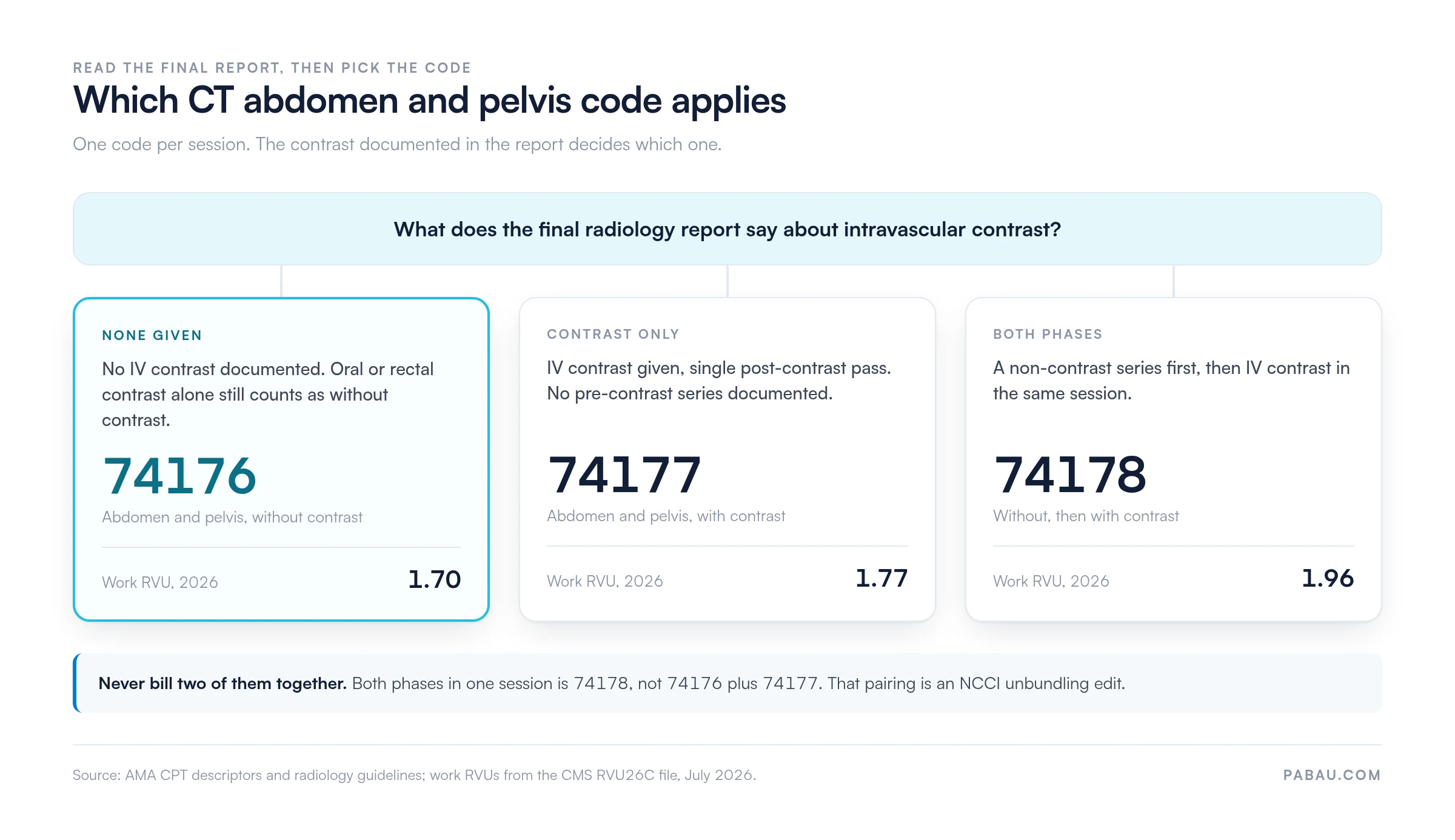
One CPT rule catches people out here. In the radiology section, with contrast means contrast given intravascularly, intra-articularly, or intrathecally. Oral or rectal contrast on its own does not qualify, so a stone protocol with oral prep is still 74176.
Here is how the three codes land once the report is in front of you.
Watch the neighboring codes as well. CPT 74150 and 74160 cover the abdomen alone, without and with contrast. CPT 74170 is the abdomen alone, without contrast then with it. CPT 74175 is a CT angiography study. Reach for 74176 only when both the abdomen and the pelvis were imaged.
The claim stands on the ordering provider’s note. That note has to say why the patient needed imaging, and why the study skipped contrast.
American College of Radiology (ACR) appropriateness criteria put non-contrast CT first in two situations. Contrast is contraindicated, or the clinical question does not need enhancement to answer it.
Scenarios that regularly support a 74176 claim include:
A one-line indication such as “abdominal pain” will not carry a claim through review at most Medicare Administrative Contractors (MACs). Name what the study is ruling out. Then note the reason contrast was withheld, in the ordering provider’s own words.
Diagnosis codes are how a payer sees the medical necessity you documented. The codes below are widely accepted by Medicare and the major commercial plans on 74176 claims.
Coverage still varies by MAC and by local coverage determination (LCD). Check your jurisdiction’s LCD and our ICD-10-CM code reference before the claim goes out.
Specificity does the work here. Payers read an unspecified code as thin justification for imaging, and they lean on that reading hardest on repeat studies.
The 2026 national non-facility rate for 74176 is roughly $183. That figure comes from 5.48 total RVUs at the 2026 conversion factor of $33.4009, per the CMS RVU26C file.
Your own payment will differ. Geographic practice cost index (GPCI) adjustment moves the amount by locality. Confirm your own figure in the CMS fee schedule lookup before you quote a patient.
Place of service (POS) decides which rate applies, because the cost of the scanner sits with whoever owns it.
A radiologist reading a hospital study bills the professional component with modifier 26. The hospital bills the technical component on its own claim. An imaging center that owns the scanner bills the global service, with no modifier at all.
Post-payment audits are where thin documentation gets expensive. The ordering note and the radiologist’s report both have to stand on their own.
A 74176 claim should be backed by these records:
Build these checks into intake and order entry. Rebuilding a justification after a denial costs far more than capturing it while the patient is still in the department.
Audit your 74176 claims against their linked diagnosis codes once a quarter. Flag any claim that went out on R10.9 (unspecified abdominal pain) when the record supported something more specific. Payers increasingly single out unspecified pain codes on imaging claims for extra documentation.
The right modifier depends on which component you are billing. That, in turn, depends on who owns the equipment and who reads the study.
The expensive miss is modifier 26. Bill a hospital read globally and the payer matches your claim against the facility’s technical claim. Both then get flagged as duplicates.
One session gets one code. Billing 74176 with 74177, or 74176 with 74178, is unbundling under the National Correct Coding Initiative (NCCI). The edit catches it every time.
So what if the radiologist ran a non-contrast series and then a contrast series? That study is 74178 on its own. It is never two codes added together.
Modifier 59 will not rescue this pair either. It exists for a separate, distinct service, not for two views of one study.
CMS updates the NCCI tables every quarter. Check the current version before you assume a modifier will bypass an edit.
Denials on this code trace back to a short list of causes. Each one is cheaper to catch before submission than to appeal afterward.
Those five checks are most of what separates a clean claim from a rework cycle. They take a coder about a minute per study.
Set a scrubbing rule that flags unspecified diagnosis codes on 74176 claims. Watch for R10.9 (unspecified abdominal pain) and N20.9 (urinary calculus, unspecified). Those are your highest-risk claims for a documentation request. Fix the specificity at order entry, not at the billing stage.
Radiology billing is spread across systems. The order sits in one place, the report in another, and the claim in a third. Coders then re-check contrast, diagnosis, and modifier by hand, which adds minutes to every study.
Practice management software like Pabau pulls those steps into one place. Our claims software for radiology keeps documentation, coding, and submission in one workflow. Each claim gets checked for common edit errors as it is built.
Claims leave through our Claim.MD clearinghouse integration, which reaches thousands of payers, including Medicare, Medicaid, and Blue plans. Remittance advice comes back to the same screen, so a 74176 denial appears beside the claim that caused it.
Reporting by CPT code then shows which studies deny most often. That is how a practice fixes the order-entry step, instead of appealing one imaging claim at a time.

Pabau connects coding, documentation, and claim submission in one platform. See how integrated claims management cuts denial rates on imaging codes like CPT code 74176.

CPT 74176 is a high-volume code with one narrow decision at its center. Read the report, confirm both regions were imaged, and the rest of the claim tends to follow.
Practices that check contrast, diagnosis, and modifier before submission spend far less time in appeals. That habit outlasts any single correction on this page. Rates change every year, and the check still works.
Want to see those checks built into your own workflow? Book a demo and we will walk through how Pabau handles a radiology claim, from the order to the remittance.

Want to see how a claim reaches the payer? Medical claims clearinghouse follows an electronic claim from the practice to the payer and back again.
Denials stacking up on imaging codes? Denial management in healthcare sets out a workflow for clearing them by cause rather than one by one.
Waiting on approval for CT scans? The prior authorization process explains each step and where imaging requests usually stall.
Comparing billing systems for your practice? Best medical billing software for US practices weighs the features that lift first-pass claim rates.
Original Medicare generally does not require prior authorization for a CT of the abdomen and pelvis. Many Medicare Advantage and commercial plans do, often through a radiology benefit manager. Check the plan’s imaging policy before the appointment, because a retroactive request rarely succeeds.
No. Medicare pays for imaging that investigates signs, symptoms, or a known condition. It carries no screening benefit for abdominal CT. A scan ordered without a documented indication falls to the patient, so issue an advance beneficiary notice (ABN) first.
Under original Medicare Part B, the patient owes any unmet annual deductible, then 20% coinsurance on the approved amount. Secondary coverage often absorbs that share. Collect the estimate at check-in rather than chasing it after the remittance arrives.
Medicare holds clean electronic claims for about two weeks, then usually pays within 30 days of receipt. Paper claims wait longer. Commercial timelines vary by contract and by state prompt-pay rules.
Start with a redetermination request to the MAC, filed within 120 days of the remittance notice. Send the ordering note, the signed order, and the full radiology report. Most reversals come from documentation the first submission never included.



