CPT code 21011: Excision of soft tissue tumor of the face
CPT code 21011: Official descriptor and procedure overview CPT code 21011, as pu...

Last Updated: Oct 8, 2026

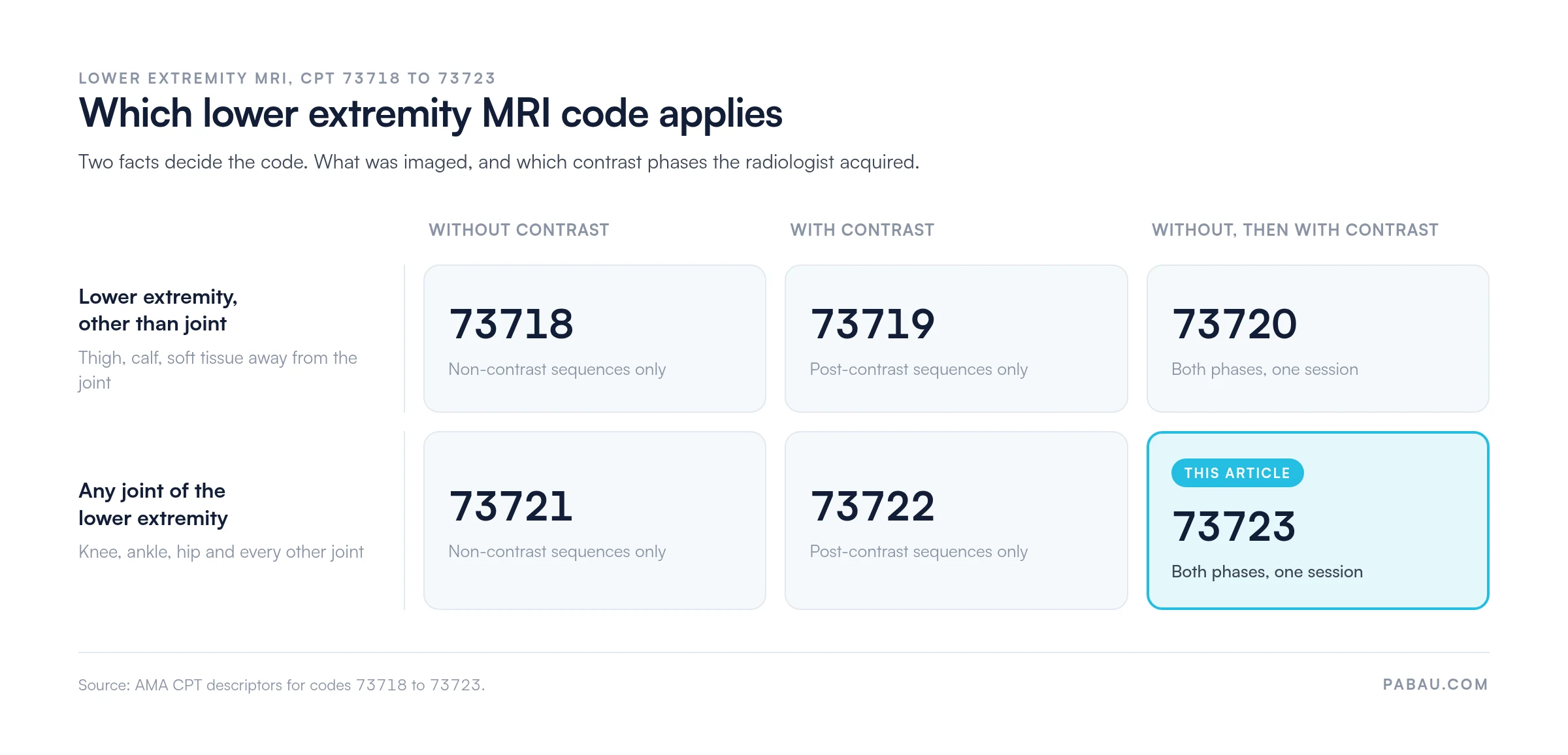
CPT code 73723 covers MRI of a lower extremity joint taken both without and with contrast, unlike 73721 (without only) and 73722 (with only).
Codes 73718 to 73720 cover the lower extremity other than the joint, so a knee, ankle, or hip study never belongs there.
2026 Medicare pays roughly $285 to $330 for the global service, and the rate moves with locality and place of service.
Modifiers 26 and TC split the professional and technical components, while LT and RT set laterality. Missing either pair is a top denial trigger.
Most commercial payers and many Medicare Advantage plans require prior authorization. Submit the clinical indication and prior imaging results before scheduling.
CPT code 73723 is the billing code for an MRI of any joint of the lower extremity. The scan is taken without contrast, then with contrast and further sequences. Coders shorten that to a “with and without contrast” MRI of the knee, ankle, or hip.
Medicare pays roughly $285 to $330 for the global service in 2026, and most commercial payers want prior authorization first. The sections below cover the descriptor, the modifiers, the ICD-10 crosswalk, and the documentation a payer expects to see.
CPT code 73723 is the American Medical Association’s billing code for an MRI of any joint of the lower extremity performed in two contrast phases.
The radiologist acquires non-contrast images first, then administers intravenous contrast and runs further sequences. The American Medical Association owns and maintains the CPT code set, and its descriptor language governs how payers adjudicate the claim.
This code covers the knee, ankle, and hip joints, as well as any other lower extremity joint that needs the dual-phase protocol. Ordering both phases in a single session is what separates 73723 from the rest of the lower extremity MRI family.
Six codes cover lower extremity MRI. Knowing the family prevents miscoding:
The two triplets are split by anatomy, not by era. Codes 73718 to 73720 cover the lower extremity other than the joint, such as the thigh or the calf. Codes 73721 to 73723 cover any joint of the lower extremity, which is where knee, ankle, and hip studies belong.
Read as a grid, the family comes down to two questions: the region imaged and the contrast phases acquired.
CPT code 73723 requires both pre-contrast and post-contrast sequences. CPT 73721 covers the without-contrast examination only. The distinction is clinical. If the radiologist acquires non-contrast images alone, billing 73723 is upcoding and a compliance violation.
Use CPT code 73723 when the ordering physician’s indication needs contrast enhancement to evaluate pathology that non-contrast sequences cannot show. The American College of Radiology Appropriateness Criteria support a with-and-without contrast protocol in situations like these:
For routine meniscal tears, ligament injuries, or uncomplicated osteoarthritis, the non-contrast 73721 is appropriate. It also draws fewer medical necessity challenges from payers.
The 2026 Medicare Physician Fee Schedule sets national average reimbursement for CPT code 73723 at roughly $285 to $330 for the global service. The figure moves with geographic locality and with the facility or non-facility setting.
Verify the rate for your MAC jurisdiction in the CMS Medicare Physician Fee Schedule Look-Up Tool before you submit. Locality adjustments shift rates by 15-25%.
The relative value unit breakdown for 73723 (approximate, national values) is:
RVU figures are approximate and drawn from published fee schedule data. Always confirm them against the current CMS MPFS final rule for your MAC locality.
The setting where 73723 is performed changes what you are paid. Non-facility rates, which cover independent imaging centers and physician offices, are higher because CMS assumes the provider carries the equipment and overhead costs.
In a hospital outpatient department the facility is paid separately through the Outpatient Prospective Payment System, so the professional fee is lower.
Check the place of service code on every 73723 claim before it goes out. POS 11 (office) and POS 49 (independent clinic) trigger the non-facility rate, while POS 22 (on-campus outpatient hospital) triggers the facility rate. A mismatched POS code is a guaranteed underpayment or denial. Review the default POS settings in your billing software and confirm they match where the scan is performed.
Modifier selection for CPT code 73723 falls into two groups. Component billing modifiers (26 and TC) say who is billing for what, and laterality and circumstance modifiers (LT, RT, 59, 51) describe the service. Applying the wrong one, or skipping a required one, accounts for a large share of 73723 denials.
Billing the global service without a modifier is correct when one provider or group performs both components in a non-facility setting. Appending both 26 and TC to the same claim line is an error, and most clearinghouses reject it before the claim reaches the payer. Practice management software like Pabau flags that combination when the claim is built, so the rejection never happens.

Every 73723 claim needs a supporting ICD-10 diagnosis code that establishes medical necessity for the imaging order. Payers adjudicate the diagnosis-to-procedure relationship, so a code with no documented indication for contrast is a straightforward denial.
When the ordering note points to a diagnosis outside this shortlist, work from the full index of ICD-10-CM codes. Code to the highest specificity the documentation supports.
Payer Local Coverage Determinations (LCDs) govern which diagnosis codes are accepted for 73723. Verify that the supporting ICD-10 code appears on the relevant MAC’s LCD before you submit. Codes outside the LCD may require an Advance Beneficiary Notice (ABN) for Medicare patients.
Prior authorization is required by most commercial payers and many Medicare Advantage plans for CPT code 73723. Traditional Medicare fee-for-service does not require it for outpatient MRI in most MACs, though this varies, so check payer by payer before scheduling. Running insurance eligibility verification at the booking stage catches an auth requirement before the patient arrives.
What most payers want in the prior authorization submission:
Prior auth denials on 73723 usually trace back to two omissions. The submission never says why contrast is clinically necessary rather than a non-contrast 73721, or it shows no conservative treatment before the advanced imaging order.
A clean 73723 claim rests on two documents: the physician order and the radiologist’s final report. Payers audit both during post-payment review and pre-payment edits. Where the order and the report disagree, or one of them is missing detail, medical necessity denials follow.
The physician order must include:
The radiologist’s report must include:
If the report documents only non-contrast sequences, the claim must be downgraded to 73721. Billing 73723 when the radiologist acquired non-contrast images alone is False Claims Act exposure, not a clerical slip.
Five errors cause the majority of 73723 claim denials. Each one has a straightforward fix when it is caught before submission.
Run a monthly denial audit for 73723 on its own. Filter the clearinghouse denial report by procedure code, then group the denial reasons. If missing laterality and unsupported diagnosis each show up more than 5% of the time, the problem is the workflow. Those are not one-off coder errors. Fix the intake form or the order template instead of appealing case by case.
Radiology billing teams often work across three disconnected systems. Clinical notes sit in the EHR, claims are built in a separate billing platform, and prior authorizations live in a spreadsheet. Denial rates climb when a biller has to reconstruct the contrast protocol, the ordering physician’s documentation, and the auth status from three sources.
Pabau’s claims management software connects scheduling, clinical documentation, and claim submission in one workflow. When the radiology order is placed, the contrast protocol carries through to the billing record, which is the step where 73721 and 73723 get conflated.
The Claim.MD clearinghouse integration then submits claims electronically to thousands of US payers, with eligibility checks and ERA processing in the same system.
For a practice running imaging alongside clinical services, that removes the switch between a lookup tool and the billing screen. Billers stay in one system from the order through to the ERA posting. That shortens the wait between the scan and the payment.

Pabau links your radiology orders, clinical documentation, and claim submission in one platform. See how the Claim.MD integration handles electronic submission, eligibility verification, and ERA posting for imaging practices.

CPT code 73723 holds up only when both contrast phases were performed and written down. The denials worth preventing start well before the claim, at the order and at the prior authorization call.
Name the joint, the side, and the contrast protocol in the order, and the biller already has what the payer will ask for. Leave any of the three out and no amount of scrubbing at submission recovers it.
For a practice billing steady 73723 volume, connecting the clinical record to the billing platform pays for itself quickly. Book a demo to see how Pabau handles radiology claims from the order through to ERA posting.

Need a framework for reducing claim denials across all codes? Denial management in healthcare walks through how to audit denial patterns and build workflows that prevent the same errors from repeating.
Submitting claims electronically and want to understand the file format? 837 electronic claim file guide explains how the standard EDI transaction works and what payers expect in each segment.
Handling remittances manually after payment posts? Electronic remittance advice (ERA) covers how to automate ERA posting and reconcile payments against claims without manual data entry.
CPT code 73723 is the billing code for magnetic resonance imaging of any joint of the lower extremity. The study is taken without contrast material first, then with contrast material and further sequences. It covers the knee, ankle, hip, and any other lower extremity joint imaged with the dual-phase contrast protocol.
CPT 73721 covers MRI of a lower extremity joint without contrast only. CPT 73723 covers the same examination performed without contrast first, then repeated with IV contrast, so both phases are required. Billing 73723 when only non-contrast images were acquired is upcoding, and the claim should be downgraded to 73721.
The primary modifiers are 26 (professional component, the radiologist’s interpretation only) and TC (technical component, equipment and staff costs only). Laterality is set with LT for the left joint and RT for the right joint. Modifier 59 marks a distinct procedural service when unbundling from another same-date code. Most payers require LT or RT on a single-joint study.
The 2026 Medicare national average for CPT code 73723 is roughly $285 to $330 for the global service, depending on locality and setting. Non-facility rates at imaging centers are higher than facility rates at hospital outpatient departments. Check the exact amount for your MAC locality in the CMS Physician Fee Schedule Look-Up Tool, since rates vary by 15-25% across localities.
Yes. Most commercial payers and many Medicare Advantage plans require prior authorization for CPT code 73723. Traditional Medicare fee-for-service generally does not require it for outpatient MRI, though this varies by MAC. Verify the payer’s requirement before scheduling to avoid a post-service denial.
No. Modifier 26 and modifier TC should never share a claim line from the same billing entity. Together they equal the global service. Bill the global code with no modifier when one provider or group controls both components. Otherwise split the claim, so the radiologist bills with modifier 26 and the imaging center bills with modifier TC.
Commonly accepted diagnosis codes for CPT code 73723 include M87.051 (idiopathic aseptic necrosis, right femur) and M65.161 (infective synovitis, right knee). M79.89 (soft tissue disorder) and C40.21 (malignant neoplasm, lower limb) also support the contrast protocol. Verify the supporting code against your MAC’s Local Coverage Determination, because accepted diagnoses vary by payer and locality.