CCSD code 20210: Pure tone audiogram billing guide
CCSD code 20210 is the UK private billing code for a pure tone audiogram by air ...

Last Updated: Nov 16, 2026
72129 is the CPT code for computed tomography, thoracic spine; with contrast material(s). The contrast is most often given intravenously, and no pre-contrast series is performed.
CPT Code 72129 is one of three thoracic spine CT codes: 72128 (without contrast), 72129 (with contrast), and 72130 (without and then with contrast). Billing the wrong member of this triplet is a common cause of denials. So is a missing note on why contrast was clinically necessary.
Let Pabau's smart automation suggest the right codes, reduce claim denials, and keep your practice compliant—effortlessly.
Automate repetitive tasks and focus on what matters most—your patients.
Reduce coding errors and ensure compliance with the latest regulations.
Clean claims, fewer denials, and faster reimbursements.
Powerful insights and reporting to help your practice thrive.
HIPAA compliant SOC 2 certified GDPR-compliant Trusted by 4,000+ clinics worldwide

CPT Code 72129 describes a CT scan of the thoracic spine with contrast material only, distinct from 72128 (without) and 72130 (with and without).
Medical necessity documentation must state the clinical indication for contrast, not just the spinal symptom, to withstand payer review.
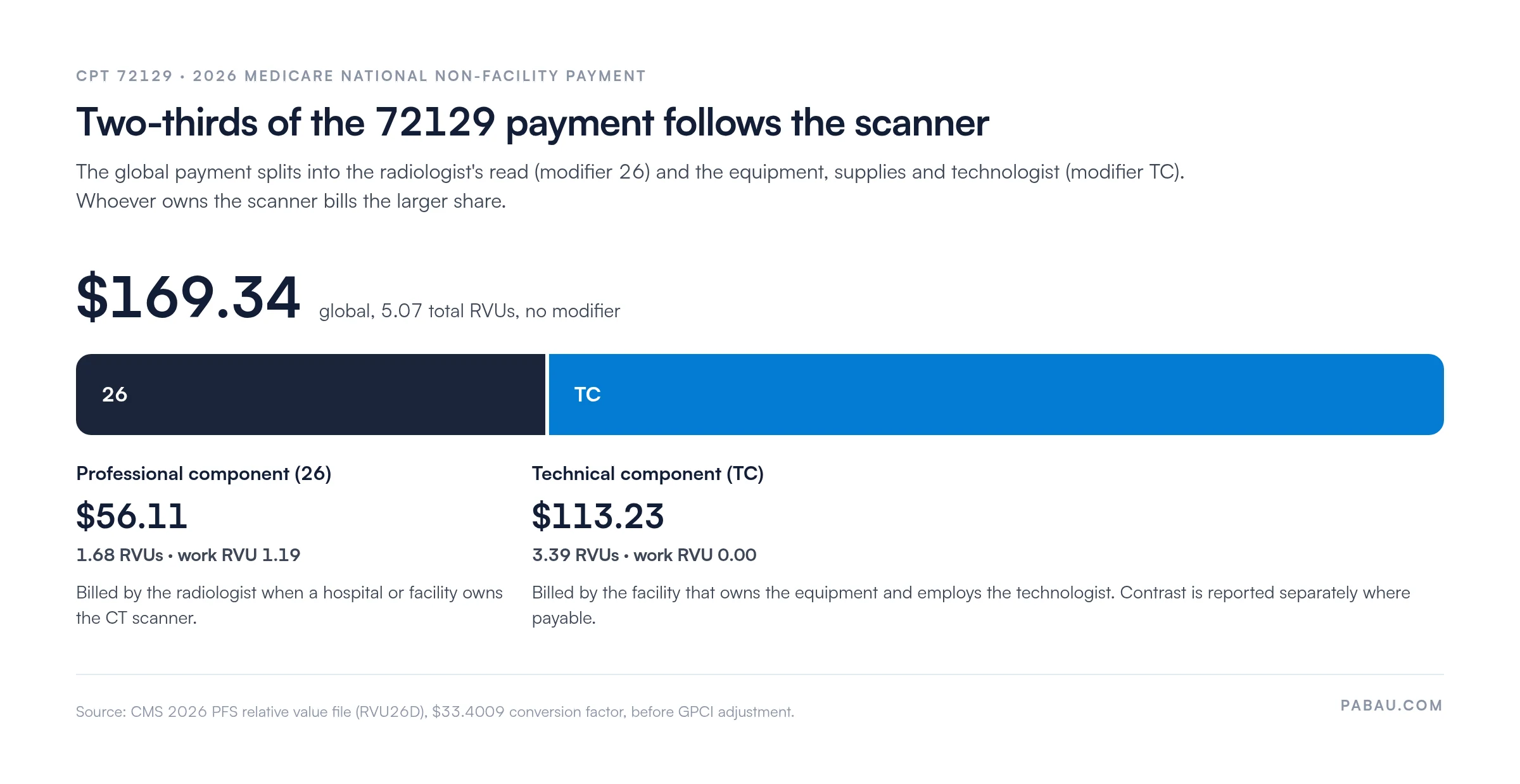
Medicare pays the global rate, the professional component (modifier 26), or the technical component (modifier TC) depending on the billing entity and service site.
For 2026, the national non-facility global rate is about $169.34, split into $56.11 for modifier 26 and $113.23 for TC.
Pabau sends 72129 claims through Claim.MD with eligibility checks and remittance tracking, and warns when a case is missing its authorization code.
CPT Code 72129 is the code for a CT scan of the thoracic spine with contrast. Its descriptor reads Computed tomography, thoracic spine; with contrast material(s). AAPC’s CPT 72129 reference describes it as a CT exam of the thoracic spine using contrast material. In short, the code belongs to the Radiology section (70010-79999).
Within Radiology, it sits under Diagnostic Radiology (Diagnostic Imaging), 70010-76499, in the Spine and Pelvis subheading, 72020-72295. Also, the numbering follows anatomy. Codes 72125-72127 cover cervical spine CT, 72128-72130 cover thoracic spine CT, and 72131-72133 cover lumbar spine CT.
The phrase “with contrast material(s)” in the descriptor refers to contrast given for the CT scan, most often intravenously. So the radiology report should name the agent and the route, because the code choice rests on what the report shows.
Picking the wrong member of the triplet is a common cause of denials on thoracic spine CT. A claim for 72129 when the report supports 72128 or 72130 carries the wrong payment and triggers an edit. In short, the choice turns on one question: which contrast method does the radiology report document?
Documentation test: If the radiology report states only a post-contrast series, with no mention of pre-contrast images, bill 72129. But if the report shows both a pre- and post-contrast scan, bill 72130. If contrast is not named at all, bill 72128. In addition, payers flag a 72129 claim on a report that supports 72130, or the reverse, as a documentation mismatch on post-payment audit.
CPT Code 72129 is supported when the ordering provider states why contrast enhancement is needed, not only why a thoracic spine CT is the right test. In fact, payers tell the two apart. A radiculopathy complaint alone supports 72128, while suspected epidural abscess or metastatic cord compression supports 72129.
Payers check that the diagnosis code on the claim supports a thoracic CT with contrast. The ICD-10-CM codes below are often paired with 72129 in radiology billing. Also, each must be supported by the ordering doctor’s note, not selected to match the scan request.
Payer review note: M54.6 (thoracic pain) paired with 72129 draws frequent prepayment review. So, without a stated clinical reason for contrast in the ordering note, payers often downcode to 72128 or deny outright.
Before submitting a 72129 claim paired with M54.6, check the ordering physician’s note for a finding that justifies contrast. A lab result suggesting infection or a known malignancy both qualify. If no such finding is noted, query the ordering doctor before billing. Submitting without that justification is the fastest route to a medical necessity denial.
A clean claim submission for CPT Code 72129 needs documentation from two sources: the ordering doctor’s note and the radiologist’s report. In short, both must be present and agree with each other before billing.
First, the ordering doctor’s note must include a clear clinical reason for contrast, the ordering provider’s NPI, and a diagnosis code that supports a scan with contrast.
Second, the radiologist’s report must confirm that contrast was given and state its type and route, often IV iodinated contrast. It must also describe the post-contrast findings. Indeed, a report that lists contrast in the technique section but gives no post-contrast findings raises an edit flag.
CPT Code 72129 is a diagnostic imaging code subject to CMS global billing rules. So, the right modifier depends on who owns the scanner, whether the radiologist is employed or contracted, and where the service is done.
Also, the contrast agent itself is not part of the technical component. Where it pays by itself, it is billed with a HCPCS contrast supply code. For example, Q9967 covers low-osmolar contrast per mL.
Common modifier error: A radiologist bills 72129 globally when the CT scanner sits in a hospital the radiologist does not own. In that setting the hospital bills TC and the radiologist bills modifier 26. As a result, global billing there leads to overpayment recovery on audit.
Medicare pays CPT Code 72129 under the Medicare Physician Fee Schedule (MPFS), which CMS updates every year. In the CMS 2026 relative value file, 72129 carries 5.07 total RVUs, with a work RVU of 1.19.
The table shows 2026 national non-facility rates at the $33.4009 conversion factor. But qualifying APM participants use a slightly higher $33.5675 factor. So, confirm local numbers in the CMS Physician Fee Schedule lookup tool before billing.
In fact, the split matters as much as the total. The technical component carries about two-thirds of the payment, so the entity that owns the scanner collects most of it.
The Geographic Practice Cost Index (GPCI) raises payment in high-cost urban areas and lowers it in rural ones for the same code. Then, use the FastRVU 2026 lookup tool to retrieve area-adjusted rates for your MAC jurisdiction.
Prior authorization for CPT Code 72129 varies by payer. Medicare fee-for-service does not require it, but Medicare Advantage plans, commercial insurers, and Medicaid managed care organizations often do. So confirm insurance eligibility verification and authorization rules at scheduling, not at billing.
Medicare Advantage plans: Most require prior auth for CT spine scans. Plans also often ask for the ordering doctor’s note showing medical necessity, related prior scan reports, and a diagnosis code showing why contrast is needed.
AUC program: CMS paused the Appropriate Use Criteria (AUC) program for advanced diagnostic imaging in the CY2024 Physician Fee Schedule final rule. In fact, the same rule removed its regulation, 42 CFR 414.94, starting January 1, 2024. As a result, claims for 72129 no longer need to report a clinical decision support consultation.
Denials for CPT Code 72129 follow set patterns. Reading the denial reason code (CARC) on the remittance advice is the first step in an effective denial management workflow. The table below then maps the most common denial reasons to their root causes and resolution steps.
See medical billing denial codes for a full reference on the CARC codes that appear on radiology claims. It also lists the codes tied to medical necessity and authorization failures.
Run a quarterly audit of your 72129 claims against the radiology reports behind them. Look for claims coded as 72129 where the technique section describes a without-contrast or with-and-without protocol. That mismatch is the highest-yield correction in thoracic spine CT billing, and it usually needs only a code correction, not a full appeal.
The National Correct Coding Initiative (NCCI) publishes edit tables that govern which codes can share a claim. For CPT Code 72129, the main bundling questions involve E/M codes on the same date of service and the link to 72128 and 72130.
72128, 72129, and 72130 cannot share a claim for the same body site on the same date. In fact, billing 72129 and 72128 for the same thoracic spine is an NCCI edit error. Instead, 72130 is the single correct code when both a without-contrast and a with-contrast series were done.
A radiologist’s E/M service on the same date as 72129 is billable only for a separate visit with its own notes. Indeed, reviewing the scan findings does not count. The CMS NCCI procedure-to-procedure edit tables list the modifier indicator for each 72129 code pair. Thus, that indicator shows whether a modifier can override the edit for a given same-day pair.
Pabau, the practice management and billing platform we build, sends 72129 claims through Claim.MD, its built-in clearinghouse. The connection also runs eligibility checks and returns remittance advice from Medicare and thousands of US payers. Pabau’s status-tracking claims management then shows where each sent claim stands.
Also, prior authorization lives on the patient’s case. Pabau records the authorization code, its dates, and the approved sessions, and it shows a warning when a case has no code on file. As a result, your team sees the missing authorization before the scan is billed, not after the payer denies it.
Split billing still rests with your coders, who apply modifier 26 or TC from the setup with the site. In short, with eligibility, authorization, and claim status in one system, they can spend their time on the coding choices this guide covers.

Pabau records the authorization code, dates, and sessions on each case and warns when one is missing. Claims then go out through Claim.MD with eligibility checks and remittance tracking.

Read the radiology report’s technique section before you choose a code. A post-contrast series alone is 72129, and that one check removes a common cause of thoracic spine CT denials.
Then pair the claim with a diagnosis that justifies contrast, and match 26 or TC to whoever owns the scanner. With the 2026 global rate near $169, a downcode to 72128 or a modifier recovery costs more than the minutes the check takes.
Book a demo to see how Pabau keeps authorizations and claim status in view for your imaging services.

Need a full reference on medical billing denial codes? Medical billing denial codes covers CARC codes, remittance advice reading, and resolution steps for the most common radiology denials.
Unsure how clearinghouse claim validation works? Pabau’s Claim.MD clearinghouse guide explains how electronic claims are validated, scrubbed, and routed to payers before payment decisions are made.
Looking to understand the full revenue cycle context? What is revenue cycle management walks through every stage from eligibility check through payment posting and denial resolution.
CPT Code 72129 is the billing code for a computed tomography scan of the thoracic spine performed with contrast material only. It covers a post-contrast CT acquisition of the T1-T12 region. A study that adds a pre-contrast phase is reported with CPT 72130 instead.
Use 72129 when contrast was administered and no pre-contrast series was performed. Use 72128 when no contrast was given at any phase. Use 72130 when both a pre-contrast and a post-contrast series were acquired. The radiology report’s technique section determines which code is correct, not the ordering physician’s request.
For 2026, Medicare’s national non-facility rate for CPT 72129 is about $169.34 for the global service, based on 5.07 total RVUs. The professional component (modifier 26) pays about $56.11, and the technical component (modifier TC) pays about $113.23. Rates vary by locality, so confirm current figures in the CMS Physician Fee Schedule lookup tool.
Yes, but only when the E/M service is a distinct clinical encounter documented separately from the radiology interpretation. The radiologist’s review of the images is part of the professional component of 72129 (modifier 26) and cannot be billed as a separate E/M service. A separately documented consultation unrelated to reading the scan is separately billable.