CPT code 63081: Vertebral corpectomy, cervical spine
CPT code 63081: official descriptor and procedure overview CPT code 63081 descri...

Last Updated: Oct 6, 2026
71555 is the CPT code for magnetic resonance angiography, chest (excluding myocardium), with or without contrast material(s). One code covers all three contrast scenarios.
Coders choose 71555 when the clinical question is vascular, and the MRI chest series (71550-71552) when it is parenchymal or soft tissue. Getting that distinction wrong is a frequent reason these claims deny.
Let Pabau's smart automation suggest the right codes, reduce claim denials, and keep your practice compliant—effortlessly.
Automate repetitive tasks and focus on what matters most—your patients.
Reduce coding errors and ensure compliance with the latest regulations.
Clean claims, fewer denials, and faster reimbursements.
Powerful insights and reporting to help your practice thrive.
HIPAA compliant SOC 2 certified GDPR-compliant Trusted by 4,000+ clinics worldwide

CPT 71555 covers MRA of the chest’s vessels, excluding the myocardium, under one code whether or not contrast is used.
Use 71550, 71551 or 71552 instead when the clinical question is soft tissue or parenchyma rather than vascular.
Most commercial and Medicaid managed care plans require prior authorization, usually routed through a Radiology Benefit Manager.
Original Medicare requires neither prior authorization nor AUC consultation for 71555, since CMS rescinded the AUC program in 2024.
Pabau, the practice management platform we build, submits claims through Claim.MD, checks eligibility in real time and tracks claim status.
CPT code 71555 is defined by the American Medical Association with the official descriptor: Magnetic resonance angiography, chest (excluding myocardium), with or without contrast material(s). Three elements in that descriptor drive virtually every billing and documentation decision for this code.
For the study itself, the patient lies in a 1.5T or 3T scanner with a thoracic or body coil. The team acquires time-resolved or contrast-enhanced MRA sequences of the thoracic vessels, then produces reformatted images for interpretation. The radiologist’s report must document the clinical indication, sequences used, contrast administration details (agent, dose, route) where applicable, image quality, and the interpreting physician’s attestation.
The territorial scope of CPT 71555 is the thoracic vasculature outside the heart. Coders and ordering clinicians need a clear inclusion and exclusion map before selecting this code.
The line between 71555 and CT angiography of the chest, reported with 71275, deserves its own note. Both answer vascular questions. MRA is non-ionizing, so it is preferred when a patient cannot tolerate iodinated contrast or has a significant radiation exposure history. It also wins when soft-tissue detail of the vessel wall matters clinically. Payers may ask why MRA was chosen over CTA, particularly for a pulmonary embolism workup, where CTA is often considered first-line.
Because CPT 71555 covers all three contrast scenarios under one code, the contrast choice is a clinical decision, not a coding decision. The code does not change. Documentation of what was actually administered does matter for claim support.
The FDA carries a black-box warning for gadolinium-based contrast agents in patients with severe renal impairment due to nephrogenic systemic fibrosis (NSF) risk. The radiology report and ordering documentation must reflect a patient-specific risk-benefit assessment when gadolinium is considered for renally impaired patients.
The code family immediately adjacent to CPT 71555 is the MRI chest series. Selecting the wrong code from this group is a frequent coding error in thoracic imaging. Two questions settle it: what the order asks, and which scanner answered it.
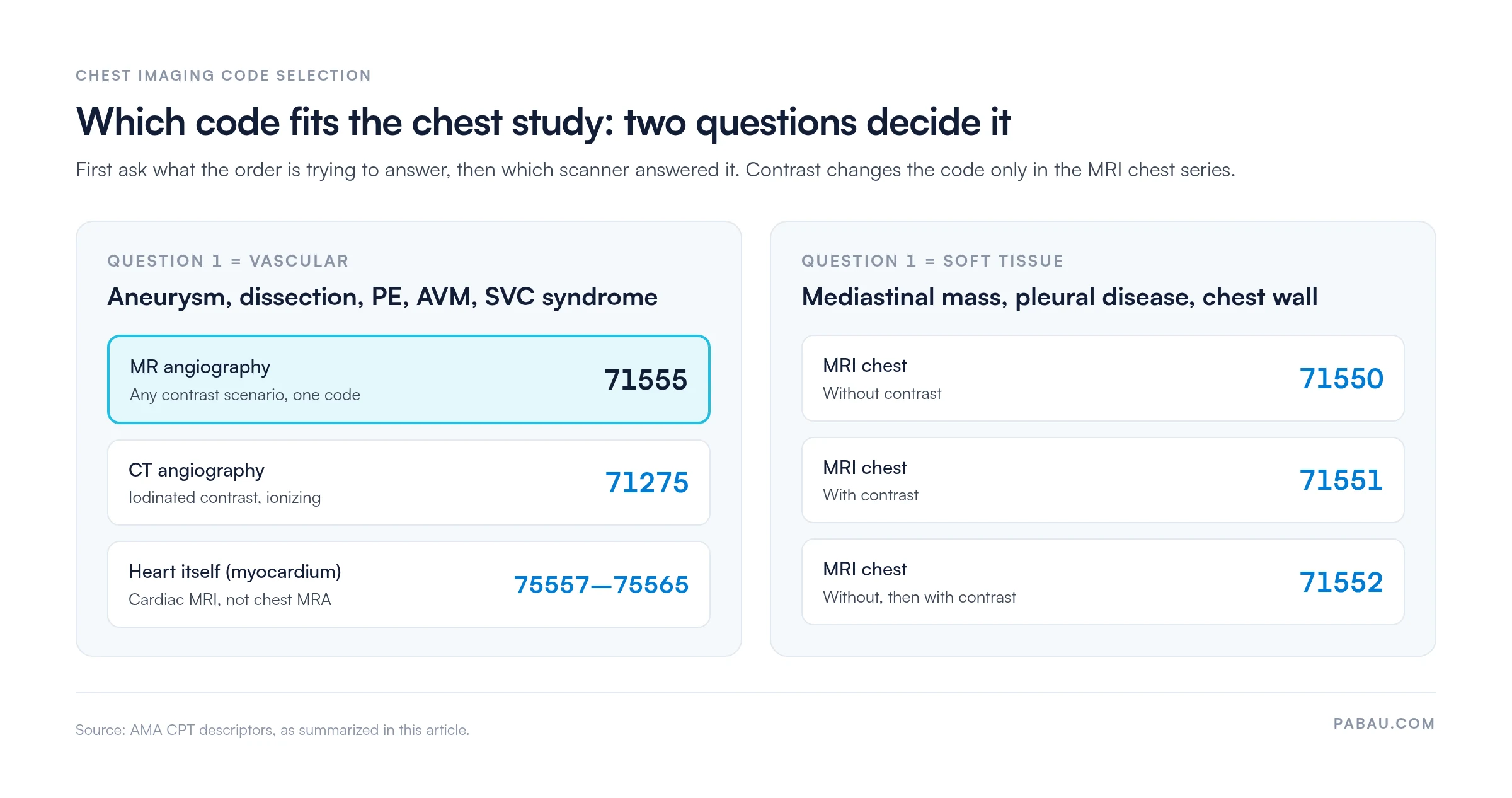
In practice, read the order first. Vascular wording points to 71555 when the study is MRI-based. Typical phrases are “rule out pulmonary embolism,” “evaluate aortic aneurysm,” “assess for pulmonary arteriovenous malformation” or “SVC syndrome workup.” If the order reads “mediastinal mass,” “pleural effusion characterization,” or “chest wall invasion,” look to 71550, 71551, or 71552 instead.
Run a pre-submission code audit on every chest MRI/MRA claim. If the radiology report uses the word ‘angiography’ or documents time-resolved or contrast-enhanced MRA sequences, the correct code is 71555, not the MRI chest series. Swapping these codes creates a pattern of upcoding or downcoding that can trigger payer audits.
Payers require that the ICD-10-CM diagnosis code on the claim establishes a vascular clinical question that justifies chest MRA. A symptom-only code without supporting clinical documentation is a primary denial trigger.
No ICD-10 code guarantees payer approval, because payers keep their own medical necessity discretion. The strongest claim pairs a specific vascular diagnosis code with physician documentation of the clinical question. Pulmonary embolism needs the most care, since the I26 category splits on whether acute cor pulmonale is present.
Four modifiers appear most often on CPT 71555 claims. Leaving off -26 or TC in a split-billing arrangement is a common denial cause for this code. Claims software for radiology that tracks each claim’s status surfaces those rejections early, while the study is still fresh.

The global code (71555 with no modifier) is billed only when a private-practice radiologist owns the scanner and both interprets and performs the technical work. In most hospital-based and outpatient imaging center settings, the claim splits into -26 and TC components.
Prior authorization is required by most commercial payers and Medicaid managed care plans for chest MRA. Original Medicare requires neither prior authorization nor Appropriate Use Criteria (AUC) consultation for 71555. CMS paused the AUC program and rescinded its regulation, 42 CFR 414.94, effective January 1, 2024, so claims no longer carry AUC data.
Many commercial payers route chest MRA through a Radiology Benefit Manager (RBM) such as eviCore healthcare or Carelon Medical Benefits Management (formerly AIM Specialty Health). Each RBM runs its own prior authorization process, with its own forms and clinical criteria. Tracking the medical billing compliance requirements of each plan in your payer mix keeps PA-related denials down.
CPT code 71555 carries an XXX global status, so no global surgical period applies. The payment covers the imaging service itself, meaning the technical performance and the professional interpretation.
Medicare reimburses 71555 through the CMS Physician Fee Schedule with separate rates for the professional component (-26), technical component (-TC), and global (when applicable). Actual payment varies by geographic practice cost index (GPCI) adjustment. MPFS rates change every year, so use the live CMS lookup tool for current figures rather than any published dollar amount. A real-time eligibility check before the scan confirms the patient’s Medicare coverage is active, so the claim goes to the right payer the first time.
Commercial payers negotiate rates separately. Contracted rates can differ significantly from MPFS by region, specialty, and plan type. Your revenue cycle management process should include an annual review of contracted rates for high-volume codes including 71555 to ensure charge capture reflects current agreements.
Most 71555 denials are preventable. The table below maps the most common denial reasons to their root causes and corrective actions. Structured denial management workflows that track reason codes by CPT code catch these patterns before they become recurring write-offs.
When a 71555 claim does come back denied, its CARC reason code tells you which row above applies. Our guide to common claim denial codes explains what each one means and how to fix it.
Many imaging billing teams still work across three screens: the scheduler, the payer portal and a clearinghouse login. Authorization numbers and eligibility results get copied by hand, and a typo surfaces weeks later as a denial.
Pabau connects to Claim.MD for US claims. Your team runs a real-time eligibility check before the scan, submits the claim from the patient record and tracks its status without leaving Pabau.
When the payer pays, the electronic remittance advice (ERA) posts back against the visit. That leaves your coders more time for the code-selection and documentation checks this guide covers.

Pabau checks eligibility in real time, submits claims through Claim.MD and tracks each one to a posted payment. Your radiology billing team spends less time on rework.

CPT code 71555 rarely goes wrong at the code level. One code covers every contrast scenario, so the risk sits upstream, in the order wording and the radiology report.
Start with the report template. When it names the vascular question, the MRA sequences and the contrast details, the code choice is obvious and medical necessity is on the page. Then build a payer-by-payer PA checklist, because commercial plans and Medicaid managed care require authorization even though Original Medicare does not.
The trade-off is a few extra fields for the radiologist on every chest MRA, in exchange for far fewer appeals. Book a demo to see how Pabau follows each chest MRA claim from eligibility check to posted payment.

Need a structured framework for managing claim denials? Denial management in healthcare covers root-cause analysis, CARC code interpretation, and appeal workflows for radiology and specialty billing teams.
Want to understand how claims move from submission to payment? How a medical claims clearinghouse works explains the EDI 837 submission path, real-time eligibility checks, and ERA remittance processing.
Looking for the full revenue cycle picture? Revenue cycle management explained maps every workflow from insurance verification through final payment posting.
Billing the CT alternative instead? CPT code 71275: CTA chest billing guide covers the noncoronary CT angiography code that sits beside 71555.
Spending hours on imaging authorizations? The best prior authorization software compares platforms that cut manual payer-portal work.
CPT code 71555 is the billing code for magnetic resonance angiography (MRA) of the chest, excluding the myocardium, with or without contrast material. One code covers all three contrast scenarios: without, with, and with and without contrast. It is used when the clinical question is vascular, such as a pulmonary embolism evaluation, aortic aneurysm assessment or SVC syndrome workup.
CPT 71555 is for magnetic resonance angiography (MRA) when the clinical question is vascular. CPT 71550 is for chest MRI without contrast when the question is soft tissue, such as a mediastinal mass, pleural disease or chest wall pathology. The sequences differ too. 71555 uses angiographic sequences optimized for the vessel lumen, while 71550 uses standard MRI sequences for tissue contrast. Selecting 71550 when MRA was actually performed is a common upcoding/downcoding error.
Yes, when the two studies answer separate clinical questions and the radiology report documents each indication. Modifier 59 (or an X modifier) is appended only if a current NCCI procedure-to-procedure (PTP) edit pairs the two codes. Check the NCCI edit table before you add one.
No. Original Medicare requires neither prior authorization nor AUC consultation for CPT 71555, because CMS rescinded the AUC program in 2024. Commercial payers and Medicaid managed care plans typically do require prior authorization. It is often managed through a Radiology Benefit Manager such as eviCore or Carelon. Verify requirements with each payer before the study is performed.