HCPCS Code L0472: Hyperextension TLSO billing guide
HCPCS code L0472: Official descriptor and device definition HCPCS code L0472 des...

Last Updated: Nov 5, 2026
70545 is the CPT code for magnetic resonance angiography, head; with contrast material(s). It covers an MRA of the intracranial vessels in which images are acquired after a contrast agent, usually gadolinium, is injected.
The code belongs to a six-code MRA family that runs from 70544 to 70549, split by body region and contrast protocol. A head study with no contrast is 70544, and a study imaged before and after contrast is 70546. Neck vessels take their own codes, 70547 through 70549. Most 70545 denials trace back to three causes: A contrast protocol that doesn't match the code, an uncovered diagnosis, or a missing prior authorization.
Let Pabau's smart automation suggest the right codes, reduce claim denials, and keep your practice compliant—effortlessly.
Automate repetitive tasks and focus on what matters most—your patients.
Reduce coding errors and ensure compliance with the latest regulations.
Clean claims, fewer denials, and faster reimbursements.
Powerful insights and reporting to help your practice thrive.
HIPAA compliant SOC 2 certified GDPR-compliant Trusted by 4,000+ clinics worldwide

CPT code 70545 covers MRA of the head with contrast material(s) only, with no pre-contrast series.
A head MRA with no contrast is 70544, and a study run before and after contrast is 70546.
Neck vessels never go on 70545, because MRA of the neck is coded 70547, 70548, or 70549.
The CY2026 national Medicare global rate for 70545 is $226.46, from 6.78 total RVUs.
Pabau, the practice management software we build, ties the CPT code to the prior authorization so contrast mismatches surface before the claim goes out.
CPT code 70545 is the AMA procedure code for magnetic resonance angiography (MRA) of the head with contrast material(s). It captures a vascular study of the intracranial vessels in which images are acquired after a contrast agent, usually gadolinium, is injected.
The code sits in the Diagnostic Radiology subsection of the CPT Radiology chapter, within the head and neck imaging codes.
The “with contrast” designation defines the code. 70545 describes a single post-contrast acquisition, with no separate pre-contrast series. If the protocol runs a non-contrast series first and then repeats imaging after contrast, the study is 70546. If no contrast is given at all, the study is 70544.
Clinically, a contrast-enhanced head MRA is ordered when better vessel definition is needed than a non-contrast time-of-flight study gives. Typical reasons include aneurysm characterization, vascular malformations, and slow-flow or post-treatment vessels. Contrast also brings its own screening and documentation steps, which the claim has to reflect.
Six codes make up the MRA family for the head and neck. Two factors sort them: The body region imaged and the contrast protocol the radiologist ran. A wrong choice on either factor leads to a denial on submission or a recoupment on audit.
Rates are total non-facility RVUs from the CMS CY2026 RVU file multiplied by the $33.4009 conversion factor. Use this sequence to land on the right head code:
The diagram below runs the same check from the report’s side and shows what each wrong choice costs at the national rate.
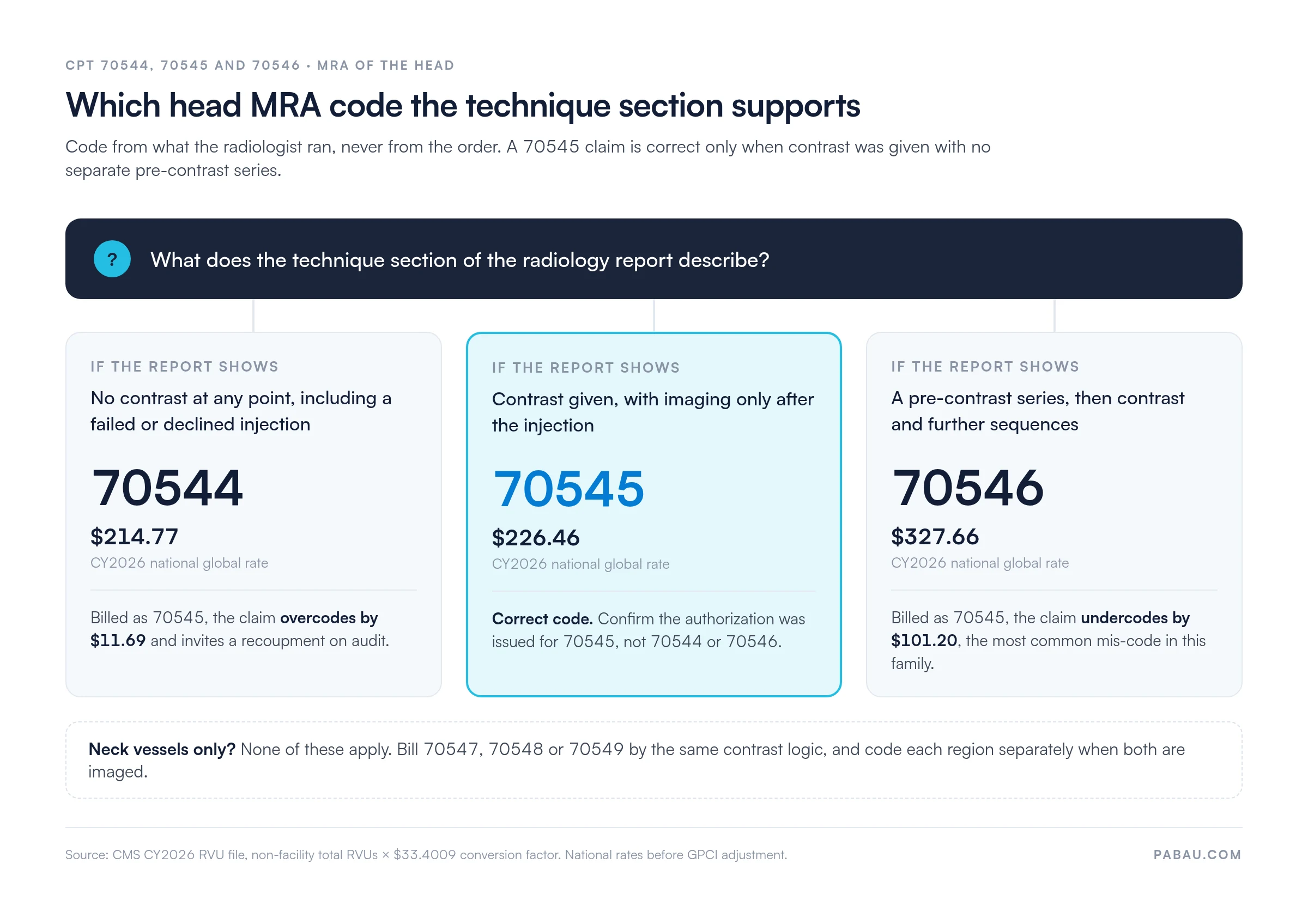
The most common mis-code: Billing 70545 for a study that also ran a pre-contrast series. Contrast-enhanced protocols often open with a non-contrast acquisition, and that study is 70546. Read the technique section of the radiology report before you code. If it describes images before and after the injection, 70545 undercodes the work by about $101 at the national rate.
The opposite error is billing 70545 when the planned contrast was never given, for example after a failed IV line or a declined injection. That study drops to 70544. When both the head and the neck are imaged, each region is reported with its own code, such as 70545 with 70548.
Every 70545 claim needs a supporting ICD-10-CM diagnosis code that establishes medical necessity. Payers match the submitted diagnosis against their covered indication list, and a mismatch is denied.
The diagnoses below are common intracranial MRA indications, but each payer keeps its own list. Novitas Solutions lists its covered codes in Billing and Coding Article A56805, and other MACs publish their own lists. Verify each code against your MAC and payer before submission.
Some diagnoses fail regardless of how well the study was performed and documented. Examples include routine headache without a documented vascular concern, screening without a clinical indication, and codes outside the MAC’s coverage list. When the ordering diagnosis is borderline, request the physician’s clinical notes before submitting.
Medicare coverage for MRA is set at the MAC level, not nationally. Novitas Solutions covers MRA under LCD L34865, and Article A56805 is the billing and coding article that supports it. Other MACs apply their own LCDs and articles, so the covered diagnosis list depends on your jurisdiction.
Key Medicare coverage parameters to keep in mind:
Commercial payers generally follow similar medical necessity logic and add prior authorization on top. Humana is one example. CPT 70545 appears on the Humana diagnostic imaging prior authorization list that Cohere Health manages for most Humana Medicare Advantage and commercial plans. Other payers vary by plan and year, so confirm prior authorization status with each payer before the study.
Original Medicare does not require prior authorization for 70545, but many Medicare Advantage and commercial plans do. A sound prior authorization process checks status for every MRA order before the study is performed. A claim submitted without a required authorization is usually denied, and most payers will not authorize it retroactively.
Running insurance eligibility verification at the time of referral confirms whether the patient’s plan requires authorization for advanced imaging. From there, a 70545 request typically needs:
Authorizations are usually issued for a specific CPT code. The radiologist may change the protocol, for example by adding a pre-contrast series that turns the study into 70546. Check whether the payer then requires an updated authorization.
When a request is denied, the notice gives the clinical reason. An appeal that documents the clinical urgency and cites the ACR Appropriateness Criteria for the indication has the best chance of success.
Medicare pays CPT 70545 under the Medicare Physician Fee Schedule (MPFS). The CY2026 national global rate is $226.46, which is 6.78 total RVUs multiplied by the $33.4009 conversion factor. Clinicians with qualifying APM participant status are paid on the $33.5675 factor, which brings the same code to $227.59.
Figures come from the October 2026 release of the CMS CY2026 RVU file. The global total breaks down into 1.17 work RVUs, 5.51 practice expense RVUs, and 0.10 malpractice RVUs.
Geographic Practice Cost Index (GPCI) adjustments move each amount up or down by locality. Confirm your local figure with the CMS Physician Fee Schedule lookup tool before you use it in contracting or budgeting.
Commercial payer rates are set in each payer contract and are not published. Compare your contracted rate for 70545 against the Medicare figure for your locality to see where each payer sits.
Check how your payers handle the contrast agent. In a physician office or independent imaging center, Medicare pays the gadolinium agent separately on its own HCPCS A-code, such as A9585 for gadobutrol. In a hospital outpatient department, the agent is packaged into the facility payment. A missing contrast line in the office setting leaves the agent unpaid.
Radiology claims for CPT code 70545 need documentation in two records: The ordering physician’s chart and the radiologist’s report. Both must be present and consistent with each other. A well-performed MRA with a clear report is still denied if the ordering note fails to show medical necessity.
The ordering physician’s record must include:
The radiology report must capture:
Submitting a clean claim for 70545 means both records are in the file before the claim is batched. A report that describes pre- and post-contrast series under a 70545 claim, or no contrast at all, invites a recoupment on audit. Build the technique check into the pre-submission workflow rather than the denial workflow.
Most 70545 denials fall into five categories, and each one is preventable with a pre-submission check. A structured approach to denial management workflows helps practices fix the pattern rather than each denial.
When a denial arrives, decide whether it is technical or clinical. The claim adjustment reason code on the remittance usually shows which kind it is. Our guide to medical billing denial codes explains what each one means. A technical denial is fixed with corrected information and resubmitted. A medical necessity denial needs a formal appeal with a letter of medical necessity from the ordering physician. Where relevant, cite the ACR Appropriateness Criteria that support the order.
CPT code 70545 can be split into professional and technical components when the reading physician and the imaging facility are separate entities. Splitting is the default in most hospital outpatient and academic settings. It is less familiar to billing teams at physician-owned imaging centers.
When to bill globally: One entity owns the scanner, employs the technologists, and employs the reading radiologist. That entity bills 70545 with no modifier and captures both components on one claim line.
When to split: The radiologist reads for a facility that does not employ them, as in teleradiology or contracted groups. The radiologist bills 70545-26 for the read, and the facility bills 70545-TC on its own claim. Billing globally when the components belong to different entities creates an overpayment.
The 26/TC decision must be made before the claim goes out, not corrected after a duplicate billing denial. In Pabau’s billing software, modifiers are set on the claim, and radiology claims management reports show denial patterns by modifier across a billing period. Claims go out through the Claim.MD clearinghouse, which connects to over 4,000 US payers.
Audit your 70545 claims each quarter against the radiology reports. Pull every 70545 line and check the technique section for a pre-contrast series or a missed injection. Each one you find is either an underpayment to correct or an overpayment to refund.
On most imaging teams, the order, the prior authorization, and the radiology report live in different places. The coder sees the order, codes 70545, and only learns about the pre-contrast series when the payer pushes back.
Pabau keeps the CPT code, ICD-10 pairing, modifier, and prior authorization status on one claim record. A billing team can check the code against its approval before the claim leaves. Denial reports then group outcomes by CPT code and modifier, so a recurring contrast-protocol error shows up as a pattern.
The outcome is fewer 70545 claims coming back for a code the payer never authorized. It also means fewer refund requests after an audit.

Pabau keeps the CPT code, the prior authorization, and the ICD-10 pairing on one claim record. Your billing team sees a 70545 that doesn’t match its approval before the payer does.

CPT code 70545 depends on two facts in the radiology report: The study imaged the head, and contrast was given with no separate pre-contrast series. Change either fact and the code moves to 70544, 70546, or the neck codes. Each of those carries a different rate and often a different authorization.
The practical step is to code from the technique section, never from the order. Do that and contrast denials largely disappear, along with the audit exposure that follows them. Book a demo to see how Pabau links each CPT code to its authorization before radiology claims go out.

Need to understand how clearinghouse claims processing works? Our Claim.MD clearinghouse guide explains how 837P claims flow from practice to payer and back.
Want to reduce denial rates across your billing workflow? Medical billing compliance practices covers the documentation and process controls that prevent the most common claim rejections.
Handling electronic remittance advice from payers? Electronic remittance advice (ERA) explained walks through how 835 files map denial reasons back to individual claim lines.
CPT code 70545 covers magnetic resonance angiography (MRA) of the head with contrast material(s). It describes a study of the intracranial vessels in which imaging is done after a contrast agent, usually gadolinium, is injected. Radiologists and imaging facilities bill it for indications such as intracranial aneurysm, vascular malformation, and cerebrovascular disease.
CPT 70545 covers a head MRA with contrast only. CPT 70546 covers a head MRA that runs a non-contrast series first and then repeats imaging after contrast. If the technique section describes images both before and after the injection, the correct code is 70546.
CPT 70545 is the with-contrast code for head MRA. A head MRA without any contrast is CPT 70544. Confirm the contrast protocol from the radiologist’s technique report rather than the order, because protocols sometimes change during the study.
No. CPT 70545 covers the head only. MRA of the neck is coded 70547 without contrast, 70548 with contrast, or 70549 without contrast followed by contrast. When both regions are imaged, each one is reported with its own code.
It depends on the payer. Original Medicare does not require prior authorization for 70545, but many Medicare Advantage and commercial plans do. CPT 70545 appears on the Humana diagnostic imaging prior authorization list that Cohere Health manages. Confirm the requirement with each payer before the study is scheduled.
The CY2026 national Medicare global rate for CPT 70545 is $226.46, based on 6.78 total RVUs and the $33.4009 conversion factor. The professional component (modifier 26) is $55.11, and the technical component (modifier TC) is $171.35. Rates are adjusted by locality, so check the CMS Physician Fee Schedule lookup tool for your area.
Common ICD-10-CM pairings for CPT 70545 include I67.1 (cerebral aneurysm, nonruptured), G45.9 (TIA), I63.89 (other cerebral infarction), and I67.89 (other cerebrovascular disease). Coverage lists differ by MAC and payer. Verify the code against your MAC’s LCD or the payer’s policy before submission.