

CCSD code G5100: Bypass of duodenum billing guide
CCSD code G5100 bills a bypass that leaves the duodenum in place CCSD code G5100...

Last Updated: Oct 16, 2026
70540 is the CPT code for magnetic resonance imaging (MRI) of the orbit, face, and/or neck performed without contrast materials. One claim line covers any combination of those three regions in a single non-contrast session.
The American Medical Association maintains the CPT code set and publishes the official descriptor for 70540. Medicare coverage runs through Local Coverage Determinations issued by each Medicare Administrative Contractor, so the criteria vary by region. Rates change every January, so check the dollar figure against the current fee schedule rather than a saved one.
Let Pabau's smart automation suggest the right codes, reduce claim denials, and keep your practice compliant—effortlessly.
Automate repetitive tasks and focus on what matters most—your patients.
Reduce coding errors and ensure compliance with the latest regulations.
Clean claims, fewer denials, and faster reimbursements.
Powerful insights and reporting to help your practice thrive.
HIPAA compliant SOC 2 certified GDPR-compliant Trusted by 4,000+ clinics worldwide

CPT Code 70540 covers MRI of the orbit, face, and/or neck without contrast, separate from 70542 with contrast and 70543 for a same-session study.
Medicare covers 70540 only when a supported ICD-10-CM diagnosis is linked to the order. Claims without that linkage draw a medical necessity denial.
Modifier 26 covers the professional component and TC the technical component. Both are used when the radiologist and the facility bill separately.
Practice management software like Pabau submits and tracks 70540 claims through a Claim.MD integration. It does not select the code or adjudicate LCD coverage for you.
CPT Code 70540 is a radiology billing code for a non-contrast MRI study of three anatomical regions. The orbit covers the bony eye socket and its soft tissue contents. Facial imaging spans the maxillofacial structures, the salivary glands, and the parotid region. Neck imaging covers the lymph nodes, the thyroid, and the cervical soft tissue. The AMA publishes the official descriptor as: Magnetic resonance (eg, proton) imaging, orbit, face, and/or neck; without contrast material(s).
Code 70540 falls within the Radiology section of CPT (codes 70010 through 79999), specifically the diagnostic radiology subsection for the head and neck. It is used by radiologists, ordering physicians, and imaging centers when billing for MRI studies of these regions performed without intravenous gadolinium-based contrast agents.
The phrase “and/or” in the descriptor is clinically significant. A single 70540 claim covers the orbit alone, the face alone, or the neck alone. It also covers any combination of those regions in one non-contrast session. Billing multiple units of 70540 for different sub-regions scanned in the same session is incorrect.
Medicare and commercial payers require documentation linking a supported diagnosis code to the imaging order. The current billing and coding article MRI and CT scans of the head and neck lists the covered indications for 70540, 70542, and 70543. Diagnoses that commonly support medical necessity for 70540 include orbital masses, cervical lymphadenopathy, parotid gland pathology, thyroid nodules, soft tissue neck lesions, and vascular anomalies.
The diagnosis code on the claim has to reflect the clinical reason the scan was ordered. A secondary finding from the report does not stand in for it.
Verify all ICD-10-CM codes against the current CDC/NCHS ICD-10-CM lookup tool before submission. LCD-covered diagnoses vary by MAC jurisdiction. A diagnosis supported in one region may need extra documentation in another. Cervical lymphadenopathy is one of those indications, and R59.0 is the diagnosis code that supports it.
Modifier selection for CPT Code 70540 depends on whether the radiologist and the facility bill as a single global service or separately. Getting that split wrong produces denials and overpayment review flags.
When no modifier is appended, payers interpret the claim as a global bill, meaning the single payment covers both the professional and technical components. Appending both modifier 26 and modifier TC on the same claim line is incorrect and will be rejected. Choose one or the other, or bill without a modifier for the global service.
Medicare reimbursement for CPT Code 70540 is calculated using the Resource-Based Relative Value Scale (RBRVS). The total payment equals Work, Practice Expense, and Malpractice RVUs multiplied by the annual CMS conversion factor and a geographic locality adjustment.
Rates change each January 1 under the CMS Physician Fee Schedule. Pull the current figure from the CMS Physician Fee Schedule lookup tool, not a third-party RVU calculator, then check it against your payer contract.
CPT 70540 carries different reimbursement rates depending on the place of service. The facility rate applies when the scan is done in a hospital outpatient department or ambulatory surgical center (ASC). There, the facility bills its overhead separately.
The non-facility rate is higher and applies in a private imaging center or physician office, where overhead is built into the single payment.
Commercial payers set their own contracted rates, which may sit above or below the Medicare fee schedule. Verify payer-specific rates in your contract. Checking each remittance against the rate you expected is how underpayments get caught before they age.
Pull your 70540 payment variance report quarterly. Compare non-facility rates against facility rates by payer. Some commercial contracts default to facility pricing even when your imaging center qualifies for non-facility rates, resulting in systematic underpayments that compound over time.
CMS and commercial payers require specific documentation to support medical necessity for CPT Code 70540. Incomplete documentation is a frequent reason for denial. The ordering physician’s record and the radiologist’s report must together satisfy the LCD requirements for head and neck MRI.
On a neck mass, the prior study on record is often a plain radiograph. A soft tissue neck X-ray is reported as 70360, and a report that did not characterize the lesion strengthens medical necessity for the MRI.
Applying the same documentation discipline across every imaging code reduces audit exposure. The AMA’s CPT code set overview sets out the documentation standards that run across the radiology section.
Four errors drive most of the rework on CPT 70540 claims. Each one is visible on the claim before it goes out.
Set up a denial dashboard filtered to CO-4 (incorrect modifier), CO-50 (medical necessity), and CO-97 (bundling) across your 70540, 70542, and 70543 claims. Each of the three points at a different step you control. One is the modifier, one is the diagnosis link, and one is the code choice.
CPT Code 70540 is the first of the orbit, face, and neck MRI codes. Three live codes share that anatomy, and the contrast protocol is what separates them. The decision below is the one a coder makes on every study in the family.
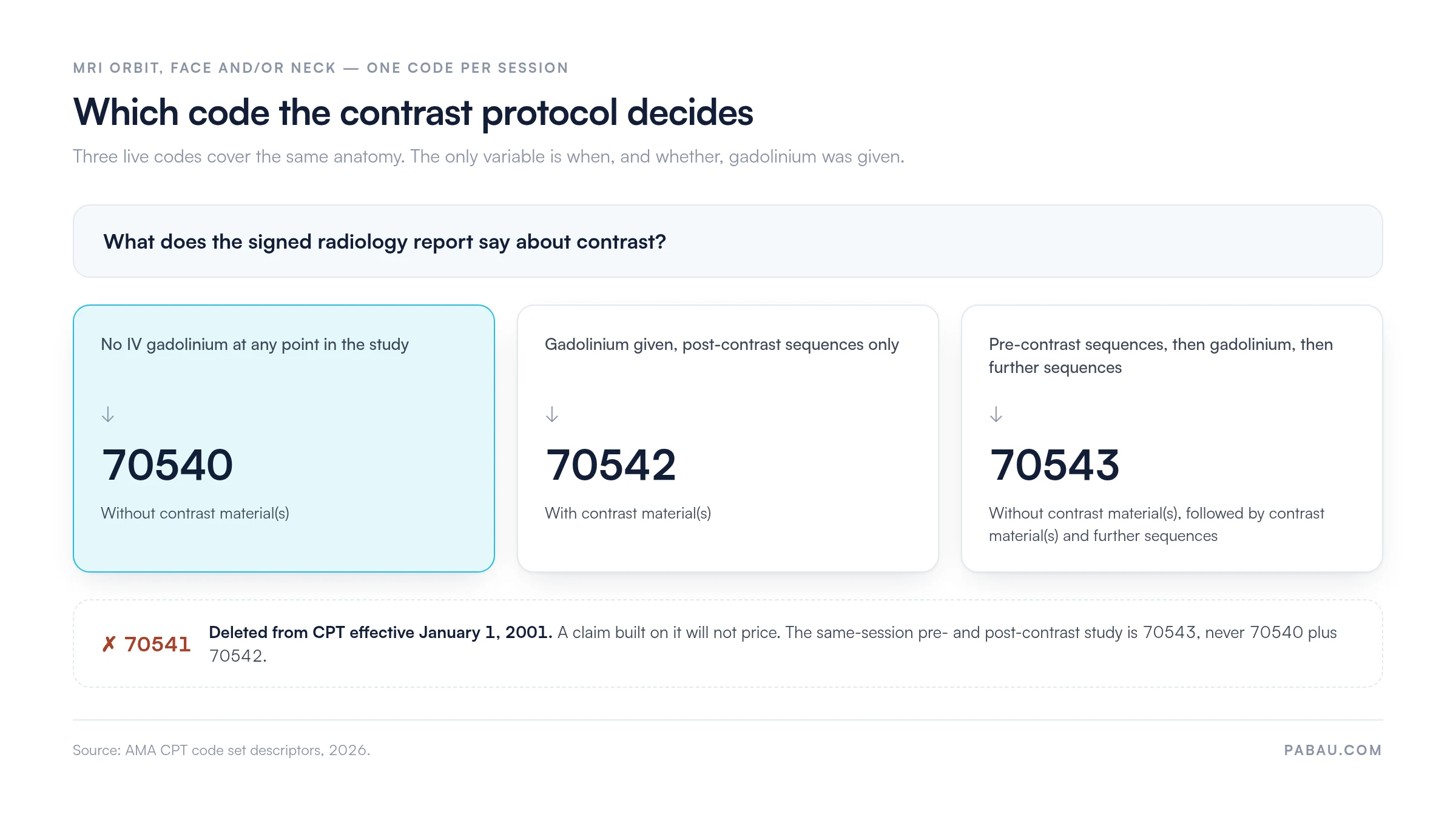
Code 70541 appears in older references and crosswalks, but it was deleted from CPT effective January 1, 2001. The MRA codes 70544 through 70549 cover magnetic resonance angiography of the head and neck. They are separate from the MRI orbit, face, and neck series. Do not reach for 70544 to 70549 on a standard soft tissue MRI, even when the neck vasculature is incidentally evaluated.
A study limited to the jaw joints has its own code. Report CPT code 70336 for a temporomandibular joint MRI rather than a code from the orbit, face, and neck series.
A CT of the same region also falls outside this family. A soft tissue neck CT run without contrast and then with it is 70492, not 70543.
Static code reference lookups require a coder to transfer code selections, modifier logic, and ICD-10 linkage into a separate billing system by hand. Each manual step introduces transcription risk. On a radiology code like 70540, compliant and non-compliant billing are separated by one contrast-protocol choice and one modifier.
Pabau connects the documentation trail to the billing event. When a radiologist signs off a non-contrast orbit, face, or neck study, the claim draws on the record it already sits in. That record holds the order, the place of service, and the signed report.
Its claims management software then submits the claim through our Claim.MD integration and tracks its status back. The code selection and the coverage judgment stay with your coder. All of it sits in the same platform used for scheduling, patient records, and reporting.

Routing claims through a clearinghouse adds a validation layer before the payer sees them. CPT to ICD-10 crosswalk edits and NCCI bundling checks catch errors that a manual read misses. Pabau connects to Claim.MD for US claim submission, so imaging centers get eligibility checks and claim status in one system.

Pabau’s claims management software sends 70540 claims to payers through Claim.MD and tracks each one through to payment. Your coders still choose the code. What goes is the re-keying between the patient record and the claim.

What decides a 70540 claim is already written in the radiologist’s report. Whether gadolinium was given, and whether pre-contrast sequences ran first, settles the code. The modifier then follows from who owns the scanner and who reads the study.
Practices that stop repeating these denials move the check upstream. A coder reading the signed report before the claim leaves recovers more than an appeal does afterward. The trade-off worth remembering is that a 70540 claim is cheap to fix before submission and slow to fix after it.
That check is easier to hold when the report, the order, and the claim live in one record. Book a demo to see how Pabau submits and tracks radiology claims for imaging practices.

Need to understand how clearinghouse claim validation works? Medical claims clearinghouse explains how electronic claim routing catches errors before they reach a payer.
Looking for a framework to manage denials systematically? Denial codes in medical billing covers the most common CARC codes and how to address each one.
Want to see how Pabau handles insurance eligibility before imaging? Insurance eligibility verification covers real-time eligibility checks that reduce authorization-related denials.
CPT code 70540 is the billing code for magnetic resonance imaging of the orbit, face, and/or neck performed without contrast materials. It covers any combination of those three anatomical regions in a single non-contrast session. The official AMA descriptor reads: Magnetic resonance (eg, proton) imaging, orbit, face, and/or neck; without contrast material(s).
The two most common are 26 and TC. Modifier 26 covers the professional component, used when the radiologist bills the interpretation separately. Modifier TC covers the technical component, used when the facility bills equipment and staffing separately. A partially completed study calls for modifier 52. Modifier 59 applies when 70540 is billed on the same day as a different-region MRI. Some payers also require LT or RT on a unilateral orbital scan.
Yes, Medicare covers CPT 70540 when a covered ICD-10-CM diagnosis code is linked and the documentation supports medical necessity. Coverage is governed by Local Coverage Determinations issued by each Medicare Administrative Contractor, so covered diagnoses vary by region. A claim submitted without a supported ICD-10 code receives a CO-50 medical necessity denial.
Four errors cover most of them. The first is using 70540 when contrast was given, where 70542 or 70543 applies. Wrongly appending or omitting modifiers 26 and TC on split-billing claims ranks second. Linking an ICD-10 diagnosis that is not on the LCD-covered list is the third, which draws a CO-50 denial. The fourth is billing 70540 and 70542 together for a single pre- and post-contrast study instead of 70543.



