ICD-10 Code S42.444P: Medial epicondyle fracture, right humerus
ICD-10 Code S42.444P: full descriptor and code validity ICD-10 Code S42.444P car...

Last Updated: Oct 13, 2026
Billable Code Specific Code
H04.9 is the billable ICD-10-CM code for disorder of lacrimal system, unspecified.
Let Pabau's smart automation suggest the right codes, reduce claim denials, and keep your practice compliant—effortlessly.
Automate repetitive tasks and focus on what matters most—your patients.
Reduce coding errors and ensure compliance with the latest regulations.
Clean claims, fewer denials, and faster reimbursements.
Powerful insights and reporting to help your practice thrive.
HIPAA compliant SOC 2 certified GDPR-compliant Trusted by 4,000+ clinics worldwide

ICD-10 Code H04.9 is a billable ICD-10-CM diagnosis code for disorder of lacrimal system, unspecified, valid for reimbursement submission.
H04.9 became effective October 1, 2025 under the 2026 ICD-10-CM edition and falls under Chapter 7 (H00-H59), category H04.
Use H04.9 only when clinical documentation cannot support a more specific lacrimal code such as H04.0 (dacryocystitis) or H04.53x (nasolacrimal duct obstruction).
Practice management software like Pabau helps eye practices capture laterality and diagnosis specificity in clinical documentation at the point of care, so coders can reach a more specific H04.x code instead of defaulting to H04.9.
H04.9 is a billable and specific ICD-10-CM code, valid for claim submission. Payers accept it as a complete diagnosis code for reimbursement purposes.
Note that the parent code H04 is not billable on its own. H04.9 is the unspecified terminus when no more granular H04.x code applies.
The lacrimal system includes the lacrimal glands, lacrimal canaliculi, lacrimal sac, and nasolacrimal duct. ICD-10 Code H04.9 captures a documented abnormality affecting any part of this system when the clinical record does not establish which specific component is involved or what the exact pathological process is.
In practice, this code applies to a narrow set of presentations. Ophthalmologists and oculoplastic surgeons working across skin and eye practice workflows encounter it most often in two situations: early-stage workups where imaging or specialist referral is pending, and retrospective chart closures where documentation was insufficiently detailed at time of service.
The same specificity discipline applies in plastic surgery EMR workflows, where oculoplastic procedures like duct probing and stent placement carry the same laterality requirements.
AAO coding resources emphasize that H04.9 should be used only when clinical notes cannot support a more specific diagnosis, echoing the ICD-10-CM Official Guidelines’ specificity requirement. That threshold is the key clinical decision point.
Understanding where ICD-10 Code H04.9 sits in the tabular hierarchy helps coders navigate to the correct alternative when documentation improves. The full hierarchy runs from chapter level down to the billable code.
The CMS ICD-10 codes page provides the full annual tabular list and update files. The same hierarchy-navigation principle carries over to other Chapter 7 codes.
H04 also carries an Excludes1 note: congenital malformations of lacrimal system (Q10.4-Q10.6). This distinction matters most when a nasolacrimal duct obstruction shows up in a neonate. Acquired neonatal NLDO is coded to H04.53x, while a true congenital lacrimal anomaly must be coded to Q10.4-Q10.6 instead of anywhere under H04.
Check the ICD-10-CM tabular list entry for H04 before coding. The parent category lists all subcategories with their descriptions and any applicable code-first or code-also notes. Reviewing these prevents sequencing errors, particularly when a lacrimal disorder is secondary to another condition.
A GP practice platform keeps recurring ear infections and vision changes visible across a patient’s timeline.
H04 contains a substantial number of subcategory codes covering specific lacrimal conditions with laterality modifiers. According to the AAPC ICD-10-CM code reference, there are approximately 83 codes beneath H04. The most clinically relevant for ophthalmology billing are listed below, with their laterality options noted.
For clinical documentation for eye conditions, the breadth of the H04 subcategory means there is almost always a more specific code available when the diagnosis is properly recorded. H04.9 is a genuine fallback, not a shortcut.
The same standard applies outside ophthalmology. ICD-10 code K37 covers unspecified appendicitis, and it fits only when the record names the condition without calling it acute, chronic, recurrent, or complicated.
The ICD-10-CM Official Guidelines for Coding and Reporting (Section I.B) require coders to use the highest level of specificity supported by the documentation. H04.9 is appropriate only when the clinical record genuinely cannot support a more specific code.
One practical nuance: when a nasolacrimal duct obstruction is documented but laterality is not, H04.539 (NLDO, unspecified eye) is still more specific than H04.9 and should be used. The “unspecified” modifier within a specific code family is always preferable to the catch-all H04.9.
A key distinction between H04.9 and virtually every other H04.x code is laterality. H04.9 carries no laterality modifier because the diagnosis itself is unspecified.
Every other substantive subcategory within H04 provides laterality options: right eye, left eye, bilateral, and unspecified eye. Where the physician’s note records which eye is affected, the laterality-specific code must be used. Using H04.9 when laterality is documented is a coding error, not an acceptable shortcut.
Coders reviewing H52.11 will recognize the same laterality logic: right, left, and bilateral variants exist wherever the anatomy supports it, and an unspecified-eye version within a specific code family is still preferred over a catch-all code. The principle is consistent across Chapter 7: specificity on both condition and laterality is always the target.
When H04.9 is submitted, payers may request supporting documentation. Claims without adequate notes to justify why a more specific code was not available are the most common denial pathway for this code.
Good clinical record-keeping practice is the first line of defense.
Using digital clinical intake forms that prompt for laterality and symptom detail at intake further reduces the rate of unspecified coding. The same discipline applies to standard clinical paperwork like a vital signs record, where missing detail creates the same coding problems downstream.
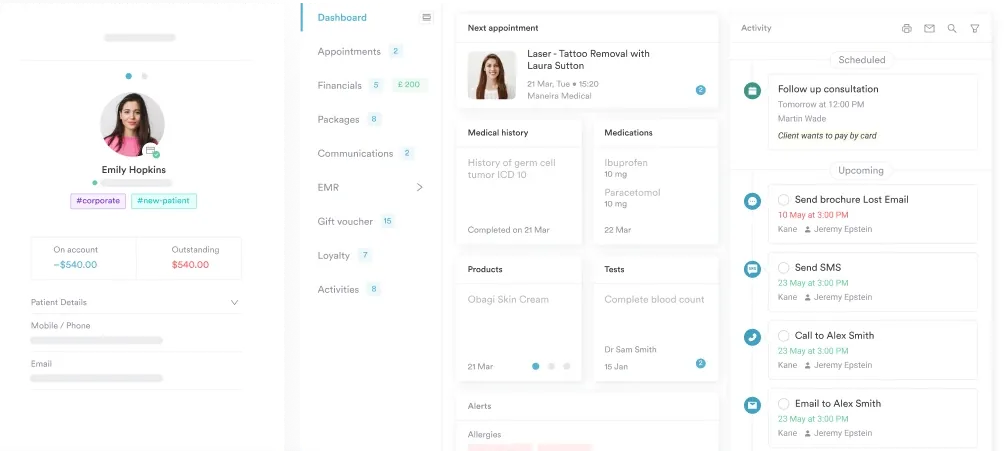
For practices following HIPAA-compliant medical record documentation standards, the same completeness expectations apply. The CDC/NCHS ICD-10-CM web tool provides the official tabular list entries, including any code-also and code-first instructions that may apply alongside H04.9.

Pabau’s digital intake and clinical documentation tools help eye practices capture laterality and diagnosis specificity at the point of care, so coders can reach a more specific ICD-10-CM code instead of defaulting to unspecified.

H04.9 is paired with CPT procedure codes depending on what clinical service was performed during the encounter. The table below lists the most commonly associated CPT codes for lacrimal system procedures. Note that CPT pairing does not guarantee reimbursement; medical necessity must be separately established through documentation. Practices using structured documentation and billing workflows benefit from pairing verification before submission. Compliance risk rises where one person codes, bills and reconciles without a second review.

For evaluation and management codes (99202-99215) billed alongside an ophthalmology-specific code, the lacrimal system complaint must be the primary presenting problem documented in the medical decision-making section. Routine eye exams like 92004 are separate from the targeted ophthalmological service codes above, since a comprehensive exam and a lacrimal-specific procedure aren’t billed as the same encounter type.
When H04.9 is billed with a lacrimal probing CPT code (68810-68840), document the diagnostic rationale in the procedure note, not just the clinic note. Payers reviewing lacrimal procedure claims expect to see which structure was targeted and why the specific diagnosis had not been established prior to the procedure.
The 2026 edition of ICD-10-CM became effective October 1, 2025, following the standard CMS fiscal year update cycle. H04.9 is unchanged from prior editions, with no modifications to its description, billable status, or hierarchy in the 2026 update. That means existing billing templates and code sets tied to ophthalmology practice management don’t need revision for this code specifically.
Coders should verify code status annually. The ICD List lookup tool mirrors official CMS and NCHS data and flags any codes that are new, revised, or deleted in each fiscal year update. For the authoritative source, the CMS ICD-10 codes page publishes the complete tabular list and addenda files each October 1.
H04.9 is a legitimate diagnosis code, but its role is narrow. It exists for genuine diagnostic uncertainty, not for encounters where the clinical record already contains the information needed to code more specifically.
The most common documentation failure is a chart that describes epiphora or nasolacrimal duct obstruction but still submits H04.9, because the coder didn’t recognize the more specific option.
Pabau supports eye practice teams with structured intake and clinical forms that capture laterality and diagnosis specificity at the point of care, giving coders what they need to reach a more specific code instead of defaulting to H04.9. To see how the workflow operates in practice, book a demo.

Documenting a thyroiditis diagnosis that won’t fit? ICD-10 code E06.5 guide This guide covers billable status and when to assign it for Riedel’s, ligneous, or fibrous thyroiditis.
Coding a diabetic foot ulcer diagnosis? ICD-10 code E11.621 guide This guide covers coding for type 2 diabetes with foot ulcer, a complication affecting about 15 percent of patients.
Placing a duct stent during probing? A4262 is the supply code most often billed alongside H04.9 for the implant itself.
Coding type 2 diabetes with hyperglycemia? ICD-10 code E11.65 guide This guide explains how to avoid confusing E11.65 with E11.9 or E11.69 when coding hyperglycemia.
H04.9 is the ICD-10-CM diagnosis code for disorder of lacrimal system, unspecified. It applies when a documented lacrimal system abnormality cannot be classified into a more specific H04 subcategory. It is a billable code valid for reimbursement under the 2026 edition.
Yes. H04.9 is a billable, specific ICD-10-CM code valid for claim submission. Its parent category H04 (Disorders of lacrimal system) is a non-billable header, but H04.9 can be submitted as a complete diagnosis code.
Use H04.9 only when documentation does not support a more specific diagnosis. If the chart documents epiphora, dacryocystitis, or nasolacrimal duct obstruction, use the corresponding H04.x code with the correct laterality. The ICD-10-CM Official Guidelines require the most specific code available.
H04.539 is neonatal obstruction of unspecified nasolacrimal duct: the condition (neonatal NLDO) is established and only the duct’s laterality is unspecified. H04.9, by contrast, identifies neither the condition nor the structure. When neonatal NLDO is documented, use H04.539 even if laterality is not recorded.
The record should document which lacrimal structures were examined, the presenting symptoms, why a more specific diagnosis wasn’t established (e.g. workup pending), and any referral or follow-up plan. Notes omitting this rationale risk medical necessity denials.
Common pairings include ophthalmological evaluation codes (92002, 92012) and lacrimal probing codes (68810, 68811, 68815, 68840) when a diagnostic or therapeutic procedure is performed. Pairing doesn’t guarantee reimbursement; payers require documented medical necessity for each service.