



CCSD code G5100: Bypass of duodenum billing guide
CCSD code G5100 bills a bypass that leaves the duodenum in place CCSD code G5100...

Last Updated: Oct 16, 2026
CPT code 67820 is the procedure code for correction of trichiasis by epilation using forceps only. It covers the removal of misdirected eyelashes that scrape the cornea or conjunctiva.
The code carries a 0-day global period, so a repeat session is billable whenever the record supports it. Medicare pays roughly $41.75 to $41.96 for it in a non-facility office in 2026.
Bill it with modifier -50 when both eyes are treated in one session. Pair it with an H02.05x diagnosis that matches the documented laterality. The sections below cover modifiers, the RVU breakdown, frequency limits, documentation, and the denials this code attracts.

CPT code 67820 covers correction of trichiasis by epilation with forceps only, not electrosurgery, cryotherapy, or laser.
The code has a 0-day global period, so each medically necessary session can be billed again.
Modifier -50 applies when both eyes are treated in one session, and Medicare then pays 150% of the allowed amount.
The diagnosis codes that pair with 67820 are the H02.05x trichiasis series, reported by documented laterality.
Practice management software like Pabau passes the diagnosis and modifier already documented in the record through to the claim.
CPT code 67820 sits in the Excision and Destruction subsection of Eye and Ocular Adnexa procedures. That subsection belongs to the AMA CPT code set. Its official descriptor is: Correction of trichiasis; epilation, by forceps only.
Trichiasis is a condition in which eyelashes grow in an abnormal direction, contacting the cornea or conjunctiva. Left untreated, it causes persistent irritation, corneal abrasion, and in severe cases, ulceration and vision loss. Epilation using forceps is the most basic intervention, physically removing the offending lashes. Because the hair follicle remains intact, lashes regrow, making repeat procedures medically necessary for most patients.
The code applies exclusively to the forceps technique. If a more definitive method is used, such as electrosurgical epilation, cryotherapy, or laser ablation, a different CPT code is required. This distinction is one of the most frequent sources of upcoding audit risk for practices that perform multiple trichiasis correction techniques.
CPT code 67820 sits within a family of trichiasis correction codes. Selecting the wrong code, particularly when a more invasive procedure was performed, can result in underpayment or a compliance issue. The table below covers the key adjacent codes and when each applies.
Practices that bill several trichiasis techniques should confirm the note names the method before anyone picks a code. A chart note reading “lashes removed” leaves the choice open to payer interpretation.
Eyelid work outside this family follows its own rules. An excision of an eyelid lesion is coded as 67840, chosen from the lesion rather than from the lashes.
Medical necessity for CPT code 67820 requires pairing with a valid ICD-10-CM diagnosis code that supports the clinical indication. The primary diagnosis family is H02.05x, covering trichiasis of the eyelid with and without entropion, specified by laterality. Laterality specificity is required. Submitting an unspecified code when the record documents a specific eye can trigger a denial.
When trichiasis is caused by an underlying entropion, report the entropion code on its own. The H02.00 to H02.04 entropion subcategories already include trichiasis caused by entropion, so a second trichiasis code adds nothing to the claim.
Check validity before the claim goes out, because the H02 family shifts with each fiscal year. The CMS ICD-10 code files carry the current tabular list. Our ICD-10-CM code index covers the eyelid codes in the same detail as this page.
Correct modifier use is critical for CPT code 67820, particularly because trichiasis frequently presents bilaterally and because eyelid laterality modifiers are required by many payers. The table below covers the modifiers most commonly applied to this code.
When CPT code 67820 is performed bilaterally in the same session, apply modifier -50 to the single claim line. CMS Medicare Physician Fee Schedule rules assign every code a bilateral surgery indicator. Where that indicator is 1, Medicare pays 150% of the allowed amount when modifier -50 is used. Verify the current bilateral surgery indicator for 67820 in the MPFS database before billing.
Check your MAC’s Local Coverage Determination (LCD) for trichiasis epilation before billing bilaterally. Some MACs have frequency policies that apply per eye, and using modifier -50 without understanding how your MAC counts units can create a frequency-limit denial.
Reimbursement for CPT code 67820 comes from the Medicare Physician Fee Schedule. The calculation is relative value units (RVUs) multiplied by the annual conversion factor. CY2026 carries two conversion factors, $33.5675 for qualifying alternative payment model participants and $33.4009 for everyone else.
The rates below are unadjusted, so your payment moves with your locality’s Geographic Practice Cost Index (GPCI). Verify the current figure in the CMS fee schedule search before you quote a price to a patient.
Practice expense is what separates the two settings. The office keeps 0.58 practice expense RVUs and the facility keeps 0.18, which is where the difference in payment comes from.
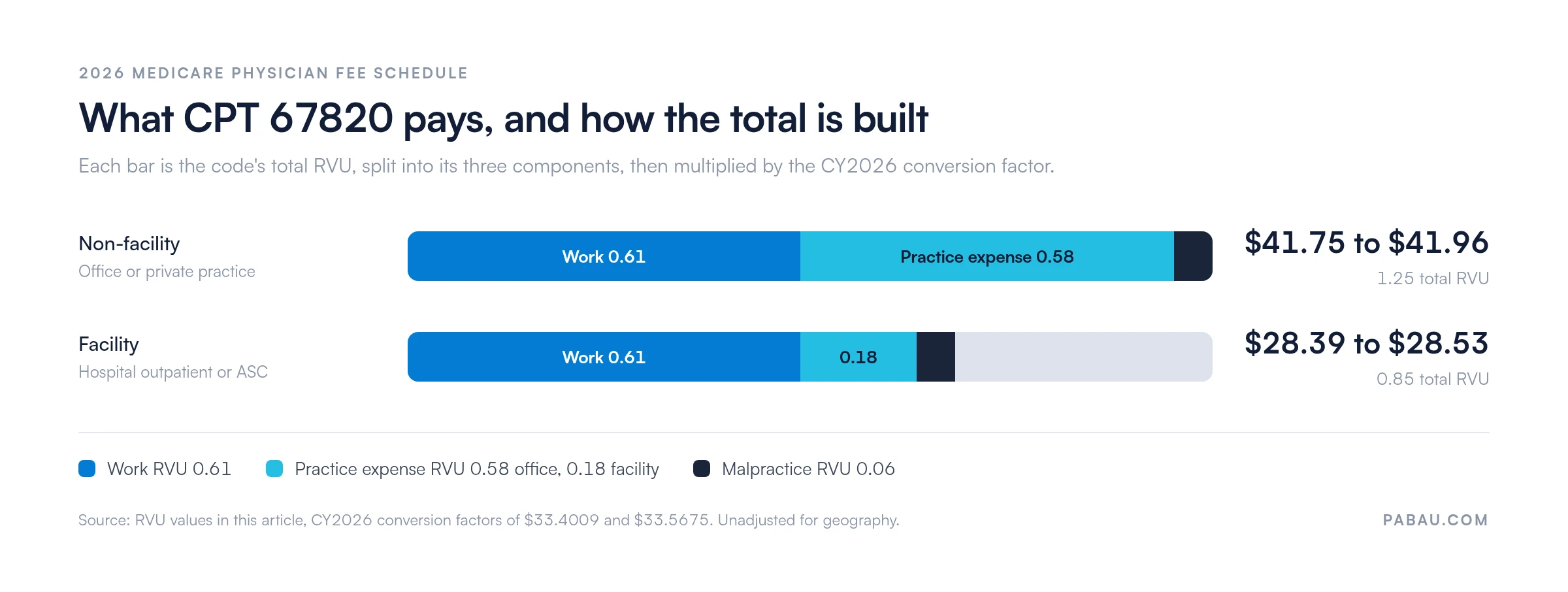
Non-facility rates apply when the procedure is performed in a private ophthalmology office. Facility rates apply in a hospital outpatient department or an ambulatory surgery center. Confirming the place of service code on the claim is what keeps the two apart.
CPT code 67820 can be billed each time the procedure is medically necessary. Because forceps epilation does not destroy the hair follicle, lashes reliably regrow, and many patients require repeat treatment every four to eight weeks. The American Academy of Ophthalmology’s coding guidance supports repeated billing as long as medical necessity is documented at each encounter.
That said, individual Medicare Administrative Contractors (MACs) may impose frequency limitations through Local Coverage Determinations. Some MACs have policies limiting the number of billable epilation sessions per eye per rolling period without additional supporting documentation. Before establishing a regular epilation schedule for a patient, check your MAC’s active LCDs for CPT 67820 and any applicable National Coverage Determinations.
Complete chart documentation is the strongest defense against denied claims and audit recovery demands for CPT code 67820. The record has to support both the diagnosis and the specific technique used. A note reading “lashes removed” establishes neither technique, laterality, nor medical necessity.
Each encounter note should include all of the following:
The documentation has to be complete before the claim is generated, not repaired after a denial arrives. Structured note templates that prompt for each required field during the visit beat asking a coder to interpret free text weeks later.
Most claim denials for CPT code 67820 come from a short list of avoidable errors. Catching them before submission costs far less than working the denial after the explanation of benefits arrives.
Running a pre-submission claim scrub against National Correct Coding Initiative (NCCI) edits catches the most common pairing and modifier errors. Refer to the AAPC CPT code reference for current NCCI companion code edits applicable to 67820.
Trichiasis epilation is a high-frequency, low-complexity procedure. That combination is where quiet billing errors accumulate. A missing modifier, an unspecified ICD-10 code, or an unchecked place of service can repeat across dozens of claims before a payer audit surfaces it.
Pabau, practice management software for medical and aesthetic practices, integrates with Claim.MD, our US clearinghouse partner. That route covers eligibility verification, NCCI edit checks, and 837P submission to thousands of payers.
For an ophthalmology practice billing 67820 every few weeks, each session generates a claim from the structured encounter record. It passes the diagnosis, modifier, and place of service already documented there through to the payer, with no transcription step in between.
Pabau’s cleaner claims management also tracks electronic remittance advice and 835 remittance files. Denial patterns for one CPT code then surface in the dashboard instead of staying buried in individual remittances.
A practice still working from a superbill can export a CMS-1500 aligned version straight from the encounter, pre-populated with the codes in the clinical note. That suits a practice not yet ready for fully automated submission.
Either way, the transcription step where laterality and specificity errors start is removed from the process.
Run a quarterly audit of your 67820 claims. Pull every submission for the period, then check denial rates by reason code. Compare the modifier used against the laterality documented in the chart. A repeating modifier or specificity error usually shows up on the first pass.

Pabau links the clinical note to the claim, so the diagnosis, modifier, and place of service documented at the visit reach the payer unchanged.

Trichiasis epilation is a small procedure with an exacting claim. The technique in the note has to match the code. The modifier has to match the eyelid treated, and the diagnosis has to carry the same laterality.
Because the follicle survives the procedure, the same patient returns, and any error in that first claim returns with them. Rewriting the note template once is worth more than appealing the denials one at a time.
Decide where the billing detail gets captured, then hold the workflow to it. Book a demo to see how Pabau keeps repeat 67820 claims consistent from the encounter note through to the remittance.

Need to understand how claim denials are categorized and appealed? Denial management in healthcare covers the full denial workflow from reason code identification through resubmission.
Billing eye exams alongside minor eyelid procedures? CPT code 92012 sets out the four elements an intermediate eye exam has to document before it can be billed.
Coding another eyelid procedure this week? CPT code 67840 explains how eyelid lesion excision is coded and where its two exclusions sit.
Want to understand how electronic claim files work end to end? 837 claim file guide explains the EDI 837P format used to submit professional claims to Medicare and commercial payers.
CPT code 67820 covers correction of trichiasis by epilation using forceps only, meaning the physical removal of misdirected eyelashes with forceps instruments. It does not cover electrosurgical epilation, cryotherapy, laser ablation, or surgical reconstruction of the eyelid. Those techniques have their own codes in the 67825 to 67835 range.
The primary modifiers are -50 for both eyes in one session, plus -RT and -LT for a unilateral procedure. Eyelid laterality modifiers -E1 through -E4 apply when payer policy requires eyelid-specific reporting. Modifier -59 applies when 67820 is performed alongside another distinct eye procedure in the same encounter.
CPT code 67820 can be billed each time the procedure is medically necessary and documented. Because forceps epilation leaves the hair follicle intact, lashes regrow and repeat treatment is expected. Individual MACs may impose frequency limits through Local Coverage Determinations. Check your MAC’s active LCD before setting a regular billing cadence for repeat sessions.
Yes, Medicare covers CPT code 67820 when medical necessity is established. The claim also needs a supporting ICD-10-CM diagnosis from the H02.05x trichiasis series. Coverage is subject to MAC-specific LCDs that may impose frequency or documentation requirements beyond the national standard. Medicare Advantage plans follow the same baseline coverage but may apply additional prior authorization or frequency policies.



