

CCSD code G5100: Bypass of duodenum billing guide
CCSD code G5100 bills a bypass that leaves the duodenum in place CCSD code G5100...

Last Updated: Oct 16, 2026
65855 is the CPT code for trabeculoplasty by laser surgery, 1 or more sessions in a defined treatment series.
It covers selective laser trabeculoplasty (SLT) and argon laser trabeculoplasty (ALT) for open-angle glaucoma and ocular hypertension. The code carries a 10-day global period, and every unilateral claim needs modifier LT or RT. A 2016 revision removed the argon-specific wording, so coders working from pre-2016 rules often apply it too narrowly.
Let Pabau's smart automation suggest the right codes, reduce claim denials, and keep your practice compliant—effortlessly.
Automate repetitive tasks and focus on what matters most—your patients.
Reduce coding errors and ensure compliance with the latest regulations.
Clean claims, fewer denials, and faster reimbursements.
Powerful insights and reporting to help your practice thrive.
HIPAA compliant SOC 2 certified GDPR-compliant Trusted by 4,000+ clinics worldwide

CPT 65855 covers trabeculoplasty by laser surgery, including SLT and ALT, for open-angle glaucoma and ocular hypertension
Laterality modifiers LT and RT are required on every claim; missing them is the single most common denial reason
The global period is 10 days, so routine follow-up visits inside that window are bundled and not separately billable
A same-day eye exam (92012 or 92014) requires modifier 25 on the E&M to avoid bundling denial
Pabau flags a missing laterality modifier and routes 65855 claims through Claim.MD for eligibility checks before submission
CPT code 65855 is defined by the American Medical Association as “trabeculoplasty by laser surgery, 1 or more sessions (defined treatment series).” The code sits in the Eye and Ocular Adnexa section of the Surgery chapter (CPT codes 65091-68899), within the narrower Anterior Segment subsection.
Its descriptor was revised in 2016 to remove the earlier argon-specific language, making the code applicable to all laser trabeculoplasty modalities.
The phrase “defined treatment series” in that descriptor carries billing weight. One or more sessions that complete a single planned series are reported once, not once per session. A second laser sitting a week later, planned from the outset as part of the same series, does not earn a second unit of 65855.
Trabeculoplasty by laser surgery applies laser energy to the trabecular meshwork at the anterior chamber angle. The treatment improves aqueous humor outflow and reduces intraocular pressure (IOP). Two techniques are covered under this single CPT code.
Clinical indications that establish medical necessity include primary open-angle glaucoma (POAG), pseudoexfoliative glaucoma, and pigmentary glaucoma. Ocular hypertension qualifies where IOP control is inadequate on medical therapy. Coders and practice managers need this clinical context, because payers often ask for proof of failed medical therapy before approving 65855.
High glaucoma volume makes this documentation load heavier. Pabau, our practice management software, structures the procedure note so IOP readings, laser parameters, and diagnosis codes are captured at the point of care. That feeds cleaner claims management, because no value has to be reconstructed from memory at billing time.
Every 65855 claim must be accompanied by an ICD-10-CM diagnosis code that establishes medical necessity. Submitting without a supported diagnosis, or with a code that doesn’t match the operative laterality, reliably produces a medical-necessity denial.
Laterality in the ICD-10 code must match the operative side in the procedure note. A right-eye SLT billed with H40.112×2 (left eye, moderate stage POAG) will deny on the laterality mismatch alone. Your billing workflow should include a laterality crosscheck between the operative note and the claim before submission.
Unspecified glaucoma, H40.9, rarely holds up on its own. Most payers want the specific glaucoma type, the treated side, and the documented stage before they approve a laser claim.
Modifier selection for 65855 is one of the most audited areas in ophthalmology billing. The rules are straightforward, but one missing modifier produces a denial that takes weeks to appeal.
The bilateral billing distinction between modifier 50 and separate LT/RT line items is the most practice-specific decision here. Check your Medicare Administrative Contractor (MAC) guidance and individual commercial payer contracts before standardizing your workflow.
Pabau’s Claim.MD clearinghouse integration performs payer-specific edits at submission, catching modifier mismatches before a claim reaches the payer.
CPT 65855 carries a 10-day global period under the Medicare Physician Fee Schedule. The surgical package covers the laser procedure plus routine post-operative care on the day of surgery and the 10 days after it.
A follow-up visit related to the treated eye inside that window is not separately billable. The timeline below maps each type of visit to its side of the window.
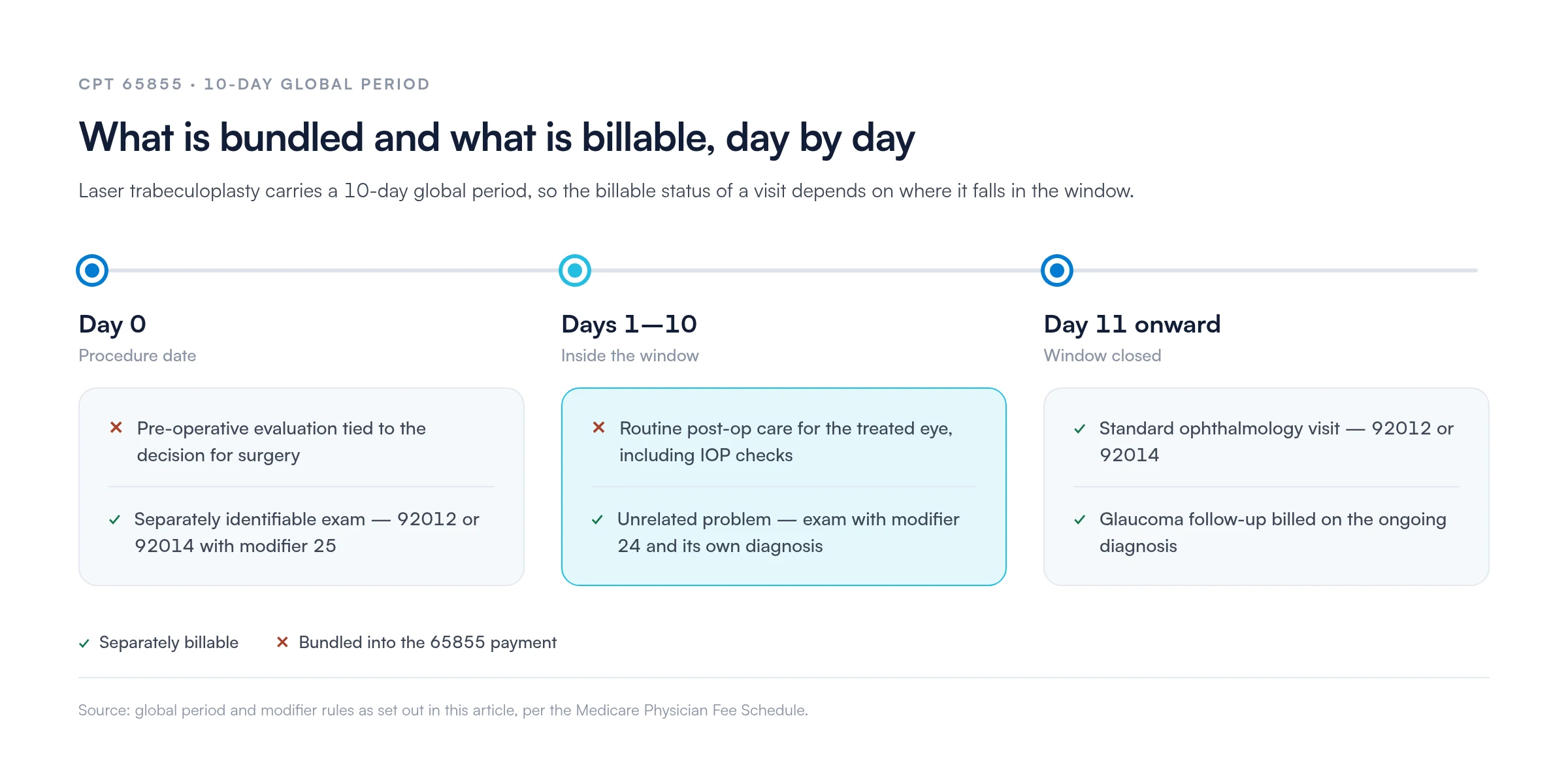
The rule runs the other way too. A corneal debridement billed under CPT code 65435 inside the 65855 window takes modifier 79 when the indication is unrelated.
Manual global period tracking fails in both directions. A bundled visit gets billed and denied, or a billable visit after day 10 gets written off as post-op courtesy. Whatever system your practice bills from should record the 10-day end date against each 65855 procedure. Staff can then see at check-in which side of the window a visit falls on.
Record the 65855 global period end date on the patient’s chart at the time of the procedure, not at billing. A visit on day 8 is bundled and should never reach a claim, while the same visit on day 12 is a billable exam. Staff who can see the date make that call at check-in rather than after a denial arrives.
A same-day eye examination can be billed alongside 65855 when the exam was a separately identifiable service. Modifier 25 goes on the E&M code, not on the procedure code.
The American Academy of Ophthalmology (AAO) confirms that a comprehensive or intermediate eye exam is separately reportable on the same day as laser trabeculoplasty. Two conditions apply. The exam must go beyond the routine pre-operative assessment tied to the procedure, and the record must document the separate service.
Same-day 65855 and E&M denials follow predictable patterns, so the appeal for them should be templated. An appeal letter that cites the AAO guidance resolves faster than one written from scratch. Pre-validating the modifier 25 pairing before submission saves most of that work.
Medicare reimbursement for 65855 varies by place of service. The non-facility rate applies when the procedure is performed in the physician’s office. The facility rate applies in an outpatient hospital or ambulatory surgery center (ASC).
These figures are national unadjusted rates based on the Medicare Physician Fee Schedule conversion factor. Each payment is then adjusted by the geographic practice cost index (GPCI) for your locality.
That adjustment can move the figure up or down by 10-25%. Always verify current rates via the CMS Physician Fee Schedule lookup. Private payer rates are typically set as a percentage of Medicare, and they vary widely by payer and contract.
For RVU-level breakdowns by component (work, practice expense, malpractice), the FastRVU lookup tool provides free access to CMS-sourced values. Benchmark 65855 reimbursement against your practice’s cost to deliver SLT. The comparison shows whether in-office or facility-based delivery suits your patient mix better.
Medicare does not require prior authorization for CPT 65855. Commercial payers commonly do require it for laser trabeculoplasty. The documentation they request is consistent enough that practices can standardize the prior auth package.
Missing prior authorization is one of the most expensive denial types, because it often cannot be appealed retroactively and the whole claim is forfeited. Confirm PA requirements during eligibility verification before every SLT procedure, not at the time of billing. The superbill your practice generates for 65855 should carry a PA confirmation number field that must be populated before the claim goes out.
CPT 65855 is frequently confused with two other ophthalmic laser codes. The wrong code usually produces a denial. Sometimes it produces a payment that survives adjudication and then triggers a post-payment audit.
The confusion between 65855 and CPT code 66821 (YAG posterior capsulotomy) is the most common code-selection error in ophthalmology billing. SLT and YAG capsulotomy are frequently performed in the same practice, sometimes on the same day.
The two procedures remain anatomically and clinically distinct. Watch for billing software that auto-populates posterior capsule opacification (H26.49) alongside 65855. That crosswalk error will trigger a denial.
Our guide to decoding denial remark codes explains how to read the CO-4 and CO-97 messages that usually accompany a misrouted ophthalmic procedure claim.
The following denial patterns account for the majority of 65855 claim failures across ophthalmology practices. Most are preventable with a pre-submission checklist.
Tracking denial reasons by code and payer is the fastest way to identify which of these patterns is your highest-volume problem. The 837 claim file your clearinghouse processes returns denial reason codes in the 835 remittance.
Those codes should feed back into your practice management system automatically. Electronic remittance advice is where systematic denial patterns surface. That only works when the data is mapped to code-level reports rather than buried in batch totals.
A compliant 65855 operative note must contain enough information to support both the claim on submission and a post-payment audit request. Thin notes that pass initial adjudication often fail on audit, requiring repayment of the entire amount plus interest.
The note carries each of the following elements.
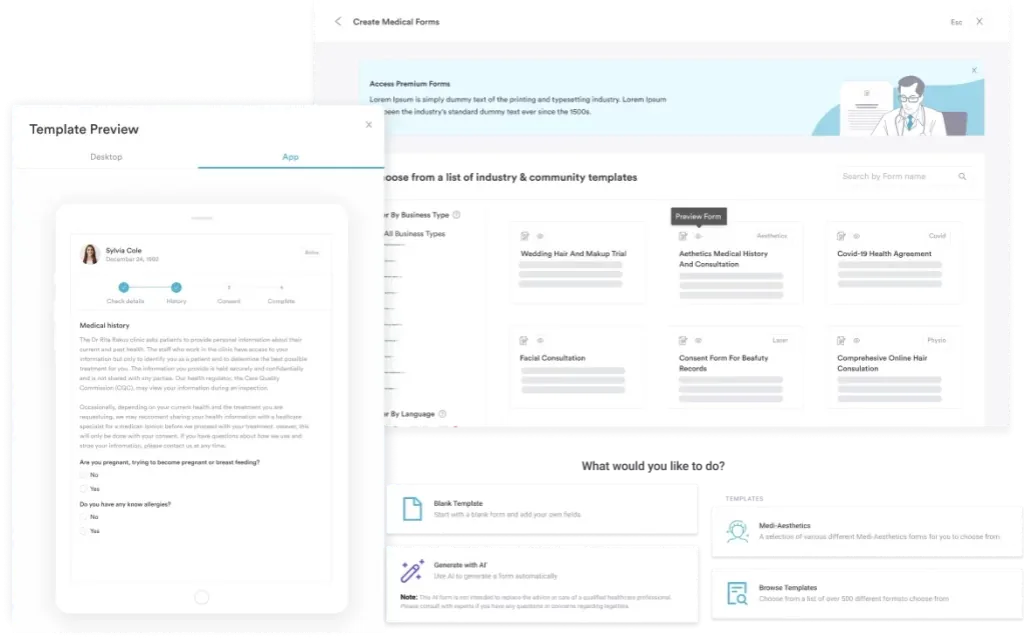
Pabau’s digital forms support SLT-specific note templates that prompt for each required field. A note cannot be completed until laser energy and pre-procedure IOP are recorded. Claim.MD then handles electronic submission of the resulting clean claims, with built-in CPT and ICD-10 catalog validation.
Build a two-field SLT note template: one required field for pre-procedure IOP and one for laser settings (energy per spot, number of spots, degrees treated). Auditors reviewing 65855 claims look for these figures first. An operative note without them is the clearest signal of documentation risk in the chart.
SLT billing usually breaks at the handoff between the laser room and the billing desk. Laterality is verified by whoever reviews the batch that week. Global period end dates sit in a spreadsheet, and modifier 25 is appended from habit rather than from what the exam note supports.
Pabau holds those rules where the claim is built. The SLT procedure template captures pre-operative IOP, laser settings and the treated eye as structured fields, and the claim draws from them directly. The 10-day global period runs from the procedure date, so a day-six follow-up is flagged as bundled before a charge is posted.
Claims then route to Claim.MD for eligibility and payer-specific edits before submission. A missing LT or an unsupported diagnosis is caught while it is still cheap to fix. Billing staff spend their time on appeals worth writing instead of on rework.

Pabau connects directly to Claim.MD to validate modifiers, ICD-10 codes, and payer-specific rules before every claim leaves your practice. Ophthalmology billing teams use it to catch an absent LT, RT or modifier 25 while the note is still open.

Every denial pattern on this page is caught in under a minute at the point of care. The same three checks cost weeks once a claim has been adjudicated and appealed. That asymmetry is the whole argument for moving laterality, modifier 25 and the global period date upstream into the note.
If your practice still verifies these after submission, the denials are already priced into your revenue cycle. A software change costs less than the appeals do. Pabau validates modifiers, diagnosis laterality and payer rules before a 65855 claim leaves the practice. Book a demo to see how it handles ophthalmology billing end to end.

Need to understand how claim denials are categorized? Denial codes in medical billing explains CO, OA, and PR remark code groups so you can route appeals correctly.
Want to improve your pre-submission clean claim rate? Clean claim protocols outlines the validation steps that prevent the most common submission errors across CPT codes.
Looking for guidance on ERA and remittance processing? Electronic remittance advice workflows covers how to map 835 data back to individual claim denials for pattern analysis.
Checking coverage before the laser is booked? Insurance eligibility verification sets out the checks that catch a prior authorization requirement while it can still be met.
Building the charge sheet your billers work from? Superbills explains which fields a procedure charge needs before it can become a clean claim.
CPT code 65855 covers trabeculoplasty by laser surgery, including both selective laser trabeculoplasty (SLT) and argon laser trabeculoplasty (ALT). The laser is applied to the trabecular meshwork to reduce intraocular pressure in open-angle glaucoma or ocular hypertension. The code was revised in 2016 to remove argon-specific language, making it applicable to all laser trabeculoplasty techniques.
Medicare paid approximately $235 for CPT 65855 in a non-facility (office) setting in 2025. The facility rate, for an outpatient hospital or ASC, was approximately $197. The 2025 work RVU is 2.93. Actual payments vary by geographic adjustment, so verify current rates via the CMS Physician Fee Schedule lookup tool at cms.gov.
Modifier LT (left side) or RT (right side) is required on every unilateral 65855 claim. For bilateral procedures, Medicare accepts modifier 50 on a single line. Many commercial payers instead require two separate claim lines with LT and RT. Modifier 25 applies to any same-day eye examination code (92012 or 92014), not to 65855 itself.
CPT 65855 has a 10-day global period under the Medicare Physician Fee Schedule. Routine follow-up care for the treated eye during those 10 days is bundled into the surgical package and is not separately billable. Visits from day 11 onward are billable as ophthalmology evaluation and management services, usually 92012 or 92014. An unrelated problem treated inside the window is reported with modifier 24 on the exam code.
Yes, a same-day eye exam (92012 or 92014) can be billed alongside 65855. The exam must be a separately identifiable service, documented as such in the medical record. Modifier 25 must be appended to the E&M code, not to 65855. Some commercial payers routinely deny this combination even with modifier 25 and require appeals with supporting documentation.
Medicare does not require prior authorization for CPT 65855. Many commercial payers do require prior authorization. They typically request the glaucoma diagnosis, serial IOP readings, and evidence that medical therapy was trialed and found inadequate. Requirements vary by payer and plan year; verify with each payer before scheduling the procedure.
The most common supporting diagnosis is H40.11x (primary open-angle glaucoma) with laterality and stage as the 6th and 7th characters. H40.10x (open-angle glaucoma, unspecified), H40.13x (pigmentary glaucoma), and H40.05x (ocular hypertension) are also accepted when clinically appropriate. The ICD-10 laterality must match the operative eye documented in the procedure note.



