CPT code 95907: Nerve conduction studies, 1-2 studies
CPT code 95907: official descriptor and code overview CPT code 95907 is the nerv...

Last Updated: Oct 13, 2026
64642 is the CPT code for chemodenervation of one extremity, 1-4 muscles.
When more limbs are treated in the same session, add-on code 64643 covers each additional extremity with 1-4 muscles. Injecting 5 or more muscles in one extremity is reported with a different primary code, 64644, with add-on 64645 for each additional extremity. The botulinum toxin itself is billed separately under its own HCPCS J-code.
Let Pabau's smart automation suggest the right codes, reduce claim denials, and keep your practice compliant—effortlessly.
Automate repetitive tasks and focus on what matters most—your patients.
Reduce coding errors and ensure compliance with the latest regulations.
Clean claims, fewer denials, and faster reimbursements.
Powerful insights and reporting to help your practice thrive.
HIPAA compliant SOC 2 certified GDPR-compliant Trusted by 4,000+ clinics worldwide

CPT code 64642 covers chemodenervation of one extremity using 1-4 muscles with a neurolytic agent such as botulinum toxin
64643 is the add-on code billed for each additional extremity (1-4 muscles) — it cannot be reported without a primary code (64642 or 64644)
Lack of medical necessity and missing prior authorization are frequent denial reasons for CPT code 64642 claims
HCPCS drug code J0585 (onabotulinumtoxinA) must be billed separately alongside the procedure code to capture the drug cost
Pabau’s claims management software supports electronic submission and denial tracking for chemodenervation claims
CPT code 64642 is defined by the American Medical Association as: “Chemodenervation of one extremity; 1-4 muscle(s).”
The procedure involves injecting a neurolytic agent directly into targeted muscles under EMG or ultrasound guidance, or by clinical landmark technique. Botulinum toxin is the agent used in virtually all 64642 claims. The code applies to one extremity per session. Each additional extremity with 1-4 muscles is reported with add-on code 64643.
CPT code 64642 covers chemodenervation for conditions causing pathological muscle overactivity in an extremity. Covered indications include upper and lower limb spasticity (from stroke, cerebral palsy, multiple sclerosis, or traumatic brain injury) and focal dystonia of an extremity. Hyperhidrosis is not a 64642 indication. Eccrine gland chemodenervation is reported with 64650 (both axillae) or 64653 (other areas). Physical therapy and rehabilitation practices that perform these injections alongside other neurological services rely on precise indication coding to meet medical necessity thresholds.
The code includes the injection technique itself, including needle insertion and the physician’s intraservice work. Needle EMG guidance is reported separately with add-on 95874, and electrical stimulation guidance with 95873. Drug cost is not included and must be billed separately using the appropriate HCPCS J-code.
Knowing what falls outside CPT code 64642 prevents unbundling violations and claim rejections. Neck muscles use 64616; facial nerve muscles use 64612; chronic migraine prophylaxis uses 64615; larynx uses 64617; salivary glands use 64611; extraocular muscles use 67345.
Before adding another code to a 64642 claim, check the pair against the current National Correct Coding Initiative (NCCI) procedure-to-procedure edits. Billing a pair that the edit table bundles is unbundling, and it triggers automated claim edits.
64643 is the add-on code reported for each additional extremity (1-4 muscles) treated in the same session. It cannot be billed without a primary code, and payers will reject a standalone 64643 claim automatically. Code 64644 is a different primary code, used when 5 or more muscles in one extremity are injected.
Report 64643 on a separate line from 64642, with units equal to the number of additional extremities. The drug code (J0585 or equivalent) is reported once per drug per date of service, with the total units administered.
The chemodenervation family spans several codes defined by anatomical site. Selecting a code for the wrong site or muscle count is a frequent cause of denials in neurology and PM&R billing.
J0585 is the HCPCS Level II code for onabotulinumtoxinA (Botox), billed per unit of the drug administered. Every toxin brand has its own J-code, and units are not interchangeable between products.
Bill J0585 units based on the number of units actually administered. Document the vial lot number, total units drawn, and any discarded waste in the procedure note. Medicare allows reporting of drug wastage when a single-dose vial is partially used – report the wasted units with modifier JW on a separate line. When no drug from a single-dose vial is discarded, Medicare requires modifier JZ on the drug line.
Every CPT code 64642 claim requires at least one ICD-10-CM diagnosis code that establishes medical necessity. The diagnosis must appear on the payer’s covered-condition list – for Medicare, that means the MAC’s Local Coverage Determination (LCD).
Off-label uses – even those widely accepted clinically – may be denied under Medicare LCDs. The diagnosis code alone does not establish medical necessity; the record must also document failed conservative treatments and functional goals.
Cross-reference your diagnosis code against the specific MAC’s LCD before submitting. Novitas Solutions (Jurisdictions H and L) and CGS (Jurisdiction 15) publish different covered-condition lists for botulinum toxin injection. A code covered by Novitas may not appear on the CGS LCD. Check CMS Article A52848 for the Novitas jurisdiction billing and coding guidance.
Medicare Part B covers CPT code 64642 when the claim meets the medical necessity criteria established by the patient’s MAC. There is no single national LCD for botulinum toxin injection – each MAC issues its own policy, and coverage requirements vary.
Medicare typically limits coverage to a minimum interval between injections – often 12 weeks for most spasticity indications. Billing more frequently than the LCD allows triggers a medical necessity denial regardless of documentation quality. Use the CMS Physician Fee Schedule lookup tool to confirm current payment rates and coverage indicators for 64642 in your geographic area.
Prior authorization is required by most commercial payers for CPT code 64642. Insurance eligibility verification before scheduling the injection prevents the most common pre-service denial: discovering a PA requirement after the procedure has been performed.
Maintaining medical billing compliance means documenting the PA approval number in the claim and in the patient record. Practices that perform 64642 regularly benefit from standardized PA request templates. These include the diagnosis, relevant functional limitation scores, and the number of treatment sessions requested.
Inadequate documentation is a frequent reason CPT code 64642 claims are denied or recouped on audit. Every procedure note must contain specific elements keyed to the LCD requirements – a generic injection note is insufficient.
Submitting a clean claim for 64642 starts with the procedure note, not the claim form. If the medical record cannot support the claim on audit, the payment will be recouped regardless of how correctly the claim was coded. Build note templates that prompt for each required element before the encounter closes.
Medicare reimburses CPT code 64642 under the Resource-Based Relative Value Scale (RBRVS). Rates are adjusted annually by CMS and vary by geographic location through the Geographic Practice Cost Indices (GPCI).
Multiply total RVUs by the Medicare conversion factor (which changes annually) and the applicable GPCI to calculate the locality-specific payment. Use the FastRVU lookup tool to retrieve current 2025/2026 payment rates for your location. Drug reimbursement for J0585 is calculated separately at the average sales price (ASP) plus 6%.
Pabau’s claims management software supports electronic submission of CPT code 64642 claims and tracks each claim’s status. When a claim is paid, the payment is recorded against the right invoice from the same Claims dashboard. Electronic claims submission via Claim.MD, Pabau’s US clearinghouse partner, routes 64642 claims to thousands of US payers with real-time eligibility checks and ERA posting.
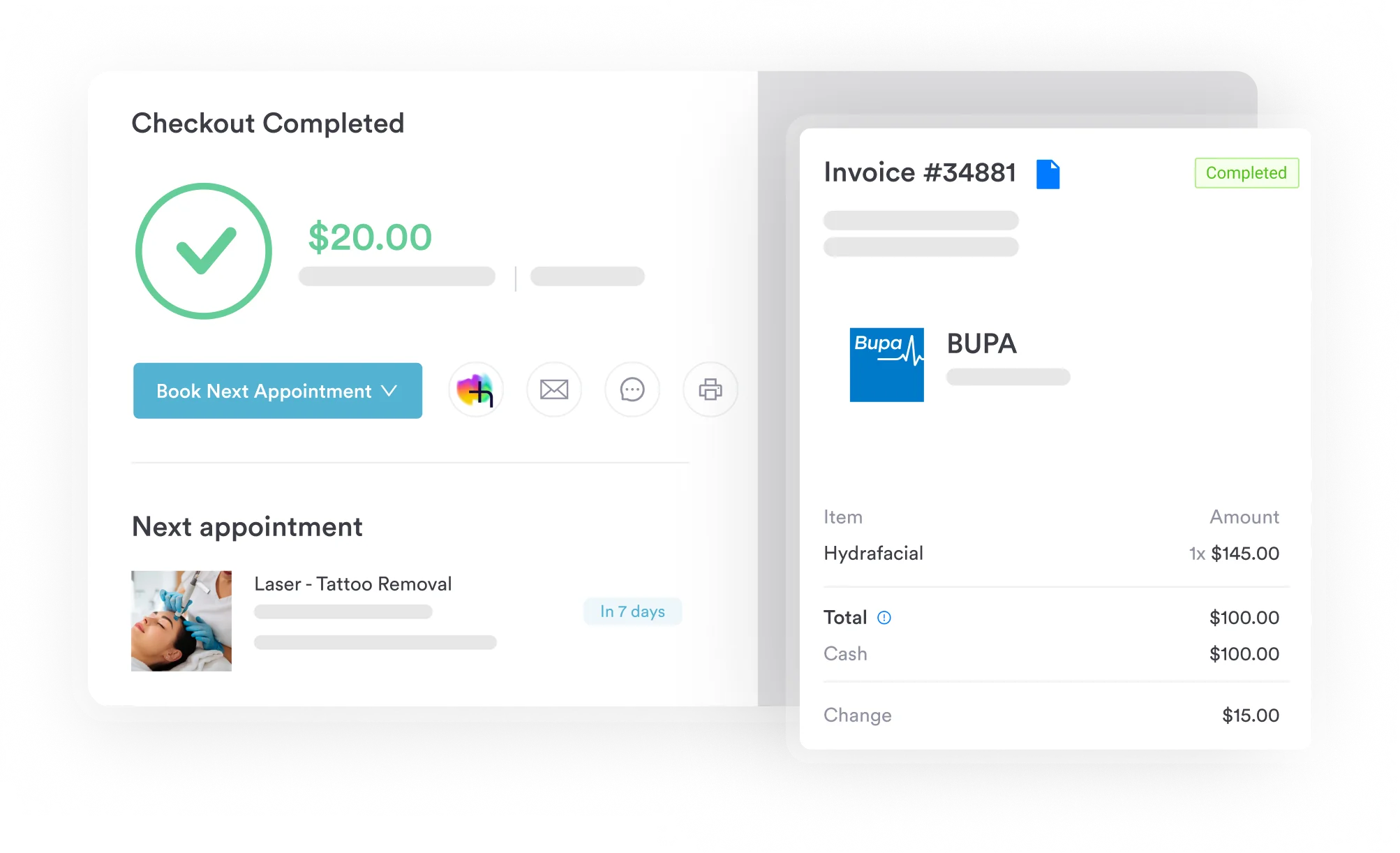
Before you follow up with a payer, open the 64642 claim from the Claims dashboard and check its status. Then confirm the payment is recorded against the right invoice.

Pabau connects electronic claim submission, denial tracking, and remittance posting in one platform. See how neurology and PM&R practices submit CPT 64642 claims and get paid faster.

Denials for CPT code 64642 cluster around five predictable failure patterns. Each has a specific corrective action. Reactive denial management workflows catch these after the fact, but prevention at the point of documentation and authorization is more efficient.
A separately identifiable evaluation and management service (99213-99215) can be billed on the same day as CPT code 64642. The E/M must be distinct from the routine pre-service assessment already included in the procedure.
Modifier 25 must be appended to the E/M code, not to 64642. It signals that the office visit addresses a separate, distinct problem beyond the injection encounter. The E/M note must document a chief complaint, history, examination, and medical decision-making. Together they must stand as a billable visit even if the injection had not occurred.
The AAPC CPT code reference provides additional modifier guidance and bundling rules that apply to the 6464x family.
Document modifier 25 E/M services in a separate note section clearly labeled with a different chief complaint. Auditors reviewing 64642 claims routinely request E/M documentation to verify the modifier is justified. A single note that blends pre-injection assessment with the E/M rationale will not survive audit scrutiny, even if the modifier was applied correctly.
CPT code 64642 is the core code for extremity chemodenervation, and meeting its documentation burden means fewer avoidable denials. Four elements decide whether a 64642 claim pays on first submission. They are correct code selection, accurate ICD-10 pairing, timely prior authorization, and a procedure note that maps directly to LCD requirements.
Pabau’s claims management platform helps neurology and PM&R practices track authorization status, submit electronic claims, and monitor denial patterns by procedure code. To see how Pabau handles chemodenervation billing workflows end to end, book a demo with the team.

Need help understanding what goes on a clean claim? Clean claim submission guide covers every required element that keeps 64642 claims out of the denial queue.
Wondering how clearinghouses route your claims? Medical claims clearinghouse explained breaks down how electronic claim routing works between your practice and the payer.
Tracking down the source of repeated denials? Denial codes in medical billing maps the most common CARC and RARC codes back to their root causes. That way you fix the documentation instead of only resubmitting the claim.
CPT code 64642 covers chemodenervation of one extremity using 1-4 muscles, performed with a neurolytic agent such as botulinum toxin. The code applies to conditions including limb spasticity, focal dystonia, cerebral palsy, and multiple sclerosis-related muscle overactivity.
CPT 64642 is the primary code for the first extremity treated with 1-4 muscles. CPT 64643 is the add-on code for each additional extremity (1-4 muscles) in the same session, and it cannot be billed without a primary code. For a patient treated in two extremities, report 64642 once and 64643 once. CPT 64644 is a separate primary code for 5 or more muscles in one extremity.
Yes, Medicare Part B covers CPT code 64642 when the claim meets the medical necessity criteria in the patient’s MAC-issued Local Coverage Determination. Covered indications and frequency limits vary by jurisdiction – Novitas, CGS, and Palmetto each publish their own LCD for botulinum toxin injection.
There is no universal unit limit in the CPT descriptor itself, but payers set their own maximum toxin units per session and per year. Novitas billing article A52848 ties dose and frequency to the FDA label. Services above those parameters may be reviewed for medical necessity. Always verify the current payer policy before billing.
Most commercial payers require prior authorization for CPT 64642, including Aetna (CPB 0113), UnitedHealthcare, Cigna, and most BCBS plans. Medicare generally does not require prior authorization for physician-administered injections, but documentation must support medical necessity on post-payment audit. Always verify PA requirements with the specific plan before scheduling the procedure.
Common denial reasons include lack of documented medical necessity (no record of failed conservative treatments) and missing or expired prior authorization. Others include an ICD-10-CM code missing from the payer’s covered-condition list and an injection interval below the payer’s minimum. NCCI bundling conflicts with another code on the claim also cause denials.