CCSD code F4600: Incisional drainage of salivary gland abscess
CCSD code F4600: what the descriptor covers CCSD code F4600 covers incisional dr...

Last Updated: Oct 20, 2026
58600 is the CPT code for ligation or transection of fallopian tube(s), abdominal or vaginal approach, unilateral or bilateral. It covers open interval sterilization through a mini-laparotomy or colpotomy, billed as one unit for one or both tubes.
Most 58600 denials trace back to three errors. Coders append modifier 50 even though the descriptor already includes bilateral procedures. Laparoscopic sterilization gets billed as 58600 when it belongs to 58670 or 58671. And Medicaid claims arrive without a valid sterilization consent form.
Let Pabau's smart automation suggest the right codes, reduce claim denials, and keep your practice compliant—effortlessly.
Automate repetitive tasks and focus on what matters most—your patients.
Reduce coding errors and ensure compliance with the latest regulations.
Clean claims, fewer denials, and faster reimbursements.
Powerful insights and reporting to help your practice thrive.
HIPAA compliant SOC 2 certified GDPR-compliant Trusted by 4,000+ clinics worldwide

CPT code 58600 describes open tubal ligation or transection through an abdominal or vaginal approach, not laparoscopic sterilization.
The descriptor already covers unilateral or bilateral procedures, so modifier 50 does not apply and appending it causes an overpayment.
Medicaid denies sterilization claims that lack a Consent for Sterilization form (HHS-687) signed 30 to 180 days before the procedure.
Laparoscopic sterilization is billed with 58670 or 58671, and sterilization at cesarean delivery uses add-on code 58611.
Pabau, the practice platform we build, submits and tracks 58600 claims electronically through Claim.MD.
CPT code 58600 is the American Medical Association’s code for ligation or transection of the fallopian tube(s), via abdominal or vaginal approach, unilateral or bilateral. In the AMA’s CPT code set, both open approaches and either laterality fall under this one code. You bill a single unit whether the surgeon ligated one tube or both.
The code sits in the Oviduct/Ovary incision range, 58600-58615, while laparoscopic procedures on the tubes sit at 58660-58679. The approach and the timing of the procedure decide whether 58600, 58605, 58611, 58670 or 58671 is correct.
Both approaches fall under CPT code 58600, but the operative report must clearly state which was used. Payers and auditors look for this language during claim review, and an ambiguous report can trigger a documentation request that delays payment.
Neither approach requires a different code. What changes is the documentation language the auditor will scan for. Coders reviewing an operative report should confirm three points:
A report that covers all three rarely draws a documentation request.
Modifier 50 (bilateral procedure) is not appended to CPT code 58600. The official AMA descriptor already states “unilateral or bilateral,” so one billing unit covers either scenario. Modifier 50 tells payers to pay 150% of the single-procedure rate. On this code, that creates an overpayment that invites audits and takebacks.
The rule is straightforward: if the descriptor already contains “unilateral or bilateral,” modifier 50 does not apply. Coders who inherit claims from another biller should verify modifier history before re-submission to avoid a duplicate overpayment flag.
Run a modifier audit on your 58600 claim history. Filter for any claim with modifier 50 appended. Each of those is a potential overpayment that payers can recoup retroactively, even years after payment. Correcting the pattern proactively protects the practice.
These codes cover the same anatomical region but describe different procedures. Picking the wrong one leads to approach-mismatch denials and can trigger an upcoding review.
58600 vs 58670 and 58671: If the operative report mentions trocars, ports, insufflation or a laparoscope, the sterilization was laparoscopic. Report 58670 for fulguration, or 58671 for occlusion by a band, clip or Falope ring. CPT code 58600 is reserved for open abdominal and vaginal approaches.
58600 vs 58611: Tubal ligation can happen at the same operative session as a cesarean delivery (CPT 59510 or similar). In that case, report 58611 as the add-on code, not 58600. Billing 58600 alongside a cesarean code will often bundle incorrectly or generate an edit requiring documentation to unbundle.
The decision path below runs the same checks in the order a coder reads the operative report.
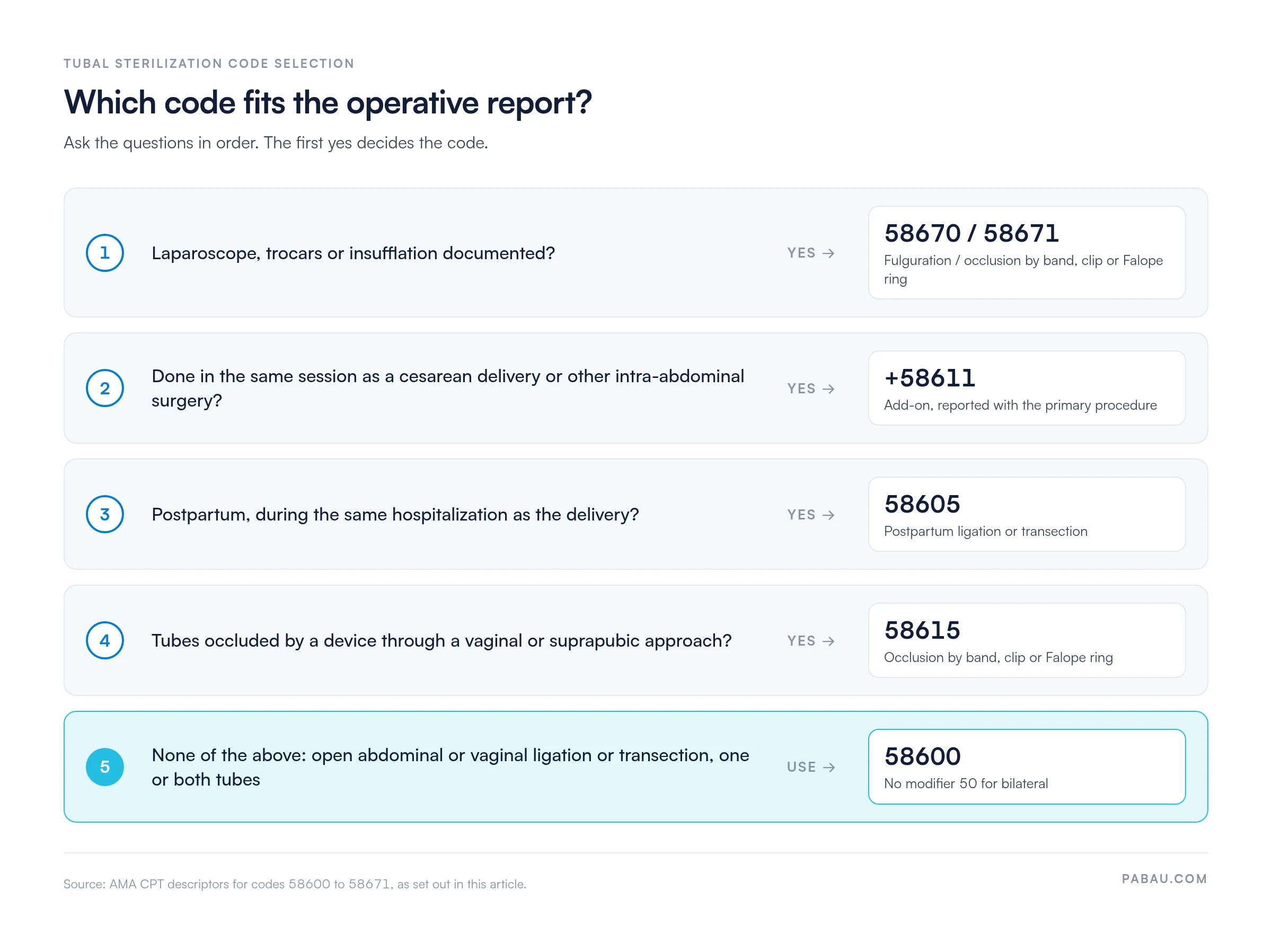
Before finalizing code selection, confirm where the procedure falls in the full code range. The table below covers the codes coders meet most often alongside CPT code 58600 in sterilization billing.
Salpingectomy removes the tube rather than ligating it, so it is never billed as 58600. A laparoscopic removal is 58661, and an open salpingectomy is 58700.
Diagnosis code selection for CPT code 58600 depends on whether the sterilization is elective or medically necessary. Pairing the wrong ICD-10 code with 58600 is a common denial trigger, particularly for Medicaid and Medicare claims where coverage is conditioned on clinical indication.
Z30.2 is the default pairing for elective sterilization. Medicare, however, does not cover voluntary sterilization under NCD 230.3 (discussed below), so submitting Z30.2 to Medicare results in a non-covered denial by design. For more on ICD-10-CM code structure, the CMS ICD-10 codes page publishes annual updates and valid code lists.
Federal Medicaid regulations under 42 CFR Part 441 Subpart F require a voluntary consent form before any sterilization procedure is reimbursed. A missing or late form is one of the most common reasons a Medicaid claim for CPT code 58600 is denied.
Prior authorization is a separate requirement. It varies by state Medicaid program, managed care plan and commercial payer, so verify it through each payer’s provider portal before scheduling. Practices with high Medicaid sterilization volumes should confirm the consent date on a pre-procedure checklist, since a late signature cannot be corrected after surgery.
Medicare does not cover voluntary sterilization under National Coverage Determination (NCD) 230.3. Submitting a CPT code 58600 claim to Medicare for elective sterilization will result in a non-covered denial. Coverage exists only when the sterilization is medically necessary, such as when performed to address tubal pathology rather than for contraceptive intent.
When Medicare does cover a 58600 procedure as medically necessary, reimbursement follows the Medicare Physician Fee Schedule (MPFS). The 2026 figures below are national unadjusted values at the $33.4009 conversion factor. Actual payment varies by locality through the Geographic Practice Cost Index (GPCI) adjustment. Verify current rates using the CMS Physician Fee Schedule lookup tool or a dedicated RVU calculator such as FastRVU’s 2026 lookup.
Important: Facility and non-facility payment are the same for 58600, because its practice expense RVUs are 3.17 in both settings. Locality adjustment moves the final figure, and CMS updates the values each January. Confirm the figure for your locality in the CMS file before quoting it.
An operative report that supports CPT code 58600 must contain specific elements. Auditors reviewing 58600 claims check for each of them. Missing any one can turn a paid claim into a documentation request or a denial on re-audit.
Ensuring clean claim submission starts at documentation, before coding begins. Operative note templates that carry these elements as standard fields cut rework, because the coder no longer has to query the surgeon. Pabau’s digital forms and clinical note templates let OB/GYN teams capture them at the point of care.
Most CPT code 58600 denials follow a short list of predictable patterns, and the claim denial codes on the remittance show which one hit. Each pattern has a prevention step you can build into the billing workflow.
Proactive denial management workflows catch most of these patterns before a claim leaves the practice. The result is fewer first-pass denials and less rework for the billing team.
Build a pre-submission edit rule specifically for CPT 58600. It should flag any claim carrying modifier 50 and any claim with Z30.2 billed to a Medicare payer. It should also flag a missing prior auth number when the payer’s policy requires one. If your clearinghouse supports custom claim edits, set this one up before the next batch.
Without a connected system, billing teams check consent dates, approach language and modifiers by hand. The consent form often sits in a paper chart while the claim lives in a separate billing tool.
Pabau’s OB/GYN claims software keeps the signed consent form, the operative note and the claim in one patient record. Your team submits and tracks each claim electronically through Claim.MD, so the claim status sits next to the documents a payer may request.
When a Medicaid plan asks for the HHS-687 or an auditor asks for the operative report, the answer is one search away.

Pabau stores signed sterilization consent forms with the patient record, then submits and tracks claims electronically through Claim.MD. Your team finds the form and the claim status in one place.

Treat 58600 as the fallback code. Rule out a laparoscopic approach, a cesarean session, a postpartum stay and device occlusion first. Bill 58600 only when the open report clears all four.
A wrong code or a stray modifier 50 can be corrected and resubmitted. A late Consent for Sterilization form (HHS-687) cannot, because the 30-day wait cannot be met after surgery. Put your checking effort into the consent date at scheduling, not into the claim afterward.
Pabau keeps the signed form and the claim in the same patient record, so the consent date is easy to confirm before surgery. Book a demo to see how it fits your OB/GYN billing workflow.

Need a reference for denial code meanings? Denial codes in medical billing explains the most common CARC and RARC codes that appear on 58600 remittances.
Billing anesthesia for the same procedure? CPT code 00851 covers the anesthesia code for tubal ligation and how it is reported.
Seeing a patient who wants the procedure reversed? ICD-10 code Z31.0 covers the diagnosis code for an encounter to reverse a previous sterilization.
Submitting 837P files through a clearinghouse? 837 electronic claim file guide covers the transaction format, required data elements, and how to validate before transmission.
Want to understand ERA reconciliation after claim payment? Electronic remittance advice explains how to read the 835 file and match payments back to the original claim.
CPT code 58600 covers open ligation or transection of the fallopian tube(s), abdominal or vaginal approach, unilateral or bilateral, as a standalone procedure. It does not cover laparoscopic approaches, postpartum ligation during the delivery stay, or procedures performed at a cesarean delivery.
CPT 58600 is for open (abdominal or vaginal) tubal ligation or transection. Laparoscopic sterilization uses 58670 for fulguration or 58671 for occlusion by a band, clip or Falope ring. If the operative report documents trocars, insufflation or a laparoscope, bill 58670 or 58671 rather than 58600.
No. The AMA descriptor for CPT 58600 already states “unilateral or bilateral,” so the code covers both scenarios in one billing unit. Appending modifier 50 creates an overpayment error and audit risk. The same rule applies to modifier LT/RT for bilateral identification purposes.
The 2026 national unadjusted payment is about $332.34, based on 9.95 total RVUs at the $33.4009 conversion factor. Medicare does not cover voluntary sterilization under NCD 230.3, so this applies only when the procedure is medically necessary. Your MAC locality adjusts the final amount.
CPT 58611 is an add-on code for tubal ligation or transection performed at the same session as a cesarean delivery or other intra-abdominal surgery. When sterilization is concurrent with a C-section, report 58611 alongside the delivery code rather than 58600 as a standalone. Code 58611 cannot be billed without a primary procedure code.