ICD-10 Code Y76.0: Diagnostic obstetric and gynecological devices
ICD-10 Code Y76.0: Definition and billable status ICD-10 Code Y76.0 is a valid, ...

Last Updated: Oct 23, 2026
Billable Code Specific Code
Z31.0 is the billable ICD-10-CM code for encounter for reversal of previous sterilization.
The code took effect on October 1, 2025 in the 2026 ICD-10-CM edition. It is valid for reimbursement in inpatient and outpatient settings, as confirmed by the CDC/NCHS ICD-10-CM web tool. Denials on these encounters rarely come from the code choice. They come from what the record does or does not say.
Let Pabau's smart automation suggest the right codes, reduce claim denials, and keep your practice compliant—effortlessly.
Automate repetitive tasks and focus on what matters most—your patients.
Reduce coding errors and ensure compliance with the latest regulations.
Clean claims, fewer denials, and faster reimbursements.
Powerful insights and reporting to help your practice thrive.
HIPAA compliant SOC 2 certified GDPR-compliant Trusted by 4,000+ clinics worldwide

ICD-10 code Z31.0 describes an encounter for reversal of previous sterilization, covering both tubal ligation reversal (tuboplasty) and vasectomy reversal (vasoplasty) under one billable code.
Z31.0 became effective October 1, 2025 as part of the 2026 ICD-10-CM edition. It is billable and valid for reimbursement in inpatient and outpatient settings.
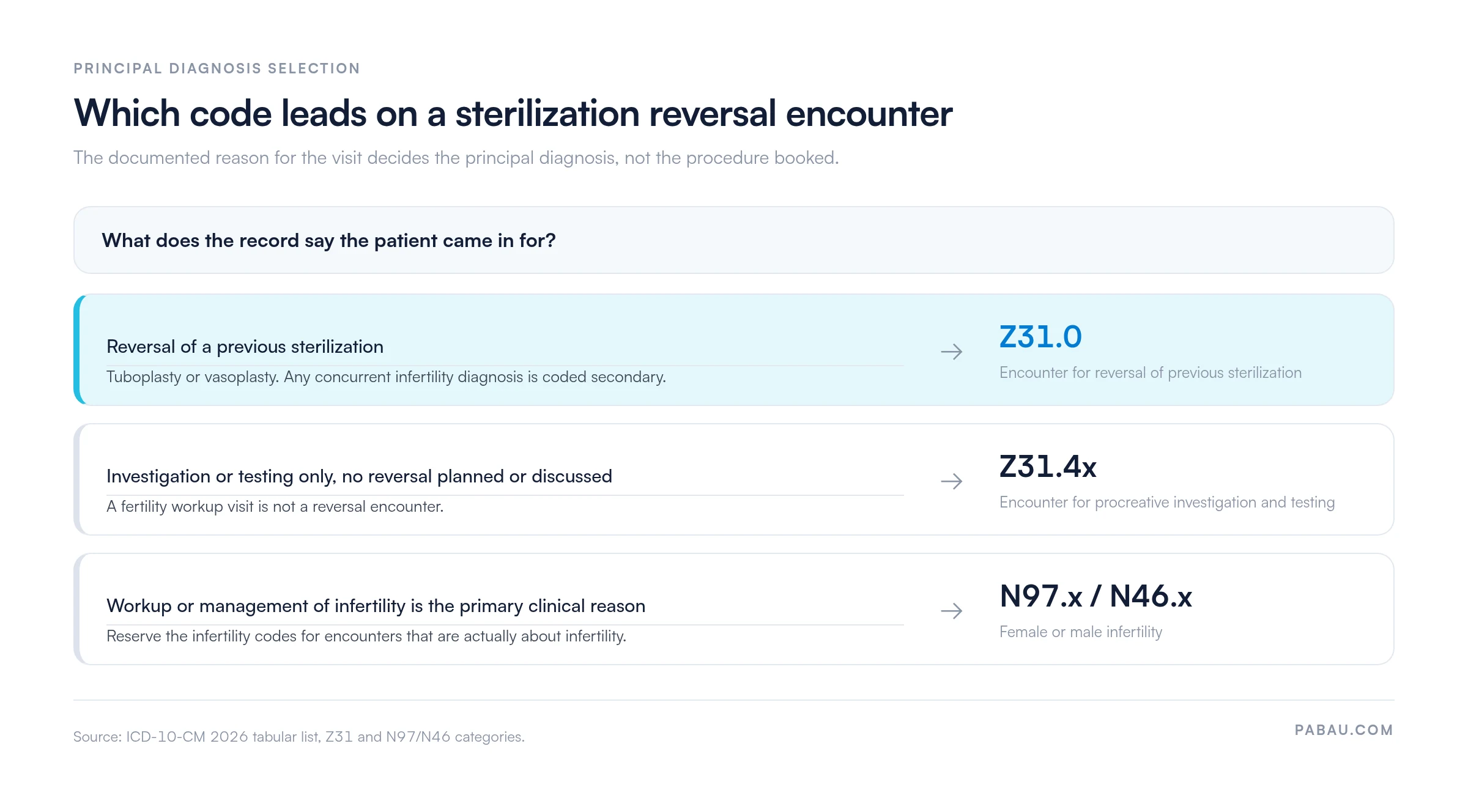
Substituting infertility codes such as N97.x or N46.x is the most common mistake. Z31.0 leads whenever the documented reason for the encounter is the reversal itself.
Practice management software like Pabau helps reproductive health practices document Z31.0 encounters accurately and route clean claims through the Claim.MD clearinghouse.
The official ICD-10-CM Applicable To notes under Z31.0 cover two distinct clinical scenarios. Both fall under the same code regardless of the patient’s sex.
Neither the patient’s sex nor the surgical technique changes the diagnosis code. Z31.0 applies whenever the documented reason for the encounter is reversal of a previous sterilization. A patient may also carry a concurrent infertility diagnosis that needs separate management. Code that diagnosis as secondary and keep Z31.0 as the principal diagnosis.
Z31.0 is a child code of the Z31 parent category, which covers all encounters for procreative management. Knowing the sibling codes helps when the clinical picture is more complex than a straightforward reversal encounter.
The CMS ICD-10 codes page carries the full Z31 tabular list and the annual updates. Bookmark it, because the Z31 subcategory structure is revised each October.
ICD-10 code Z31.0 is the diagnosis code. The procedure performed is captured separately using CPT codes, as confirmed by the AAPC ICD-10-CM code lookup. The codes below are the ones commonly paired with Z31.0 in practice, not guaranteed payer-accepted combinations. Verify current CPT codes with the AMA and confirm coverage policies before you submit.
CPT 55400 is a single code for vasovasostomy, and it covers the repair whether it is unilateral or bilateral. Report a bilateral repair with modifier 50 or with two units, following the payer’s own instructions. There is no separate bilateral vasovasostomy code to reach for.
Coverage for sterilization reversal varies significantly by payer. Medicare generally does not cover these procedures, and private insurer policies differ by plan and by state. Running insurance eligibility verification before the consultation tells you which of those applies to this patient.
Sterilization reversal is frequently excluded from coverage, so check benefits before the consultation is booked rather than at check-in. Knowing early lets your team discuss financial responsibility with the patient and document that conversation in the record.
A correctly assigned Z31.0 still fails a payer audit if the medical record does not support it. Three elements have to appear in the chart.
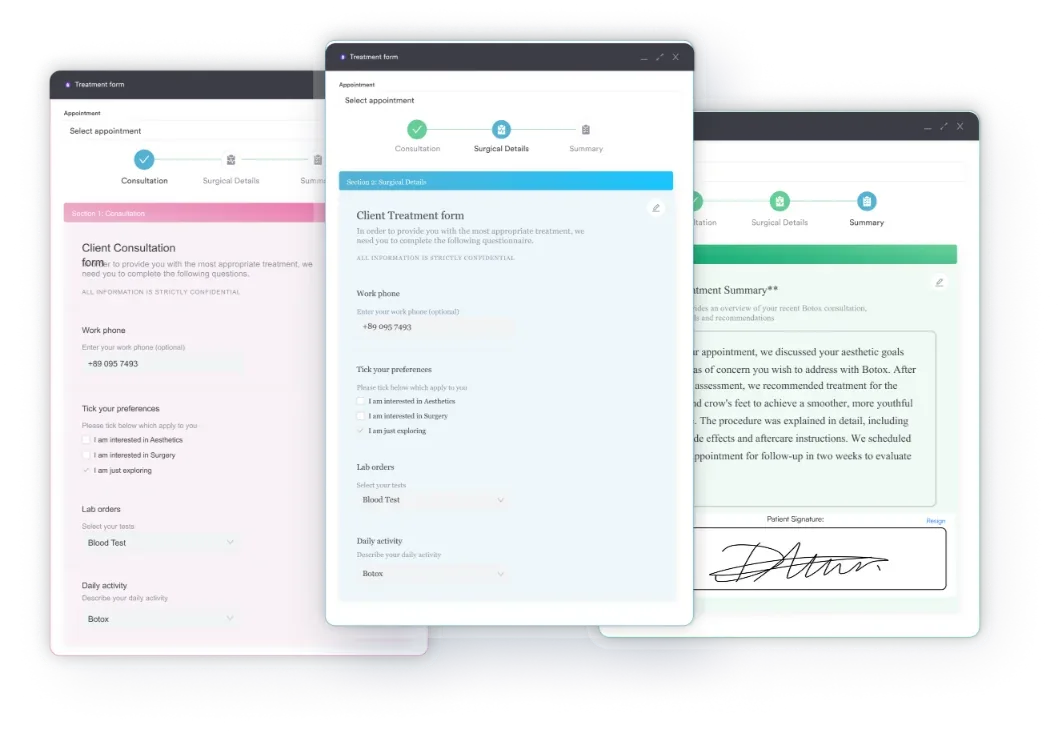
Digital intake forms that prompt for prior sterilization history at registration capture that detail before the clinician opens the chart. Structured fields are also faster to audit than free-text notes when a payer asks for support.
Claim denials on sterilization reversal encounters follow predictable patterns. Most trace back to one of four mistakes, and the first is a decision about which diagnosis leads the claim.
A denial that does slip through arrives with a reason code naming the problem. Our guide to medical billing denial codes explains what the common ones ask a coder to fix before resubmission.
These codes appear most often in the same clinical contexts as Z31.0. Several of them are secondary codes, so read the relationship column before you attach one to a reversal claim.
Reproductive health practices running high volumes of procreative management encounters need a documentation workflow that keeps Z31.0 claims clean from intake through submission. Today that usually means a coder emailing a clinician for a chart amendment days after the visit.
Practice management software like Pabau gives billing teams claims software for practices that connects to Claim.MD, our US clearinghouse partner. Claim.MD routes completed claims to thousands of US payers.
The integration supports real-time eligibility verification, CMS-1500 and 837P electronic claim submission, and ERA/835 remittance processing. Your billing team knows whether the payer has the patient on record as eligible before a claim leaves your system.
Structured intake captures prior sterilization history at registration rather than as an afterthought. That data flows into the clinical record, giving coders the documentation Z31.0 needs without chasing clinicians for amendments.
Denied claims come back through the same connection with structured denial reason codes. Your team can correct and resubmit instead of decoding rejection letters by hand.

Pabau connects reproductive health practices to the Claim.MD clearinghouse for real-time eligibility checks, clean claim submission, and ERA remittance processing. See how structured documentation reduces denials on procreative management encounters.

Record the prior sterilization procedure in a structured field, not just as a line in a progress note. Coders find a dedicated field in the patient history instantly. A note buried in a three-page consult takes minutes to locate under audit pressure.
Z31.0 is a single billable code covering both tubal ligation reversal and vasectomy reversal encounters. Picking it is the easy part. Practices lose clean claims on the documentation behind it: the prior sterilization, the reason for the visit, and the procedure type.
So build the prior sterilization question into your intake forms rather than leaving it to the consult note. That single change puts the supporting history in the chart before a coder goes looking for it. It also costs less than appealing the denial it prevents. Book a demo to see how Pabau keeps procreative management encounters documented and submitted in one workflow.

Submitting IVF procedure codes alongside Z31.0? IVF CPT codes covers the procedure billing side of assisted reproductive technology encounters, including common crosswalk considerations.
Need a clearinghouse that handles reproductive health claims? Claim.MD vs Office Ally compares the two US clearinghouses most commonly used by specialty practices on volume reproductive health billing.
Coding a contraception encounter next? ICD-10 code Z30.46 walks through the surveillance code for implantable contraceptives and the documentation payers expect with it.
Z31.0 is a billable ICD-10-CM diagnosis code used to report an encounter for reversal of previous sterilization. It applies when a patient presents specifically to undergo tuboplasty (tubal ligation reversal) or vasoplasty (vasectomy reversal) to restore fertility after a prior sterilization procedure. The code covers both male and female patients, and it is valid in inpatient and outpatient settings.
Yes. Z31.0 is a billable and specific ICD-10-CM code valid for reimbursement purposes as of the 2026 edition, effective October 1, 2025. It can be reported as the principal or primary diagnosis on claims submitted to payers. Coverage of the underlying reversal procedure varies by payer, particularly for Medicare and Medicaid, so verify individual payer policies before submission.
CPT 58750 (tubotubal anastomosis) and CPT 58752 (tubouterine implantation) are commonly used with Z31.0 for tubal ligation reversal. CPT 55400 (vasovasostomy) covers vasectomy reversal, whether the repair is unilateral or bilateral. Report a bilateral repair with modifier 50 or two units, per the payer’s instructions. Verify these pairings against current AMA CPT guidance before submission.
Yes. The official Applicable To notes under Z31.0 include tuboplasty for reversal of previous sterilization, which is tubal ligation reversal. They also include vasoplasty, which is vasectomy reversal. The code applies regardless of patient sex. The distinction between the two procedures is captured at the CPT level, not at the ICD-10 diagnosis level.
The medical record must document three things. First, the reason for the encounter as a sterilization reversal. Second, a confirmed history of prior sterilization, including the type and approximate date. Third, the specific procedure type planned. A note that records only a desire for pregnancy is not enough. Missing any of these elements creates audit exposure and may trigger a denial or a request for records.
Z31.0 became effective on October 1, 2025 as part of the 2026 ICD-10-CM edition. ICD-10-CM codes are updated annually by the National Center for Health Statistics (NCHS) and CMS. Practices should verify code validity each October, when the new edition takes effect. Check the code description, the Applicable To notes, and the parent category structure.