



CCSD code G5100: Bypass of duodenum billing guide
CCSD code G5100 bills a bypass that leaves the duodenum in place CCSD code G5100...

Last Updated: Oct 16, 2026

CPT code 58301 describes removal of an intrauterine device (IUD). It sits in the Introduction Procedures on the Corpus Uteri section, codes 58300 to 58356.
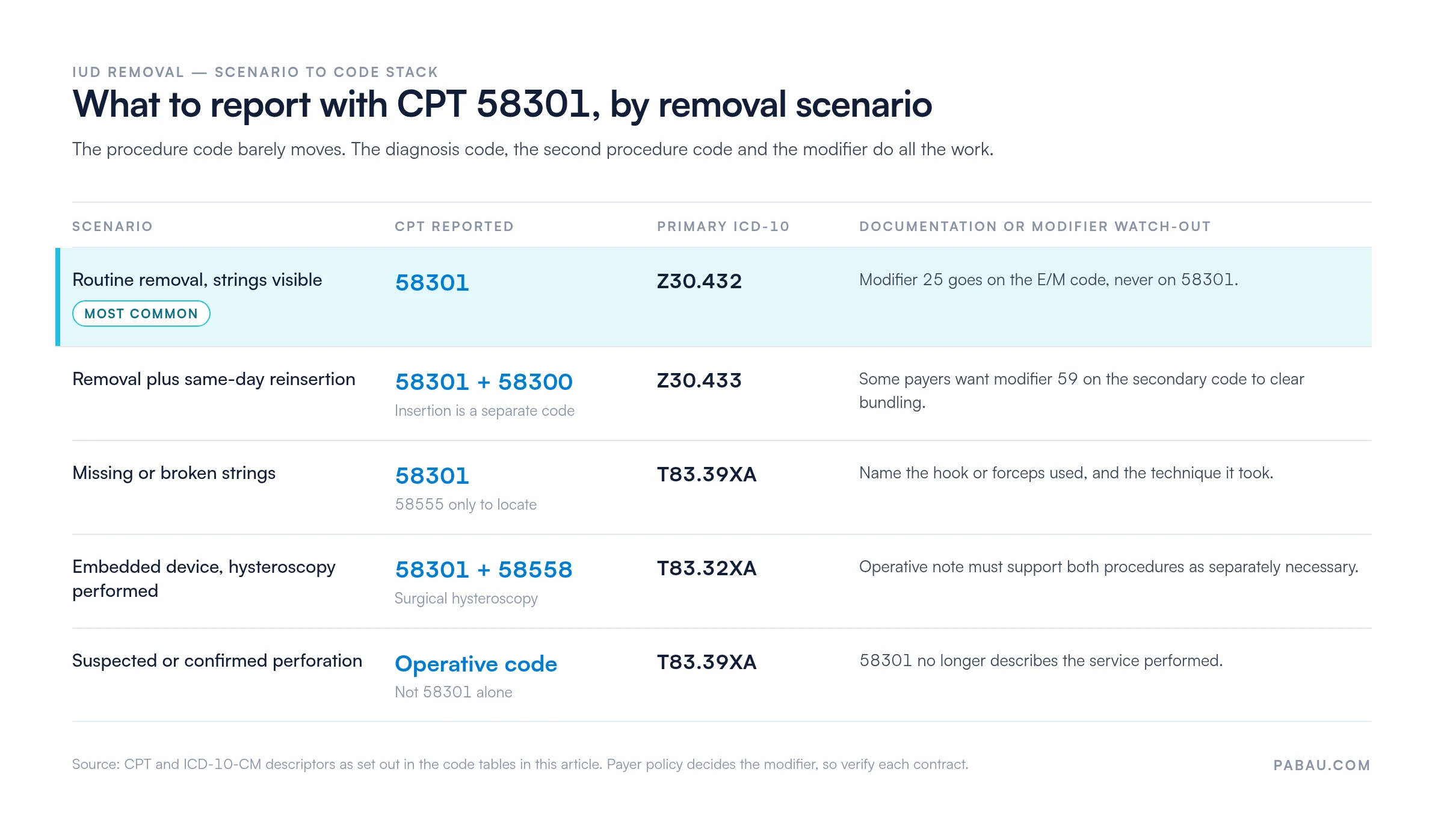
The diagnosis code carries the claim: Z30.432 for a routine removal, Z30.433 for same-day removal and reinsertion, and T83.39XA for a mechanical complication.
Medicare values 58301 at 1.24 work RVUs and 3.34 total non-facility RVUs, which works out near $108 at the 2025 conversion factor.
No dedicated CPT code exists for a complicated IUD removal. You still report 58301, plus a hysteroscopy code such as 58558 where the note supports it.
Practice management software like Pabau links the removal note, the ICD-10 pairing, and claim submission in one ob-gyn billing workflow.
CPT code 58301 is the procedure code for removal of an intrauterine device (IUD). According to the American Medical Association (AMA), which maintains the CPT code set, the short descriptor is “removal of intrauterine device (IUD).” The code sits within the Introduction Procedures on the Corpus Uteri subsection, which spans codes 58300 through 58356.
The 0-day global period means a separate E/M service on the same date is billable. It has to be separately identifiable, and modifier 25 goes on the E/M code rather than on 58301. Verify the current global period assignment in the CMS Physician Fee Schedule lookup tool, since CMS updates this data annually.
IUD removal is indicated across a range of clinical scenarios. The procedure itself is usually brief. A clinician uses ring forceps or a similar instrument to grasp the IUD strings and withdraw the device. When the strings are absent or the device is embedded, the removal becomes far more involved, as the difficult removal section below sets out.
Common clinical indications for reporting CPT code 58301 include:
Documentation should specify the clinical indication clearly. Payers increasingly require the note to connect the removal reason to the ICD-10 code selected. A vague entry like “patient request”, with no supporting diagnosis, can trigger a medical necessity review.
Selecting the right ICD-10-CM code is where many 58301 claims fail. The diagnosis code must reflect the reason for removal, not just the fact of removal. Verify all codes against the current CDC/NCHS ICD-10-CM web tool before submitting claims.
For routine elective removals, Z30.432 is the most defensible primary diagnosis. When the scenario involves a complication, lead with the complication code from the T83 range. List Z97.5 as a secondary code where the payer’s LCD requires device status documentation. Our ICD-10-CM code library carries the neighboring Z30 and T83 codes if the note points somewhere more specific.
Medicare reimburses CPT 58301 under the Physician Fee Schedule (PFS). Payment varies by geographic location using the Geographic Practice Cost Index (GPCI). The RVUs below are the national values, before the GPCI adjustment for your locality. Verify locality-specific rates in the FastRVU 2026 RVU lookup tool or the official CMS PFS search. Rates are subject to annual adjustment.
At the 2025 conversion factor, 3.34 non-facility RVUs works out to roughly $108 for an office removal. The same procedure in a facility setting carries 1.73 total RVUs, or about $56, because the practice is not absorbing the supply and staff cost.
Setting shifts the payment for 58301, but other codes are tied to one facility type outright. HCPCS code G0128 is payable only inside a Medicare-certified comprehensive outpatient rehabilitation facility, and identical nursing work in home health uses separate codes.
Most commercial payers set their rates as a percentage of the Medicare fee schedule. In-network ob-gyn contracts typically land between 100% and 140% of it. Reconciling each remittance line against the contracted rate is the only reliable way to spot a payer paying below it.
Run a quarterly fee schedule audit for CPT 58301. Pull your paid claims, compare each ERA payment against the contracted rate for that payer, and flag any variance above 10%. Underpayment on a low-RVU code like 58301 goes unnoticed because each claim is small. At 200 removals a year, the aggregate loss stops being small.
Five modifiers come up with 58301: 25, 51, 52, 59 and XU. Modifier selection here is one of the most disputed areas in ob-gyn billing, and appending the wrong one is a leading driver of denials. Practice management software like Pabau builds those rules into automated claims management. The coder gets prompted at the point of entry instead of working from memory.
Modifier 25 is the most misapplied. It goes on the E/M code, not on 58301. The note must show that the E/M service was a decision-making encounter distinct from the removal itself. Payers auditing ob-gyn practices frequently target same-day E/M plus minor procedure combinations. Write the modifier rationale into the note at the point of coding, not into an appeal after the denial arrives.
A patient can have one IUD removed and a new device inserted at the same visit. Both CPT 58301 for the removal and CPT 58300 for the insertion are typically billable. The American College of Obstetricians and Gynecologists (ACOG) confirms this in its LARC Quick Coding Guide. However, same-day billing of both codes requires specific documentation and the correct ICD-10 selection.
Capturing the removal and the insertion as discrete line items on the encounter form is what keeps them unbundled downstream. A single combined entry gives the biller nothing to split.
No dedicated CPT code exists for a complicated IUD removal. CPT code 58301 is used regardless of difficulty. The clinical scenario still drives the documentation requirements, any additional codes, and the risk of audit scrutiny.
Complicated removals typically involve one of three scenarios:
Maintain detailed operative notes for any difficult removal. Payers treat 58301 as a low-complexity code, so a supplemental code without supporting documentation is a primary audit trigger.
The procedure code barely moves across these scenarios. What changes is the diagnosis code, the second procedure code and the modifier, as the matrix below sets out.
A HCPCS Level II J-code applies when the practice supplies and administers the device, rather than the patient bringing it. That code is billed alongside 58300 for the insertion, or 58301 where the visit is a removal. J-code billing policies vary significantly by payer. Some bundle the device cost into the procedure code, while others reimburse it separately. Always verify with the individual payer before billing both a J-code and a procedure code on the same claim.
A removal-only visit rarely carries a J-code, because the practice is not supplying a device. Where a new IUD goes in at the same visit, the relevant J-code rides on the 58300 line rather than the 58301 line.
Practices that stock devices in-house should check the payer rules for J7298 before the reinsertion visit, not after the claim rejects. Validating the J-code against the procedure code at submission catches a bundling edit while the claim is still editable.
Knowing which codes sit next to 58301 in the CPT manual helps coders pick the most accurate one. The coding reference AAPC Codify lists the full 58300-58356 range with descriptors and crosswalk data. AAPC is a coding education company, so treat the AMA’s own CPT publication as the authority where the two differ.
Earlier in the same corpus uteri section, CPT 58100 covers an endometrial biopsy taken without cervical dilation. Where a biopsy is sampled at the same visit as the removal, check the current NCCI tables before billing both lines.
Routine IUD removal is covered by most commercial plans without prior authorization. The Affordable Care Act requires most non-grandfathered commercial plans to cover FDA-approved contraceptive methods, including LARC management, without cost-sharing. Coverage of the removal procedure itself still varies by payer and by how the plan reads that requirement. Verify each patient’s benefits before the visit rather than assuming.
Practices with high LARC volumes see fewer payer-specific rejections when their claims run through a validated clearinghouse. Checking eligibility in real time before each removal appointment surfaces a lapsed plan or an unmet deductible while the visit can still be rescheduled.
Build a pre-visit benefit verification step into your IUD removal scheduling workflow. Confirm the coverage category for 58301, whether the visit applies to the deductible, and the prior auth requirements for that payer. Five minutes before the appointment saves a 30-minute appeal afterwards.
In most ob-gyn practices, 58301 gets coded from memory or a printed cheat sheet. The coder picks the diagnosis, checks whether the payer bundles 58300, and hopes the note supports the modifier. That lookup runs hundreds of times a year, and it is where the variance creeps in.
Pabau keeps the code set inside the clinical record instead. The removal note, the ICD-10 pairing, the modifier and any device J-code sit on one screen. The claim gets built from what the clinician documented, so no one retypes it from a superbill afterwards.
Claims then go out electronically through the clearinghouse connection, with edit checks running before transmission. Your coders spend their time on the removals that were genuinely complicated, not on reworking the routine ones.

Pabau connects CPT code entry, ICD-10 pairing, and electronic claim submission in one platform. Your team spends less time on lookups and more time with patients.

IUD removal reads like a one-code procedure, and that is exactly why it generates so many ob-gyn claim errors. The judgment sits in the diagnosis code and the modifier, not in the 58301 line itself.
So make the decision once and reuse it. A coder who knows the three rules will clear most of these claims first time. Z30.432 covers the routine case, Z30.433 carries the reinsertion visit, and modifier 25 belongs on the E/M code.
What is left is documentation good enough to survive a records request. Book a demo to see how Pabau ties the removal note to the codes your ob-gyn claims get paid on.

Billing the Mirena device alongside the removal? HCPCS code J7298 sets out how the 52 mg levonorgestrel device is reported, reimbursed and bundled.
Supplying a lower-dose device instead? HCPCS code J7296 covers Kyleena at 19.5 mg, including payer coverage and documentation requirements.
Want to reduce claim rejections across your practice? Denial management in healthcare outlines how to catch and reverse denied claims before they reach your write-off column.
Not sure what makes a claim payable first time? What is a clean claim explains the data a payer needs on the first pass, and what triggers a rework.
Reconciling what the payer actually paid? Electronic remittance advice shows how to read an ERA and match each payment line against your contracted rate.
CPT code 58301 is used to report the removal of an intrauterine device (IUD). It covers routine removals in an office setting, as well as complicated extractions where missing strings or device displacement requires additional instruments or techniques. The code falls under the Introduction Procedures on the Corpus Uteri section (58300-58356) of the CPT code set.
The most common ICD-10-CM code paired with CPT 58301 is Z30.432 (encounter for removal of intrauterine contraceptive device) for routine elective removals. T83.39XA is used for mechanical complications such as device displacement or malposition. Z30.433 applies when removal and reinsertion occur on the same visit.
Yes. Both codes are billable on the same date when one device comes out and a new one goes in at the same visit. Report 58301 for the removal and 58300 for the insertion. Use ICD-10 code Z30.433 as the primary diagnosis, and confirm whether the payer requires modifier 59 on the secondary code to prevent bundling.
Modifier 25 is appended to the E/M code, never to 58301. It applies when a separately identifiable office visit is documented on the same date as the removal. Modifier 51 applies when 58301 is performed alongside a second procedure on the same date. Modifier 59 signals distinct procedural service when 58301 and 58300 are billed together and the payer requires explicit unbundling.
No dedicated CPT code exists for a complicated or difficult IUD removal. CPT 58301 is still reported. When hysteroscopy is needed to complete the removal, add the surgical hysteroscopy code CPT 58558 as a separately documented service. CPT 58555 covers diagnostic hysteroscopy only, so it fits locating missing strings rather than completing the removal.
J7298 is the HCPCS code for the levonorgestrel-releasing IUD at 52 mg (Mirena). It is typically billed alongside CPT 58300 (insertion) when the practice supplies the device, not alongside 58301 (removal only). Payer bundling policies vary. Verify whether the J-code is separately reimbursable before billing it on the same claim as the procedure code.
Medicare reimbursement for CPT 58301 varies by locality through the GPCI adjustment. The code carries 1.24 physician work RVUs and 3.34 total non-facility RVUs. At the 2025 conversion factor of about $32.35, that puts an office removal near $108, and a facility-setting removal near $56. Verify the current rate for your locality in the CMS Physician Fee Schedule lookup tool.



