CPT code 51797: Intra-abdominal voiding pressure add-on
What CPT code 51797 covers CPT code 51797 is the add-on code for intra-abdominal...

Last Updated: Oct 19, 2026
55530 is the CPT code for excision of varicocele or ligation of spermatic veins for varicocele; (separate procedure). It covers open repair through an inguinal or subinguinal incision, while the abdominal approach is CPT 55535 and laparoscopic ligation is CPT 55550.
Most denials on this code trace to five causes: bundling edits, bilateral coding, ICD-10 mismatch, missing prior authorization, and 69990 exclusions.
Let Pabau's smart automation suggest the right codes, reduce claim denials, and keep your practice compliant—effortlessly.
Automate repetitive tasks and focus on what matters most—your patients.
Reduce coding errors and ensure compliance with the latest regulations.
Clean claims, fewer denials, and faster reimbursements.
Powerful insights and reporting to help your practice thrive.
HIPAA compliant SOC 2 certified GDPR-compliant Trusted by 4,000+ clinics worldwide

CPT 55530 covers open varicocele repair through an inguinal or subinguinal incision. The abdominal approach is 55535, and laparoscopic ligation is 55550.
Bill a bilateral repair as 55530 with modifier 50 where the payer allows it, and keep 55540 for cases with a same-session hernia repair.
The code carries a separate procedure designation, so NCCI edits can bundle it into a more comprehensive scrotal procedure performed the same day.
ICD-10 I86.1 (scrotal varices) is the primary diagnosis, and a male infertility code (N46.x) strengthens medical necessity for most commercial payers.
Most commercial payers require prior authorization, so document the exam, ultrasound or semen analysis findings before the surgery date.
CPT code 55530 describes “Excision of varicocele or ligation of spermatic veins for varicocele; (separate procedure).” It covers open varicocele repair through an inguinal or subinguinal incision and carries a 90-day global period. The American Medical Association places it in the Spermatic Cord subsection (55500-55559) of the Male Genital System (54000-55899). The “separate procedure” label means NCCI bundling edits apply, so check them before you submit a claim.
CPT 55530 covers open varicocele repair through an inguinal or subinguinal incision. The descriptor does not separate these two approaches, so both are coded the same way. It also groups two techniques under one code: excising the varicocele and ligating the spermatic veins.
Clinical indications listed in urology coding resources include varicocele-associated male infertility, scrotal pain, and testicular atrophy. Most commercial payer policies require at least one of these in the chart. Infertility is the indication payers cite most often when they authorize surgery.
Picking the wrong code in this family is a common reason varicocelectomy claims come back to the practice. A code selection error can’t be fixed with an appeal. It needs a corrected claim.
The decision path below starts from the base code. It then adds the two items that change the claim line: modifier 50 for a bilateral open repair and add-on 69990 for an operating microscope.
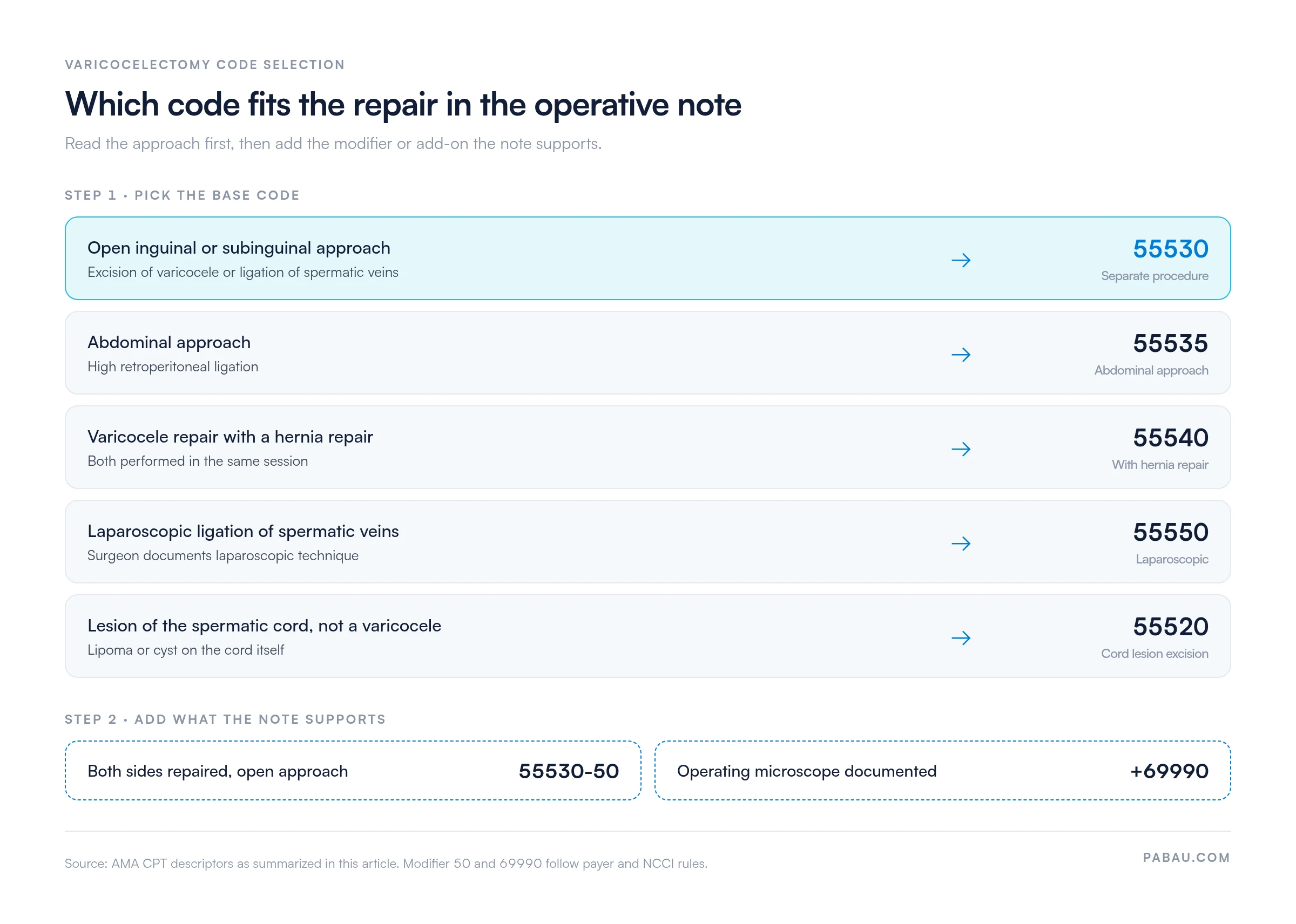
CPT 69990 (microsurgical techniques requiring use of operating microscope) may be appended to CPT 55530. It applies when the surgeon performs a subinguinal varicocelectomy with an operating microscope. The AAPC coding community treats the pairing as reportable when microscope use is medically necessary and clearly documented. Four rules govern it.
Run a quarterly internal audit on your 55530 claims by pulling every instance where 69990 was appended. Cross-reference the operative reports to confirm the note documents operating microscope use, not just microscope availability. This audit catches a frequent post-payment recovery finding on microsurgical varicocelectomy claims.
Every CPT 55530 claim needs at least one supporting ICD-10-CM diagnosis code. The primary code is almost always I86.1 (scrotal varices), though payers differ on what they accept as medical necessity support. Check current ICD-10-CM tabular listings in the CDC ICD-10-CM web tool to confirm active status and descriptors before filing.
Adding a secondary male infertility code alongside I86.1 strengthens medical necessity when the chart documents infertility. Many commercial payers restrict coverage to patients with documented semen analysis abnormalities. Aetna’s Clinical Policy Bulletin 0413 on varicocele treatment is one example, which makes the infertility code critical rather than optional.
Medicare reimburses CPT 55530 under the Resource-Based Relative Value Scale (RBRVS). National unadjusted rates shift each year with the conversion factor update. Use the CMS Physician Fee Schedule lookup tool to get the locality-adjusted figures for your practice’s ZIP code. Geographic adjustment multipliers vary substantially across the country.
Commercial payers typically pay a percentage of the Medicare allowed amount or negotiate their own fee schedule rates. Before submission, check that the superbill carries the same CPT code, modifier and ICD-10 codes as the operative note.
Always pull the locality-adjusted fee schedule rather than the national unadjusted rate. An urban practice can see noticeably higher reimbursement than a rural one for the identical CPT code. Use the CMS MPFS lookup with your Medicare Administrative Contractor (MAC) jurisdiction and ZIP code to get the figure that appears on your EOBs.
Most commercial payers put CPT 55530 through a prior authorization process before surgery. It is the step that most directly decides whether a claim pays on first submission.
Authorization criteria vary by payer and plan year, but major commercial insurers commonly ask for the items below. Check each payer’s current clinical policy bulletin before you submit a request. Aetna CPB 0413 and similar documents are updated periodically, so cite the version that matches the current plan year.
The operative note is the claim’s foundation. Every element listed below maps to a specific denial or audit risk that medical billing workflows should verify before submission. A clean claim submission for CPT 55530 needs all of them present and consistent across the pre-op note, operative report, and claim form.
Denials on CPT 55530 cluster around five distinct failure patterns. Recognizing the pattern tells you the right response. Some need an appeal with clinical documentation, others need a corrected claim, and some need policy verification before resubmission.
Proactive denial management workflows that check NCCI bundling edits before submission catch most of the first two denial types early. When a claim does come back, the denial codes on the remittance tell your team whether to appeal or send a corrected claim.
A bilateral varicocelectomy in one session is reported as 55530 with modifier 50. CPT 55540 is not a bilateral code. It describes varicocele repair performed with a hernia repair, and payer policy only decides how the modifier 50 line is formatted.
Use this decision logic before you submit a bilateral claim. If you know bilateral surgery is planned, check the payer’s policy before the procedure.
The CPT code itself (55530, 55535 or 55550, depending on approach) does not change for adolescents. What changes is the medical necessity documentation and the payer authorization pathway. Practices coding adolescent varicocelectomy should note the following.
Many urology practices still key each varicocelectomy claim into a clearinghouse portal by hand. Then someone checks payer websites for its status and matches the payment against a spreadsheet.
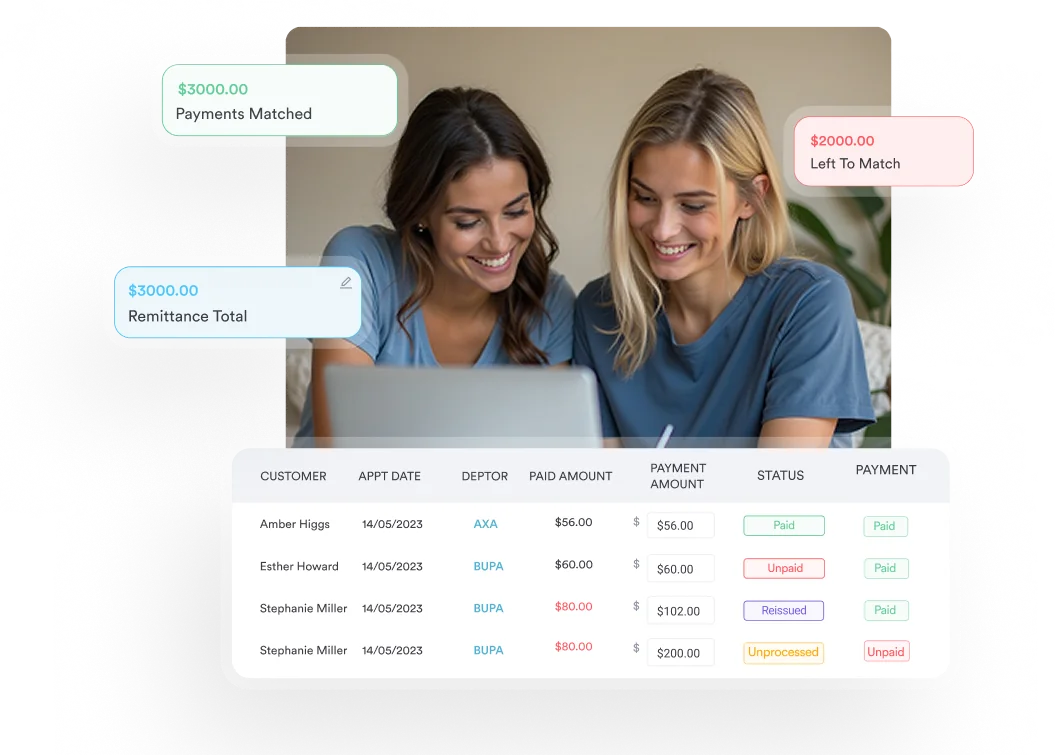
Pabau’s claims management software sends the claim electronically through the Claim.MD clearinghouse from the patient record. It runs real-time eligibility checks, tracks each claim’s status, and posts electronic remittance advice (ERA) when the payer pays.
Your coders still choose 55530, the modifier and the ICD-10 codes. Pabau carries those choices to the payer and shows the response in one place, so your billing team spends less time chasing claim status.

Pabau sends varicocelectomy claims through Claim.MD, checks eligibility in real time, and posts ERAs against each claim. Book a demo to see the workflow in a urology billing team.

Most 55530 denials trace to five failure patterns, and each one starts before the claim reaches the payer. Bilateral coding, the ICD-10 pairing, NCCI bundling, prior authorization and the 69990 add-on are all settled at the desk.
That makes the pre-submission check the best place to spend your team’s time. Confirm the approach code and laterality from the operative note, attach the diagnosis the chart supports, and secure authorization before the surgery date.
If your practice bills this code often, turn that check into a written checklist and run it on every claim. Book a demo to see how Pabau tracks each varicocelectomy claim from submission to payment.

Need to understand how clearinghouse submissions reduce 55530 denial rates? Medical claims clearinghouse guide walks through how electronic claim routing catches coding conflicts before payer adjudication.
Confused about ERA reconciliation after varicocelectomy claims pay? Electronic remittance advice explained covers how 835 transaction files report payment, adjustment, and denial reasons back to your practice.
Want to understand how IVF and male fertility procedures are coded together? IVF procedure coding reference covers the CPT codes used alongside fertility diagnosis codes when varicocele repair is part of a broader infertility treatment plan.
Preparing a varicocelectomy authorization request? Medical prior authorization form gives you a structured template for sending the request to the payer.
CPT code 55530 covers excision of varicocele or ligation of spermatic veins for varicocele through an open inguinal or subinguinal approach. It does not cover the abdominal approach (use 55535), laparoscopic varicocelectomy (use 55550), or excision of a lesion on the spermatic cord (use 55520). A bilateral repair is billed as 55530 with modifier 50 per payer rules. Use 55540 only when a hernia repair was also performed.
CPT 55530 carries a “separate procedure” designation in the AMA CPT code set. That makes it subject to NCCI bundling edits when billed with a more comprehensive procedure on the same date of service. If the varicocelectomy is the only procedure performed, no bundling issue applies. If it accompanies a higher-level scrotal or spermatic cord procedure, check the current NCCI table first. Apply a modifier (59 or an X-modifier) only when a separate and distinct service is documented.
ICD-10-CM I86.1 (scrotal varices) is the primary code for virtually every CPT 55530 claim. For infertility-driven indications, a secondary N46.x code (male infertility) strengthens medical necessity. Commercial payer policy bulletins such as Aetna CPB 0413 often require it for prior authorization. For pain-driven cases without infertility, N50.82 (scrotal pain) supports the surgical indication when failed conservative management is documented.
Yes. Report a bilateral varicocelectomy as 55530 with modifier 50, where the payer and the MPFS bilateral indicator allow it. Some payers want a single line (55530-50), while others want two claim lines. CPT 55540 is not the bilateral code, because it describes varicocele repair with a hernia repair. Confirm the payer’s format before the procedure, and document both sides explicitly in the operative report.