CPT Code 25210: Excision of a single carpal bone
CPT Code 25210: Official descriptor and quick-reference data CPT Code 25210 is a...

Last Updated: Nov 26, 2026
CPT code 50593 reports percutaneous cryotherapy ablation of one or more renal tumors in one kidney. The official descriptor reads "Ablation, renal tumor(s), unilateral, percutaneous, cryotherapy." You report it once per kidney per session, however many tumors are frozen.
When the physician treats both kidneys in one session, add modifier 50 or use RT and LT lines, per payer policy. Imaging guidance is billed separately, and radiofrequency ablation belongs to 50592. Most denials on this code trace back to the side treated or the energy source used.
Let Pabau's smart automation suggest the right codes, reduce claim denials, and keep your practice compliant—effortlessly.
Automate repetitive tasks and focus on what matters most—your patients.
Reduce coding errors and ensure compliance with the latest regulations.
Clean claims, fewer denials, and faster reimbursements.
Powerful insights and reporting to help your practice thrive.
HIPAA compliant SOC 2 certified GDPR-compliant Trusted by 4,000+ clinics worldwide

CPT code 50593 reports percutaneous cryotherapy ablation of one or more renal tumors in one kidney, once per session.
When both kidneys are treated in one session, report bilateral work with modifier 50 or RT/LT, per payer policy.
Radiofrequency ablation goes to 50592, laparoscopic ablation to 50542 and open cryosurgical ablation to 50250.
Imaging guidance is not included in 50593, so report 77013, 76940 or 77022 separately when it is documented.
The operative note should name the side, the percutaneous approach, the freezing method and the guidance used.
CPT code 50593 reports percutaneous cryotherapy ablation of one or more renal tumors in a single kidney. The AAPC Urology Coding Alert confirms that the percutaneous renal ablation codes are unilateral. CPT directs you to append modifier 50 when both kidneys are treated. The surgeon places cryoprobes through the skin, freezes the tumor and confirms the ice ball on imaging.
Tumor count does not change the code. You report 50593 once per kidney per session, whether the physician treats one lesion or three.
Both percutaneous codes are unilateral. The difference is how the tumor is destroyed. 50592 covers radiofrequency ablation, which heats the tissue. 50593 covers cryotherapy, which freezes it.
Approach then separates the percutaneous codes from the surgical ones. 50542 is laparoscopic ablation of renal mass lesions, with intraoperative ultrasound included when performed. 50250 is open cryosurgical ablation, also with intraoperative ultrasound included.
Read the operative note for two facts before you pick a code. First, how did the surgeon reach the kidney? Second, did the probes freeze or heat the tissue? A laparoscopic note cannot support 50593, and a radiofrequency note cannot either. The panel below adds the side and imaging questions that finish the claim.
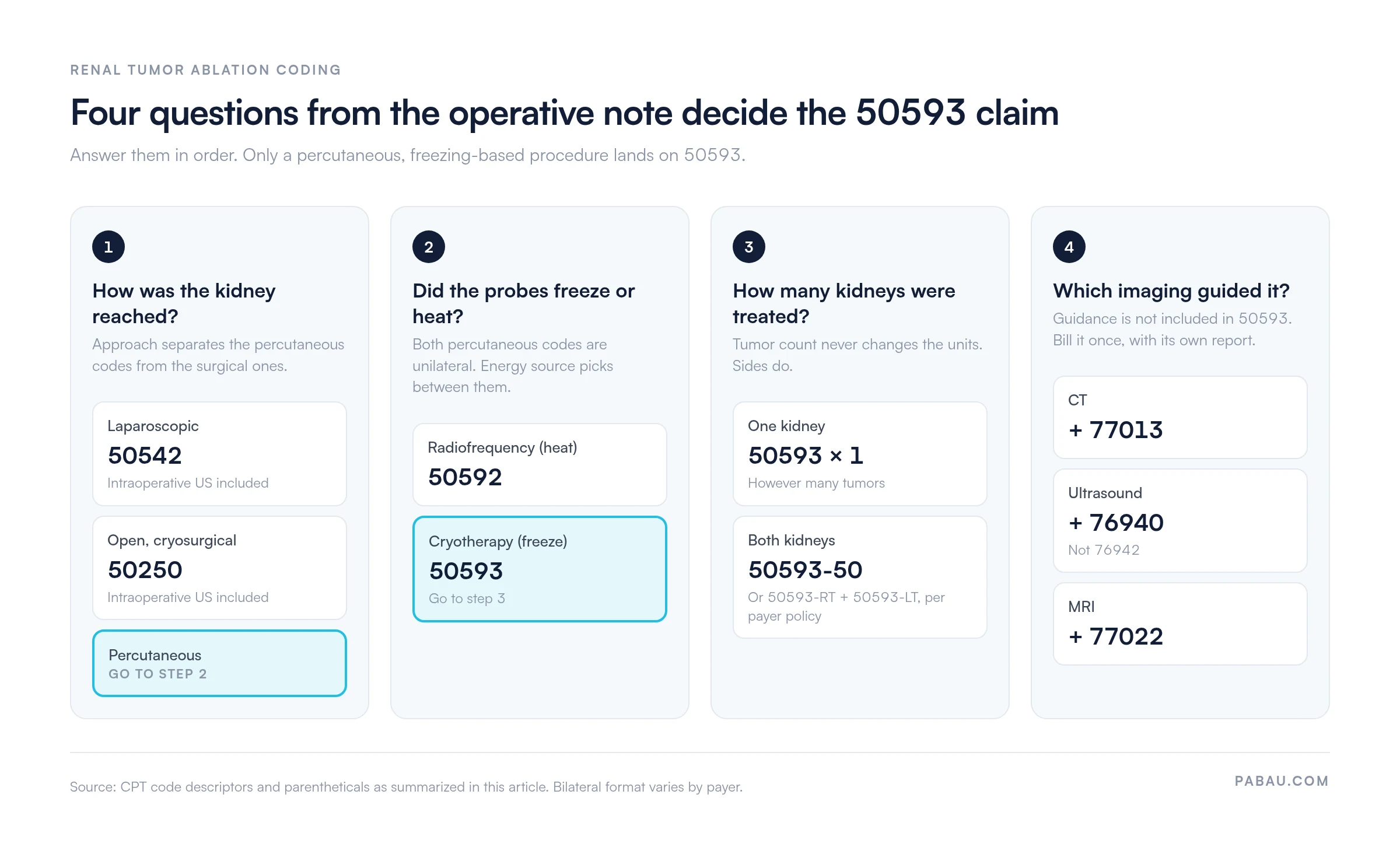
The CPT parenthetical for the percutaneous ablation codes directs you to modifier 50 when the physician treats both kidneys. Payers differ on the format they accept, though. Some want 50593-50 on one line. Others want two lines with RT and LT, and some ASC claims reject modifier 50 outright.
Work through a bilateral case in this order:
Example: A patient with tumors in both kidneys has CT-guided cryoablation of the right kidney and the left kidney in one session. For a Medicare professional claim, you would typically report 50593-50 plus 77013. For a commercial payer that asks for side modifiers, you would report 50593-RT and 50593-LT instead.
Medicare prices bilateral claims through its own bilateral surgery rules. Look up the code’s bilateral indicator in the fee schedule rather than assuming a fixed percentage.
50593 does not include imaging guidance. When the physician documents it, report the matching tissue-ablation guidance code alongside the procedure. Check the current NCCI procedure-to-procedure table for the quarter, as edits can change.
A common slip is choosing 76942 for ultrasound. That code covers needle placement for biopsy or aspiration, so it does not fit ablation monitoring. 76940 is the ablation code.
Support the guidance code with stored images and a separate written report. The report should say the imaging guided probe placement and monitored the ablation zone.
Don’t add 76940 to 50250 or 50542. Both descriptors already include intraoperative ultrasound when performed, so a separate ultrasound guidance line is not supported.
Medicare pays 50593 through the Medicare Physician Fee Schedule (MPFS), adjusted by setting and location. Values change every year, so pull current figures from the CMS Physician Fee Schedule lookup tool before you quote them.
The FastRVU lookup tool offers a quick second check by location. To estimate payment, multiply the GPCI-adjusted total RVUs by the current conversion factor.
Medicare covers percutaneous renal cryoablation when the record supports medical necessity. Check your Medicare Administrative Contractor (MAC) for any local policy. Commercial payers set their own criteria, so read the plan’s tumor ablation policy before you schedule.
Payer policies tend to look for the same elements:
Side matters on the diagnosis line too. A malignant tumor in the right kidney is C64.1, and the left kidney takes C64.2. Check the benign D30 codes in the ICD-10-CM code library the same way.
Traditional Medicare rarely asks for prior authorization here. Medicare Advantage and commercial plans often do. Build the request into scheduling, because a claim without a required authorization will deny as “authorization not on file.”
Coders can only report what the note supports. For 50593, make sure it covers these points:
Most 50593 denials trace back to a short list of causes. Fixing them at the source is cheaper than appealing them, a point our guide to denial management covers in more depth.
NCCI procedure-to-procedure edits update every quarter. Treat the points below as a starting check, then confirm against the current table.
50593 is mostly done in hospital outpatient departments and ASCs, sometimes as an inpatient. The POS code must match the setting, because the professional payment changes with it.
Confirm the POS code at charge entry rather than at billing. Our guide to clean claim submission walks through the rest of that front-end check.
Bilateral renal ablation claims often stall on small things, such as a missing authorization code or the wrong side modifier. Those slips are easier to catch when the claim is built from the patient record.
Pabau, a practice management platform with built-in claims management, pre-fills the claim from the record. The CPT code attached to the service lands on the charge line. Pabau tracks the authorization code on the case and warns you when one is missing before the claim goes out.
In the US, Pabau’s Claim.MD integration sends CMS-1500 and 837P claims. It also runs eligibility checks, posts ERAs and handles secondary claims, so your team can follow a 50593 claim from scheduling to payment.
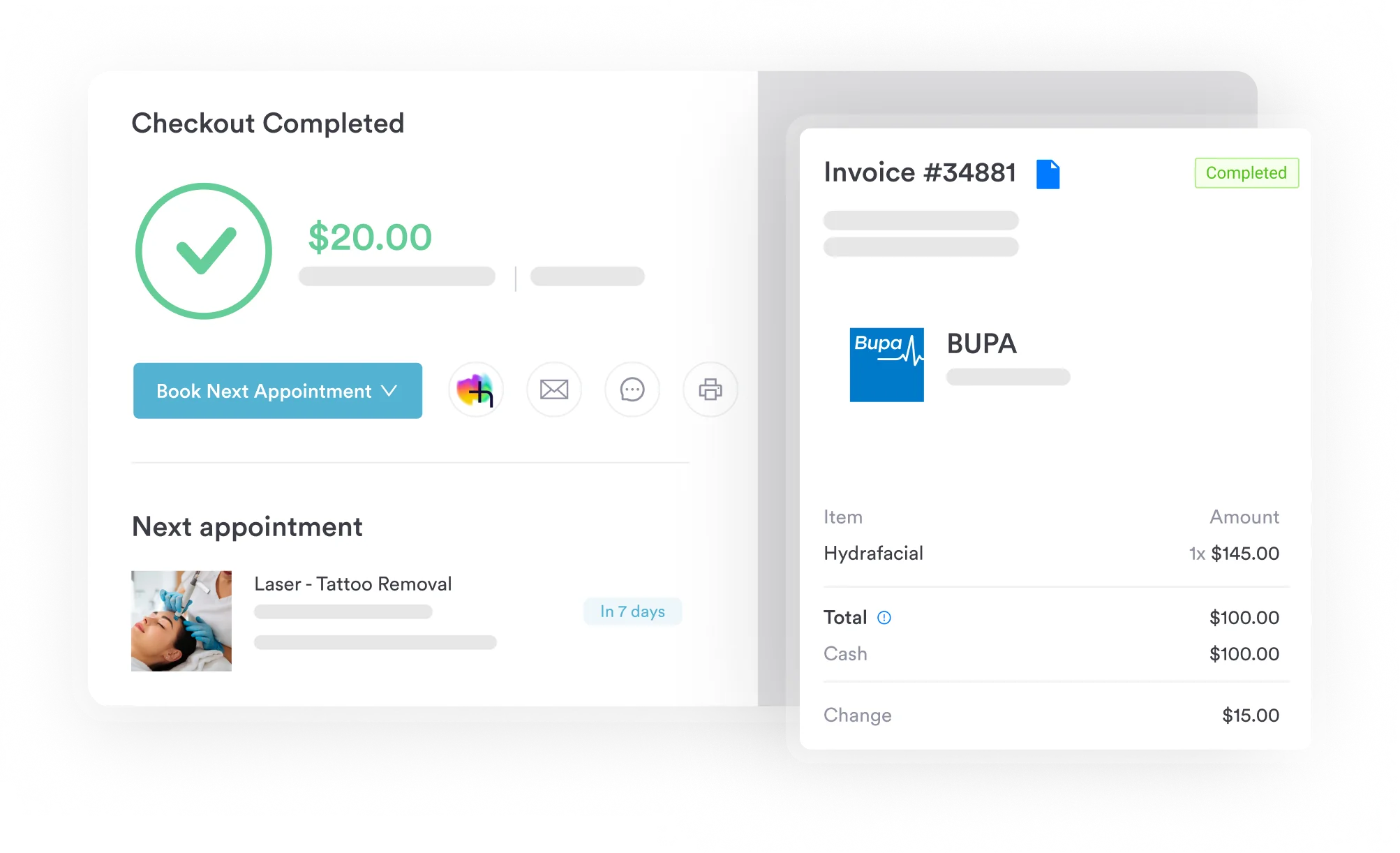

Pabau pre-fills claims from the patient record and warns you when an authorization is missing. In the US, Claim.MD handles submission, eligibility checks and ERAs.

CPT code 50593 is narrower than many older references suggest. It covers one kidney, one freezing method and one percutaneous approach. A second kidney and the imaging guidance are reported around it.
If you change one habit, check the payer’s bilateral format before the claim goes out. That single step prevents the denial that most often follows these cases.
Book a demo to see how Pabau builds 50593 claims from the patient record and tracks them to payment.

Need to understand how clearinghouses process your 50593 claims? Medical claims clearinghouse guide explains how electronic claims are validated, routed, and adjudicated before reaching payers.
Trying to reduce denial rates across your CPT billing? Denial management in healthcare covers root-cause analysis frameworks and appeal workflows for surgical procedure denials.
Looking for a primer on the 837P claim format for surgical codes? 837 file guide explains the electronic transaction structure used for professional fee claims including interventional radiology procedures.
Billing the CT guidance that goes with 50593? CPT code 77013 covers CT guidance for, and monitoring of, parenchymal tissue ablation.
CPT code 50593 means percutaneous cryotherapy ablation of one or more renal tumors in one kidney. The physician freezes the tumor with probes placed through the skin under imaging guidance.
CPT 50593 is unilateral. If both kidneys are treated in one session, add modifier 50 or report RT and LT lines, depending on the payer.
Percutaneous radiofrequency ablation of renal tumors is CPT 50592. Like 50593, it is unilateral and reported once per kidney per session.
Common choices are C64.1 or C64.2 for a malignant kidney tumor, and D30.01 or D30.02 for a benign one. D41.01 or D41.02 apply when behavior is uncertain. Match the side to the kidney treated.
Open cryosurgical ablation is CPT 50250. Laparoscopic ablation of renal mass lesions is CPT 50542. Both include intraoperative ultrasound when performed, so don’t add a separate guidance code.