HCPCS code V2599: Other type contact lens billing guide
What is HCPCS code V2599? HCPCS code V2599 is the Level II supply code for a con...

Last Updated: Oct 20, 2026
49405 is the CPT code for image-guided fluid collection drainage by catheter (eg, abscess, hematoma, seroma, lymphocele, cyst); visceral (eg, kidney, liver, spleen, lung/mediastinum), percutaneous. In plain terms, it covers draining a collection inside a solid organ through a catheter placed through the skin.
The fact that matters most is that imaging guidance is already built into 49405. Adding 76942, 77002 or 77012 for the same drainage is a bundling error that payers deny or recoup. Choosing between 49405, 49406 and 49407 comes down to the organ, the approach and what the note documents.
Let Pabau's smart automation suggest the right codes, reduce claim denials, and keep your practice compliant—effortlessly.
Automate repetitive tasks and focus on what matters most—your patients.
Reduce coding errors and ensure compliance with the latest regulations.
Clean claims, fewer denials, and faster reimbursements.
Powerful insights and reporting to help your practice thrive.
HIPAA compliant SOC 2 certified GDPR-compliant Trusted by 4,000+ clinics worldwide

CPT code 49405 covers image-guided catheter drainage of a fluid collection inside the kidney, liver, spleen, or lung/mediastinum.
Imaging guidance is part of the code, so 75989, 76942, 77002, 77003, 77012 and 77021 are never billed with it for the same drainage.
Site and approach separate the family: 49406 covers peritoneal or retroperitoneal collections, and 49407 covers transrectal or transvaginal access.
The diagnosis code must name the organ you drained, such as K75.0 for a liver abscess or N15.1 for a renal abscess.
Medicare gives 49405 a 0-day global period, so no post-procedure visits are bundled into the payment.
CPT code 49405 reports image-guided drainage of a fluid collection inside a visceral organ, using a catheter placed through the skin. It sits in the Surgery section of the American Medical Association’s CPT code set, under Digestive System and then Abdomen, Peritoneum, and Omentum.
The official descriptor reads: Image-guided fluid collection drainage by catheter (eg, abscess, hematoma, seroma, lymphocele, cyst); visceral (eg, kidney, liver, spleen, lung/mediastinum), percutaneous.
Interventional radiologists perform most of these drainages, although surgeons bill the code too. Three words in that descriptor do the heavy lifting: catheter, visceral and percutaneous. If one of them doesn’t fit the case, you’re looking at a different code.
That’s where the sibling codes come in. A peritoneal or retroperitoneal collection drained through the skin is 49406. The same space reached through the rectum or vagina is 49407.
Knowing the procedure helps you read the note the way a payer will. Drainage starts with imaging to find the collection and plan a safe route in. The radiologist chooses ultrasound, CT or fluoroscopy based on depth, size and nearby structures.
Each step leaves a trace in the note, and the claim leans on it. If the report shows aspiration but no catheter left in place, 49405 doesn’t apply.
Scope is where most 49405 coding errors start. Two services get over-reported: imaging guidance, and aspiration with no catheter left behind.
Included in 49405 (not billed separately for the same drainage):
Billed separately when performed:
Guidance is bundled at the descriptor level, not only through an NCCI edit. CPT tells coders not to report 49405 with 75989, 76942, 77002, 77003, 77012 or 77021 for the same procedure. Payers deny or recoup those lines even when no edit pair fires.
All three codes share the same base descriptor. Anatomical site and approach decide which one you report, and a wrong pick is a frequent audit finding on interventional radiology claims.
The diagram below walks through the choice in the order a coder should ask it.
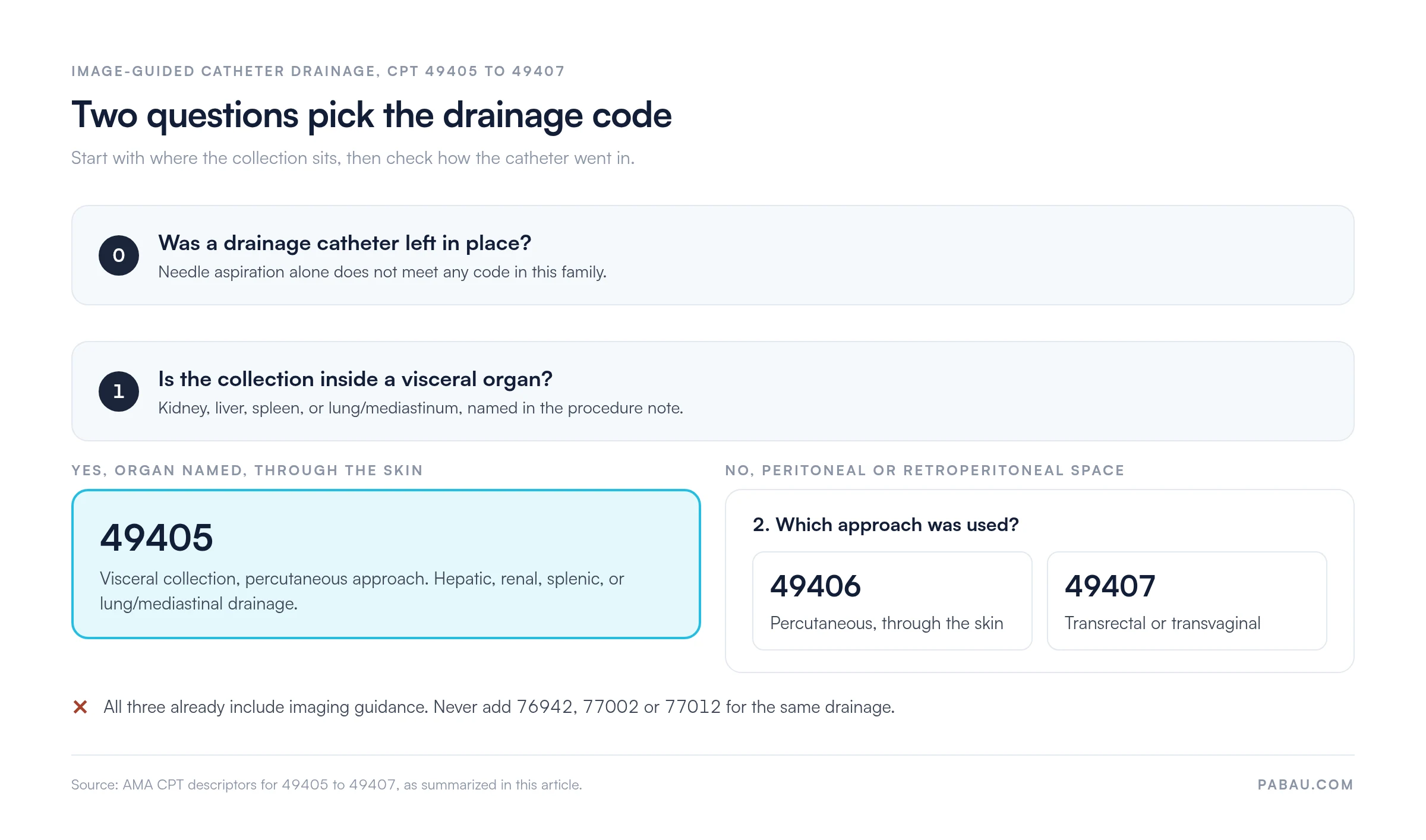
49405 (visceral, percutaneous): Use it for a collection within or immediately next to a solid organ. Think hepatic, renal or splenic abscess, or a lung or mediastinal collection. The organ must be named in the procedure note.
49406 (peritoneal or retroperitoneal, percutaneous): Use it when the collection sits in the peritoneal cavity or retroperitoneal space, outside a solid organ. A post-surgical abscess in the paracolic gutter, for example, maps to 49406.
49407 (peritoneal or retroperitoneal, transrectal or transvaginal): Use it when that same space is reached through the rectum or vagina instead of the skin. The approach, not only the location, triggers this code.
When a note describes a ‘pelvic abscess drained under CT guidance,’ pause before defaulting to 49405. Check whether a solid organ is named. A collection free in the pelvis without organ involvement is 49406, and a transvaginal approach makes it 49407. The organ or approach must be explicit in the documentation.
Medical necessity for 49405 depends on an ICD-10-CM code that names the collection and the organ. Use the table as a starting point, then code from the note.
A generic diagnosis weakens the claim. K65.1 on a liver drainage claim will fail a medical necessity review, because the diagnosis and the procedure don’t match at the organ level.
A complete procedure or radiology report is what makes a 49405 claim defensible. Auditors look for six elements, and one missing element can trigger a denial or a recoupment request.
The procedure note and the radiology report should also agree with each other. If one records CT guidance and the other doesn’t, expect questions in an audit.
CPT code 49405 carries a 0-day global period under the Medicare Physician Fee Schedule (MPFS). No post-operative visits are bundled into the payment. A same-day evaluation and management visit needs a significant, separately identifiable reason, documented and billed with modifier 25.
Payment depends on the place of service. The CMS Physician Fee Schedule lookup tool shows current national rates for facility and non-facility settings. Work RVUs for 49405 have historically sat around 3.5 to 4.5. Check the current year in that tool before quoting figures, because rates update each January.
Here’s the path a typical 49405 claim takes. Knowing it tells you where to look when one stalls.
Steps two and three are where coding errors creep in. A superbill that ties the procedure to its diagnosis stops the coder from guessing.
These clean claim checks take a few minutes per claim. Skipping them can cost weeks of rework.
Medicare Administrative Contractors (MACs) may publish LCDs that add diagnosis or documentation rules. Check your MAC’s policies, especially for less common sites like the spleen or mediastinum.
Commercial payers vary more. Many require prior authorization for percutaneous drainage, especially in an ambulatory surgical center (ASC). Verify it at scheduling, because a missing authorization can’t be appealed on medical necessity grounds.
Coders can also confirm the current descriptor in the AAPC’s CPT code reference before submitting.
Denials on 49405 cluster around a few repeat triggers. Fixing them as patterns recovers more revenue than appealing claims one at a time. Denial management works best when every denial gets a root cause.
Payers explain each rejection with denial codes. Group your 49405 denials by claim adjustment reason code (CARC) each month. A pattern, like one coder billing 77012 with 49405, shows up far faster than in claim-by-claim review.
Run a monthly audit of 49405 claims. Pull every claim with a guidance code (76942, 77002 or 77012) on the same date of service. Each match is a likely overpayment. Correcting it before a payer audit protects the practice from repayment demands with interest.
A drainage claim passes from the note to the charge to the payer. At each handoff, a modifier or a diagnosis can slip through when the data is re-keyed.
Pabau’s claims management software, part of the practice platform we build, pre-fills the claim form from the patient record. The CPT code attached to the service lands on the charge line, and ICD-10 slots draw from the recorded problem list. Required fields must be complete before the claim can be sent.
For US practices, the Claim.MD integration adds real-time eligibility checks, electronic claim submission and claim status tracking. ERAs come back into the same record, so your team sees what’s paid, pending or denied in one place.
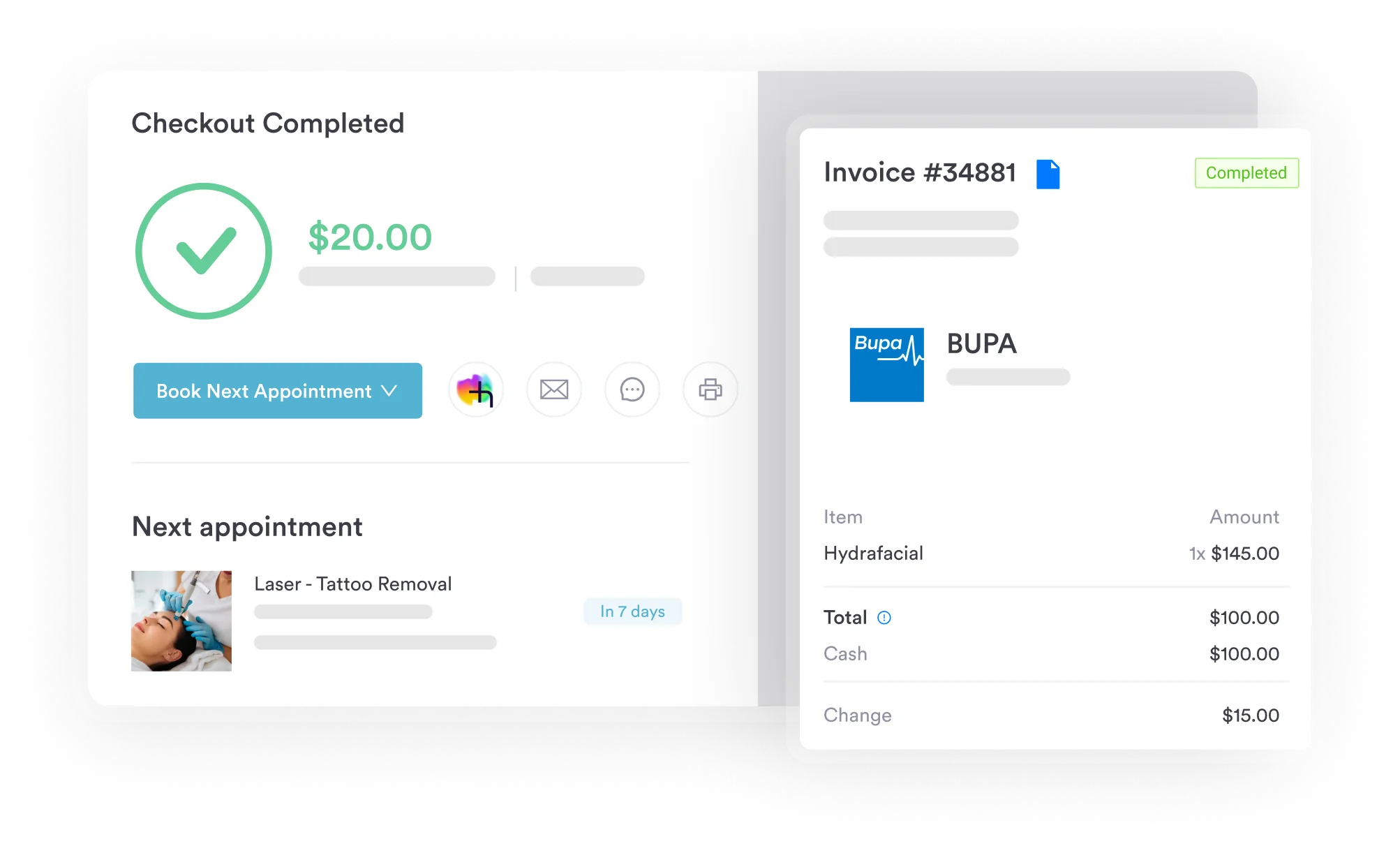

Pabau pre-fills claims from the patient record. Through Claim.MD, it checks eligibility, submits claims electronically and posts ERAs back to the record.

CPT code 49405 rewards coders who read the note before they pick a code. Confirm the organ, confirm a catheter stayed in, and leave every guidance code off the claim.
Do that every time and the denials in the table above stop repeating. The cost is a few extra minutes per claim, which is far cheaper than a recoupment letter with interest.
Pabau’s Claim.MD integration supports electronic claim submission and ERA processing, so remittances post back without re-keying. Book a demo to see it on one of your own drainage claims.

Need a framework for cleaner claim submissions? Clean claim submission best practices covers the elements every interventional radiology claim needs before it reaches the payer.
Tracking denial patterns across your practice? Denial management in healthcare explains how to categorize, appeal and prevent recurring billing denials.
Reading remittances after a drainage claim pays? Electronic remittance advice walks through what an ERA tells you and how to post it.
Want an audit-ready billing process? Medical billing compliance sets out the documentation and coding standards payers check.
Chasing payer approvals before the procedure? The prior authorization process shows how to request and track approvals so drainage claims aren’t denied for missing auth.
Use CPT 49423 for exchanging a previously placed abscess or cyst drainage catheter under radiological guidance. Don’t report 49405 again, because no new collection is being drained.
No. A pleural drainage catheter is reported with 32557 when imaging guidance is used, or 32556 without it. 49405 covers collections in the lung or mediastinum, not the pleural space.
Use CPT 10030 for image-guided catheter drainage of a soft-tissue collection, such as a subcutaneous abscess or seroma. 49405 is reserved for collections inside a visceral organ.
Sometimes. 49424 covers contrast injection through a catheter placed at an earlier encounter, so it can be reported separately. Contrast through the catheter placed in the same session is included. Check current NCCI edits before billing both.
Report one unit per drainage site. A second, separate collection drained in the same session takes its own line with modifier 59 or XS. The note must show that each site is distinct.