



HCPCS code E0198: Water pressure pad billing guide
HCPCS code E0198 is a water pad for a standard mattress HCPCS code E0198 is the ...

Last Updated: Oct 13, 2026

CPT Code 43653 describes laparoscopic surgical gastrostomy without construction of a gastric tube, also known as the Stamm procedure.
The separate procedure designation means 43653 cannot be billed alongside a more comprehensive procedure unless NCCI edits allow it.
Medicare reimbursement varies by facility versus non-facility setting and by CMS locality.
Verify the payable amount in the current year CMS Physician Fee Schedule for your own locality before billing.
Practice management software like Pabau helps surgical practices submit and track 43653 claims, so denials get worked sooner.
CPT Code 43653 describes a laparoscopic surgical gastrostomy performed without construction of a gastric tube. The official American Medical Association (AMA) descriptor reads: “Laparoscopy, surgical; gastrostomy, without construction of gastric tube (eg, Stamm procedure) (separate procedure).” The parenthetical reference to the Stamm procedure and the “(separate procedure)” designation are both clinically and administratively significant, and both require careful attention before billing. Risk of complications carries more weight than volume of notes when the visit level is questioned.
This code sits in the CPT range for laparoscopic procedures on the esophagus and stomach, codes 43644 to 43659. Neighboring upper GI codes such as 43273 and codes such as 43273 and 43361 describe other approaches to the same anatomy. 43653 itself is narrowly scoped. It covers laparoscopic gastrostomy access without tube construction, which separates it from open gastrostomy and from endoscopic percutaneous placement.
A gastrostomy creates a direct opening into the stomach for feeding or decompression when oral intake is unsafe. CPT Code 43653 covers the laparoscopic version of that access without constructing a gastric tube. The surgeon does not fashion a stomach segment into a tube, as happens in a Janeway gastrostomy.
The operative sequence recorded by surgical practice teams runs through four steps. Trocars go in, the abdomen is insufflated, the stomach is visualized directly, and the tube passes through the abdominal wall under camera guidance.
The Stamm procedure named in the descriptor is classically an open technique. The parenthetical reference identifies the approach being replicated laparoscopically. That is a purse-string suture technique securing the stomach to the abdominal wall, with no tube built from gastric tissue.
A feeding tube sitting in place at the end of surgery does not disqualify 43653. The “without construction” language refers to fashioning a tube from stomach tissue. It says nothing about whether a feeding tube device was placed.
Patients presenting for laparoscopic gastrostomy under 43653 typically have one of the following clinical indications:
The laparoscopic route is chosen over open surgery to reduce morbidity and recovery time. It is chosen over endoscopic PEG when endoscopy is contraindicated or when anatomy prevents safe transillumination. It is also chosen when the surgeon needs direct visualization to place the tube safely.
The “(separate procedure)” label is the billing detail that generates the most claims denials for 43653. AMA CPT conventions and CMS National Correct Coding Initiative (NCCI) policy agree on the rule. A separate procedure is not reported when it forms an integral part of a more comprehensive service. Coders own that call, and no billing system makes it for them.
CPT Code 43653 is billable without restriction when the laparoscopic gastrostomy is the only procedure performed. The same holds when it happens at a separate patient encounter. If a surgeon performs 43653 alongside other laparoscopic GI procedures in the same session, NCCI edits govern whether the pair is allowable. Check the current procedure-to-procedure edit files published in the CMS NCCI edit tables before billing the combination.
Modifier selection for CPT Code 43653 follows the same logic as other surgical laparoscopy codes. The table below summarizes the most commonly applicable modifiers and the scenario each one addresses. Commercial policies differ from Medicare, so verify payer acceptance before you bill any of them.
Modifier -59 is the most frequently disputed. CMS expects documentation showing the procedures were truly distinct, not simply different codes on the same claim. When it unbundles a separate procedure code like 43653, the operative note has to state why the gastrostomy was a discrete service. An incidental component of the primary operation does not qualify.
The same test applies to an incidental appendectomy. CPT Code 44970 is generally not separately billable when the appendix is removed during an unrelated laparoscopic operation.
Before appending modifier -59 to CPT Code 43653 alongside another laparoscopic code, run the pair through CMS’s NCCI PTP edits to check the indicator. If the indicator is 0 (no override allowed), the modifier cannot be used to bypass the bundle, regardless of clinical rationale.
Medicare pays for CPT Code 43653 under the Medicare Physician Fee Schedule (MPFS). The Centers for Medicare and Medicaid Services (CMS) updates that schedule annually. Three variables set the payable amount. They are the relative value units (RVUs), the conversion factor, and the geographic practice cost index (GPCI) for the locality.
The FastRVU 2026 RVU lookup calculates a locality-adjusted figure from current CMS data. Keeping those values in your practice management software means the charge on the claim matches the fee schedule you are billing against.
CPT Code 43653 carries different rates depending on where the procedure is performed. Laparoscopic gastrostomy is almost always performed in a facility setting (hospital or ambulatory surgery center), so the facility rate is the operationally relevant figure. The non-facility rate applies when the procedure is performed in a physician office setting, which is rare for surgical laparoscopy.
Because rates shift with each annual MPFS update and vary by locality, stating a single national dollar figure would be misleading. Verify CPT Code 43653 reimbursement in the CMS Physician Fee Schedule lookup. Enter the current calendar year and your practice’s CMS locality code. The AAPC CPT code lookup also carries reference RVU data.
Every claim for CPT Code 43653 needs a supporting ICD-10 code that establishes medical necessity. The diagnosis has to state why this patient required laparoscopic gastrostomy, not what the surgeon did. For dysphagia cases the underlying cause is usually recorded in the swallowing assessment, which practices keep in their speech therapy software.
Select the most specific code supported by the operative report and clinical documentation. Defaulting to R13.10 when the record supports I69.391 gives away specificity you already have. That raises audit risk and weakens the medical necessity argument on the claim.
CPT Code 43653 is one of several codes covering gastrostomy-related procedures. Picking the wrong one is among the most common billing errors in GI surgery. The table below sets out each code alongside the detail that separates it from 43653.
The most common coding error in this family is reporting CPT Code 43653 when the correct code is 43246 (PEG via endoscopy). The distinction is the surgical approach. PEG placement uses an endoscope introduced orally; the tube is guided through the stomach wall by transillumination. Laparoscopic gastrostomy (43653) uses laparoscopic cameras and ports through the abdominal wall, with the stomach directly visualized and sutured to the peritoneum.
An operative note documenting endoscope insertion, transillumination, and percutaneous needle passage describes 43246. In that case 43653 is the wrong code. If the note documents laparoscopic ports, pneumoperitoneum, direct visualization of the stomach, and abdominal wall fixation sutures without endoscope assistance, CPT Code 43653 is appropriate.
A clean 43653 claim depends on what the operative note actually says. HIPAA-compliant documentation protects the claim and the patient record at the same time. Capturing the pre-operative indication on digital intake forms means the reason for surgery is already on file when the coder builds the claim.
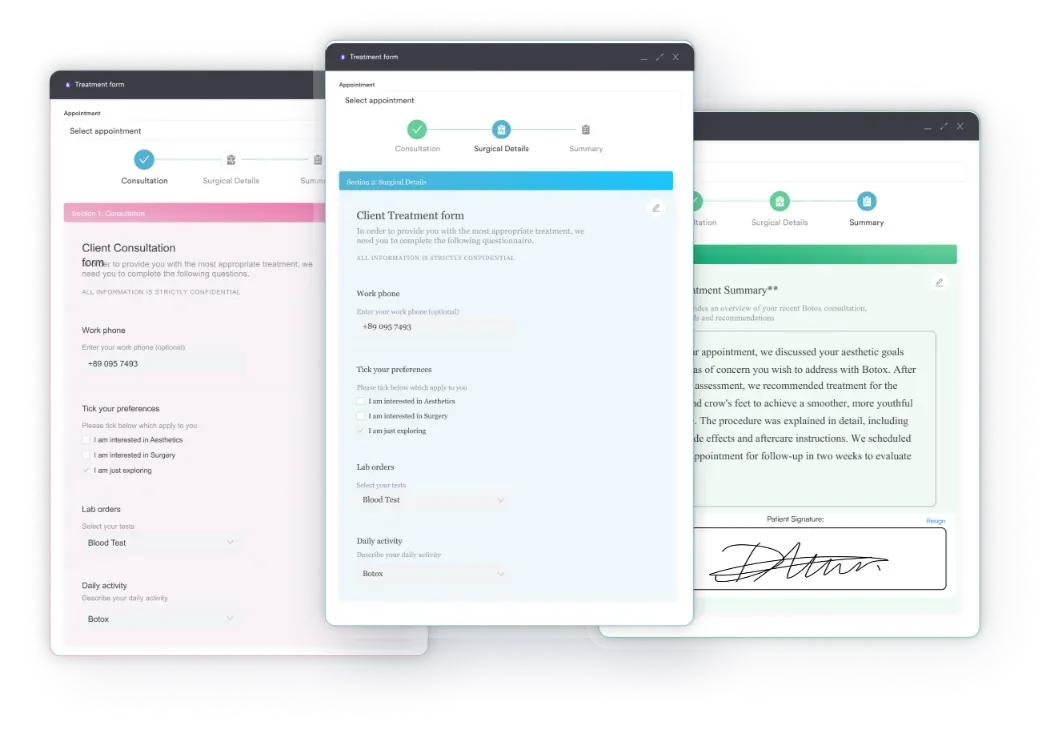
Audit 5 recent 43653 operative notes against this checklist before your next billing cycle. Two omissions trigger most post-payment audits on this code. One is a missing laparoscopic approach statement. The other is silence on gastric tube construction.
In most surgical practices the 43653 claim leaves the building through one system and comes back through another. The operative note sits in the chart, the charge sits in the billing tool, and the denial arrives by mail or portal weeks later. Reconciling the three is manual work.
Practice management software like Pabau keeps the note, the charge, and the claim on the same patient record. Our claims management software submits the claim and tracks its status, so a rejection surfaces while the operative detail is still fresh.
Deciding whether 43653 belongs on the claim is still your coder’s judgment, and no platform replaces the NCCI check. What changes is the follow-up. A comparison of Pabau and Waystar shows how that submission and tracking workflow differs between platforms.

Pabau’s claims management tools submit 43653 claims, track their status, and keep the operative record beside them. Your team sees a denial early instead of finding it in an aging report.

Three avoidable problems drive most denials for CPT Code 43653. Reporting it alongside a comprehensive procedure without checking NCCI edits is the first. Confusing it with PEG placement code 43246 is the second. Submitting an operative note that never confirms the laparoscopic approach is the third.
All three are settled at the operating table and in the note, not in the billing queue. Fix the documentation habit and the denial rate follows within a billing cycle or two. Book a demo to see how Pabau tracks surgical claims from submission through payment.

Coding a cholangioscopy in the same session? CPT Code 43273 covers the billing rules for that add-on and the documentation it needs.
Working an open reconstruction case instead? CPT Code 43361 walks through gastrointestinal reconstruction billing and its modifier logic.
Coding an Achilles tendon repair? CCSD code T6780 covers billing for primary repair of the Achilles tendon in UK private orthopaedic practice.
Coding a distal biceps repair? CCSD code T6782 is the designated code for surgical repair of the distal biceps tendon in UK billing.
CPT Code 43653 is a laparoscopic surgical gastrostomy performed without construction of a gastric tube. It references the Stamm technique and carries the AMA separate procedure designation. It covers laparoscopic access to the stomach for feeding or decompression, where the surgeon does not fashion stomach tissue into a tube.
Yes. The AMA designates 43653 as a separate procedure, meaning it should not be reported when performed as a component of a more comprehensive operation. It is billable standalone when the laparoscopic gastrostomy is the primary or sole procedure. It is also billable when NCCI edits allow it alongside another code with modifier support.
The most commonly applicable modifiers are -51 for multiple procedures and -59 for a distinct procedural service. Modifier -22 covers increased complexity, and -80 covers an assistant surgeon. Modifier -59 requires supporting documentation confirming the gastrostomy was a truly distinct service. Always verify modifier acceptance with your specific payer before billing.
CPT 43659 is the unlisted laparoscopic procedure code for the esophagus and stomach, used when no specific code describes the procedure performed. Where the operative report describes a laparoscopic gastrostomy without gastric tube construction, 43653 is the specific code. Use it in preference to the unlisted 43659. Use 43659 only when the specific procedure has no matching CPT descriptor.



