HCPCS code V2630: Anterior chamber intraocular lens
HCPCS code V2630: official descriptor and code definition HCPCS code V2630 is th...

Last Updated: Oct 15, 2026
40810 is the CPT code for excision of a lesion of the mucosa and submucosa in the vestibule of the mouth, without repair. It covers removing a mucocele, fibroma or similar lesion from between the lips or cheeks and the gums. The wound is left to heal without sutures, flaps or grafts.
The code belongs to the 40808-40820 vestibule excision group. If the surgeon closes the wound, the claim moves to 40812, 40814 or 40816, depending on the repair.
Let Pabau's smart automation suggest the right codes, reduce claim denials, and keep your practice compliant—effortlessly.
Automate repetitive tasks and focus on what matters most—your patients.
Reduce coding errors and ensure compliance with the latest regulations.
Clean claims, fewer denials, and faster reimbursements.
Powerful insights and reporting to help your practice thrive.
HIPAA compliant SOC 2 certified GDPR-compliant Trusted by 4,000+ clinics worldwide

CPT code 40810 covers excision of a mucosal and submucosal lesion in the vestibule of the mouth with no repair performed. Once any closure is added, the code changes.
The 40810 vs 40812 decision hinges on repair: 40812 requires simple repair, 40814 complex repair, and 40816 complex repair with excision of underlying muscle.
CPT 11440 is an integumentary code for skin or mucous membrane lesions. Choose 40810 once the operative note confirms the lesion sits in the vestibule.
Pabau’s claims management software pre-fills claims from the patient record and runs validation checks before submission, so fewer 40810 claims come back rejected.
The American Medical Association (AMA) publishes CPT code 40810 with this official descriptor: Excision of lesion of mucosa and submucosa, vestibule of mouth; without repair. In plain terms, it covers cutting a lesion from the inside of the lip or cheek, with no stitches afterward.
The code sits in the 40808-40820 excision and destruction group, inside the 40800-40899 vestibule of mouth range of the CPT codebook. Confirm all three elements of the descriptor before billing:
Understanding the surgical steps helps coders verify that the operative note supports the code before the claim goes out. A typical 40810 procedure follows this sequence:
That last step is the coding fulcrum. If the surgeon closes the defect with even a single interrupted suture, the claim belongs under 40812 instead. Silence on repair does not prove the wound was left open, so the operative note has to state it.
CPT code 40810 applies when a surgeon removes a discrete benign or malignant lesion from the vestibular mucosa without repairing the wound. The most common clinical indications include:
Coding guidance from the American Association of Oral and Maxillofacial Surgeons (AAOMS) lists 40810 through 40816 for excising salivary gland retention cysts.
That diagnosis is K11.6 in ICD-10, formerly 527.6 in ICD-9. The choice within the family depends on what the surgeon did after removing the cyst, not on the diagnosis.
Payers require a diagnosis code that establishes medical necessity. The ICD-10-CM codes most frequently linked to CPT code 40810 claims are listed below.
Select the most specific code available. Payers and Medicare Administrative Contractors (MACs) may deny a claim coded K13.70 when the clinical note supports K11.6 or K13.6.
The 40810 family is organized around repair complexity. The excision is the same procedure in each code. Only what the surgeon does after it changes.
Make the coding decision from the operative note, not from the post-op note or the charge capture sheet. If the surgeon dictated that the wound was left open, bill 40810. If any sutures are documented, decide whether the closure was simple (40812) or complex (40814 or 40816).
The decision path below runs the whole family, plus its neighbors, in the order a coder reads the note.
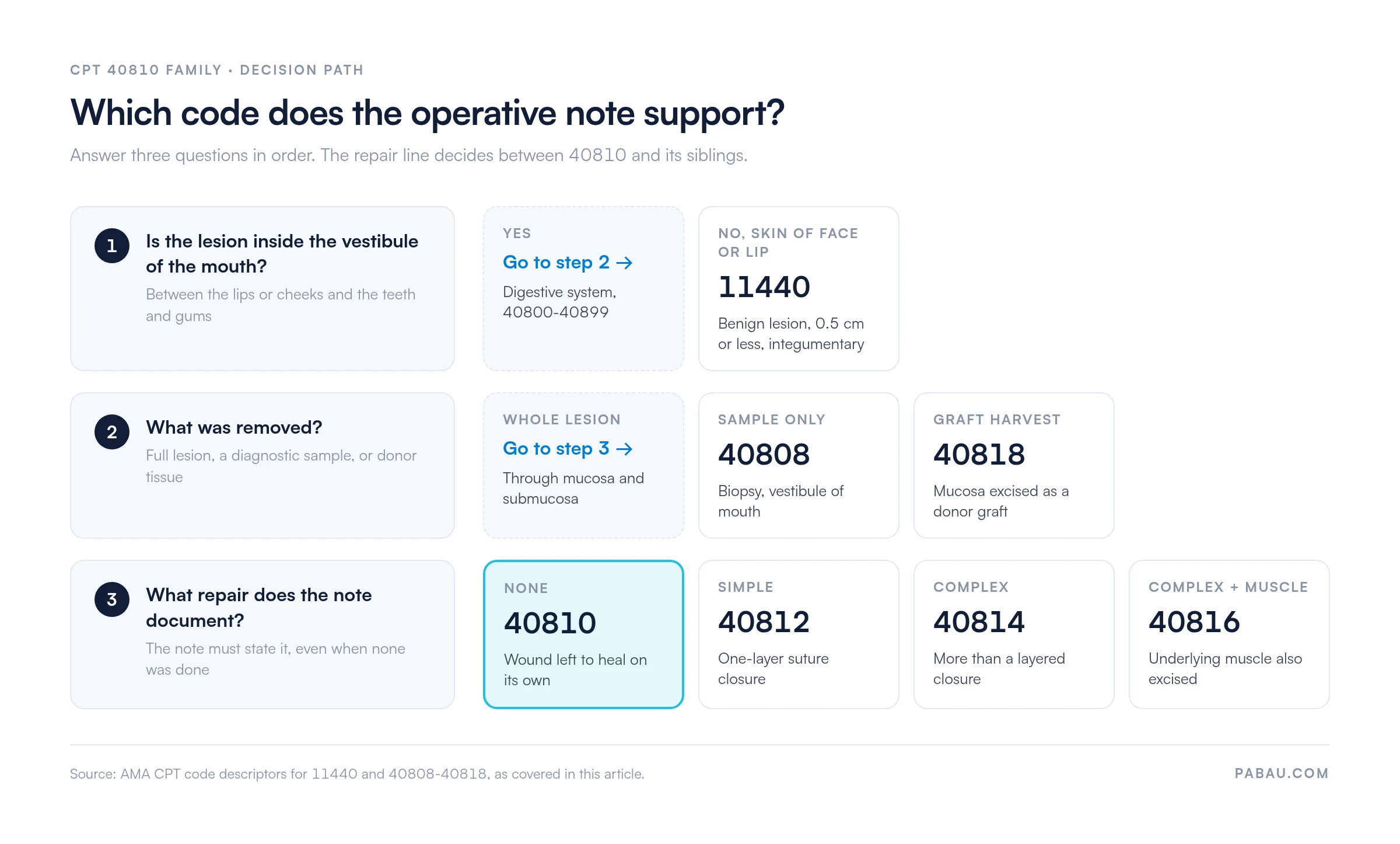
CPT code 11440 covers excision of a benign lesion, 0.5 cm or less in diameter, on the face, ears, eyelids, nose, lips, or mucous membrane. Skin tag removal is excluded. Both codes mention mucous membrane, so the anatomical site is what separates them.
Use this decision framework before selecting either code:
The core rule is simple. When the lesion sits within the oral vestibule and the excision goes through mucosa and submucosa, 40810 is correct regardless of lesion size. Applying 11440 to an intraoral procedure moves it from the Digestive to the Integumentary section, and that mismatch can trigger a specialty denial.
Two other codes in the 40800-40899 range are sometimes confused with 40810:
Before finalizing the code, confirm three facts in the operative note. The site is the vestibule of the mouth, the excision reached the submucosa, and no repair was documented. If all three hold, CPT code 40810 is correct. If repair is documented, move to 40812, 40814, or 40816 based on closure complexity.
Modifier selection for CPT code 40810 depends on the clinical scenario and payer requirements. The most commonly applied modifiers are listed below.
Modifier 59 carries particular risk. Using it to bypass a valid NCCI edit is a billing compliance violation. Confirm the edit pair in the current NCCI table before appending modifier 59 to CPT code 40810 or any procedure billed alongside it.
The operative note is the document payers audit first on a CPT code 40810 claim. Payers and MACs check for medical billing compliance and require documentation that maps directly to the code descriptor. A clean claim submission for 40810 requires the operative note to contain all of the following:
Medicare reimbursement for CPT code 40810 comes from the annual CMS Physician Fee Schedule. It sets facility and non-facility rates from relative value units (RVUs), adjusted by geographic practice cost indices (GPCIs).
Rates change each January 1 and vary by MAC jurisdiction. Use the CMS fee schedule lookup tool for the current year’s rates in your locality.
The RVU components for CPT code 40810 under the Medicare Physician Fee Schedule are structured across three categories:
For precise dollar figures, use the FastRVU 2026 RVU lookup tool or the CMS lookup linked above. A practice in San Francisco is paid a noticeably different amount for the same code than one in rural Mississippi.
Check each remittance against your local rate as part of revenue cycle management, so underpayments get appealed rather than written off.
Private payer coverage for 40810 follows the same medical necessity logic, but each payer sets its own policy. Key considerations:
CPT code 40810 claims are denied for predictable reasons. A structured denial management workflow catches many of these before submission. The most frequent denial triggers are:
Review common denial codes to map each denial reason to its claim adjustment reason code (CARC). Then build a corrective process for your billing team.
Clean billing for CPT code 40810 follows a consistent pre-submission checklist. The medical billing basics still apply, with a few code-specific additions:
Run a quarterly audit of your 40810 vs 40812 billing ratio. If 40812 claims heavily outnumber 40810, pull a random sample of 40812 operative notes and check that each one documents the simple repair. Payers use lopsided ratios like this to flag accounts for post-payment audit.
In many oral surgery practices, a coder reads the operative note and keys the code and diagnosis into a claim by hand. A missing membership number or authorization code only surfaces when the payer rejects the claim.
Pabau, the practice management platform we build, includes surgical practice claims software that pre-fills each claim from the patient record. Validation checks run in the background, so missing details are flagged before the claim leaves the practice.
US practices submit through Claim.MD, which adds real-time eligibility checks and posts electronic remittance advice (ERA) back against the invoice. Every claim sits on one dashboard as pending, submitted, processing, paid, or error. Your team sees a rejected 40810 claim while the operative note is still fresh.
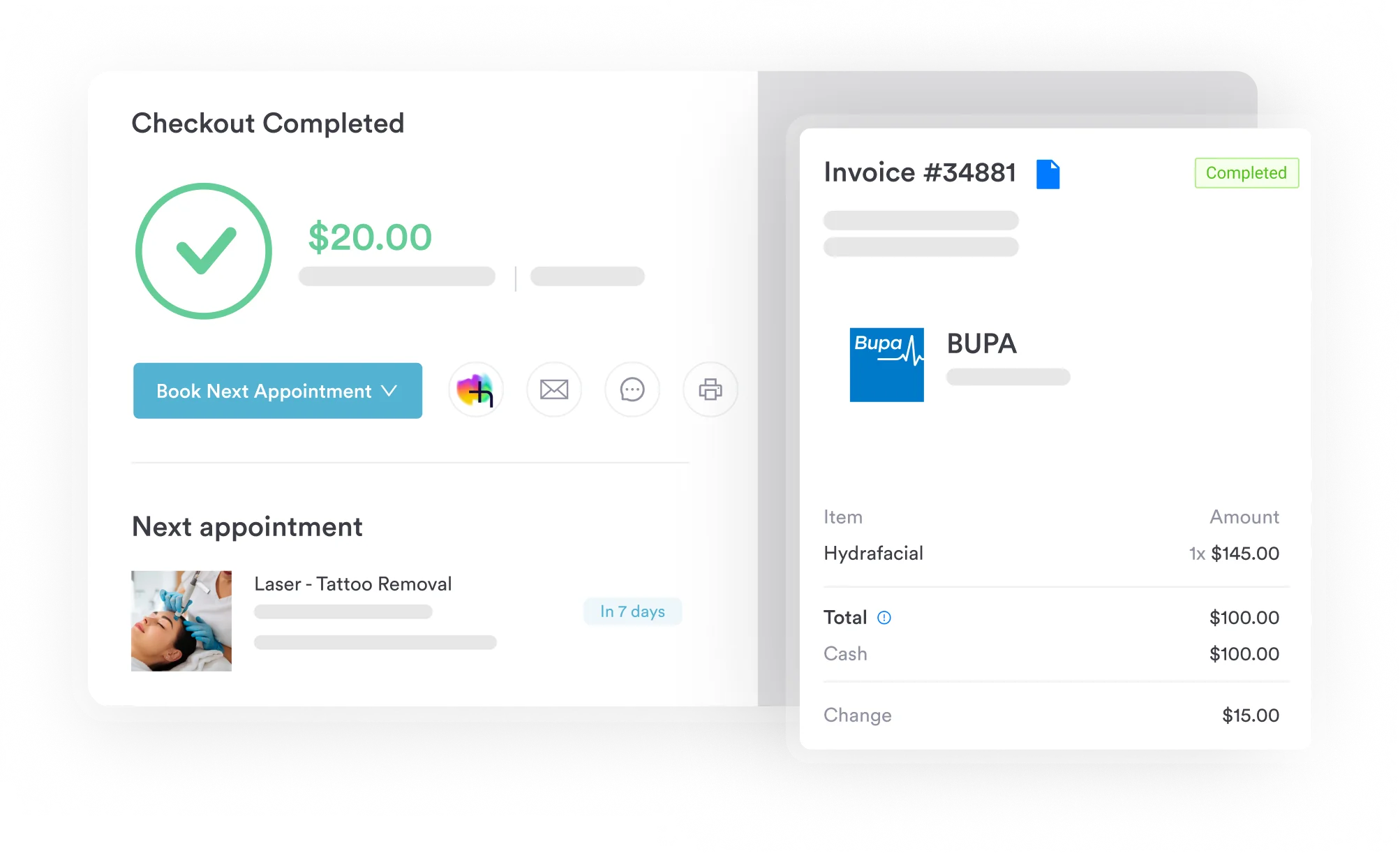

Pabau pre-fills claims from the patient record, runs validation checks before submission, and tracks every claim to payment. See how oral surgery practices keep 40810 claims moving.

CPT code 40810 rewards the surgeon who dictates one extra sentence. A note that says “no repair performed” settles the choice between 40810 and 40812 before anyone has to argue it.
So start at the note, not the claim. Ask surgeons to name the vestibule as the site and state the repair status in every excision note. Then pair the code with the most specific diagnosis the pathology supports. A few seconds of dictation costs far less than a denial that takes weeks to work.
Book a demo to see how Pabau keeps oral surgery claims moving from operative note to payment.

Looking to understand how clearinghouse submission works? Claim.MD clearinghouse explains how electronic claims flow from practice management software to payers, including eligibility checks and ERA handling.
CPT code 40810 covers excision of a mucosal and submucosal lesion in the vestibule of the mouth, with no wound repair. It sits in the 40800-40899 vestibule range of the CPT Digestive System section, maintained by the American Medical Association.
The difference is repair. CPT code 40810 is used when no repair follows the excision, while 40812 applies when the surgeon performs a simple one-layer closure. The excision technique is the same, so the code depends on what the operative note documents after the lesion is removed.
Code a vestibular retention cyst (mucocele) as 40810, or as 40812, 40814 or 40816 when a repair is documented. CPT 11440 is an integumentary code for facial skin and mucous membrane lesions, and it is not specific to the oral vestibule. Using it for an intraoral vestibular excision puts the procedure in the wrong CPT section and can trigger a specialty mismatch denial.
Modifier 51 (multiple procedures) applies when 40810 is performed with another surgical code in the same session. Modifier 59 (distinct procedural service) applies only when the service is genuinely distinct, so confirm the edit in the current NCCI tables first. Modifiers LT/RT for laterality and modifier 22 for increased complexity apply in specific cases. Check the payer’s policy before adding either.
Yes. Medicare covers CPT code 40810 when medical necessity is documented and a supporting ICD-10-CM diagnosis code is submitted. Coverage follows the Local Coverage Determinations of the relevant Medicare Administrative Contractor. Rates vary by locality and are updated each year in the CMS Physician Fee Schedule.
Most 40810 denials trace back to the operative note or the claim details. The usual causes are a note that never states the repair status, an ICD-10 code that is too vague, or a missing pathology report. Modifier 59 used without a valid NCCI rationale is another, as is billing inside the global period of a prior procedure.