



CCSD code G5100: Bypass of duodenum billing guide
CCSD code G5100 bills a bypass that leaves the duodenum in place CCSD code G5100...

Last Updated: Oct 16, 2026

CPT Code 38525 covers biopsy or excision of lymph node(s); open, deep axillary node(s), used in breast cancer and melanoma staging.
Two qualifiers decide the code: the approach must be open, and the nodes must be deep axillary.
Modifiers LT and RT carry laterality, Modifier 50 covers bilateral cases, and Modifier 59 separates 38525 from a bundled add-on code.
The operative report must confirm depth, approach, laterality, and a pathology order before the claim goes out.
Practice management software like Pabau validates the code, checks the ICD-10 pairing, and routes the claim to the clearinghouse.
CPT Code 38525 is the code for biopsy or excision of lymph node(s); open, deep axillary node(s). It applies when a surgeon uses an open approach to reach and remove deep nodes in the axilla, usually for breast cancer or melanoma staging.
Two qualifiers decide whether the code fits. The approach must be open rather than percutaneous, and the nodes must be deep rather than superficial. Miss either one and the claim is denied outright or recoded downward on audit.
This reference covers the official descriptor, the clinical indications, and the modifier rules. It also covers the ICD-10 crosswalk, Medicare reimbursement, documentation requirements, common billing errors, and the add-on codes that travel with 38525.
CPT Code 38525 describes: Biopsy or excision of lymph node(s); open, deep axillary node(s). The American Medical Association (AMA) publishes and maintains the CPT code set. It places 38525 within the Excision Procedures on the Lymph Nodes and Lymphatic Channels subsection of Surgery, in the 38500-38555 series.
Coders must verify both qualifiers before assigning the code: the approach and the anatomical depth. If either one is absent from the operative report, a different code in the 38500 series applies instead.
The code is used mainly in oncology settings, where surgeons need to evaluate axillary lymph node involvement. Medicare covers sentinel lymph node biopsy procedures when the medical necessity criteria are met. The rules sit in CMS Medicare Coverage Article A52437 and in the applicable Local Coverage Determination.
Covered scenarios include breast cancer staging, melanoma staging, and a suspected lymphoma workup that needs tissue confirmation. Payers expect the ordering provider to state the clinical indication in both the operative note and the supporting diagnosis. When that lymphoma workup leads to a donor stem cell transplant, the infusion is billed separately under CPT Code 38240.
Coverage is not automatic. MAC-level LCDs specify which diagnoses qualify as covered indications, and the lists differ between jurisdictions. Check the LCD that applies to your MAC before billing 38525 to Medicare.
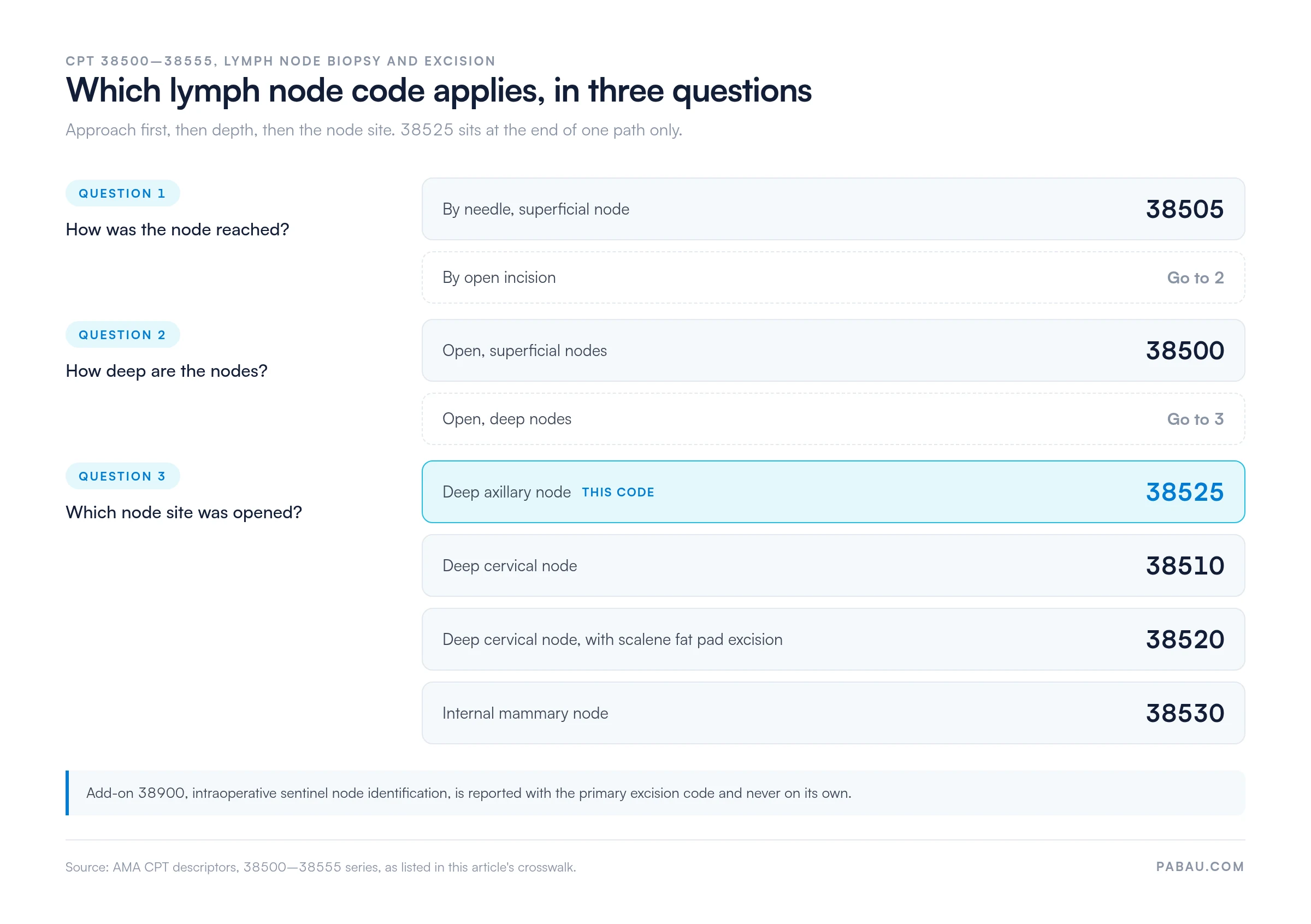
Picking the wrong code inside the 38500 series is the most common depth-selection error for axillary node procedures. The two differentiators are approach and depth. Use the crosswalk below to confirm 38525 before submission.
Read as a sequence, the choice comes down to three questions in order. How was the node reached, how deep does it sit, and which site was opened?
Modifier selection hinges on laterality and on distinctness from concurrent procedures. Getting it wrong is one of the fastest ways to trigger a denial or a payer audit. The table below covers the modifiers most relevant to axillary node procedures, with notes on where payer rules diverge.
Important: CMS and commercial payers read modifier rules differently, especially Modifier 50 versus separate LT and RT line items. Verify the payer’s own modifier policy before you finalize the claim. The guidance above reflects generally accepted coding principles rather than a universal rule.
Medical necessity has to be supported by a specific ICD-10-CM diagnosis on the claim. The diagnosis should reflect the condition that prompted the axillary node procedure, not the procedure itself.
The crosswalk below lists the ICD-10-CM diagnosis codes most commonly paired with 38525. Codes are updated every October, so verify them against the CDC/NCHS ICD-10-CM web tool.
Code specificity matters: for C50.x and C43.x, payers require the laterality and site subcodes, not the category code alone. A claim carrying C50 instead of C50.411 (upper outer quadrant, right breast) is likely to deny for insufficient specificity. Check the current ICD-10-CM tabular list to confirm the pairing.
CPT Code 38525 carries a 90-day global surgical period and is paid under the Medicare Physician Fee Schedule. The 2026 national rate varies by geographic location, practice setting, and the applicable geographic practice cost indices.
Use the CMS Physician Fee Schedule Look-Up Tool for the current published figures. Cross-check any rate taken from a commercial fee schedule aggregator against CMS data first.
The payment is built from three relative value unit (RVU) components: work, practice expense, and malpractice. Practice expense is where the facility and non-facility rates diverge. The total RVU is then multiplied by the annual Medicare conversion factor.
Submitting electronically through a clearinghouse shortens the remittance cycle considerably. Claims software for coders can also validate the code, the modifier, and the diagnosis pairing before the file leaves the practice.
The facility rate applies when the procedure happens in a hospital outpatient department or an ambulatory surgical center. The non-facility rate, usually higher, applies in an office-based setting, because the practice carries the overhead. A surgeon operating in a hospital receives the facility rate, and the hospital bills separately for its resources.
Confirm the place of service code on the claim: POS 22 for outpatient hospital, POS 24 for an ASC, or POS 11 for the office.
Commercial rates vary considerably. Most commercial contracts are negotiated as a percentage of Medicare, often in the 120-180% band, though the figure differs by contract. Prior authorization rules also vary, and many commercial plans require pre-authorization for elective axillary node procedures.
Read the remittance advice closely, because the adjustment reason codes on a 38525 remit show where the payer’s coverage reading departs from Medicare policy.
Check the electronic remittance advice (ERA) from each commercial payer after your first 38525 claim submission. The CARC codes on the remit show whether the denial is a coverage issue, a documentation shortfall, or a modifier conflict. Fixing the root cause on the first denial stops the same error recurring across other patients.
Documentation is how medical necessity is established and how an audit is survived. The operative report has to carry enough anatomical and procedural detail to show that the code billed matches what the surgeon performed.
When a MAC audits a 38525 claim, the focus usually falls on whether the depth qualifier is verifiable from the submitted records. If the operative report cannot support “deep axillary,” the claim can be recoded to 38500 and paid at the lower rate. A pre-bill documentation check built into the surgical workflow prevents that outcome.
Three errors account for the majority of 38525 denials, and each one is preventable with a pre-bill checklist. A working denial management process helps coders spot these patterns before they turn into recurring revenue leaks.
Code-level edit checks in the pre-submission workflow catch depth-code mismatches and missing modifiers before a claim reaches the clearinghouse. For a practice running steady surgical oncology volume, that step repays the time it costs within a few billing cycles.
38525 is often performed alongside intraoperative sentinel node identification, which brings add-on codes onto the claim. Two of them are relevant here, and their NCCI bundling relationships with 38525 need careful handling.
NCCI edit caution: CMS updates NCCI bundling edits quarterly, so the edit status between 38525 and its add-on codes can change between releases. Check the current edit table on the CMS NCCI edits resource page before submitting a claim that pairs 38525 with 38900 or 38792. A static billing reference will not tell you the current bundling rule.
Before billing 38525 with 38900, pull the current NCCI procedure-to-procedure edit table from CMS directly. If the pair carries a Modifier Indicator of 1, Modifier 59 can bypass the edit when your documentation supports a distinct service. If the indicator is 0, the edit cannot be bypassed and 38900 is not separately billable for that encounter.
In many practices a depth-code error surfaces only once the remittance arrives. The coder builds the claim from the operative report and the biller sends it. The mismatch between 38500 and 38525 then surfaces weeks later as an adjustment code.
Pabau is practice management software that keeps the clinical record and the claim in one system. The operative note, the diagnosis code, and the charge sit on the same client record. The coder reads the documentation that has to support the depth qualifier while building the claim, rather than after a denial.
Claims route to payers through the Claim.MD clearinghouse, and eligibility responses and 835 remittances come back into that same record. A denial on 38525 lands next to the note that caused it, which shortens the distance between a rejection and the fix.

Pabau’s claims management software brings CPT code selection, ICD-10 crosswalk validation, and Claim.MD clearinghouse routing into one platform. See how practices handling surgical oncology billing use Pabau to cut claim errors and speed up reimbursement.

Three checks keep a 38525 claim clean. Confirm the depth qualifier in the operative report, append the laterality modifier, and resolve the NCCI edit before you add 38900. Each takes a minute at the desk.
The trade-off is where that minute gets spent. A pre-bill review costs time on every claim. An appeal costs far more on the few claims that fail, and an audit costs more again when the depth wording will not hold up.
Build the check into the workflow while the operative report is still open, and the surgical oncology denial rate falls without anyone chasing remits. Book a demo to see how Pabau ties the operative note, the code, and the claim together.

Need a medical billing compliance framework? Medical billing compliance practices covers the documentation and audit-readiness requirements that apply across surgical CPT codes.
Want to understand how clearinghouses process surgical claims? How medical claims clearinghouses work explains the claim routing and validation steps between practice and payer.
Looking for denial prevention strategies? Denial codes in medical billing breaks down the most common CARC and RARC codes and how to respond to each.
CPT Code 38525 is biopsy or excision of lymph node(s); open, deep axillary node(s). It covers an open procedure in which the surgeon reaches and removes or samples one or more deep axillary lymph nodes. It is used most often for oncological staging in breast cancer or melanoma cases.
The 2026 Medicare rate for CPT 38525 is published in the CMS Physician Fee Schedule. It varies by geographic location and by place of service, meaning facility or non-facility. Use the CMS Physician Fee Schedule Look-Up Tool for the current official figures, and verify any rate from a third-party aggregator against CMS data first.
Modifiers LT and RT indicate which axilla was operated on, and most payers require one of them. Modifier 50 applies when the procedure was performed bilaterally in the same session, though some payers prefer two line items with LT and RT. Modifier 59 applies when 38525 is billed with an add-on code that NCCI edits flag as bundled, provided the documentation supports a distinct service.
CPT 38522 does not exist in the standard 38500 series. The adjacent codes are 38520, open deep cervical node with scalene fat pad excision, and 38525, open deep axillary node. The distinctions within the series are anatomical site and whether additional tissue was excised. If an older billing reference cites 38522, check the current CPT codebook.
CPT 38525 can be used for an open deep axillary excision performed as part of a sentinel lymph node biopsy workflow. The sentinel-specific intraoperative mapping is captured separately by add-on code 38900. The excision and the mapping are distinct services, so 38525 covers the excision and 38900 covers the mapping when it is performed.
Yes, 38525 can be billed with 38900 when both services were distinctly performed in the same operative session. NCCI bundling edits may apply, so check the current CMS procedure-to-procedure edit table before billing the pair. If the edit carries a Modifier Indicator of 1, Modifier 59 can override it where documentation supports a separate service for each code.
The operative report must confirm the open surgical approach, deep axillary node depth, laterality, the number of nodes excised, and a pathology order. The supporting ICD-10-CM code must link to a covered clinical indication, and the pre-operative note should establish medical necessity. Missing depth confirmation is the most common audit trigger for 38525 claims.



