HCPCS Code J1560: Gamma globulin IM injection billing guide
HCPCS Code J1560: Official descriptor and covered services HCPCS Code J1560 carr...

Last Updated: Nov 11, 2026
28755 is the CPT code for arthrodesis, great toe; interphalangeal joint. It reports a surgical fusion of the joint between the two phalanges of the big toe. The usual cause is osteoarthritis that conservative care has not controlled.
Podiatric and orthopedic foot and ankle surgeons perform it as a 90-day global procedure. Clean payment turns on an IP-joint osteoarthritis code rather than a hallux rigidus code. It also needs an RT or LT modifier and an operative note naming the joint and fixation.
Let Pabau's smart automation suggest the right codes, reduce claim denials, and keep your practice compliant—effortlessly.
Automate repetitive tasks and focus on what matters most—your patients.
Reduce coding errors and ensure compliance with the latest regulations.
Clean claims, fewer denials, and faster reimbursements.
Powerful insights and reporting to help your practice thrive.
HIPAA compliant SOC 2 certified GDPR-compliant Trusted by 4,000+ clinics worldwide

CPT Code 28755 reports arthrodesis of the great toe interphalangeal joint, which sits between the two phalanges, not the MTP joint fused under 28750.
Pair it with M19.071 for the right foot or M19.072 for the left, matching the operative side, rather than a hallux rigidus code.
Bilateral fusion under modifier 50 pays 150% of the unilateral rate, and many MACs prefer separate RT and LT line items instead.
The 2026 Physician Fee Schedule assigns 28755 a total of 13.99 facility RVUs and a 90-day global period.
Pabau, the practice management platform we build, tracks 28755 claims from submission through ERA posting and denial follow-up.
CPT Code 28755 reports a surgical fusion of the great toe interphalangeal joint. Coders also bill it with an osteoarthritis diagnosis, an RT or LT modifier and a 90-day global period. The table below lists the fields coders check before they submit a claim. Also, verify RVU values against the current-year CMS Physician Fee Schedule, because it updates each January.
CPT Code 28755 covers arthrodesis of the interphalangeal joint of the great toe, the joint between the proximal and distal phalanges of the hallux. The procedure permanently fuses the two bones, so painful motion stops at a joint damaged by osteoarthritis, post-traumatic arthritis or inflammatory arthritis.
The American Medical Association (AMA), which maintains the CPT code set, publishes the descriptor as “Arthrodesis, great toe; interphalangeal joint.” The descriptor covers the whole surgical episode, from joint prep through internal fixation. For example, the code includes these steps:
However, bone grafting is not separately billable when it is minor and part of the fusion prep. If the surgeon harvests and places a large graft, describe that work clearly in the operative report. Then check whether payer policy allows a separate graft code.
CPT 28755 fits when a patient has end-stage arthritis of the great toe IP joint that has not responded to recorded conservative treatment. Osteoarthritis is the usual cause, although post-traumatic and inflammatory arthritis also lead to this fusion.
Medicare Administrative Contractors (MACs) often want proof that conservative care failed before they pay for arthrodesis. However, the minimum length and the treatments required vary by MAC Local Coverage Determination (LCD), so check the LCD for your area.
First, the chart should show the conservative treatment tried before surgery:
For this reason, the clinical record should separate IP joint problems from metatarsophalangeal (MTP) joint problems. Payers audit this difference because it decides the code. In other words, the choice is 28755, the neighboring great toe MTP fusion code 28750, or a midfoot fusion code such as 28730.
Hallux rigidus codes (M20.2-) describe arthritis of the first MTP joint, so they do not fit an IP fusion. Instead, primary osteoarthritis of the great toe IP joint is coded M19.07-, primary osteoarthritis of the ankle and foot. In contrast, post-traumatic or inflammatory arthritis has its own code family, so code the cause the record shows. Also, side is required, and the code must match the operative side.
First, confirm that the ICD-10 code you chose appears on your MAC LCD’s list of covered diagnoses for foot arthrodesis. For example, using M19.079 on a claim when the operative report states the side is an avoidable error. As a result, it triggers edit flags and manual review.
Cross-reference the ICD-10 code against the MAC’s covered diagnosis list before submitting. Some MACs maintain separate LCDs for foot and ankle arthrodesis that specify exactly which ICD-10 codes support medical necessity for CPT 28755. Pull the LCD from your MAC’s website and keep a copy in the patient file.
First, payers check 28755 by comparing the operative report with the code descriptor. Therefore, each surgical step needs a note, because examiners look for proof that the joint was fused rather than reshaped by a lesser procedure.
Specifically, five operative elements must appear in the notes:
For example, an operative note that says only “joint fusion of the great toe” will not survive a payer audit. Instead, it has to name the joint, the fixation method and the bone prep. That wording fits both IP joint and MTP joint procedures, which bill at other codes and other rates. As a result, a vague note invites a denial.
In fact, the most common coding error for great toe arthrodesis is billing the MTP fusion code for an IP fusion, or the reverse. The anatomy decides the code, so start from the joint the operative note names, as the map below shows.
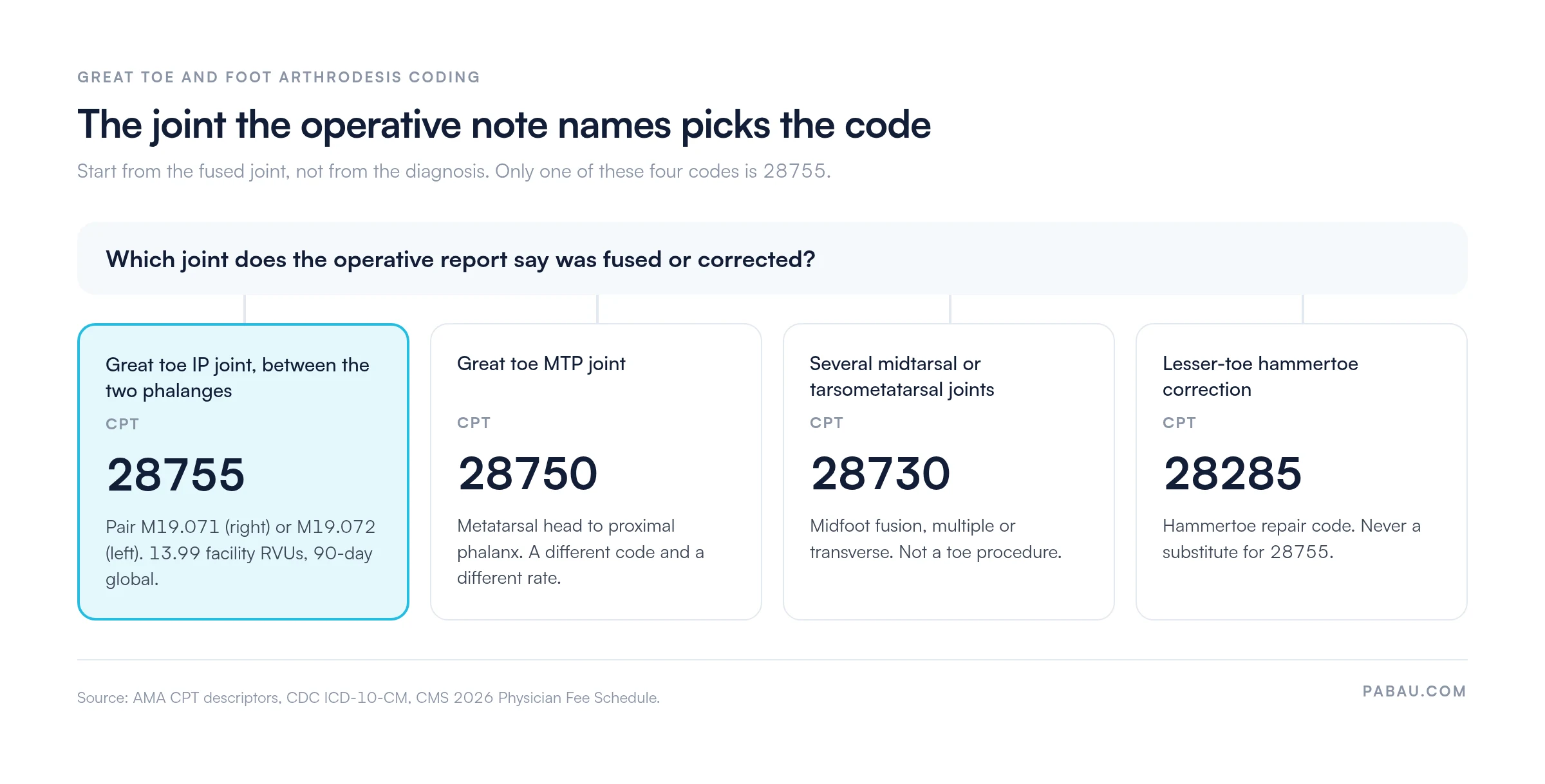
The AAPC Codify CPT lookup can confirm the descriptor for each of these neighboring codes before filing. Above all, the operative report must name the joint fused, not just “the great toe.”
Modifier choice for 28755 depends on the side, whether the surgery was bilateral, and the clinical situation. If RT or LT is missing, a unilateral claim gives the payer no side to match against the diagnosis. As a result, some payers flag it for review.
In fact, many MACs prefer RT/LT over modifier 50 for paired bilateral claims submitted as separate line items. Therefore, check the MAC’s billing guidelines before you default to modifier 50 on a bilateral case.
Because prior authorization rules for 28755 vary by payer and change often, the guidance below reflects broad payer patterns. So check with each payer before scheduling surgery. Also, understanding medical billing fundamentals helps practices build a steady pre-auth workflow that reduces last-minute denials.
In addition, a prior auth request for 28755 should include four documents:
Turnaround often runs 3 to 10 business days for non-urgent surgical requests, though payer timelines vary.
Medicare pays for CPT Code 28755 through the CMS Physician Fee Schedule (MPFS), updated each January 1. Next, the national figures below are the 2026 MPFS relative value units (RVUs) for 28755. However, payment in a given area depends on the geographic practice cost index (GPCI) for the practice’s locality.
Then use the FastRVU lookup tool to calculate the exact current-year Medicare payment for 28755 in your locality. First, each RVU component is multiplied by its locality GPCI. Then the sum is multiplied by the annual conversion factor, which CMS publishes each November for the following year.
In fact, 28755 claims fail for a small set of repeatable reasons. Therefore, a denial management workflow should catch each of them before filing. Also, each denial type below maps to a clear prevention action.
Next, use the denial codes in medical billing guide to match CARC and RARC reason codes on an EOB to the denial types above. A medical claims clearinghouse returns those codes with the ERA, so billers can act on a rejection without logging into each payer portal.
Finally, this checklist combines the record rules across pre-operative, intraoperative and post-operative notes. Post-operative notes are on it because payers audit them as closely as the operative report. Therefore, use it when you prepare a 28755 claim or answer a records request after a denial.
A checklist like this is what submitting a clean claim looks like for a code with heavy paperwork. Revenue cycle management for surgical foot practices gains most when the checklist runs at claim prep, before the claim leaves the practice.
Run a 28755-specific charge audit quarterly. First, pull every claim for the code from the prior 90 days. Next, check that each carries an RT or LT modifier and an ICD-10 code on the same side. Then confirm box 23 holds the prior auth number where the payer required one. Finally, no same-day code should go out unbundled without modifier 59. Most billing errors repeat across multiple claims before they are caught.
The denial reasons above all start when the claim is built. For example, a hallux rigidus code lands on an IP fusion, the RT or LT modifier is dropped, or the auth number never reaches box 23. As a result, billers often find out weeks later, when the remittance arrives.
Instead of chasing these errors by hand, Pabau, the practice management platform we build, runs end-to-end claims management for surgical practices. It also submits 28755 claims electronically through Claim.MD and tracks each one from filing to payment. ERA responses post against the claim automatically, so a denial reason reaches your biller the day it arrives.
Your coders still choose the CPT and ICD-10 codes. Pabau keeps the claim, the remittance and the follow-up on one record, so a rejected fusion claim gets corrected and resubmitted quickly.
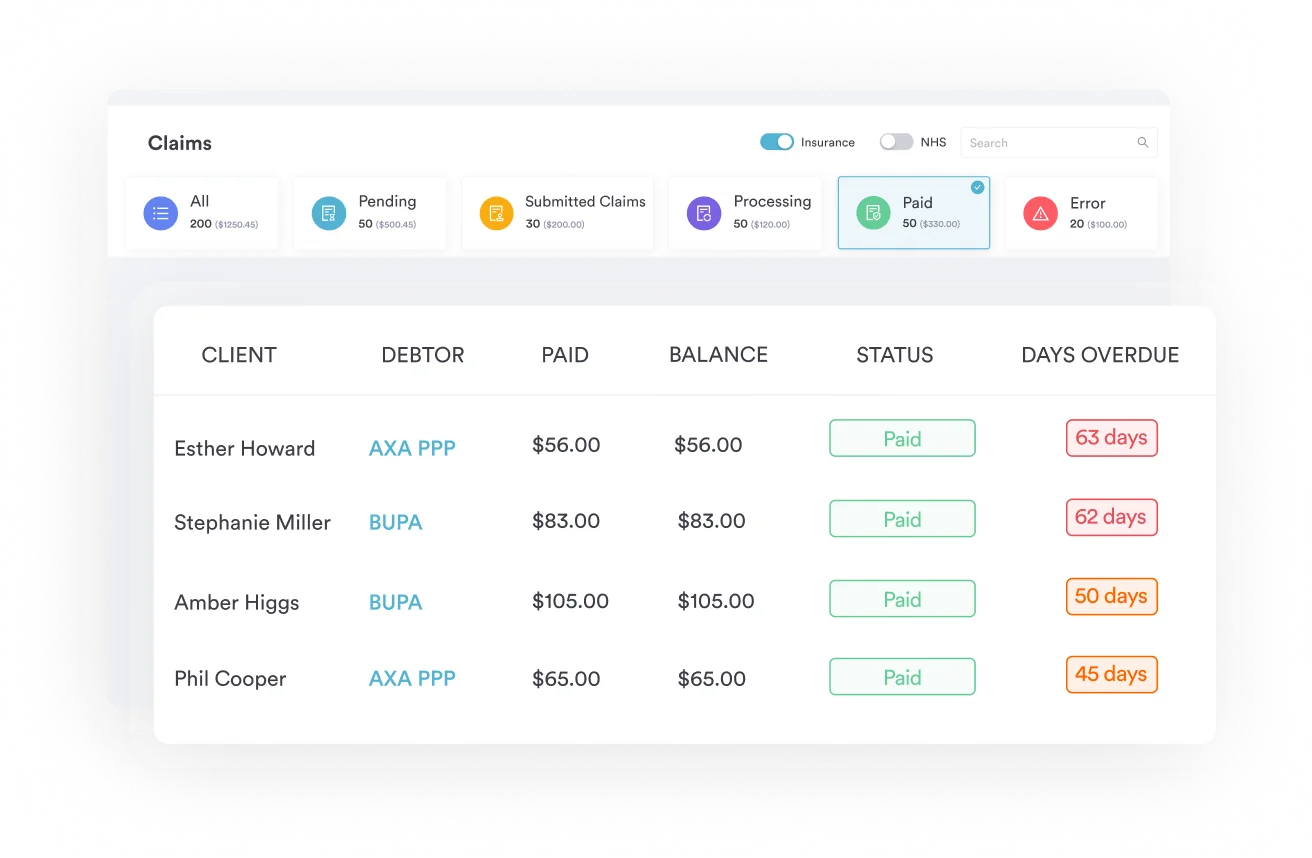

Pabau connects directly to Claim.MD’s clearinghouse to submit surgical foot claims, track ERA responses, and flag denials the same day they hit. See how it works for podiatry and orthopedic foot practices.

Overall, the code itself is rarely the problem on a great toe IP fusion. A 28755 claim fails when the paperwork describes another joint or another diagnosis than the code does.
Before the next claim goes out, check that the operative note, ICD-10 code and modifier describe the same joint on the same side. Once that match is routine, the remaining denial reasons become exceptions rather than a pattern.
Next, book a demo to see how Pabau tracks surgical foot claims from filing to payment.

Need to understand how clearinghouse billing works? Medical claims clearinghouse guide explains how 837P claim files move from practice to payer and back.
Seeing ERA remittance codes you don’t recognize? Electronic remittance advice explained breaks down CARC and RARC denial codes from payer EOBs.
Want to benchmark your denial rate? Denial management in healthcare covers root-cause analysis and appeals workflow for surgical claims.
CPT Code 28755 is the billing code for arthrodesis (surgical fusion) of the interphalangeal joint of the great toe. The surgeon removes the articular cartilage from both joint surfaces and prepares the underlying bone. The joint is then aligned in a functional position and secured with screws, K-wires or other internal fixation. It is distinct from MTP joint fusion codes (28750) and hammertoe repair (28285).
Pair 28755 with M19.071 (primary osteoarthritis, right ankle and foot) or M19.072 (left), matching the operative side. Hallux rigidus codes (M20.2-) describe the first MTP joint, so they do not fit an IP fusion. Avoid M19.079 (unspecified) when laterality is documented. Confirm the code appears on the applicable MAC Local Coverage Determination for foot arthrodesis before submitting.
CPT 28755 fuses the interphalangeal joint between the proximal and distal phalanges of the great toe. CPT 28730 covers arthrodesis of the midtarsal or tarsometatarsal joints, multiple or transverse, a midfoot procedure that does not involve the toes. CPT 28285 is a hammertoe repair code, not an arthrodesis code at all. Selecting 28730 or 28285 for an IP joint fusion is a code selection error that will trigger a denial or audit.
Yes, Medicare covers CPT Code 28755 when medical necessity is established. The 2026 Physician Fee Schedule assigns it 13.99 total facility RVUs and a 90-day global period. Payment applies the locality GPCI and the annual conversion factor to those RVUs, so check the CMS lookup tool for your ZIP code.