CPT code 65205: Conjunctival foreign body removal
CPT code 65205 covers superficial conjunctival foreign bodies only CPT code 6520...

Last Updated: Oct 22, 2026
28005 is the CPT code for incision, bone cortex (eg, osteomyelitis or bone abscess), foot. It covers a surgeon opening the outer cortex of a foot bone to drain infection or an abscess inside it.
The code sits in the 28001-28035 incision range for the foot and toes and carries a 90-day global period. It applies only when the operative note documents cortical entry. Below-fascia drainage with no bone entry is 28003 instead.
Let Pabau's smart automation suggest the right codes, reduce claim denials, and keep your practice compliant—effortlessly.
Automate repetitive tasks and focus on what matters most—your patients.
Reduce coding errors and ensure compliance with the latest regulations.
Clean claims, fewer denials, and faster reimbursements.
Powerful insights and reporting to help your practice thrive.
HIPAA compliant SOC 2 certified GDPR-compliant Trusted by 4,000+ clinics worldwide

CPT Code 28005 requires an incision through the cortex of a foot bone, not just soft-tissue drainage.
Pair it with a bone-level ICD-10-CM code, such as M86.171 or M86.172, and add modifier RT or LT for most payers.
The operative report must state explicitly that the bone cortex was incised, or the claim won’t hold up at audit.
CPT 28005 carries a 90-day global period, and 2026 Medicare values put it at 16.01 total RVUs.
Pabau’s claims management software scrubs every claim for missing or invalid details before it leaves Pabau.
CPT Code 28005 is the Current Procedural Terminology code for “Incision, bone cortex (eg, osteomyelitis or bone abscess), foot.” The American Medical Association’s CPT Editorial Panel maintains it. The code sits in the 28001-28035 range for incision procedures on the foot and toes, within the Musculoskeletal System chapter. It covers every bone of the foot, including the tarsals, metatarsals and phalanges.
The examples in the descriptor’s parentheses, osteomyelitis and bone abscess, are illustrative rather than exhaustive. Any condition that needs an incision through the cortex of a foot bone qualifies, as long as the operative note documents cortical entry. In the medical billing process, that means matching the procedure performed to the descriptor word for word before anyone codes the claim.
The procedure typically takes place in an operating room or ambulatory surgery center under regional or general anesthesia. The surgical steps are:
The operative report must describe each of these steps. Step 2, cortical entry, is the element that separates a billable 28005 from a 28003.
CPT 28005 is appropriate when the underlying diagnosis involves the bone itself, not only the surrounding soft tissue. Primary qualifying diagnoses include:
CPT 28005 does not apply when the infection is confined to soft tissue, subcutaneous layers, or deep fascial planes without bone involvement. In those cases, report 28003 instead. It covers below-fascia incision and drainage, with no bone entry.
Imaging that confirms bone involvement is essential for supporting medical necessity at prior authorization and audit. Plain films, MRI and nuclear bone scans all serve that purpose.
Every CPT 28005 claim needs a supporting ICD-10-CM diagnosis code that confirms bone-level pathology. Laterality must match the operative side. The table below lists the osteomyelitis codes that support this procedure.
Always verify ICD-10-CM codes against the CDC/NCHS ICD-10-CM tool for the current fiscal year. Codes update on October 1 each year, and a retired or changed code on a claim triggers an automatic rejection.
These two codes are easy to confuse because both drain an infection in the foot. The single differentiator is whether the surgeon reached bone.
Some operative reports describe only soft-tissue dissection and drainage, with no mention of cortical entry. Payers will downcode those claims to 28003 or deny them outright. The rule itself is simple. If the surgeon penetrated the cortex, report 28005. Otherwise, report 28003.
Bone excision and bone surface debridement have codes of their own, so the decision has four outcomes rather than two. The path below works through them in order.
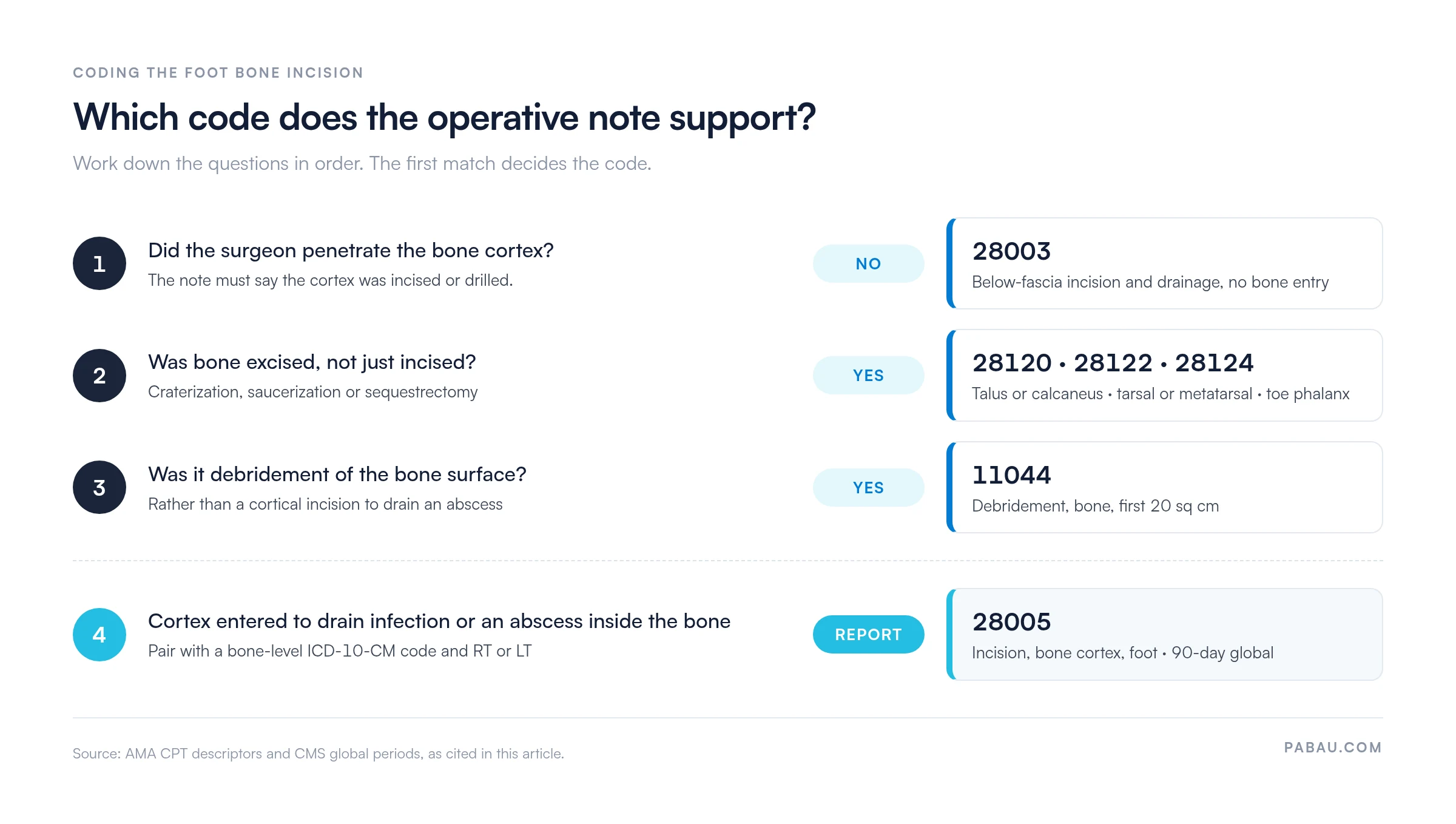
Several adjacent codes describe procedures that overlap clinically with 28005. Knowing when each one applies prevents bundling errors.
When the surgeon removes infected bone from a tarsal or metatarsal, 28122 describes the excision. A toe phalanx takes 28124, and the talus or calcaneus takes 28120.
Check current NCCI edit tables before billing CPT 28005 alongside 28120, 28122 or 28124 in the same session. Column 1/Column 2 edits may bundle these codes without modifier 59, and submitting without the modifier causes automatic denial. The NCCI edit tables update quarterly.
Modifier selection for CPT Code 28005 affects payment rate, laterality, and surgical package compliance. The table below covers the modifiers most commonly required.
The Medicare Physician Fee Schedule (MPFS) sets both facility and non-facility rates for CPT Code 28005. Each rate is the total relative value units (RVUs) multiplied by the annual conversion factor. The geographic practice cost index (GPCI) then adjusts it by locality.
The table below uses 2026 national values. Verify current amounts with the CMS MPFS lookup tool before quoting a patient or submitting a claim.
The payment figure is 16.01 total RVUs at the 2026 conversion factor of $33.4009. Your locality’s GPCI moves it up or down. Use a free RVU lookup tool to confirm locality-adjusted values.
Commercial payers reimburse under their own contracts. Contracted rates vary by payer and are often above the Medicare rate. If you bill through Pabau, the practice management and billing platform we build, you can submit electronic claims to US payers. You can also check eligibility and track claim status through Claim.MD, Pabau’s US clearinghouse partner.
Prior authorization for CPT 28005 is required by most Medicaid managed care plans and many commercial payers. Medicare fee-for-service does not currently require prior auth for this code, but Medicare Advantage plans vary by carrier and state.
When submitting a prior authorization request, payers typically require:
Turnaround times vary, typically 3-5 business days for standard requests and 24-48 hours for urgent cases. Always verify prior authorization requirements with the specific payer plan before scheduling.
Following medical billing compliance protocols for surgical codes includes confirming auth status before the day of surgery. Authorization obtained after surgery is rarely approved retroactively.
The operative report is the primary document payers review at audit. Missing a single phrase can turn a paid claim into a recovery demand. The operative note for CPT Code 28005 must contain all of the following:
A clean claim submission on surgical codes like 28005 depends on these elements being in the note before the claim is coded. Billing from an incomplete operative report and correcting it later costs time and risks a second denial on the resubmission.
CPT 28005 carries a 90-day global surgical package under the CMS Medicare Physician Fee Schedule. During this period, routine post-operative visits related to normal recovery are included in the surgical fee and cannot be billed separately.
Services that CAN be billed separately during the global period include:
Some services CANNOT be billed separately during the global period. They include routine wound checks, suture removal, dressing changes, and office visits for post-operative osteomyelitis management.
CPT Code 28005 claims fail when the documentation doesn’t prove bone involvement, and many operative reports leave that proof out. The most common denial patterns are:
Proactive denial management workflows catch items 4-7 before claims go out. Checking laterality modifiers, diagnosis codes and NCCI bundling before submission stops these denials at first pass. The list of common denial codes maps each rejection reason to a corrective action.
Without a claims tool, a biller checks each 28005 claim by hand. That means confirming RT or LT, a bone-level diagnosis code and the cortical-entry phrase before the claim goes out. One missed field sends the claim back.
Pabau’s podiatry claims management software takes that check off the biller’s desk. Its claim validation scrubs every claim for missing or invalid details before it leaves Pabau. Each problem comes with a Fix link that opens the field needing correction.
If a claim still comes back rejected, Pabau flags it as Needs action and shows the rejection reason. Your team knows exactly what to correct before resubmitting, so the claim doesn’t sit unpaid while someone works out why.

Pabau’s claim validation scrubs every CPT 28005 claim for missing or invalid details before it leaves Pabau. Rejected claims are flagged with the reason, so your team can fix and resubmit them.

Whether CPT 28005 pays comes down to one sentence in the operative note. It has to say the surgeon entered the bone cortex. Pair that with a bone-level diagnosis and the right laterality modifier, and the claim holds up at audit.
So build the cortical-entry phrase into your surgical dictation template now. It costs the surgeon a few seconds per case. A recovery demand on a 90-day global surgery costs far more.
Pabau scrubs every claim for missing or invalid details before it leaves the system, so your team fixes errors before a payer sees them. Book a demo to see claim validation in a podiatry billing workflow.

Coding a below-fascia drainage instead? CPT code 28003 covers incision and drainage below the fascia when no bone is entered.
Debriding bone rather than incising it? CPT code 11044 explains when bone debridement replaces a cortical incision on the claim.
Need to understand how claims reach the payer? Medical claims clearinghouse guide explains how electronic claims are validated and routed to insurers.
Struggling with post-submission rejections? Electronic remittance advice (ERA) explained covers how to read 835 files and map CARC denial codes back to specific claim lines.
Want to confirm insurance coverage before surgery? Insurance eligibility verification shows how checking benefits before the visit keeps surgical claims from bouncing on coverage.
CPT Code 28005 is the procedure code for incision of the bone cortex of the foot. Surgeons use it when they enter the cortex to drain infection from osteomyelitis or a bone abscess. It sits in the 28001-28035 incision range for the foot and toes, and the operative note must document cortical entry.
CPT 28003 covers below-fascia incision and drainage of the foot, with no bone entry. CPT 28005 requires the surgeon to incise through the bone cortex. The operative note must state that the cortex was penetrated for 28005 to be defensible. If only soft tissue was drained, 28003 is the correct code.
Laterality modifiers RT (right) or LT (left) are required by Medicare and most commercial payers for foot surgery codes. Use modifier 59 when billing 28005 alongside 28120, 28122 or 28124 at a separate anatomical site. Modifier 78 applies if the patient returns to the OR for a related complication during the 90-day global period.
CPT 28005 carries a 90-day global surgical package under the CMS Medicare Physician Fee Schedule. Routine post-operative visits related to normal recovery during this period are included in the surgical fee. New or unrelated conditions, and complications requiring a return to the OR, may be billed with the right modifiers.
Prior authorization is required by most Medicaid managed care plans and many commercial payers, but not by Medicare fee-for-service. Medicare Advantage plans vary by carrier. Submit imaging confirming bone involvement, documentation of failed conservative treatment, and culture results when requesting authorization.
Yes, CPT 28005 may be reported with CPT 11043 (debridement, muscle and/or fascia) when a distinct soft-tissue debridement is performed at a separately identifiable site. Check current NCCI edit tables to confirm whether modifier 59 is needed. NCCI edits update quarterly, and payer policies vary.