



CCSD code G5100: Bypass of duodenum billing guide
CCSD code G5100 bills a bypass that leaves the duodenum in place CCSD code G5100...

Last Updated: Oct 16, 2026

CPT code 23430 describes an open tenodesis of the long tendon of the biceps, coded in the 23395-23491 shoulder repair range.
An arthroscopic biceps tenodesis is 29828, so the approach in the operative report decides the code.
Every claim needs a laterality modifier, RT or LT, and a missing one is the most common denial trigger.
The ICD-10 code must carry the same side as the modifier, and M75.2 is the code for bicipital tendinitis.
Practice management software like Pabau surfaces modifier prompts, ICD-10 pairings, and NCCI edit alerts at charge entry.
CPT code 23430 covers tenodesis of the long tendon of the biceps. It is an open procedure that anchors the long head of the biceps tendon to the humerus or nearby soft tissue.
The American Medical Association (AMA) lists it in the shoulder repair range, 23395-23491, inside the Musculoskeletal System section of the CPT code set.
One distinction drives a large share of 23430 denials. The code describes an open procedure only. When the surgeon performs the tenodesis arthroscopically, the correct code is 29828, arthroscopy of the shoulder with biceps tenodesis. Billing 23430 for an arthroscopic case invites a medical necessity denial.
Denials on this code cluster around a short list of avoidable errors. Missing laterality modifiers, mismatched ICD-10 codes, and approach confusion account for most of them. Each one is caught at charge entry rather than on appeal.
Medical necessity is the first thing a payer audits. The operative report must tie the procedure to a documented condition that justifies surgery. Biceps tenodesis is indicated once conservative treatment has failed and the patient presents with one of the following.
Three elements of the clinical record decide whether the claim survives review.
Medicare MACs set these criteria through Local Coverage Determinations, and the bar varies by jurisdiction. Pull your own MAC’s determination rather than relying on a neighboring state’s.
CMS publishes the Medicare rate for CPT 23430 annually. It varies by geographic location, practice setting, and the Geographic Practice Cost Index (GPCI) for your locality. Use the CMS Physician Fee Schedule lookup tool to pull current figures for your Medicare Administrative Contractor (MAC) locality.
National averages are a starting reference only. Your actual payment reflects the GPCI where you practice, which can move the figure in either direction.
The Medicare payment for CPT 23430 comes from three RVU components multiplied by the CMS conversion factor. The conversion factor itself is set in the annual Physician Fee Schedule final rule. Use FastRVU’s 2026 RVU lookup to confirm the current values for your locality.
The setting where CPT 23430 is performed changes the physician’s Medicare payment. In a facility setting, CMS pays the hospital or surgery center directly for overhead. The physician’s payment then reflects the lower facility PE RVU. In an office the physician absorbs overhead and receives the higher non-facility rate.
Submitting a claim with the wrong place-of-service code is one of the less obvious denial triggers. A claim billed with POS 11 for a procedure performed at a hospital outpatient department will be recouped on audit. Confirm the POS code matches the setting on the date of service.
Pull your MAC locality GPCI values before estimating reimbursement for CPT 23430. A practice in a high-cost metropolitan area can be paid meaningfully more than the national average, while rural localities often land below it. Check the CMS Physician Fee Schedule search tool with your locality code each January, when the new conversion factor takes effect.
Every claim for CPT 23430 requires a laterality modifier. The shoulder is a bilateral structure, so CMS rejects claims without RT for the right side or LT for the left. This is the single most common reason for an initial denial on a biceps tenodesis claim.
Confirm modifier requirements against the current CMS NCCI Policy Manual before submitting. Modifier 59 draws ongoing CMS scrutiny. Some MACs now prefer the X-modifier subset instead, meaning XE, XS, XP, and XU.
The ICD-10-CM code paired with CPT 23430 must match the documented diagnosis and carry the correct laterality extension.
Laterality on the diagnosis code is a second denial trigger, separate from the procedure modifier. Coverage still depends on your MAC’s Local Coverage Determination (LCD), so verify the pairing against current-year AAPC code resources and your own LCD.
An unspecified-laterality extension triggers medical necessity review at many MACs, so always code the right or left side. Where several diagnoses apply, sequence the primary reason for the procedure first. In a combined case that also repairs the cuff, the right-shoulder companion diagnosis is M75.121.
Biceps tenodesis is often performed alongside other shoulder procedures in the same operative session. Whether a companion code can be billed separately depends on the National Correct Coding Initiative (NCCI) edits table that CMS maintains. A medical claims management system should flag these edit relationships at charge entry, before the claim reaches the payer.
Each companion code in the table describes an arthroscopic approach. When the distal clavicle is resected through an open incision instead, the claim carries CPT 23120 rather than 29824. On the biceps itself, a tendon that is released without reattachment is a tenotomy, billed as CPT code 23405 rather than 23430.
NCCI edits define which code pairs CMS treats as inherently bundled. When 23430 and a companion arthroscopic code are both reported, the edit table decides whether they can be billed together. It also decides whether a modifier can override the edit. CMS updates the tables quarterly, so check the current quarter rather than a cached copy.
A clean operative report is the primary line of defense against a medical necessity denial. For CPT 23430, the documentation must support the diagnosis, the open approach, and the technique used. Practices that build these checks into the billing workflow catch errors before submission rather than during a retrospective payer audit.
CPT 23430 carries a 90-day global surgery period under CMS rules. Post-operative care inside those 90 days is included in the original payment. It cannot be billed separately to Medicare, apart from the exceptions below.
Billing a routine follow-up inside the 90-day window without a valid modifier is a common compliance error in orthopedic practices. Audit post-op billing quarterly against your surgical date logs, so you find the pattern before a payer does.
Denial patterns for CPT 23430 cluster around a small set of preventable errors, and each one maps to a step in the pre-submission workflow. The denial codes reference covers the CARC and RARC remittance codes that arrive with these rejections.
A pre-submission eligibility check removes another category of denials. Confirming active coverage and any prior authorization requirement at booking is far faster than appealing afterward.
Billing a 23430 claim means clearing six checkpoints in order, and each one has a denial attached to it.
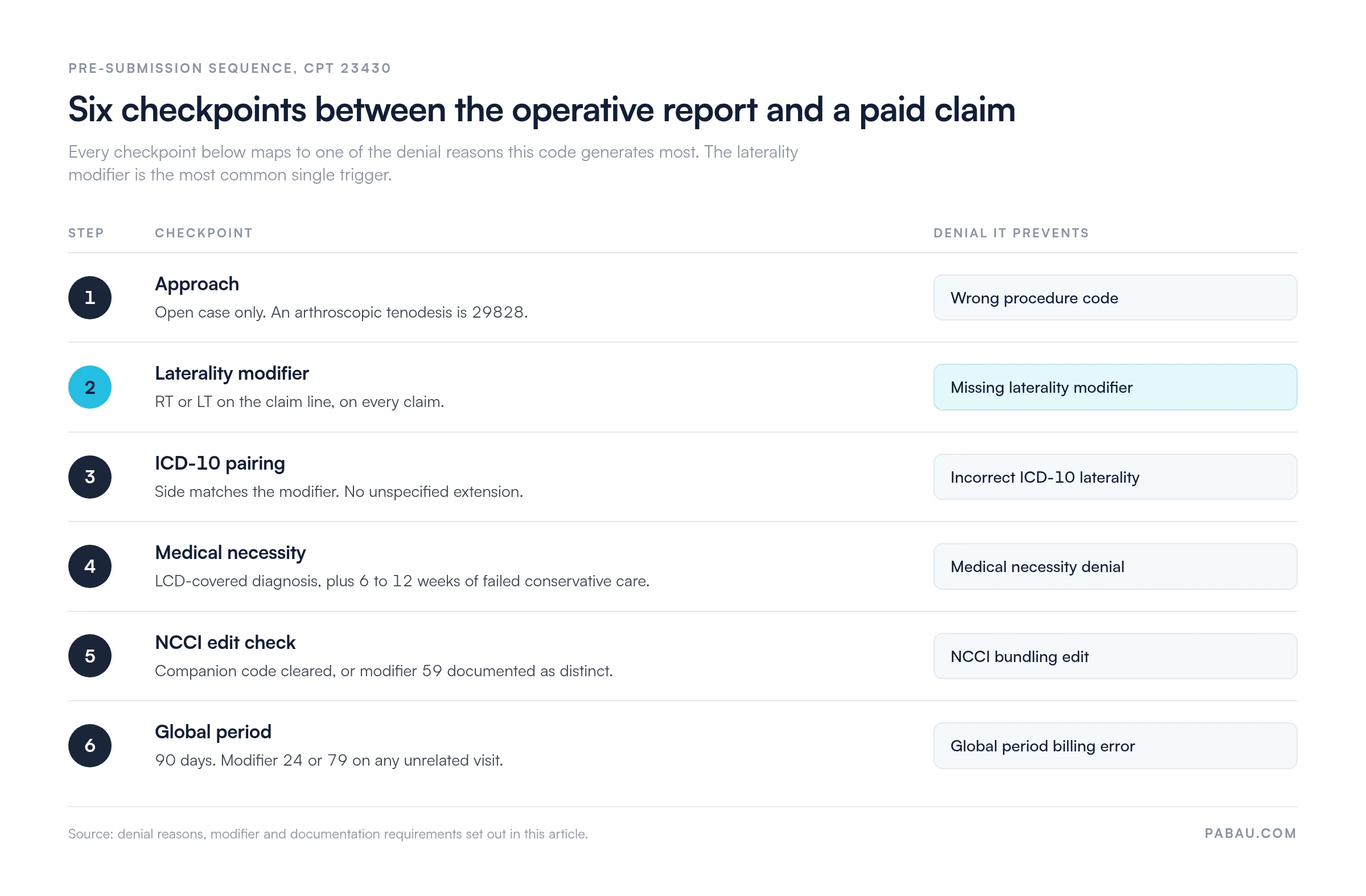
Reference tools give coders the answers. Practice management software like Pabau puts the answer in front of the coder at the moment the charge is created. That is the only moment when acting on it costs nothing.
Pabau’s Claim.MD integration reaches thousands of US payers for real-time eligibility checks and electronic claim submission. When a coder enters CPT 23430, the system can surface the laterality requirement and check the ICD-10 pairing against the linked diagnosis. It also flags an active NCCI edit on a companion code before the claim leaves the practice.
Pabau also generates superbills and exports CMS-1500 claims to Claim.MD. Electronic remittance advice and 835 files feed back into denial tracking, so the billing loop stays auditable at every step. That matters most for practices billing shoulder procedures in volume, where one repeated coding habit multiplies across dozens of claims.
Track CPT 23430 denial rates as a standalone metric in your practice reporting. When the rate drifts above 5%, split the causes across laterality, ICD-10 mismatch, NCCI bundling, approach mismatch, and global period errors. Knowing which category drives the spike tells your billing team where to intervene.

Pabau connects operative documentation, charge capture, and claim submission in one workflow. Modifier prompts, NCCI edit alerts, and ICD-10 pairings surface at charge entry, so your team catches errors before they reach the payer.

CPT 23430 is a simple code with an unforgiving claim. Payment turns on the approach, the laterality modifier, the ICD-10 side, and the global period. Those four checks are most of the job.
Move each check out of a coder’s memory and into the charge entry screen. The denial rate on this code then stops being a monthly surprise. The trade-off is setup time now against far fewer appeals later.
Pabau surfaces those prompts and edit alerts at the point of charge entry rather than during an appeal. Book a demo to see how it handles high-volume shoulder surgery billing.

Need to understand how claims move through the clearinghouse? Medical claims clearinghouse explained walks through how electronic claims are validated, scrubbed, and routed to payers.
Want to reduce the time between service and payment? Electronic remittance advice (ERA) guide covers how 835 files automate payment posting and denial identification.
Looking for the 837 transaction format requirements? 837 file format for medical billing explains the EDI transaction standard used for professional and institutional claim submission.
CPT 23430 is the procedure code for tenodesis of the long tendon of the biceps. The open technique anchors the long head of the biceps tendon to the humerus or surrounding soft tissue. Surgeons use it to relieve pain from bicipital tendinitis, SLAP lesions, and partial biceps rupture.
The CMS global surgery period for CPT 23430 is 90 days. Routine post-operative visits, wound care, and uncomplicated recovery management fall inside the original surgical payment. None of them can be billed separately to Medicare. Unrelated services during the global period require modifier 24 or 79 with supporting documentation.
CPT 23430 requires a laterality modifier on every claim, RT for the right shoulder and LT for the left. Modifier 59 applies when you co-bill a companion shoulder code with documented separate steps. Modifier 51 covers multiple procedures in one session, and modifier 22 covers increased procedural complexity.
CPT 23430 pairs most often with M75.2 for bicipital tendinitis and S46.11 for a strain of the long head of the biceps. M75.12 covers a complete rotator cuff tear, and M75.4 covers shoulder impingement syndrome. Always add the laterality extension, 1 for right and 2 for left. Verify coverage against your MAC’s current LCD before submission.
CPT 23430 and 29827 are generally separately billable when the surgeon performs distinct procedures documented in the operative report. Check the current CMS NCCI edits table for an active column relationship between the two codes. Apply modifier 59 only when the work is a separate surgical service.
Four causes account for most CPT 23430 denials. The first is a claim line missing its RT or LT modifier. The second is an ICD-10 code outside the MAC’s LCD covered diagnoses. The third is a companion code that breaks an NCCI edit without a valid modifier override. The fourth is an arthroscopic case coded as 23430 instead of 29828.
CPT 23430 carries work RVU, practice expense RVU, and malpractice RVU components that together determine the Medicare payment. The exact values are updated annually in the CMS Physician Fee Schedule final rule. Use the CMS PFS lookup tool or FastRVU to pull the current 2026 values for your MAC locality. The conversion factor and GPCI adjustments both move the dollar figure.



