



CCSD code G5100: Bypass of duodenum billing guide
CCSD code G5100 bills a bypass that leaves the duodenum in place CCSD code G5100...

Last Updated: Oct 16, 2026
CPT Code 22856 covers total disc arthroplasty (artificial disc), anterior approach, single interspace, cervical. Medicare pays about $1,522 for it nationally in 2026. The code bundles the discectomy, the end plate preparation, the osteophytectomy and the microdissection into one line.
The artificial disc itself is billed separately by the facility, and a second cervical level is reported with add-on code 22858. Coverage sits under CMS Article A57021, which sets the patient selection criteria the operative note has to satisfy. This guide covers the descriptor, the RVU math, the modifiers, the ICD-10-CM pairings, and the errors that hold these claims.

CPT Code 22856 describes total disc arthroplasty (artificial disc), anterior approach, single interspace, cervical, including discectomy, end plate preparation, osteophytectomy and microdissection.
The code carries 45.57 total facility RVUs in CY2026, which pays roughly $1,522 nationally before your locality adjustment is applied.
Medicare prices 22856 for the facility setting only, so there is no non-facility rate to choose between.
Medical necessity now needs a level-specific diagnosis, because M50.12, M50.22 and M50.32 are parent codes rather than billable ones.
Modifier -62 applies when two surgeons perform distinct portions, and both surgeons have to append it for the claim to process correctly.
CPT Code 22856 is the primary code for single-level cervical total disc arthroplasty. The American Medical Association (AMA) maintains the descriptor as the standard for physician procedure coding.
The descriptor reads: total disc arthroplasty (artificial disc), anterior approach, including discectomy with end plate preparation, single interspace, cervical. The end plate preparation clause carries its own parenthetical, which bundles osteophytectomy for nerve root or spinal cord decompression along with microdissection.
In plain language, the surgeon reaches the damaged cervical disc through the front of the neck and removes it. The vertebral end plates are then prepared and a prosthetic disc is implanted. Any bone spur removal needed to decompress the nerve root or the spinal cord is part of the code, as is microsurgical dissection. The code covers one cervical interspace and no more.
Medicare pays roughly $1,522 for CPT Code 22856 nationally in 2026. That figure is 45.57 total facility RVUs multiplied by the CY2026 conversion factor of $33.4009. Clinicians paid as qualifying alternative payment model participants use the higher $33.5675 factor, which works out at about $1,530.
Both numbers are national and unadjusted. Your Medicare Administrative Contractor (MAC) applies a geographic practice cost index to each RVU component, so the amount on your remittance will differ. Confirm the locality rate with the CMS Physician Fee Schedule lookup tool before you post an expected payment.
Relative value units (RVUs) drive the payment calculation, and 22856 splits into three of them. Surgeon work carries just over half of the total, which is typical for a major spine procedure. Take the values from the CMS relative value files rather than a third-party calculator, because CMS republishes the components every year. The chart below shows how the three divide the total, and how that total turns into a payment.
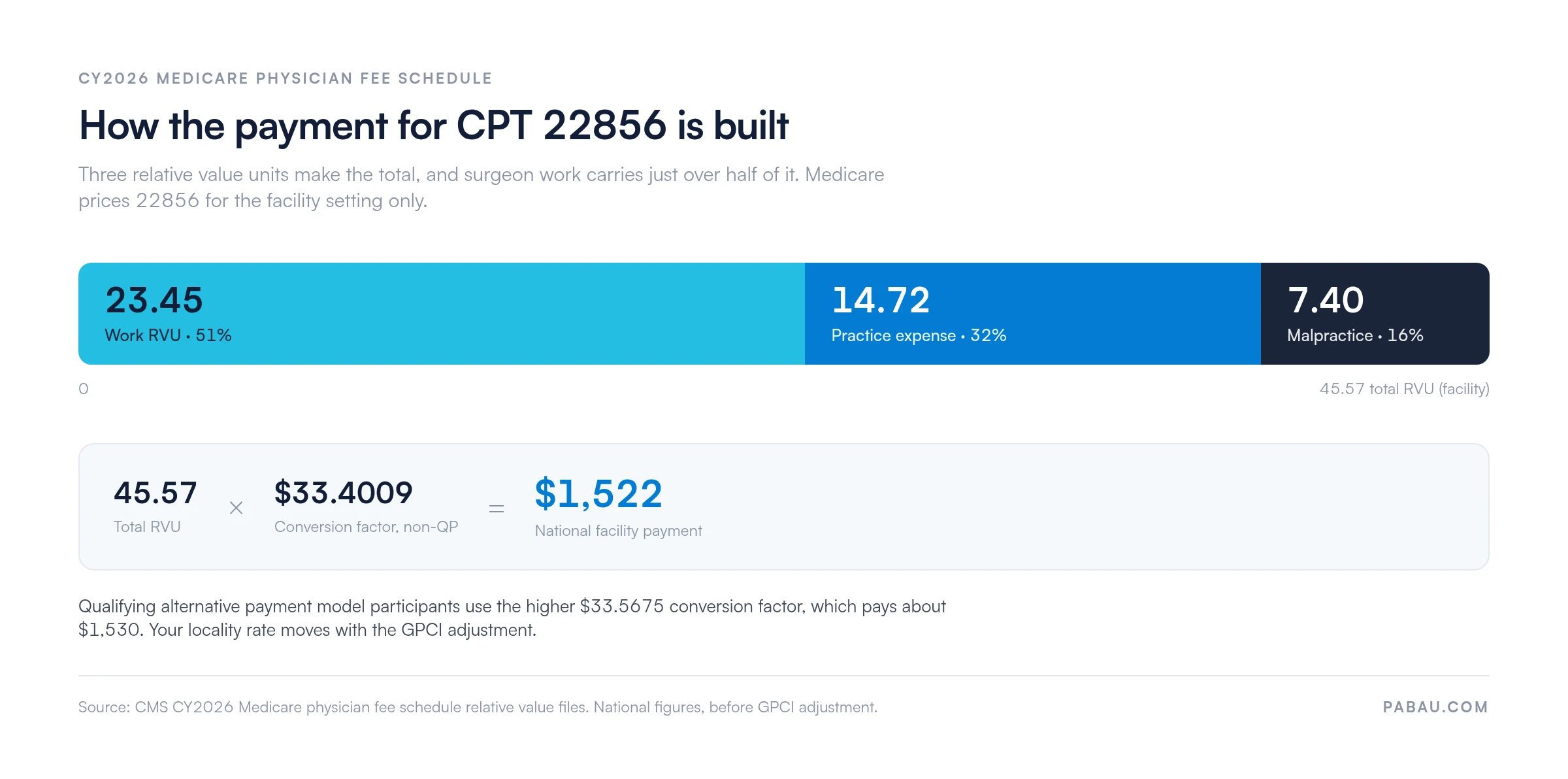
One caveat: the values above are national. Your MAC’s geographic adjustment decides what actually lands, so reconcile each remittance against the expected amount rather than against a published average.
Medicare prices CPT Code 22856 for the facility setting only. Cervical disc arthroplasty happens in a hospital outpatient department or an ambulatory surgical center, never in a physician’s office. The fee schedule therefore carries one practice expense value for the code, and the facility bills separately for its own overhead and for the device.
That removes a decision most codes force on a biller, but it does not remove the place of service field. Report the place of service that matches where the surgery happened. A place of service that contradicts the facility’s own claim invites a review.
Modifier selection on this code decides how the claim adjudicates. Applying the wrong one, or leaving out one that was required, is the most common reason spine surgery claims are held or denied. Check every modifier against current National Correct Coding Initiative (NCCI) edits before submission.
Pairing CPT Code 22856 with an approved diagnosis is what establishes medical necessity. CMS Article A57021 governs Medicare coverage for cervical disc replacement and names the codes that support it. Source your pairings from that article and your MAC’s local coverage determination (LCD), then check each one against the current ICD-10-CM code library.
One recent change catches spine coders out. Since October 1, 2025, the four-character codes M50.12, M50.22 and M50.32 have been parent codes rather than billable ones. Each needs a sixth character identifying the level, so the diagnosis on the claim has to match the interspace named in the operative note.
Watch M47.812 in particular. It reads “spondylosis without myelopathy or radiculopathy, cervical region”, so it describes the opposite of the indication an arthroplasty claim needs. M47.22 is the code for cervical spondylosis with radiculopathy, and swapping the two is a quiet route to a medical necessity denial.
Verify the final list against the current CMS Article A57021 and your MAC’s LCD. A code that is clinically correct but absent from the approved list still triggers a denial. The medical record then has to support whichever code you selected, at the level you selected.
Medicare covers cervical disc replacement when specific patient selection criteria are met, as defined in CMS Article A57021. Coverage is not automatic for every patient with a cervical disc problem. The determination also varies by MAC, so confirm the LCD that applies in your region.
Submit prior authorization where the payer requires it, and keep the imaging reports, the conservative treatment records and the clinical notes in the chart. A technically correct 22856 claim still gets denied on medical necessity when one of those is missing.
A clean claim for CPT Code 22856 starts in the operative report. Auditors reviewing arthroplasty claims look for the elements that confirm the procedure performed matches the descriptor billed. A thin operative note is the second largest source of post-payment audit exposure on this code, behind modifier errors.
The note has to contain all of the following.
Procedure-specific note templates cut the risk of losing one of those elements. Practice management software like Pabau lets a practice build a template that prompts for each component before the surgeon signs off. The billing team then stops chasing a missing device model after the fact.
Run a pre-submission checklist on every CPT 22856 claim. Confirm that the operative note names the specific interspace, the device model, and the history of failed conservative treatment. Claims missing any of those three have the highest denial rate in cervical arthroplasty billing.
CPT Code 22856 rarely appears alone on a spine claim. Knowing the rest of the family keeps the code combination right and keeps unbundling edits off the claim.
Anterior cervical discectomy and fusion (ACDF) and cervical disc arthroplasty are different operations that take different codes. ACDF uses CPT 22551, with 22552 as the add-on for additional levels. Arthroplasty uses CPT 22856.
The differentiator is motion. Arthroplasty preserves movement at the operative level by implanting a prosthetic disc, while fusion eliminates it by joining adjacent vertebrae. The surgical note says which one happened, so read it before you code. Miscoding between the two is a CMS audit trigger.
Not every motion-preserving implant has its own code. Dynamic stabilization and nucleus replacement devices still fall to the unlisted spine code 22899, which payers price by comparison with the closest specific code.
These are the errors billing teams hit most often on cervical arthroplasty claims. Accurate code selection is only the first step. The claim also needs the right modifiers, an approved diagnosis, and an operative note that supports both.
Practices billing spine surgery benefit from denial management workflows that sort denials by CPT code. If 22856 denials cluster around modifier errors rather than medical necessity, the fix belongs in the coding step, not in the documentation.
Spine surgery billing is too intricate for manual code lookups and a shared spreadsheet. A single 22856 claim involves co-surgery coordination, add-on sequencing for a second level, device code separation, and an LCD compliance check. Software that validates codes and modifiers at the point of claim creation catches the error before it becomes a denial.
Pabau’s error-checking claims management software covers the claim lifecycle for surgical practices. Fee schedule updates, modifier validation, electronic submission and remittance reconciliation sit in one place, so your billers stop reconciling three systems against each other.
For practices on the Claim.MD clearinghouse integration, claims are validated against payer-specific edits before transmission. Incorrect modifier combinations and missing diagnosis codes get caught before the payer ever sees them. The integration reaches thousands of US payers and handles 835 remittance processing, so payment reconciliation happens without a manual match.
A complete superbill carries the CPT code, the applicable modifiers, the ICD-10-CM diagnosis, the place of service and the treating provider’s credentials. Enforcing those fields at the point of entry means a missing one gets flagged before submission, rather than discovered during a denial review weeks later.
Configure your billing system to flag any 22856 claim submitted without a paired ICD-10-CM code from the approved LCD list. This one rule prevents the most common medical necessity denial on cervical arthroplasty claims. Most practice management platforms can run it as an automated pre-submission edit.

Pabau’s claims management tools help spine surgery practices submit cleaner CPT 22856 claims, with built-in modifier validation and fee schedule updates. Fewer avoidable denials means less time spent reworking claims that should have paid first time.

CPT Code 22856 pays well and gets audited hard, and the failure points are rarely exotic. A modifier that does not match what the second surgeon did will sink the claim. So will a diagnosis coded one character short of the level, or an operative note that never names the device. None of those failures say anything about the surgery itself.
The answer is a pre-submission check that runs on every claim, not another round of coder training. Three checks cover most of the risk. Match the modifier against NCCI edits, the diagnosis against the LCD list, and the operative note against the descriptor.
Do that consistently and the write-offs on this code stop being a monthly surprise. Book a demo to see how Pabau runs those checks inside the claim your coder is already building.

Need to understand how clearinghouse validation reduces denials? Pabau’s Claim.MD clearinghouse guide explains how real-time payer edits catch billing errors before submission.
Want to reduce claim rejection rates across all surgical codes? Medical billing compliance best practices covers the documentation and process standards that keep complex procedure claims clean.
Looking for guidance on credentialing with payers that cover 22856? Getting credentialed with insurance companies walks through the payer enrollment process for surgical specialties.
CPT Code 22856 is total disc arthroplasty (artificial disc), anterior approach, single interspace, cervical. It covers one level of cervical artificial disc replacement performed through the front of the neck. The descriptor bundles the discectomy, the end plate preparation, the osteophytectomy for nerve root or spinal cord decompression, and the microdissection.
About $1,522 nationally. CPT 22856 carries 45.57 total facility RVUs in CY2026. That total is multiplied by the $33.4009 conversion factor for clinicians outside an advanced alternative payment model. Qualifying participants use the higher $33.5675 factor, which pays roughly $1,530. Your locality rate moves with the geographic adjustment your MAC applies.
Yes, under the criteria set out in CMS Article A57021. Coverage requires documentation of failed conservative treatment, neurological symptoms confirmed on imaging, an FDA-approved device, and the absence of contraindications. Criteria vary by MAC region, so confirm the LCD that applies in your locality before billing.
C1889 and C1713 are the device codes most commonly billed alongside CPT 22856. C1889 covers a prosthetic implant not otherwise classified, and C1713 covers an anchor or screw for opposing bone-to-bone or soft tissue-to-bone fixation. Both are facility codes billed by the hospital or ASC. Physicians do not bill device pass-through codes.



