CPT code 22854 – Interbody device insertion into a corpectomy defect
Code Definition
22854 is the CPT add-on code for placing a biomechanical device, such as a cage or mesh, into a vertebral corpectomy defect during interbody arthrodesis. It is reported once per contiguous defect, on the same claim as the corpectomy and fusion codes.
The device's site decides the code, not how many devices go in. A cage in a disc space belongs to 22853, and a device placed without fusion belongs to 22859. Billing a disc-space cage as 22854 claims a corpectomy that never happened. Once the site is settled, the unit count and the anterior plate edit decide whether the claim goes through clean.
Related Information
Section
10004-69990 Surgery
Subsection
20100-29999 Musculoskeletal system
Code range
22840-22870 Spinal instrumentation
Billable
No
Code also known as
corpectomy cage code, vertebral body replacement (VBR) cage code
Save time. Improve accuracy. Get paid faster.
Automate coding with Pabau
Let Pabau's smart automation suggest the right codes, reduce claim denials, and keep your practice compliant—effortlessly.
Interbody device insertion into a corpectomy defect
Codes
Suggested by Pabau AI
22854Interbody device insertion into a corpectomy defect
CPT Code Suggestion
AI
Suggested code
22854Interbody device insertion into a corpectomy defectHigh match
Confidence score
98%
Why this code?
Matches patient diagnosis
Supported by clinical notes
Commonly used for this condition
Why practices choose Pabau
Save hours every week
Automate repetitive tasks and focus on what matters most—your patients.
Improve accuracy
Reduce coding errors and ensure compliance with the latest regulations.
Get paid faster
Clean claims, fewer denials, and faster reimbursements.
Grow with confidence
Powerful insights and reporting to help your practice thrive.
HIPAA compliant•SOC 2 certified•GDPR-compliant•Trusted by 4,000+ clinics worldwide
Key takeaways
CPT code 22854 reports a cage or mesh device placed into a vertebral corpectomy defect during interbody arthrodesis, once per contiguous defect.
The choice between 22853 and 22854 depends on where the device sits, a disc space or a corpectomy defect, not on the device count.
Two adjacent corpectomies form one contiguous defect and take one unit of 22854, while separate defects each take their own unit.
NCCI bundles anterior instrumentation codes 22845-22847 into 22854, so a separate plate needs a modifier and a note showing it was its own step.
As an add-on code, 22854 is exempt from modifier 51 and is always billed with a corpectomy or arthrodesis primary code on the same claim.
CPT code 22854 covers a device in a corpectomy defect
CPT code 22854 reports the insertion of an intervertebral biomechanical device, such as a synthetic cage or mesh, into a vertebral corpectomy defect. The surgeon has removed part or all of a vertebral body, and the device fills that space while interbody arthrodesis fuses the levels around it.
It is an add-on code, marked with a “+” in the AMA CPT code set, and it is reported once for each contiguous defect. The code took effect on January 1, 2017, when 22853, 22854 and 22859 replaced the deleted code 22851.
The official descriptor breaks down into five elements, and each one changes how the claim is built.
“Insertion of intervertebral biomechanical device(s) (eg, synthetic cage, mesh)”: the structural implant that replaces the resected bone
“with integral anterior instrumentation for device anchoring (eg, screws, flanges), when performed”: fixation built into the device is included, and devices without it qualify too
“to vertebral corpectomy(ies) (vertebral body resection, partial or complete) defect”: the site, which is what separates this code from 22853
“in conjunction with interbody arthrodesis”: fusion must be performed, otherwise 22859 applies
“each contiguous defect”: the unit of service, counted by defect rather than by device or level
What 22854 includes
Placement of one or more cages, mesh cylinders or expandable vertebral body replacement devices into a single contiguous corpectomy defect
Screws, flanges or other fixation that is part of the device and only holds it in place
Corpectomy defects in the cervical, thoracic or lumbar spine, from any approach the primary procedure uses
What 22854 leaves to other codes
A device placed into an intervertebral disc space, which is reported with 22853 for each interspace
A device placed without interbody arthrodesis, including methylmethacrylate, which is reported with 22859
The corpectomy and the arthrodesis themselves, which are reported with their own primary codes
Bone graft, reported with 20930-20938 as documented
Anterior plates or posterior instrumentation that work independently of the device, reported with 22840-22847
CPT 22854 vs 22853 vs 22859: Site and fusion decide the code
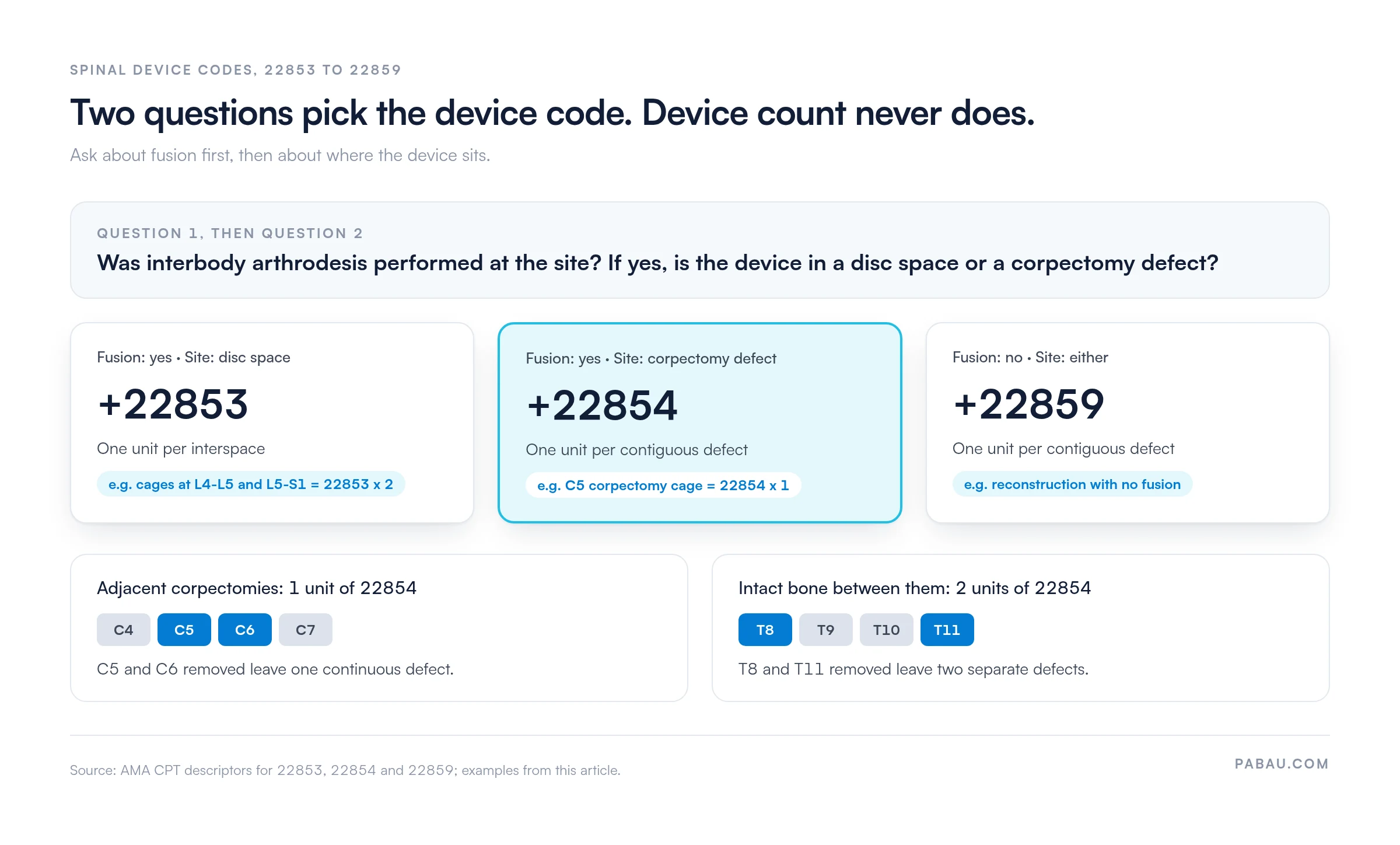
Two questions separate the three device codes. Where was the device placed, and was interbody arthrodesis performed at that site? The number of devices plays no part in either answer, as the decision path below shows.
Fusion separates 22859 from the other two codes, and the device site then splits 22853 from 22854. The rules follow the AMA CPT descriptors.
Element
CPT 22853
CPT 22854
CPT 22859
Device site
Intervertebral disc space
Vertebral corpectomy defect (partial or complete vertebral body resection)
Disc space or vertebral body defect
Interbody arthrodesis
Required
Required
Not performed
Unit of service
Each interspace
Each contiguous defect
Each contiguous defect
Integral anchoring
Included when performed
Included when performed
Not part of the descriptor
Typical case
Cage in a prepared disc space during ACDF, ALIF, PLIF or TLIF
Cage or mesh spanning a cervical, thoracic or lumbar corpectomy
Tumor or fracture reconstruction where no fusion is performed
Add-on code
Yes
Yes
Yes
A frequent error on this code family is using 22854 as a “second device” or “second level” code. A two-level TLIF with a cage at L4-L5 and another at L5-S1 is reported with 22853 x 2. Billing 22854 for the second cage claims a corpectomy that never happened.
The two codes can still appear on one claim. Take a hybrid cervical case with a C5 corpectomy cage and a separate disc-space cage at C6-C7. It reports 22854 x 1 for the defect and 22853 x 1 for the interspace.
Count defects, not devices, for 22854 units
Count defects, not devices or vertebrae. Adjacent corpectomies leave one continuous void, so they are reported as a single unit of 22854 however many vertebral bodies were removed.
Operative scenario
Corpectomy codes
Units of 22854
C5 corpectomy, one cage spanning C4 to C6
63081
1
C5 and C6 corpectomies, one cage spanning C4 to C7
63081 + 63082
1 (one contiguous defect)
C5 and C6 corpectomies, two stacked cages in the same defect
63081 + 63082
1 (device count does not add units)
T8 and T11 corpectomies with intact vertebrae between them
The corpectomy codes count each vertebral segment through their own add-on codes, such as 63082 after CPT code 63081. Coders sometimes mirror that count onto 22854, which overstates the device line.
Pro Tip
Before you code the device line, find the sentence in the operative note that names each vertebral body resected. Adjacent bodies are one defect and one unit of 22854. A level of intact bone between them makes two.
22854 rides on a corpectomy and a fusion code
CPT code 22854 cannot stand alone on a claim. It is reported with the procedure that created the defect and the arthrodesis performed across it. All of them go on the same date of service.
Primary code
Procedure
Region
63081 (+63082)
Vertebral corpectomy, anterior approach, with decompression of spinal cord and/or nerve roots, single segment (each additional segment)
Cervical
63085 (+63086)
Vertebral corpectomy, transthoracic approach, with decompression, single segment (each additional segment)
Thoracic
63087 (+63088)
Vertebral corpectomy, combined thoracolumbar approach, with decompression, single segment (each additional segment)
Lower thoracic or lumbar
63090 (+63091)
Vertebral corpectomy, transperitoneal or retroperitoneal approach, with decompression, single segment (each additional segment)
Lower thoracic, lumbar or sacral
63101, 63102 (+63103)
Vertebral corpectomy, lateral extracavitary approach, with decompression, single segment (each additional segment)
Thoracic (63101), lumbar (63102)
22110-22114 (+22116)
Partial excision of vertebral body for intrinsic bony lesion, without decompression, single segment (each additional segment)
Cervical, thoracic, lumbar
22554, 22556, 22558 (+22585)
Arthrodesis, anterior interbody technique, including minimal discectomy to prepare the interspace (each additional interspace)
Cervical below C2, thoracic, lumbar
Anterior corpectomy claims usually pair the corpectomy code with CPT code 22554, 22556 or 22558 rather than 22551. The decompression that 22551 describes is already part of the corpectomy code. The CPT parenthetical note under 22854 lists every eligible primary code, so check it in your current codebook for less common approaches.
NCCI bundles anterior plates into 22854 unless they stand alone
The main NCCI edit on 22854 pairs it with the anterior instrumentation codes 22845, 22846 and 22847. CMS implemented it in 2017, on the reasoning that the descriptor already includes “integral anterior instrumentation for device anchoring”. Reporting a plate code for that same fixation is treated as unbundling.
The edit allows an NCCI-associated modifier. CMS stated it would accept one when the surgeon places additional anterior instrumentation unrelated to anchoring the device, such as a separate plate. In that case the modifier goes on the instrumentation code, for example CPT code 22845 with modifier 59 or XS.
The specialty societies objected to the blanket edit. In a February 2017 joint letter to the NCCI contractor, the AANS, CNS, ISASS and NASS objected. They argued that most of these devices have no integral fixation. They noted CMS had dropped the matching edits for 22859.
Bundling rules to check on every 22854 claim
22853 and 22854 can both go on one claim when a single session fills a disc space and a corpectomy defect
22853 and 22854 never describe the same site, so the operative note has to name the level each device fills
A device with built-in screws or flanges takes no anterior instrumentation code for that fixation
A separate anterior plate takes 22845-22847 with a modifier, supported by a note that it was placed as its own step
Posterior instrumentation (22840-22844) and bone graft codes (20930-20938) are reported on their own lines as documented
Edit pairs change quarterly, so check the current CMS NCCI edit files before you submit
Modifiers 51 and 62 stay off the 22854 line
Once the plate question is settled, the modifier list for 22854 is short. Because it is an add-on code, two modifiers never belong on it, and a third belongs on a different line.
Modifier
Applies to 22854?
Guidance
-51
No
Add-on codes are exempt from the multiple procedure reduction, so never append it
-59 or -XS
Rarely on 22854 itself
Used on 22845-22847 when a separate plate is placed with the device, with documentation of distinct work
-62
No
CPT says not to append modifier 62 to 22854 or the other spinal instrumentation add-on codes. The primary procedure’s co-surgeon rules do not carry over to this line.
-80, -82
Check payer policy
Assistant-at-surgery rules vary by payer, so check the assistant indicator before you append either one
Spinal codes take no laterality modifiers, and no anatomical site modifier applies to 22854. Medicare identifies the spinal levels from the operative note and the diagnosis codes, not from a modifier on the device line.
Documentation that proves the defect, the device and the fusion
The operative report has to prove three facts: a corpectomy defect existed, a device filled it, and fusion was performed across it. A payer reading the note should be able to count the defects without guessing.
What the operative report must show
Corpectomy extent: each vertebral body resected, by level, and whether the resection was partial or complete
Defect count: whether the resected levels are adjacent or separated by intact vertebrae
Device identity: device type, manufacturer, product name and lot or serial number from the implant log
Fixation: whether the device has integral screws or flanges, and whether a separate plate was placed as its own step
Arthrodesis: a clear statement that interbody fusion was performed across the defect, with the graft material used
Medical necessity: the diagnosis driving the corpectomy, such as tumor, fracture or cord compression, with imaging findings
Medicare pays 22854 for the surgeon’s work, not the implant
With the note in order, payment comes down to the fee schedule. Medicare pays CPT code 22854 under the Physician Fee Schedule, using work, practice expense and malpractice RVUs multiplied by the annual conversion factor. Geographic practice cost indices then adjust the amount by locality.
As an add-on code it carries a ZZZ global period, so it takes the global period of the primary procedure. Values change every January 1, so retrieve the current rate from the CMS Physician Fee Schedule lookup tool rather than a prior-year figure.
The implant goes on the facility claim
The professional fee for 22854 covers the surgeon’s work, not the implant. The hospital or ambulatory surgery center bills for the cage or mesh on its own facility claim. Confirm each commercial payer’s implant policy before surgery, because approaches differ.
Prior authorization for 22854 depends on the payer
Prior authorization rules for CPT code 22854 depend on the payer, the plan and the setting. Check each payer’s current utilization management policy before you schedule an elective corpectomy and fusion.
What a prior authorization request usually includes
Primary and secondary diagnoses with supporting ICD-10-CM codes
MRI or CT reports documenting the pathology that requires vertebral body resection
Records of conservative treatment and its outcome, where the payer requires them for elective cases
The operative plan, with procedure codes, levels to be resected and the planned device
A medical necessity narrative linking the diagnosis to corpectomy and reconstruction
For urgent cases such as fracture or acute cord compression, follow the plan’s notification window and submit a retrospective request with the same records.
How a 22854 claim moves from operative note to payment
A corpectomy claim passes through coding, clearinghouse checks and payer edits before it is paid. Each stage can trip up the 22854 line in its own way.
The surgeon signs the operative note, and the coder reads it for each resected level, each device site and the fusion statement.
The coder enters the corpectomy and arthrodesis codes first, then adds 22854 with one unit per contiguous defect.
A disc-space cage goes on its own 22853 line, and a separate plate goes on 22845-22847 with its modifier.
Diagnosis codes are linked to each line, so the payer can see why the vertebral body was removed.
The clearinghouse rejects claims with missing required fields before the payer ever sees them.
The payer applies its NCCI edits and payment rules, then returns a remittance advice with the payment or a denial code.
Before you submit a 22854 claim
The operative note names every resected vertebral body and says whether the resection was partial or complete.
The 22854 unit count matches the contiguous defects, not the devices or levels.
A corpectomy or vertebral body excision code and an arthrodesis code sit on the same claim.
No disc-space cage is billed as 22854.
The note states that fusion was performed across the defect, otherwise the line is 22859.
Modifiers 51 and 62 are absent from the 22854 line.
Any plate code carries its modifier and a note showing the plate was a separate step.
The prior authorization number is on the claim when the payer requires one.
Why 22854 claims get denied, and how to appeal
The denials below trace back to a site, unit or pairing error, and the checklist above catches each one before the claim leaves.
Six denial reasons to watch for
No corpectomy on the claim: 22854 is billed with disc-space fusion codes only, so the payer sees a device site that was never created
22854 used as a second-level code: a second disc-space cage billed as 22854 instead of a second unit of 22853
Units counted by vertebra: two adjacent corpectomies billed as 22854 x 2 instead of one contiguous defect
Plate bundled into the device: 22845-22847 billed without a modifier, or with one but no note of a separate plate
No arthrodesis documented: the note describes reconstruction without fusion, which points to 22859
Missing primary code or prior authorization: the add-on arrives without its parent code or without the payer’s required approval
How to appeal a denied 22854 claim
Pull the operative report and confirm it documents a corpectomy, a device in the defect and fusion across it
Identify the denial reason code (CARC) on the remittance advice using the denial codes reference
Correct and resubmit when the coding was wrong, such as a disc-space cage billed as 22854
Appeal when the coding was right, citing the 22854 descriptor and the operative note excerpt that shows each resected level
For an instrumentation edit, attach the note showing the plate was placed as a separate step from the device
Submit within the payer’s appeal deadline, which is printed on the denial notice
Related codes that sit beside 22854 on the claim
CPT code 22854 sits in the spinal instrumentation codes (22840-22870). These are the codes most often reported alongside it, or confused with it.
Code
Procedure
Relationship to 22854
22853
Insertion of interbody biomechanical device(s) to intervertebral disc space with interbody arthrodesis, each interspace
Disc-space counterpart, reportable in the same session for a different site; see CPT code 22853
22859
Insertion of intervertebral biomechanical device(s), including methylmethacrylate, to disc space or vertebral body defect without interbody arthrodesis, each contiguous defect
Use instead of 22854 when no fusion is performed at the defect
22845, 22846, 22847
Anterior instrumentation; 2 to 3, 4 to 7, or 8 or more vertebral segments
NCCI edit with 22854; separate plate only, with a modifier
22840-22844
Posterior non-segmental and segmental instrumentation
Reported separately when posterior fixation is placed
20930, 20936
Morselized allograft or osteopromotive material; local autograft from the same incision
Reported per CPT; Medicare does not pay them separately
20931, 20937, 20938
Structural allograft; morselized or structural autograft through a separate incision
Reported separately when documented
22855
Removal of anterior instrumentation
Revision surgery, not device insertion
How Pabau reduces rework on CPT 22854 claims
Many spine billing teams still rebuild a corpectomy claim line by line, retyping the corpectomy, arthrodesis, device and instrumentation codes from the operative note. Each retyped line is a chance to drop the primary code or enter the wrong device code.
Pabau, the practice management platform we build, has claims software for surgeons that pre-fills each claim from the patient record. CPT codes attached to the service land on the charge lines, and diagnosis codes come from the recorded problem list. Built-in CPT and ICD-10-CM lookup libraries let coders confirm a descriptor without leaving the claim.
Before a claim goes out, Pabau checks that required fields such as authorization numbers are complete. US practices then submit through Claim.MD, with real-time eligibility checks, claim-status tracking and ERA posting. The coder’s time goes on the site and unit decisions this code depends on.
Pabau’s claims screen builds each claim from the patient record, so the corpectomy, fusion and 22854 lines reach the clearinghouse together.
Send cleaner spinal surgery claims
Pabau pre-fills claims from the patient record, checks required fields before submission and routes US claims through Claim.MD. Spine practices spend less time retyping codes and chasing rejected claims.
Start every 22854 claim from the anatomy, not the device count. If the note does not describe a resected vertebral body, the device line belongs to 22853 or 22859. If it does, count the contiguous defects and stop there.
The plate edit needs the same discipline. A separate plate earns its own line only when the note shows it was placed as its own step. Ask the surgeon to say so plainly.
Book a demo to see how Pabau carries the corpectomy, fusion and device lines from the patient record onto one complete claim.
Continue your research
Need to understand the clearinghouse behind the clean-claim check?Claim.MD clearinghouse overview explains how electronic claims are validated and routed to payers before adjudication.
Tracking denial reason codes from your payer EOBs?Denial management in healthcare walks through the CARC-based classification system and how to prioritise appeal queues.
Want the full revenue cycle picture behind surgical billing?Revenue cycle management guide covers the end-to-end workflow from patient registration through payment posting.
Reporting posterior screws alongside the cage?CPT code 22840 covers posterior non-segmental instrumentation and how it sits on a fusion claim.
Billing the graft that packs the cage?CPT code 20930 explains how morselized allograft is reported on spine surgery claims.
Frequently asked questions
What is a corpectomy?
A corpectomy is surgery that removes all or part of a vertebral body, usually to take pressure off the spinal cord or nerve roots. The discs above and below usually come out too, leaving a defect that a cage, mesh or graft then fills.
How does a discectomy differ from a corpectomy for coding?
A discectomy removes disc material from the space between two vertebrae, while a corpectomy removes the vertebral body itself. A cage after a discectomy fills a disc space and takes 22853. A cage after a corpectomy fills the defect and takes 22854.
What is a vertebral body replacement cage?
A vertebral body replacement (VBR) cage is a fixed or expandable implant sized to stand in for a resected vertebral body. Placed in a corpectomy defect with fusion, it is reported with 22854, once per contiguous defect.
Which diagnoses support CPT 22854?
Corpectomy is usually driven by cord compression, tumor or fracture. Examples include M47.12 for cervical spondylosis with myelopathy, C79.51 for metastatic disease of bone, and vertebral fracture codes in S12, S22 and S32. Link the diagnosis that explains why the body was removed.
Is CPT 22854 an add-on code?
Yes. It carries a plus sign in CPT, is never reported alone and is exempt from modifier 51. Its ZZZ global period means it follows the global period of the primary procedure.