HCPCS Code J1110: Dihydroergotamine mesylate injection billing guide
HCPCS Code J1110: Official descriptor and drug overview HCPCS Code J1110 is the ...

Last Updated: Oct 29, 2026
21462 is the CPT code for open treatment of a mandibular fracture with interdental fixation. The surgeon opens the fracture site, reduces the fragments under direct vision, and stabilizes the bite with arch bars or IMF screws.
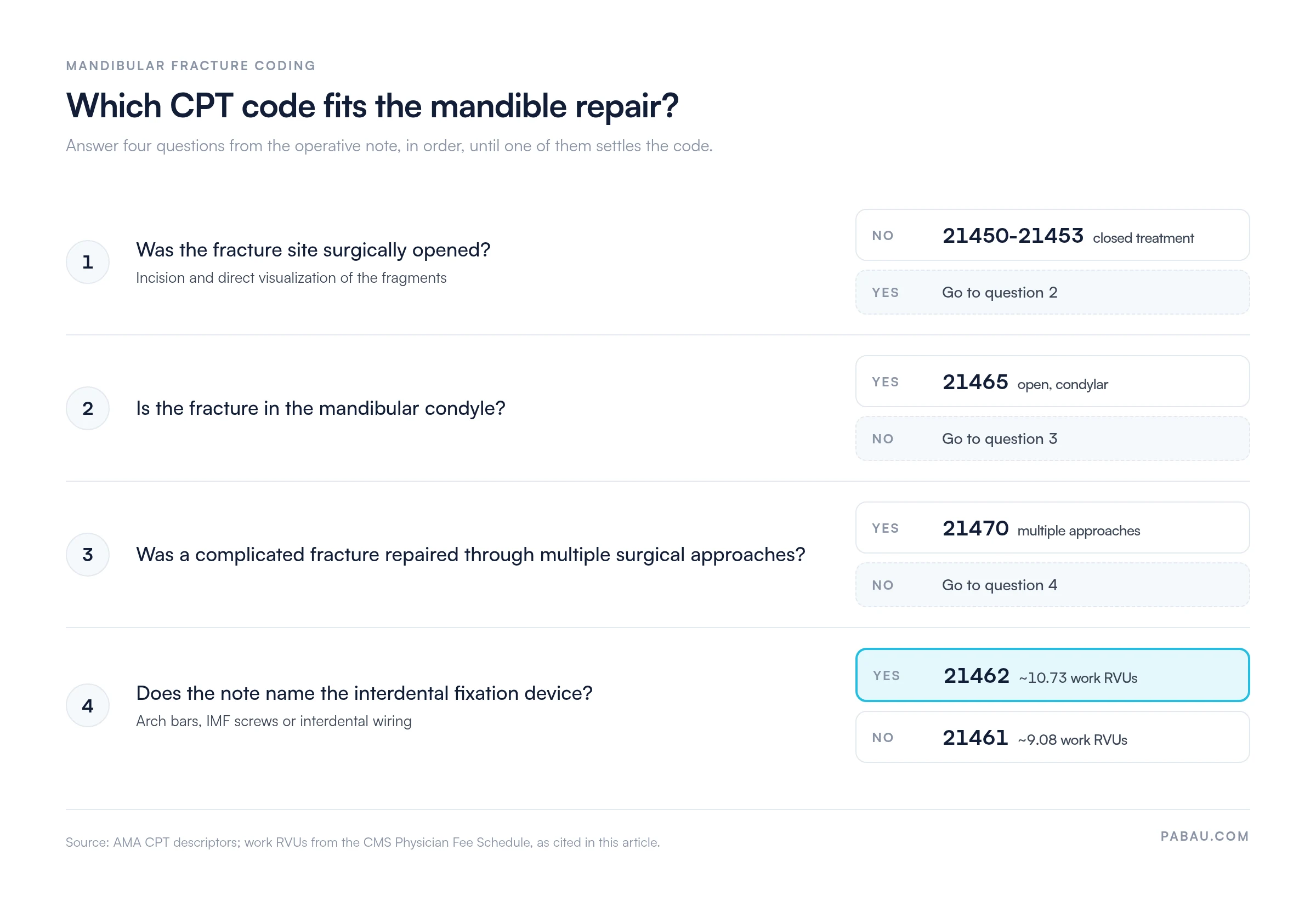
Interdental fixation is what separates 21462 from CPT 21461, the same open repair without it. The operative report has to name the device, or the claim supports only 21461. Condylar fractures are reported with 21465 instead.
Let Pabau's smart automation suggest the right codes, reduce claim denials, and keep your practice compliant—effortlessly.
Automate repetitive tasks and focus on what matters most—your patients.
Reduce coding errors and ensure compliance with the latest regulations.
Clean claims, fewer denials, and faster reimbursements.
Powerful insights and reporting to help your practice thrive.
HIPAA compliant SOC 2 certified GDPR-compliant Trusted by 4,000+ clinics worldwide

CPT Code 21462 covers open treatment of a mandibular fracture where arch bars, IMF screws or similar interdental fixation are placed alongside the open reduction.
The operative report must state that interdental fixation was applied and name the device, or the claim downcodes to 21461.
The paired ICD-10-CM code comes from the S02.6 category and names the site and side. Its 7th character follows the injury: A for a closed fracture, B for an open one.
Pabau, our practice management and billing platform, scrubs each claim for missing or invalid details and attaches stored prior authorizations before submission.
CPT Code 21462 is the code for open treatment of a mandibular fracture with interdental fixation, as described by the American Medical Association. It sits in the musculoskeletal section of the CPT code set, in the fracture and/or dislocation range for the head (21315-21497).
The code applies to the body, symphysis, parasymphysis, ramus or angle of the mandible. Three conditions must all be met on the same claim:
Condylar fractures are reported with 21465, not 21462. An open reduction where the surgeon elects not to apply interdental fixation maps to CPT 21461 instead.
Knowing the operative sequence lets a coder check the CPT selection against the report line by line. A typical open mandibular fracture repair with interdental fixation runs in five steps:
Using both interdental and internal fixation in the same session does not change the code. CPT 21462 covers the full operative construct when interdental fixation is included. To satisfy an audit, the operative report must name the interdental device used: arch bars, IMF screws or wire fixation.
Two factors separate the mandibular fracture codes: the approach (open or closed) and the type of fixation. Closed treatment is reported with codes 21450-21453, so none of them fits an open repair. The table compares 21462 with its two open-treatment neighbors.
A complicated fracture repaired through multiple surgical approaches is reported with 21470 instead. That code includes internal fixation, interdental fixation and wiring of dentures or splints.
Where 21462 claims go wrong: The operative note describes open reduction with plate fixation but never mentions arch bars or IMF screws. Payers read “interdental fixation” literally. If the note omits it, the claim downcodes to 21461 on review. The decision flow below puts the four questions in the order a coder should ask them.
The S02.6 category of ICD-10-CM covers fractures of the mandible. For CPT 21462, the paired diagnosis should specify the fracture site, the side and the encounter. The 7th character follows the injury, not the surgical approach. “A” is the initial encounter for a closed fracture, and “B” is the initial encounter for an open fracture.
A closed fracture repaired through an open approach still takes “A”. The codes below are shown with “A”; swap in “B” when the fracture itself is open, as in S02.651B.
Payer edits differ on side specificity. Some commercial payers and Medicaid managed care plans reject S02.600A when imaging or the operative report documents a unilateral fracture. Use the most specific code the clinical documentation supports. Certain payers also want external cause codes (W, X and Y categories) as secondary diagnoses, so check payer rules before submission.
Verify the 7th character on every S02.6 code before submission. Use ‘A’ for a closed fracture and ‘B’ for an open fracture while it is under active treatment, including the surgery. Later visits for routine healing, such as hardware checks inside the global, use ‘D’. A 7th character that doesn’t match the encounter leads to a technical denial.
The operative report is the primary audit target for CPT 21462 claims. Billing teams working within a medical billing compliance framework should confirm these elements before claim submission:
The Centers for Medicare & Medicaid Services (CMS) expects the operative report to support the billed procedure on its own. Coders should not rely on a pre-operative note or imaging report for elements that belong in the operative note.
CPT 21462 is a major surgical procedure with a 90-day global period, which shapes modifier selection for same-session and follow-up billing. These are the modifiers billing teams meet most often.
Confirm the modifier indicators for 21462 in the current CMS Physician Fee Schedule data file before submitting to Medicare. The assistant surgeon indicator, in particular, can change with annual MPFS updates.
CPT 21462 carries a substantial physician work component, reflecting the complexity of open fracture repair with interdental fixation. The values below come from publicly available CMS data, and payment varies by locality and year. Verify current figures in the CMS Physician Fee Schedule lookup tool before using rates for contracting or benchmarking. The FastRVU 2026 RVU lookup cross-references work and total RVUs.
For comparison, CPT 21461 carries about 9.08 wRVUs. A 21462 claim that downcodes for missing documentation loses roughly 1.65 work RVUs.
Most CPT 21462 procedures take place in a hospital or ambulatory surgery center. The facility rate reflects a lower practice expense RVU, since the facility bears the overhead. Non-facility rates apply when the procedure is done in an office-based surgical suite, which some specialized oral surgery practices use.
Prior authorization requirements for CPT 21462 vary by payer type, and no single rule covers them all. Billing staff should verify the requirement for each patient’s plan before scheduling.
A denied authorization request is not a denied claim. An authorization that was required but never obtained, though, almost always becomes a claim denial. A documented prior authorization process tracks each request against the scheduled surgery date.
CPT 21462 claims fail for a small set of repeatable reasons. The table maps each denial type to its root cause and the corrective step.
Checking each claim against the denial codes in medical billing that apply to surgery catches most of these before the payer does. The most efficient point to review the operative report is charge entry, not appeal. A denial management routine then handles the claims that still come back.
CPT 21462 carries a 90-day major surgery global period. The surgical fee includes all related post-operative evaluation and management visits from the day of surgery through the 90th post-operative day.
A clean claim workflow checks each service date against the 90-day window. Routine post-op visits then never go out as separate charges, and the claims that do go out avoid automatic global-period denials.
Create a 90-day global calendar entry when the surgery is scheduled. Flag the global expiration date in the patient record. Visits after the window are then billed without a modifier, and visits inside it are reviewed first.
Oral and maxillofacial surgery practices bill a narrow code set, but each 21462 claim carries heavy documentation, an authorization and a 90-day global. Many teams still assemble those pieces by hand across the EHR, the payer portal and a billing spreadsheet.
Pabau, the practice management platform we build, keeps them on one claim. Its error-checking claims management works from the patient record, so the authorization and the payer details are already attached when the claim is built.
The coder still confirms the operative note, the device name and the 7th character. Pabau makes sure the claim carrying them is complete, authorized and sent to the right payer.

Pabau scrubs each claim for missing or invalid details, attaches stored prior authorizations and verifies eligibility through Claim.MD. Your oral surgery claims go out complete.

For CPT 21462, the operative note is the claim. If it names the arch bars or IMF screws, 21462 holds up on review. If it says only “fixation applied,” the claim pays as 21461, about 1.65 work RVUs less.
So the work belongs before charge entry, not at appeal. Ask surgeons to name the interdental device in every open mandible note, and match the 7th character to the injury rather than the approach. Those two habits head off the downcode and the diagnosis mismatch.
Book a demo to see how Pabau checks each oral surgery claim for missing details and stored authorizations before it reaches the payer.

Want to reduce surgical claim denials systematically? Denial management in healthcare covers the end-to-end workflow for identifying, appealing and preventing claim rejections.
Need to understand what clearinghouse submission covers? Claim.MD clearinghouse overview explains how electronic claim routing, eligibility checks and ERA processing work together.
Preparing a prior authorization for jaw surgery? Medical prior authorization form gives you a ready template for the clinical details payers ask for.
Looking for the broader billing framework? What is medical billing walks through the revenue cycle from charge capture to payment posting.
CPT code 21462 is the procedure code for open treatment of a mandibular fracture with interdental fixation. It covers surgical exposure of the fracture, open reduction, and placement of arch bars, IMF screws or similar dental fixation devices. Internal plate fixation performed in the same session is included in the code.
The primary diagnosis comes from the S02.6 category of ICD-10-CM, which covers mandible fractures. Specific options include S02.601A or S02.602A for the body of the right or left mandible, and S02.651A or S02.652A for the angle. The 7th character follows the injury: A for the initial encounter for a closed fracture, B for an open fracture. Use the most specific code the documentation supports.
CPT 21462 carries a 90-day major surgery global period. All routine post-operative evaluation and management visits related to the fracture repair are included in the surgical fee during this window. Services for unrelated conditions need modifier -24 (for E/M) or modifier -79 (for unrelated surgical procedures) to be separately billable.
CPT 21462 carries approximately 10.73 work RVUs (wRVUs), compared with about 9.08 for 21461. Total RVUs add practice expense and malpractice components that vary by setting (facility vs. non-facility). Retrieve current values from the CMS Physician Fee Schedule lookup tool each year, because RVU values are updated annually.