



HCPCS code E0198: Water pressure pad billing guide
HCPCS code E0198 is a water pad for a standard mattress HCPCS code E0198 is the ...

Last Updated: Oct 13, 2026

CPT code 21387 covers open treatment of an orbital floor blowout fracture through a combined approach, using periorbital and transantral access together.
Approach separates 21385, 21386, and 21387. Implant and graft placement separate 21390 and 21395.
A repair done through one periorbital incision codes to 21386, so the operative note has to name every access route used.
Pair the claim with a laterality-specific diagnosis such as S02.31XA. The old S02.3XXA family was deleted on October 1, 2016.
Practice management software like Pabau keeps claims and clinical records in one system, so what you submit matches what you documented.
CPT code 21387 covers open treatment of an orbital floor blowout fracture through a combined approach. The surgeon reaches the fracture by two routes in the same session: a periorbital incision and a transantral window through the maxillary sinus.
The code is often described as the “without implant” version of 21386. That is wrong, and it is an expensive mistake. Implant status never appears in the 21387 descriptor.
This reference covers the correct descriptor, the 21385 to 21395 family, ICD-10 pairings, modifiers, reimbursement, and the operative note wording that supports the claim.
CPT code 21387 sits in the Fracture and/or Dislocation Procedures on the Head section of the AMA’s CPT code set. It is an indented child code, so its short descriptor only makes sense when you read it with the parent stem at 21385.
One element decides this code, and it is the access route. Nothing in the descriptor refers to an implant, a graft, or fixation hardware. If the note describes one incision, 21387 is the wrong code.
An orbital floor blowout fracture happens when blunt trauma to the orbit drives the thin bony floor down toward the maxillary sinus. Orbital fat or the inferior rectus muscle can herniate through the defect. That produces diplopia, enophthalmos, or hypoglobus, and it is what makes open repair necessary.
Blowout fractures usually follow assault, a fall, or a sports impact. The CT often arrives with the patient from an emergency department or a sports medicine practice. Attach that report to the surgical record, because the claim leans on it for medical necessity.
A combined repair uses two windows onto the same fracture. The periorbital incision gives the surgeon a direct view of the orbital rim and floor from above. The transantral route opens the maxillary sinus from below, so the surgeon can support the floor and confirm the reduction from the antral side.
The work covered by a single 21387 line includes:
Both approaches sit inside this one code. Reporting 21385 and 21386 together for the same repair is unbundling, and payers deny it on National Correct Coding Initiative edits.
Surgeons reach for a combined approach when one window will not do the job. The clinical picture, not the coder, decides that. These are the scenarios that usually justify it.
If the surgeon planned a combined approach and then completed the repair through the eyelid alone, bill 21386. The code follows what was done, not what was scheduled.
Five codes cover open repair of an orbital floor blowout fracture. Three of them are separated by access route, and two by what the surgeon places in the orbit. Mixing those two axes is the single most common error on these claims.
Notice what the family does not contain. There is no code for a combined approach with an implant, and no code for a transantral approach with a graft. That absence is where most 21387 disputes start.
The difference is the number of access routes, not implant status. CPT 21386 covers a repair done entirely through a periorbital incision, whether that is transconjunctival or subciliary. CPT 21387 covers the same fracture reached through a periorbital incision plus a transantral window.
Plenty of coding write-ups still describe 21386 as “with implant” and 21387 as “without implant”. No AMA descriptor has ever read that way. A claim built on those summaries will not survive a records request.
So the operative note has to name every incision. A note that says “the orbital floor was exposed and the fracture reduced” supports neither code. For plastic surgery software users, an operative template with a required approach field settles this at the point of documentation.
CPT 21390 and CPT 21395 both describe a periorbital approach. What sets them apart is reconstruction material.
CPT 21390 applies when the surgeon places an alloplastic or other implant, such as titanium mesh or porous polyethylene. CPT 21395 applies when the surgeon places a bone graft, and the descriptor already includes harvesting that graft.
Do not bill a separate graft harvest code alongside 21395. The harvest is bundled into the descriptor, and billing it again is a straightforward unbundling denial.
The awkward case is a combined approach that also uses an implant. No single code describes it. Most payers expect the implant code, with an operative note that documents both access routes, and some coders append modifier -22 for the added work.
Confirm the expectation with the payer before you submit, because there is no national rule here. For implant-based repair of orbital fractures outside the blowout family, see CPT code 21407.
Every CPT 21387 claim needs a paired ICD-10-CM code that establishes medical necessity. Orbital floor fracture codes became laterality-specific on October 1, 2016. The old non-lateral codes S02.3XXA, S02.3XXB, and S02.3XXD were deleted at that point and no longer pass a claim edit.
Current codes carry a laterality digit and then a seventh character for the encounter. S02.30X- is the unspecified side, S02.31X- is the right, and S02.32X- is the left.
Two errors account for most diagnosis-side rejections on these claims. The first is a deleted S02.3XXA code copied from an old superbill or an outdated coding article.
The second is a seventh character that does not match the visit, such as “D” on the initial surgical claim. Fracture codes across ICD-10 follow the same convention, as S42.302K shows.
Medial orbital wall fracture is worth its own mention. It is not a variant of the floor code, and S02.31XA does not mean medial wall. That fracture belongs to S02.83-, and mislabeling it is a common source of confusion in orbital trauma coding.
Payer policy varies on top of all this. Some Medicare Administrative Contractors publish Local Coverage Determinations naming which diagnosis codes they accept for orbital fracture repair.
Check the applicable LCD before submitting, and see ICD-10 code S02.32XB for how the laterality and encounter characters work on a single orbital floor code.
Modifier selection for CPT 21387 depends on payer rules and the operative scenario. Bilateral blowout fracture repair in one session is uncommon, but it does happen. Verify bilateral policy with the applicable MAC first, because contractors differ on modifier 50 versus separate LT and RT lines.
Modifier 62 deserves a note of its own. Some combined repairs are staffed by two surgeons, with an ENT surgeon taking the transantral route and an oculoplastic surgeon the periorbital one.
Where both act as co-surgeons on the same 21387 line, each reports the code with modifier 62. Check the CMS co-surgeon indicator for the code before you plan the claim that way.
Check your MAC’s bilateral modifier policy before submitting modifier 50 with CPT 21387. Several MACs require separate line items with LT and RT modifiers instead of a single line with modifier 50. Submitting the wrong format triggers an automatic denial and delays payment by weeks.
Medicare pays CPT 21387 from the CMS Medicare Physician Fee Schedule, which updates every January 1. The figures below reflect recently published national values. Treat them as a planning baseline, not a quote.
Two things move that number. The conversion factor changes every year, and Geographic Practice Cost Indices adjust each RVU component by locality. A surgeon in Manhattan and one in rural Kansas will not see the same payment for the same operation.
Because 21387 is the combined-approach code, it carries more work value than the single-approach codes around it. That is the practical reason payers scrutinize the approach documentation on these claims.
Pull current values from the CMS Look-Up Tool before you set contracted rates, and check the payment rules in our Medicare billing guide.
A clean CPT 21387 claim rests on four elements in the operative note. Miss any one of them and a payer has grounds to deny on medical necessity or code specificity.
Laterality belongs in the note too. The side has to agree across the operative report, the diagnosis code, and any LT or RT modifier on the claim line.
Practices running a plastic surgery EMR can build these four checkpoints in as structured fields, so they are captured before the note is signed. The same medical forms management discipline that works for consents applies here. A standard structure produces audit-ready records.
Add a two-line approach statement to your pre-closure checklist: periorbital incision type, and transantral access yes or no. A coder should never have to call the surgeon to find out how many windows were opened. Ten seconds at closure saves a month of appeal.
These are the failure patterns that show up when a 21387 claim reaches post-payment review. Most of them are settled long before submission, in the operative note.
Coding guidance from the AAPC code range lookup also carries a warning about concurrent procedures. Do not report the 21385 to 21395 series alongside a separately reportable procedure unless distinct documentation supports it. Review NCCI edits before pairing 21387 with other facial fracture codes such as CPT code 21452.
CPT 21387 is performed in hospital and ambulatory surgical center settings alike. The billing mechanics differ by setting, and the split between the professional and facility fee is where claims go wrong.
In a hospital, the surgeon bills the professional fee under the MPFS. The hospital bills the facility fee separately under the Hospital Outpatient Prospective Payment System, using an Ambulatory Payment Classification rate. The surgeon does not bill the facility component at all.
In an ASC, the surgeon again bills the professional fee under the MPFS. The ASC bills its facility fee under the CMS ASC payment system. ASC facility rates run lower than HOPPS rates, though the setting usually carries lower overhead for the practice.
The place of service code has to match where the surgery actually happened. Submitting POS 22 for an ASC case, or the reverse, applies the wrong practice expense RVU and triggers a claim edit. Practices weighing the two settings can start with our guide to opening a cosmetic surgery practice.
A combined orbital floor repair is done under general anesthesia. The anesthesia provider bills from the 00100 to 01999 range, not from 21387. The surgeon’s billing team does not submit that code.
The two records still need to tell the same story. If the anesthesia record describes a simpler operation than the surgical note, a payer can question both claims. That risk rises with 21387, because the combined approach is exactly what justifies its higher work value.
In most surgical practices the operative note lives in one system and the claim is built in another. Someone reads the note, retypes the codes into a billing tool, and hopes the two still agree at audit.
Practice management software like Pabau keeps both in one record. The patient’s insurer and policy sit on their chart, so every invoice routes to the right payer without re-keying. Claims management submits electronically, tracks each claim through submitted, processing, paid, or error, and posts the remittance back against the invoice. Downcoding is as common as upcoding, and both trace back to how the decision-making level was recorded. Patients paying up front and claiming later need a superbill, which itemizes the service, the code and the charge.
Validation runs before anything leaves the practice. A missing membership number or authorization code stops the send, rather than coming back weeks later as a rejection.
Structured forms hold the detail a 21387 note needs: each incision, the laterality, and whether an implant or graft was placed. Your team spends its time on the surgery schedule instead of reworking denials.
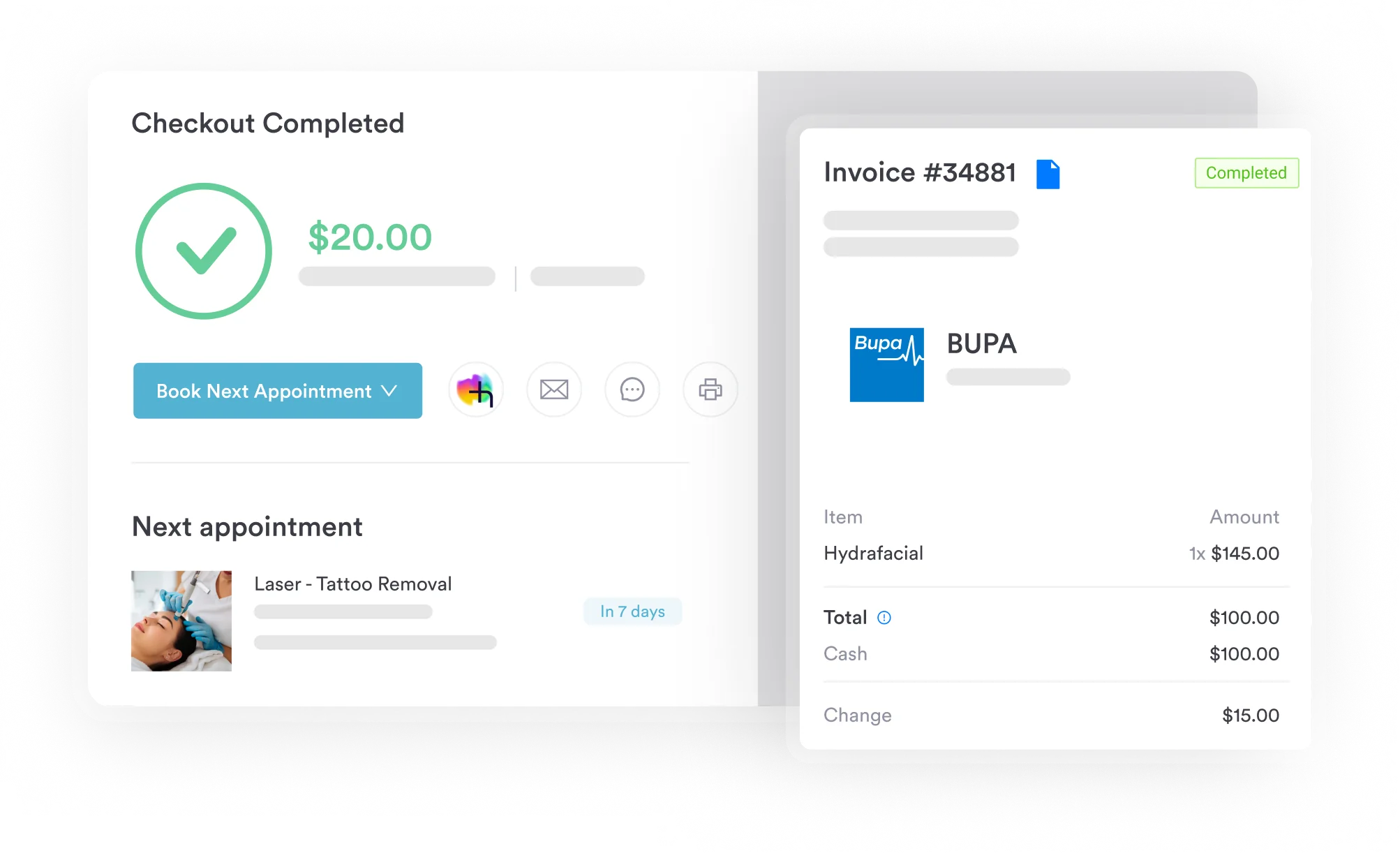

Pabau brings claims, invoices, and clinical records into one system. Submit electronically, watch every claim’s status, and fix missing details before a payer rejects them.

CPT 21387 is the combined-approach code, and nothing more. A reviewer opens the operative note looking for two access routes, and either finds them named or does not. Implant status has no bearing on that decision.
So write the note for that reader. Name the periorbital incision, name the antrostomy, name the side, and pair the claim with a current laterality-specific diagnosis code. Do that and 21387 stops being a code you defend after payment.
Fixing this while the note is still open costs a few extra lines. Fixing it at appeal costs weeks. Book a demo to see how Pabau keeps surgical claims and clinical records in step.

Reconstructing the orbital wall rather than reducing a fracture? CPT code 21184 walks through orbital wall reconstruction billing and its documentation.
Coding another facial fracture repair? CPT code 21365 covers complicated malar fractures, their modifiers, and their reimbursement.
Billing a midface fracture repair? CPT code 21422 covers open treatment of a palatal or maxillary fracture, with its modifiers and documentation.
CPT code 21387 describes open treatment of an orbital floor blowout fracture using a combined approach. The surgeon reaches the fracture through both periorbital and transantral access in the same operative session. The descriptor says nothing about implants. A repair done through a periorbital incision alone codes to 21386 instead.
The difference is the number of access routes, not implant status. CPT 21386 covers a repair performed entirely through a periorbital incision, such as a transconjunctival or subciliary approach. CPT 21387 applies when that periorbital access is combined with a transantral, or Caldwell-Luc, route through the maxillary sinus. The operative note has to name every incision for either code to hold.
A combined approach means the surgeon opens more than one route to the orbital floor during the same session. In practice that is a periorbital incision paired with a transantral window into the maxillary sinus. Both routes belong on the single 21387 line. Billing 21385 and 21386 together for one repair is unbundling, and payers deny it.
CPT 21390 covers a periorbital-approach repair in which the surgeon places an alloplastic or other implant. CPT 21395 covers a periorbital-approach repair with a bone graft, and the descriptor already includes obtaining that graft. CPT 21387 turns on access route instead, so implant and graft status do not select it. There is no code for a combined approach with an implant, so confirm the payer’s expectation before submitting that case.
Use a laterality-specific orbital floor fracture code: S02.30X- for an unspecified side, S02.31X- for the right, and S02.32X- for the left. Add the seventh character for the encounter, so an initial closed fracture on the right reads S02.31XA. The older S02.3XXA, S02.3XXB, and S02.3XXD codes were deleted on October 1, 2016. Medial orbital wall fracture is a separate family at S02.83-, not a variant of the floor code.
Common modifiers for CPT 21387 are LT, RT, 50, 51, 59, 22, 78, and 79. Use LT or RT to state the side, and 50 for a bilateral repair, though many contractors want separate LT and RT lines instead. Modifier 22 needs an operative narrative explaining the extra work. Where an ENT surgeon and an oculoplastic surgeon split the two approaches as co-surgeons, each may report the code with modifier 62.
CPT 21387 carries roughly 9.86 work RVUs and about 21.02 total RVUs, with a 90-day global period. Recent national values put the professional fee near $700. Your actual payment depends on the annual conversion factor and your locality’s geographic adjustment. Check the CMS Physician Fee Schedule Look-Up Tool for the current year before you set contracted rates.



