



HCPCS code E0198: Water pressure pad billing guide
HCPCS code E0198 is a water pad for a standard mattress HCPCS code E0198 is the ...

Last Updated: Oct 13, 2026

CPT code 22212 describes osteotomy of the spine, posterior or posterolateral approach, one vertebral segment, thoracic region.
The work RVU is 20.47 and the total RVU is 43.59, so verify both in the CMS fee schedule each year.
Medicare lists 22212 as inpatient only, which means it cannot be performed or billed in an ambulatory surgical center.
Add-on code 22216 must be reported for each additional thoracic segment, and billing 22212 alone is a common audit trigger.
Practice management software like Pabau tracks modifiers, fee schedule updates, and code capture for high-complexity surgical codes.
CPT code 22212 describes an osteotomy of the spine through a posterior or posterolateral approach, limited to one vertebral segment in the thoracic region. The surgeon opens the back, cuts and repositions a section of thoracic vertebral bone, then stabilizes it. That corrects an underlying deformity such as scoliosis or kyphosis.
The CMS CPT/HCPCS code list places 22212 in the musculoskeletal surgery section, under spinal osteotomy procedures in the 22206-22226 range. It is a base code rather than an add-on, and it covers only the first thoracic segment. Each additional thoracic segment needs its own add-on code.
CPT code 22212 carries a work RVU of 20.47 and a total RVU of 43.59. Spinal osteotomy codes sit high on both scales because of surgical complexity, operative time, and the 90-day global period. Check the CMS Physician Fee Schedule before you submit, since CMS adjusts every RVU component annually.
Watch out for a widespread mix-up in third-party code listings. Several sites publish a figure in the low 40s as the work RVU for 22212, when that number is the total RVU.
Reporting 43.59 as productivity work credit inflates a surgeon’s wRVU count by more than double. Compensation models and productivity dashboards built on that error pay out on numbers that do not exist. The same mix-up shows up on other high-value musculoskeletal codes.
Multiply the total RVU by the current CMS conversion factor to estimate the national average Medicare payment. Geographic practice cost indices then adjust that figure up or down for your locality.
Medicare payment for CPT code 22212 varies by geographic locality, place of service, and the annual fee schedule update. Rates change every January 1, so confirm the figure for the active year before you submit. The CMS lookup tool returns both national and locality-specific amounts.
CPT 22212 is an inpatient-only procedure under Medicare rules, so hospital inpatient facility rates are the standard for this code. Medicare assigns it status indicator C in the Outpatient Prospective Payment System, known as OPPS.
That indicator bars payment in a hospital outpatient department or an ambulatory surgical center. Non-facility rates exist in the fee schedule, but a physician office is not a legitimate setting for major spinal osteotomy. Check the CMS OPPS resources each year, since status indicators are reset in the annual rule.
Geographic locality adjustments can move Medicare payment by 20-30% between high-cost urban markets and lower-cost rural regions. Check the CMS locality tables for your carrier jurisdiction before you project revenue for this code.
Modifier selection decides how much of the allowable amount a surgical team collects on CPT code 22212. An incorrect or missing modifier triggers downcoding, multiple-procedure reduction, or a flat denial. Check the current National Correct Coding Initiative edits, known as NCCI, before you apply one. CMS updates those edits quarterly. Downcoding is as common as upcoding, and both trace back to how the decision-making level was recorded. Self-pay patients submitting to their own insurer need the code and the charge on one patient receipt template.
Never append modifier -51 to add-on code 22216. The AMA CPT codebook marks add-on codes as exempt from multiple-procedure reduction. Appending -51 anyway produces an automatic denial.
Practices charting musculoskeletal procedures in Jane often compare Jane App alternatives once billing and caseloads get heavier.
Spinal osteotomies rarely involve a single vertebral segment, so the add-on structure matters before any 22212 claim goes out. The AAPC CPT lookup confirms the hierarchy. 22212 is the base code for the first thoracic segment, and 22216 covers each additional segment.
CPT 22212 and CPT 22214 can be billed together when the session genuinely involves both thoracic and lumbar segments. The operative report has to document the work performed at each segment. Reporting both without that segment-by-segment detail is an unbundling risk under NCCI.
For every additional thoracic level beyond the first, stack 22216 once per segment. Three levels means one unit of 22212 and two units of 22216, each backed by its own dictation.
Medical necessity for CPT code 22212 rests on the ICD-10-CM diagnosis reported alongside it. Payers cross-reference the diagnosis against the procedure during adjudication. A diagnosis that does not clearly support spinal osteotomy is a primary denial driver.
Always pick the most specific ICD-10-CM code the clinical record supports. An unspecified deformity code, where a thoracic-region code exists, invites a medical necessity review. Fracture and injury diagnoses follow the same seventh-character logic used in ICD-10 code S62.163P.
The 90-day global period on CPT code 22212 bundles every routine post-operative service into the original payment. Only a specific modifier lifts a service back out of that bundle. Thin documentation at the front of the case becomes a denial at the back of it.
Osteotomy work also shows up outside the spine. The documentation standard does not change with the anatomy.
Key documentation requirements for CPT 22212 claims include:
A short list of avoidable patterns accounts for most denied 22212 claims. Orthopedic and sports medicine practices catch them by building the check into charge capture rather than into the appeal. Fixing them at the front end also keeps the administrative burden off an already stretched billing team.
Run a four-point audit before any CPT 22212 claim leaves the practice. Confirm the segment count against the operative report. Verify that 22216 is stacked once per additional thoracic level. Check the place of service against the scheduling system, and confirm no -51 modifier is attached to an add-on code.
High-complexity spinal codes like CPT 22212 create several points where a clean claim can go wrong. Modifier combinations, add-on stacking, 90-day global period tracking, and ICD-10 specificity each carry their own failure mode.
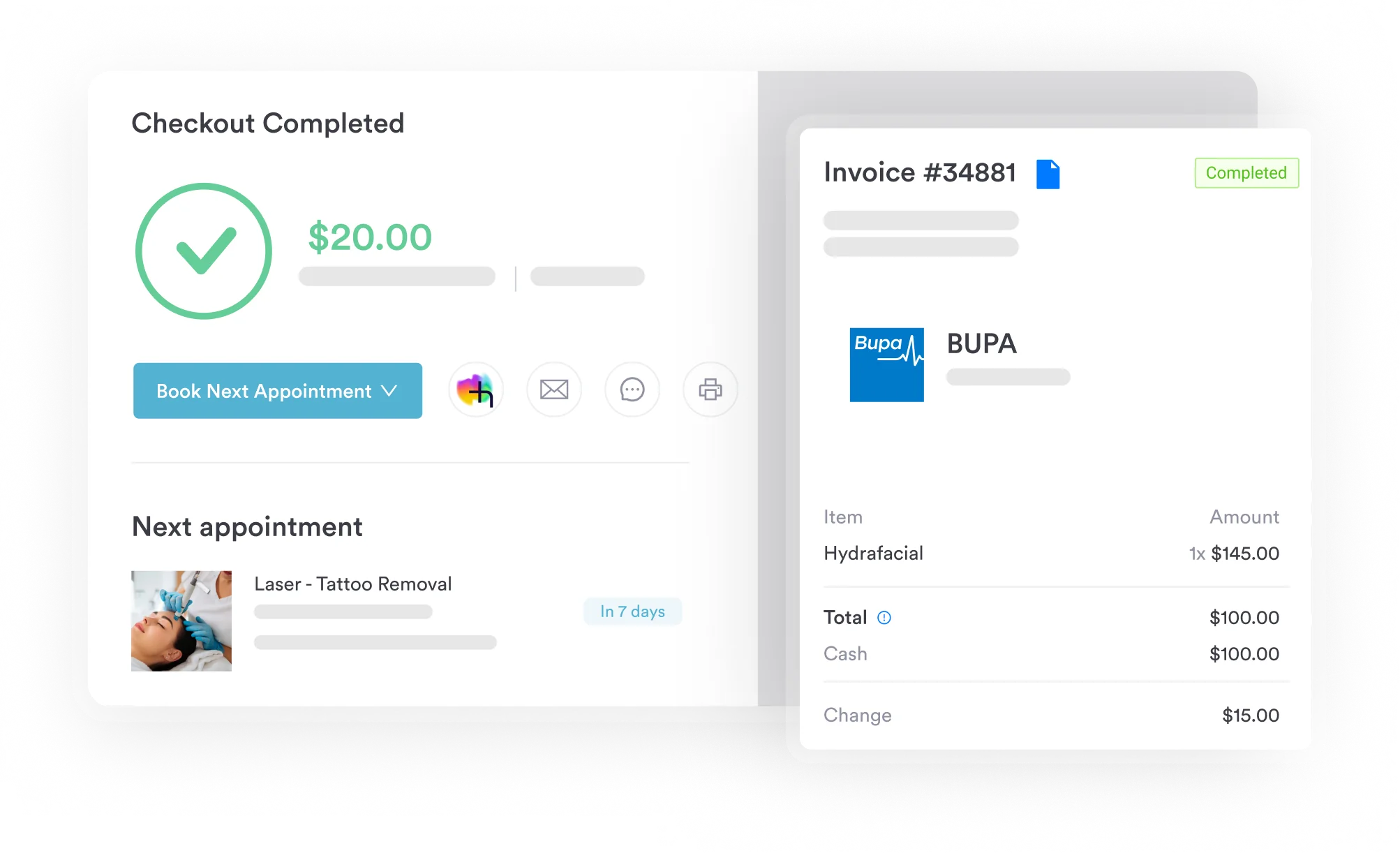
Practice management software like Pabau centralizes code capture, flags modifier conflicts before submission, and keeps fee schedules current with the annual CMS update. The EHR integration pulls documented procedure data straight into the billing queue. That removes the manual retyping between the operative report and the claim.
Global period tracking runs in the background, so every post-operative visit is cross-referenced against the 90-day window. That prevents double billing and surfaces a missing modifier before the claim goes out. Records stay in one auditable place.
A single practice management software platform for scheduling, clinical notes, and billing removes the handoffs where surgical revenue leaks. That matters most on codes like 22212, where one missed add-on segment can cost thousands per case.

Practice management software like Pabau tracks modifiers, keeps fee schedules current, and flags add-on code errors on high-complexity claims like CPT 22212.

CPT 22212 pays well and denies easily. The 90-day global period, the 22216 stacking requirement, and the modifier rules each create exposure that only a pre-submission check catches reliably.
Fix the segment count first. It is the single error that costs the most per claim, and the operative report already holds the answer. Everything else on this page is downstream of getting that number right.
Book a demo to see how Pabau captures surgical codes, tracks global periods, and flags modifier errors before a claim leaves your practice.

Billing another musculoskeletal procedure? CPT code 20705 walks through the RVU values and modifier rules for intra-articular device removal.
Handling facial fracture repairs? CPT code 21422 covers the documentation and global period requirements for open fracture treatment.
Coding grafts and tissue replacement? CPT code 15157 explains unit reporting and the modifiers that apply to autograft claims.
Coding a healed animal-related injury? Struck by pig sequela code requires the seventh character S, or the parent code cannot be submitted.
Coding a drowning-related self-harm sequela? Drowning sequela code is never the first-listed diagnosis, so coders record the residual condition first.
CPT code 22212 reports an osteotomy of the spine through a posterior or posterolateral approach, limited to one thoracic vertebral segment. It is used for surgical correction of thoracic deformities such as scoliosis or kyphosis.
The work RVU for CPT 22212 is 20.47, and the total RVU is 43.59. Several third-party listings publish the total figure as the work RVU, which more than doubles the productivity credit. Check the CMS Physician Fee Schedule for the current year before you use either number.
Yes, when the operative report documents distinct osteotomy work at both thoracic and lumbar segments in the same session. 22212 covers the thoracic segment and 22214 covers the lumbar segment. Without segment-specific documentation for each, concurrent billing creates unbundling risk under NCCI edits.
CPT 22216 is the add-on code for each additional thoracic vertebral segment treated beyond the first segment covered by 22212. Report 22216 once per additional thoracic segment. Do not append modifier -51 to 22216, since add-on codes are exempt from multiple-procedure reduction.
The global period for CPT code 22212 is 090 days, which is 90 days. All routine post-operative care inside that window is included in the surgical payment. Use modifier -78 for a return to the OR for a related complication. Use modifier -79 for an unrelated subsequent procedure.
No. Medicare assigns CPT 22212 status indicator C under the Outpatient Prospective Payment System, which makes it an inpatient-only procedure. It cannot be performed or billed in an ambulatory surgical center. Status indicators are reset each year, so confirm the current assignment before scheduling.
The most common pairings are M41.24 for idiopathic thoracic scoliosis and M40.04 for postural thoracic kyphosis. M40.14 covers other secondary kyphosis, and Q76.3 covers congenital scoliosis. Select the most specific code the clinical record supports, since unspecified deformity codes increase denial risk.



