HCPCS Code J1560: Gamma globulin IM injection billing guide
HCPCS Code J1560: Official descriptor and covered services HCPCS Code J1560 carr...

Last Updated: Nov 11, 2026
20912 is the CPT code for cartilage graft; nasal septum.
It reports obtaining septal cartilage for use as a graft, most often in nasal valve repair, tip support, and revision rhinoplasty. Ear cartilage grafts are reported with CPT 21235, and rib cartilage grafts with CPT 20910.
Placing the graft belongs to the primary nasal procedure. Whether 20912 can be reported with septoplasty (30520) or rhinoplasty depends on the current NCCI edit, the operative note, and payer policy. Naming the septum as the donor site in the operative note is where the billing work starts.
Let Pabau's smart automation suggest the right codes, reduce claim denials, and keep your practice compliant—effortlessly.
Automate repetitive tasks and focus on what matters most—your patients.
Reduce coding errors and ensure compliance with the latest regulations.
Clean claims, fewer denials, and faster reimbursements.
Powerful insights and reporting to help your practice thrive.
HIPAA compliant SOC 2 certified GDPR-compliant Trusted by 4,000+ clinics worldwide

CPT code 20912 is a cartilage graft from the nasal septum only. Ear cartilage is CPT 21235 and rib cartilage is CPT 20910
The code reports obtaining the septal graft, while placing it at the tip, dorsum, or nasal valve belongs to the primary nasal procedure
Before reporting 20912 with septoplasty or rhinoplasty, verify the current NCCI edit and payer policy rather than appending modifier 59 by default
In 2026, 20912 carries 6.38 work RVUs and 13.03 total facility RVUs, with a 90-day global period
Pabau keeps the operative note, prior authorization, and claim status on one patient record, so a bundling rejection is easy to trace
CPT code 20912 reports a cartilage graft taken from the nasal septum. The American Medical Association (AMA) code set describes it as “Cartilage graft; nasal septum.” It sits in the musculoskeletal Grafts (or Implants) subsection, 20900 to 20939, of the CPT codes surgery range. The CMS short descriptor reads “Remove cartilage for graft.”
The code reports obtaining the graft. Placing it at the recipient site belongs to the primary nasal procedure. CPT guidelines report a harvest code separately only when the primary code does not already include obtaining the graft.
Understanding the surgical steps helps coders confirm the operative report supports 20912 rather than a sibling code. The surgeon exposes the septum and removes a segment of septal cartilage. A dorsal and caudal L-strut is left in place for support. The cartilage is then shaped and placed at the recipient site.
Septal harvest often happens through the same exposure as a septoplasty, reported with CPT 30520. The septoplasty descriptor already includes replacement with graft, so many payers treat that harvest as part of the septoplasty. Check the current NCCI edit and payer policy before reporting both codes.
The operative note must name the nasal septum as the donor site and state the recipient site. A note that says only “cartilage graft” gives an auditor no way to tell 20912 from 21235 or 20910.
The most common coding error with CPT code 20912 is using it for cartilage that did not come from the septum. The donor site decides the code, and each option carries different RVUs and different bundling rules.
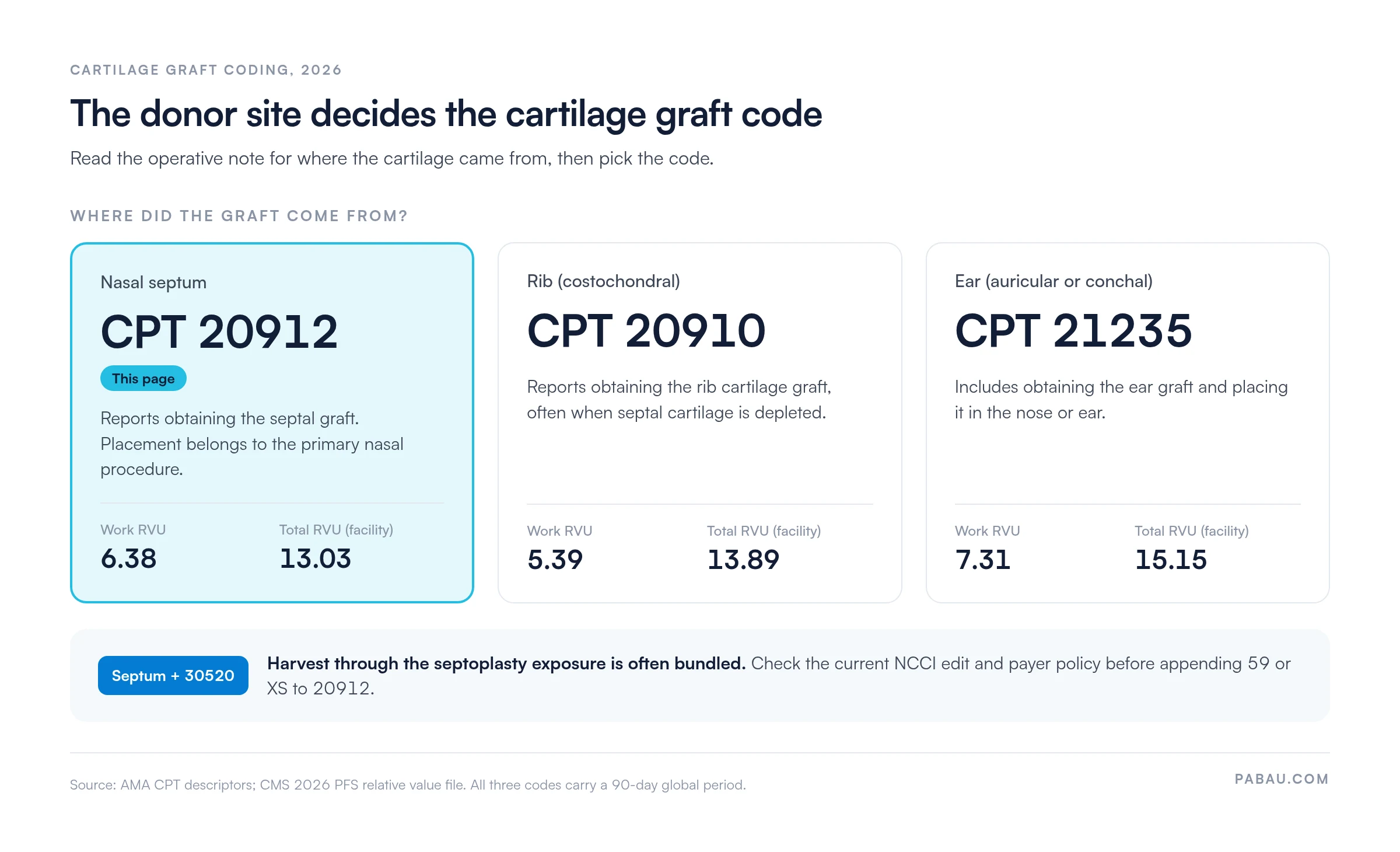
The RVU rows come from the CMS 2026 relative value file. 20912 carries more work RVUs than CPT 20910 but fewer total RVUs, because 20910 has a higher practice expense value.
CPT code 20912 is rarely billed as a standalone service. It usually accompanies a primary nasal procedure. Sources disagree on whether a septal harvest at septoplasty is separately reportable, so treat each pairing below as a check, not a rule.
When the septal cartilage comes through the same exposure as a septoplasty, many payers bundle 20912 into 30520. Report it separately only when the operative note supports a distinct harvest and the current NCCI edit allows a modifier. Payer policy varies, so confirm it before submission.
Run a live NCCI edit check before every claim that pairs CPT code 20912 with a nasal primary code. The edit table updates quarterly, and a combination that cleared last quarter may carry a new restriction. Build this check into your pre-submission workflow rather than relying on memory of previous approvals.
Modifier selection decides whether a 20912 line pays or bundles into the primary procedure. The right choice depends on the current NCCI edit for the code pair and on what the operative note supports.
Important: Modifier 59 tells the payer the harvest was a separate service, so the operative note has to show that. Using it when the graft service is not genuinely distinct from the primary procedure is improper billing. Sound medical billing workflows require the coder to verify the clinical justification first.
Payers look for a functional diagnosis behind a septal cartilage graft. The codes below are common examples, not a coverage guarantee. Confirm current code status in the ICD-10-CM tabular list before you submit.
The nasal valve collapse codes took effect on October 1, 2024, and the tabular list tells coders to code the underlying cause first. Older claims often used J34.89 for the same finding.
The 2026 Medicare Physician Fee Schedule (MPFS) governs reimbursement for CPT code 20912. The values below come from the CMS PFS relative value file (October 2026 release). They are national values; actual payment varies by GPCI (Geographic Practice Cost Index) and locality.
Use the CMS Physician Fee Schedule lookup tool to check the rate for your locality before you build fee schedules. Commercial rates often benchmark above MPFS for surgical procedures, but that depends on the contract. Check each contract against the CMS baseline rather than assuming it pays more.
Payers audit CPT code 20912 closely because the graft often appears in rhinoplasty, where cosmetic exclusions are a standard denial tool. A claim that cannot survive documentation review should not be submitted.
The operative note must address all of the following to withstand audit:
When a prior authorization covers the primary nasal procedure, confirm whether it also covers the graft. Some payers authorize the primary code only. A separate request for CPT code 20912 may be needed, depending on the payer’s policy.
Three denial patterns account for most rejected CPT code 20912 claims. Each has a distinct resolution path.
Why it happens: The payer decides the graft was part of a cosmetic rhinoplasty, not a functional reconstruction.
How to appeal: Submit the operative note with the functional indication highlighted. Add any pre-operative findings, such as airway obstruction measurements, imaging, or failed conservative treatment. Cite the payer’s medical necessity criteria for nasal reconstruction, and include the original authorization if it covered the primary procedure for functional reasons.
Why it happens: CPT code 20912 was billed with a primary nasal code. The NCCI edit or payer policy treats that code as including the septal harvest.
How to appeal: First check the current NCCI edit for the pair and the payer’s policy. If a modifier is allowed and the note supports a distinct harvest, resubmit with 59 or XS. Explain that the septal cartilage came through a separate incision, or served a recipient site outside the primary procedure. Attach the relevant section of the operative note.
If the edit does not allow a modifier, or the harvest came through the septoplasty exposure, accept the bundle rather than appeal. Effective denial management workflows catch this class of error before submission.
Why it happens: The graft service was not included in the prior authorization for the primary procedure, or no authorization was obtained at all.
How to appeal: Submit a retrospective authorization request with clinical documentation if the payer’s policy permits it. For future cases, check at intake whether the payer needs a separate authorization for 20912. Submitting a clean claim with the authorization on file is far faster than working a denial.
ENT and plastic surgery practices billing CPT code 20912 face three pressure points: NCCI edit conflicts, modifier choices, and authorizations that leave out the graft. Each one is easy to miss when the operative note, the authorization, and the claim live in different systems.
Pabau, the practice management and billing platform we build, keeps all three on one patient record. Its claims management software submits claims through the Claim.MD clearinghouse integration and tracks each one until it is paid or rejected.
For an ENT or plastic surgery practice, that means a bundled 20912 line points straight back to the note and authorization behind it. Your coders fix the pattern on the next claim instead of reworking it after the fact.
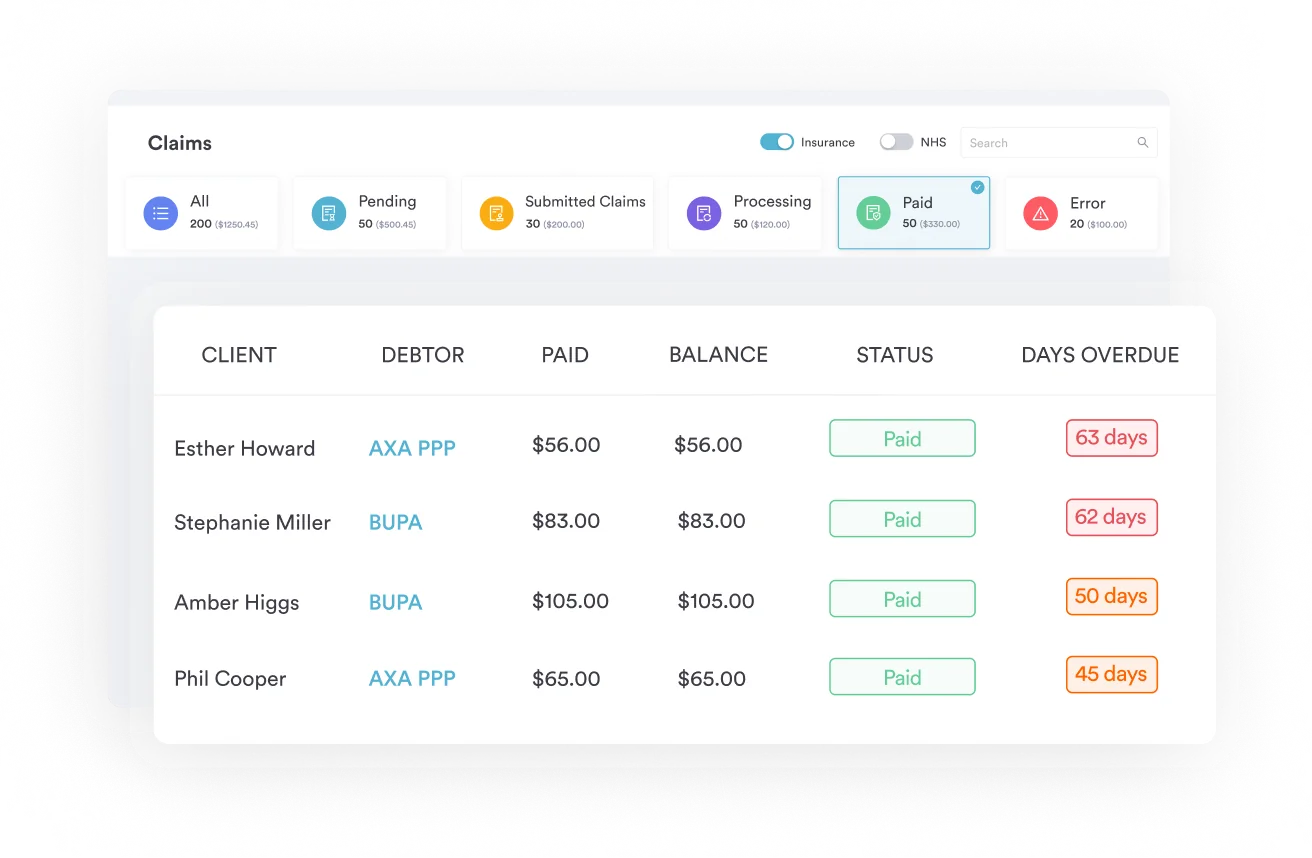

Pabau keeps the operative note, prior authorization, and claim status on one patient record. Your ENT or plastic surgery team can see why a graft line bundled and fix the next claim faster.

CPT code 20912 is narrower than many claims assume. It reports cartilage taken from the nasal septum only. Ear cartilage belongs to 21235 and rib cartilage to 20910.
Most avoidable denials come from the wrong donor code, a default modifier 59, or a cosmetic-exclusion dispute. The fix is upstream. Name the donor site in the operative note, check the current NCCI edit and payer policy, and confirm authorization before surgery.
To see how Pabau keeps nasal surgery claims traceable from note to payment, book a demo with the team.

Need a full picture of how claims management works? What is revenue cycle management explains the end-to-end billing process from patient encounter to payment posting.
Struggling with claim rejection patterns across your practice? Medical billing compliance covers the documentation and coding standards that keep claims clean across all procedure types.
Looking for Pabau’s US clearinghouse connection? Claim.MD clearinghouse guide details how Pabau’s integration with Claim.MD processes 837P claims and handles ERA remittances.
CPT code 20912 is the surgical code for a cartilage graft from the nasal septum. Its official descriptor is Cartilage graft; nasal septum. It reports obtaining the septal graft, while placing it at the recipient site belongs to the primary nasal procedure. Ear cartilage grafts use CPT 21235 instead.
CPT 20912 covers cartilage taken from the nasal septum, and CPT 20910 covers costochondral (rib) cartilage. Ear cartilage is a third code, CPT 21235, which includes obtaining the graft. The donor site decides the code, so the operative note must name it explicitly.
Sometimes, but check first. The 30520 descriptor already includes replacement with graft, and many payers treat a septal harvest through the same exposure as included. Verify the current NCCI edit and payer policy before appending modifier 59 or XS. The operative note must support a distinct harvest.
In 2026, CPT code 20912 carries 13.03 total facility RVUs. That works out to about 435 dollars nationally at the non-qualifying conversion factor, before GPCI adjustment. Check your locality rate in the CMS Physician Fee Schedule lookup tool before you rely on any figure.
The three most common reasons are cosmetic exclusion, NCCI bundling with the primary nasal procedure, and missing prior authorization. Documenting the functional indication and the septal donor site addresses the first. Checking the current NCCI edit and payer policy addresses the second, and verifying authorization before surgery addresses the third.
CPT code 20912 may be covered when rhinoplasty is performed for functional rather than cosmetic reasons. Examples include nasal valve collapse or a structural deficiency causing airway obstruction. Coverage depends on the payer’s medical necessity criteria and the operative report. Cosmetic rhinoplasty claims for 20912 are typically excluded.