



HCPCS code E0198: Water pressure pad billing guide
HCPCS code E0198 is a water pad for a standard mattress HCPCS code E0198 is the ...

Last Updated: Oct 13, 2026

CPT code 20705 is an add-on code for “removal of drug-delivery device(s), intra-articular,” effective January 1, 2020.
It is removal-only and joint-only. It never covers insertion, and it never covers deep subfascial or intramedullary devices.
The phrase “musculoskeletal, subfascial” comes from the section heading above the code, not from the 20705 descriptor itself.
Because 20705 is an add-on code, it is reported with a primary procedure and is exempt from modifier 51.
Pabau’s practice management software tracks claim status, runs validation checks, and reconciles payments next to your clinical records.
CPT code 20705 covers the removal of one or more drug-delivery devices from a joint. It is an add-on code, so it is always listed separately alongside the primary procedure performed in the same session.
The full American Medical Association descriptor is “Removal of drug-delivery device(s), intra-articular (List separately in addition to code for primary procedure).”
That descriptor is narrower than most online summaries suggest. Search results frequently attach the phrase “introduction or removal, musculoskeletal, subfascial (eg, intramuscular)” to 20705. That wording is the title of the code section that contains 20705, not the code’s own descriptor.
Coders who take the section heading at face value bill an insertion or a subfascial removal under the wrong code.
Orthopedic and musculoskeletal practices bill this code in small volumes but under close review, so accuracy pays for itself. Practice management software like Pabau keeps the operative record and the claim in one system. Your billing team then codes from the note itself rather than a re-keyed summary.
CPT 20705 describes the removal of drug-delivery device(s) from an intra-articular location. Two words in the descriptor do most of the work. “Removal” rules out every insertion service. “Intra-articular” limits the code to devices sitting inside the joint space itself.
Clinically, the devices in question are usually antibiotic-loaded beads, cement, or an articulating spacer. Surgeons place them to treat a prosthetic joint infection or septic arthritis, then take them out at a later stage. The removal is typically documented during a staged revision, an arthrotomy, or an arthroscopic irrigation and debridement. A clean claim carries the code, the modifiers and the diagnosis in agreement, and needs no rework before payment. Revenue cycle management reporting separates claims that were denied from claims nobody submitted.
The code took effect on January 1, 2020, as one of six new entries in the American Medical Association’s CPT code set. Before 2020, there was no dedicated way to report the preparation, insertion, or removal of these devices by anatomic site. The 2020 additions gave each site its own insertion and removal pair.
Code lookup tools file 20705 under the heading “General Introduction or Removal Procedures on the Musculoskeletal System.” That heading spans the whole 20500-20705 range. It summarizes dozens of codes, so it cannot describe any single one of them.
The specific phrase “deep (eg, subfascial)” belongs to 20700 and 20701, not to 20705. Anyone who copies the section heading into a coding cheat sheet ends up with a definition that is too broad in two directions at once. It admits insertions that belong to 20704, and it admits subfascial sites that belong to 20701.
Before billing 20705, confirm two facts in the operative note. First, that the device was taken out rather than placed. Second, that it sat inside the joint. If the note describes a subfascial pocket, the correct code is 20701. If it describes an intramedullary canal, the correct code is 20703.
The family is built on a simple grid. Three anatomic sites are each given two codes, one for insertion and one for removal.
Reading the family this way makes code selection almost mechanical, because you only need two facts from the note: the site and the service. Coders who bill CPT 20693 will recognize the same add-on logic elsewhere in the musculoskeletal section.
All six codes carry the instruction “(List separately in addition to code for primary procedure)” and all six took effect on January 1, 2020. The plus sign marks them as add-on codes. CPT 20704 is the direct insertion counterpart of 20705, so the two often appear months apart in the same patient’s record.
The three insertion codes carry one extra condition. The surgeon must manually prepare the delivery vehicle, for example by hand-mixing an antibiotic into bone cement.
A commercially manufactured, prefabricated device does not meet that requirement, and a non-biodegradable drug delivery implant is reported with 11981 to 11983 instead. The removal codes, including 20705, do not depend on how the device was originally prepared.
An add-on code is never the only code on the claim line set. CPT 20705 has to accompany a primary procedure performed at the same session, and the claim will reject if that primary code is absent. These reporting rules cause more denials on 20705 than the descriptor itself does.
Practices charting musculoskeletal procedures in Jane often compare Jane App alternatives once billing and caseloads get heavier.
Medicare pays CPT 20705 through the Resource-Based Relative Value Scale, the same method used for every code on the CMS Medicare Physician Fee Schedule. Three relative value unit components are multiplied by the annual conversion factor, then adjusted for locality through the Geographic Practice Cost Index.
Add-on status changes what happens next. Payment for 20705 is added to the primary procedure rather than reduced under the multiple-procedure rule. GPCI adjustments move local rates well away from the national average.
Check current figures in the CMS lookup tool rather than a third-party fee schedule. For current RVU values, use the FastRVU 2026 RVU lookup tool.
Place of service affects what Medicare pays. In a physician office, the practice absorbs overhead for staff and supplies, so the practice expense RVU is higher.
In a hospital outpatient department or ambulatory surgical center, the facility bills those components separately and the physician’s PE RVU drops. Most intra-articular spacer removals happen in a facility setting, which is where this distinction usually lands.
The same distinction matters when practices negotiate commercial contracts. A contract priced as a percentage of Medicare pays differently depending on the place of service code on the CMS-1500 form.
Practices using regenerative medicine EMR or orthopedic billing software should set place of service at the practice level. That keeps bulk claim runs from carrying the wrong PE RVU.
Modifiers tell payers something the descriptor cannot. For 20705, the add-on status shapes the whole list, because the modifier most coders reach for first does not belong here. Practices that also bill CPT 23605 know that modifier policy varies by payer, so confirm the rules for each contract.
CMS’s National Correct Coding Initiative defines which code pairs need modifier 59 to clear a bundling edit. Those edits update quarterly, so a pairing that passed in the first quarter may fail in the fourth. Run claims through an NCCI edit check before submission rather than working from memory.
Medical necessity for 20705 rests on a linked ICD-10-CM diagnosis. The diagnosis has to explain why a drug-delivery device was inside a joint and why it is coming out now.
Most supporting codes therefore describe prosthetic joint infection, septic arthritis, or the aftercare stage that follows explantation. Practices building a crosswalk reference can use the same approach they apply to knee diagnoses like S82.016B.
Listing a diagnosis here does not guarantee coverage. Each payer publishes Local Coverage Determinations or medical policies that set out which diagnoses support a given procedure, so confirm the pairing before submission.
Watch the seventh character on the T84 codes too, since an initial-encounter character on a later-stage visit is an easy reject. The same discipline applies across musculoskeletal diagnoses such as M92.8.
Payers review this family closely because the procedures involve implanted drug-delivery systems and infection management. The operative note is your defense. The elements below should appear before a claim carrying 20705 leaves the practice.
Templated procedure notes help here, because they prompt the surgeon for each element while the detail is fresh. Digital forms that carry a code-specific checklist catch omissions before the claim is built.
Practices billing across several musculoskeletal codes can review the documentation rules for neighbors like CPT 24138 to find weak spots early.
Denials on 20705 cluster around a short list of mistakes. Most of them trace back to the same root cause: a definition copied from a section heading rather than the code descriptor. The rest come from add-on reporting rules.
Run a quarterly denial audit on the 20700-20705 family. NCCI edits refresh every quarter and payer policies shift with them, so a pairing that cleared six months ago may bundle today. A rolling 90-day review catches the pattern while it is still a handful of claims rather than hundreds.
The riskiest moment in this workflow is the handoff. A surgeon documents an intra-articular spacer removal, and a biller several days later decides which code that description supports. Standalone lookup tools give accurate descriptors, but they sit outside the claim, so the detail that decides between 20701 and 20705 gets re-typed or lost.
Pabau’s claims management software keeps the claim next to the record it came from. Your team submits claims, runs validation checks before anything goes out, and watches every claim’s status on one dashboard.
Payments are reconciled in the same place, so a short-paid add-on line is visible rather than buried in a remittance file.
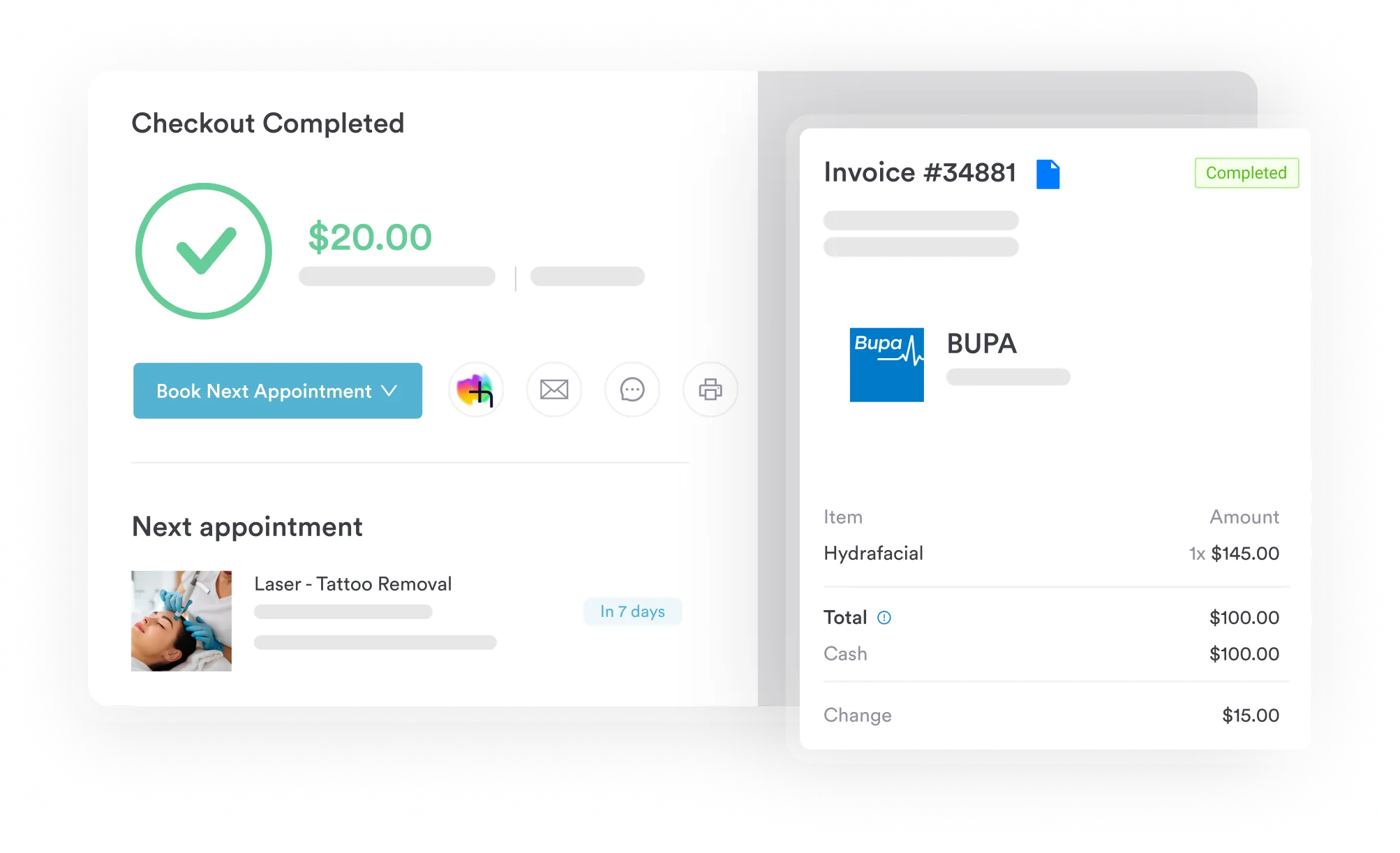
Tracking what each code earns is the other half of the job. Reporting is included in every Pabau subscription, so you can break collections down by procedure code. That surfaces the payers who settle an add-on line below the fee schedule. For sports medicine practices billing this family regularly, that visibility turns into recovered revenue.

Pabau puts claim submission, validation checks, status tracking, and payment reconciliation in the same platform your team already uses for scheduling and clinical records. Fewer handoffs between the operative note and the claim means fewer preventable denials.

CPT 20705 answers one narrow question: was a drug-delivery device taken out of a joint during a separately reported procedure? If the answer is yes, the code applies. If the device was placed rather than removed, or sat subfascially or in the medullary canal, a sibling code applies instead.
Getting paid then comes down to habits. Pair the code with its base procedure, count units per joint, and leave modifier 51 off. Then support the claim with a diagnosis that explains the removal. To see how Pabau keeps coding, documentation, and claim status in one workflow, book a demo with the team.

Coding soft-tissue excisions in the upper limb? CPT 25110 billing guide covers excision of a tendon sheath lesion in the forearm and wrist, with the documentation payers expect.
Billing an implanted device alongside a surgical procedure? HCPCS C1827 billing guide explains how an implantable generator is reported in a facility setting and what the claim needs.
Coding the rehab that follows a staged joint revision? CPT 97161 billing guide sets out the complexity criteria and the evaluation elements a low complexity physical therapy visit requires.
Unsure which seventh character a later-stage knee encounter takes? ICD-10 code S81.009S walks through the sequela character and the specificity a payer looks for.
Reporting surgical supplies that have no specific code? HCPCS A4649 covers when a miscellaneous supply code is appropriate and what documentation supports it.
CPT code 20705 means “removal of drug-delivery device(s), intra-articular.” It is an add-on code, listed separately in addition to the code for the primary procedure, and it took effect on January 1, 2020. It covers removal only, and only from inside a joint. Despite what many summaries suggest, it does not describe insertion, and it does not describe subfascial or intramuscular sites.
Because they are quoting the section heading rather than the code. Code lookup tools file 20705 under “General Introduction or Removal Procedures on the Musculoskeletal System,” a heading that covers the whole 20500-20705 range. The words “deep (eg, subfascial)” belong to the descriptors for 20700 and 20701. Always code from the descriptor printed against the code itself.
All three are removal codes, and the anatomic site separates them. Use 20701 for a deep, subfascial device, 20703 for an intramedullary device, and 20705 for an intra-articular device. Their insertion counterparts are 20700, 20702, and 20704 in the same order. Every one of the six is an add-on code reported with a primary procedure.
Leave modifier 51 off, because add-on codes are exempt from it and from the multiple-procedure payment reduction. Modifier 59, or one of the X subsets, applies when an NCCI edit bundles 20705 with another code billed the same day. LT and RT identify the joint treated. CPT guidance directs coders not to append modifier 50 to add-on codes, so report the service once per joint and confirm each payer’s bilateral policy.
The supporting diagnosis usually describes a joint infection or the aftercare that follows explantation. Common pairings include T84.53XA and T84.51XA for infected knee and hip prostheses. T84.50XA covers an unspecified joint. M00.9 fits pyogenic arthritis, M86.9 osteomyelitis, and Z47.33 the aftercare stage after a knee prosthesis is explanted. Match the side and the encounter character to the operative note, and check the payer’s coverage policy before submitting.
Medicare builds the rate from work, practice expense, and malpractice RVUs, multiplied by the annual conversion factor and adjusted for locality through the GPCI. Payment for 20705 is added to the primary procedure rather than reduced, because add-on codes sit outside the multiple-procedure rule. Rates change every year with the CMS Final Rule and vary by geography. Check the CMS Physician Fee Schedule lookup tool rather than static third-party data.



