

CCSD code G5100: Bypass of duodenum billing guide
CCSD code G5100 bills a bypass that leaves the duodenum in place CCSD code G5100...

Last Updated: Oct 16, 2026
20240 is the CPT code for biopsy, bone, open; superficial (eg, sternum, spinous process, rib, patella, olecranon process, calcaneus, tarsal, metatarsal, carpal, metacarpal, phalanx).
Superficial here describes the bone itself: a palpable, readily accessible bone like those listed. An open biopsy of a deep bone, such as the humeral shaft, ischium or femoral shaft, is reported with CPT 20245 instead. The operative note should name the exact bone, the approach and the depth of dissection. Most denials trace back to that missing detail or to missing prior authorization.
Let Pabau's smart automation suggest the right codes, reduce claim denials, and keep your practice compliant—effortlessly.
Automate repetitive tasks and focus on what matters most—your patients.
Reduce coding errors and ensure compliance with the latest regulations.
Clean claims, fewer denials, and faster reimbursements.
Powerful insights and reporting to help your practice thrive.
HIPAA compliant SOC 2 certified GDPR-compliant Trusted by 4,000+ clinics worldwide

CPT code 20240 reports an open biopsy of a superficial bone, such as the sternum, a rib or the patella, while 20245 covers deep bones.
Medicare lists 20240 with a 000 global period and bilateral indicator 0, so no postoperative days are bundled and no 150% bilateral rule applies.
The operative note should name the exact bone, the approach and the depth of dissection needed to reach it.
Traditional Medicare FFS typically does not require prior authorization, but commercial and Medicare Advantage plans often do.
Pabau, the practice and billing software we build, pre-fills 20240 claims from the patient record and submits them through Claim.MD.
CPT code 20240 reports an open biopsy of a superficial bone. First, the surgeon cuts down to a bone that is easy to reach and removes a specimen for pathology. The code is maintained by the American Medical Association. Its official descriptor reads Biopsy, bone, open; superficial (eg, sternum, spinous process, rib, patella, olecranon process, calcaneus, tarsal, metatarsal, carpal, metacarpal, phalanx). It also sits in the musculoskeletal system section of the CPT manual, within the 20000-series general procedure codes.
In the descriptor, “superficial” describes the bone itself, so depth of cut is not the test. CPT’s examples are palpable bones that are easy to reach: the sternum, spinous process, rib, patella, olecranon process and calcaneus. The tarsal, metatarsal, carpal, metacarpal and phalangeal bones are also listed. Instead of a needle, the surgeon makes a direct, open incision to expose the bone.
In an open superficial bone biopsy, the surgeon exposes a bone that is easy to reach through a direct incision and excises a specimen. It differs from a needle biopsy because the surgeon gets a direct view of the surgical site.
Before you bill CPT code 20240, make sure the op note records each of these steps:
In short, the detail that separates 20240 from 20245 is the bone biopsied. A reviewer can match the service to the right descriptor when the op note names the exact bone, the approach and the dissection.
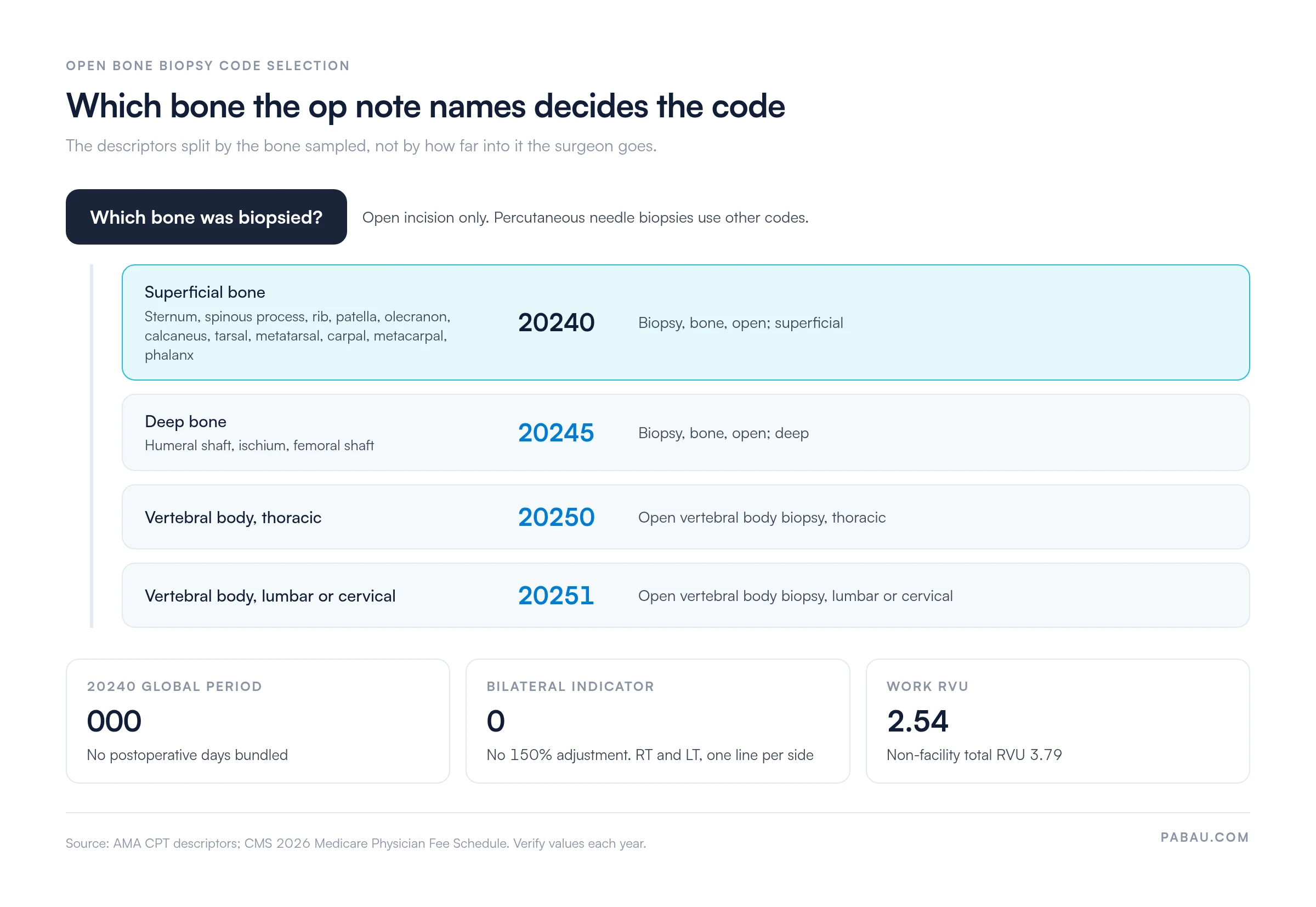
CPT 20240 covers an open biopsy of a superficial bone, while CPT 20245 covers an open biopsy of a deep bone. However, the descriptors draw that line by which bone is sampled, not by how far into the bone the surgeon goes. CPT 20245 also carries a higher work RVU, so the op note has to support the bone site billed.
When the op note does not name the bone, a reviewer cannot tell which descriptor applies. For this reason, surgeons should name the exact bone and its side in every bone biopsy op note. They should also describe the dissection needed to reach it. The chart below adds the two vertebral body codes, so the whole open-biopsy family sits on one decision path.
Several codes in the musculoskeletal and debridement families are often swapped in for CPT code 20240 or billed alongside it by mistake. The table below shows what separates each one from 20240, so you can pick the right code.
CPT 20240 and 20245 can be billed together when biopsies are performed at two distinct body sites in the same surgical session. Apply modifier 59 to the second code to show a separate service, and check NCCI edits before billing.
Check NCCI edit tables before billing CPT 20240 with any same-session musculoskeletal code. CCI edits update quarterly; a pairing that was separately billable last year may now require modifier 59 or may be bundled entirely.
Medical necessity for CPT code 20240 must be supported by an appropriate ICD-10-CM diagnosis code, so choose one that fits. Local Coverage Determinations (LCDs) can limit covered diagnoses, so check the relevant LCD for the performing contractor before submitting.
First, select the most specific ICD-10-CM code available. Unspecified codes (ending in a generic 9 or 0) are also higher denial risks under LCD policies. Then code to the highest level of detail, including side and body site.
CPT code 20240 supports several modifiers, so the right choice depends on what happened in the procedure. Choosing the wrong modifier, or leaving out a required one, is a leading cause of claim rejection.
Because 20240 has bilateral indicator 0, Medicare does not apply the 150% bilateral payment rule. Instead, report each side on a separate line with RT and LT, and check the MPFS indicator.
Payment for CPT code 20240 is calculated from the Medicare Physician Fee Schedule (MPFS), which assigns relative value units (RVUs) to the procedure. Payment rates change every year with each MPFS final rule, so verify current figures using the CMS Physician Fee Schedule lookup tool.
You can also use the FastRVU 2026 lookup tool to retrieve current work RVU, practice expense, and malpractice RVU values by region. However, commercial payer rates are negotiated on their own and may be higher or lower than Medicare rates.
Prior authorization rules for CPT code 20240 vary a lot by payer type. Because the rules vary, a missing approval is one of the most avoidable denials on this code.
A prior authorization request usually needs the clinical reason for the biopsy, supported by imaging and any non-surgical treatment tried. It also needs the ordering provider’s credentials and the planned bone site and laterality. Incomplete paperwork also extends the review timeline and increases denial risk.
CPT code 20240 covers the surgeon’s work in getting the bone specimen, but not the lab work. Instead, the pathologist bills the specimen exam on its own under the surgical pathology CPT code set.
The surgeon bills CPT 20240 under the surgeon’s NPI, while the pathologist bills 88305 under the pathologist’s NPI. Each provider therefore bills their own component. When payers bundle these under a global payment policy, the LCD or explanation of benefits will show it.
When submitting CPT 20240, include the specimen laterality and anatomical site in Box 21 of the CMS-1500. If the pathologist is in a different group, ensure the pathology lab has the correct diagnosis codes and ordering provider details to avoid coordination-of-benefits delays.
When an op note never names the biopsied bone, the 20240 vs 20245 choice is open to challenge. The op report should include each of these elements so it holds up in a pre- or post-payment review.
Pre-op notes matter too. The pre-op note or H&P should record the clinical reason, imaging findings and any prior non-surgical treatment. That record establishes medical necessity before the claim goes out.
Denials on CPT code 20240 cluster around a predictable set of issues. Build denial management workflows around these patterns and pair them with a clean claim checklist before every submission.
When a denial does come back, the claim adjustment reason code on the remittance usually points to one of these rows. Our guide to denial codes then explains how to read each code and respond.
Many bone biopsy denials start because details never reach the claim, such as the bone site, the side modifier or the authorization number. Re-keying those details into a separate billing system is where they drop out.
First, Pabau’s claims management software pulls the data already on the patient record into a pre-filled CMS-1500 or 837P claim. It then submits and tracks the claim through its Claim.MD clearinghouse integration and posts ERA 835 remittances back for payment matching.
As a result, each CPT 20240 claim has fewer hand-keyed fields. The op note, consent and prior authorization details also sit in the same record, ready if a payer asks for them.


Pabau pre-fills CPT 20240 claims from the patient record, submits them through Claim.MD, and posts ERA remittances back. Book a demo to see how the workflow runs.

CPT code 20240 turns on one fact that is easy to leave out of an op note: which bone was biopsied. So build the exact bone, the approach and the depth of dissection into your op note template. The 20240 vs 20245 choice then becomes something a reviewer can confirm rather than dispute.
However, the remaining risk sits outside the op note. Check prior authorization for Medicare Advantage and commercial plans before the procedure date, and report each side on its own line with RT or LT.
Pabau pre-fills each claim from data already in the patient record, then submits and tracks it, so the details you documented are not re-keyed. Book a demo to see how the workflow runs in a musculoskeletal or surgical practice.

Need to understand claim rejection reasons before they hit your EOB? Denial codes in medical billing explains the most common CARC codes and how to respond to each one.
Want to see how electronic claim submission works end to end? Electronic 837 claim file guide covers the 837P transaction format, payer requirements, and how clearinghouses process submissions.
Want to automate payment posting after the payer responds? Electronic remittance advice (ERA) explained covers 835 remittance files, automated payment posting, and reconciling denials from ERA data.
Did the op note name a deep bone instead? CPT code 20245 covers the open deep bone biopsy, with its own RVUs and documentation rules.
Biopsying a vertebral body? CPT code 20251 explains how open lumbar and cervical vertebral body biopsies are coded and billed.
CPT code 20240 reports an open surgical biopsy of a superficial bone. Examples are the sternum, a rib, the patella, the calcaneus or a small bone of the hand or foot. Surgeons use it when a direct incision exposes the bone to remove a specimen for pathology. Typical indications are osteomyelitis, bone lesions, and suspected malignancy.
Yes, in most cases. CPT 20240 covers the surgeon’s specimen acquisition only; CPT 88305 (Level IV surgical pathology) is billed separately by the pathologist. Each provider bills their own component under their own NPI. Confirm that no payer-specific bundling edits apply before submitting both codes on the same date of service.
The work RVU for CPT code 20240 is approximately 2.54 under the Medicare Physician Fee Schedule, though this figure updates annually. Use the CMS MPFS lookup tool or the FastRVU calculator to verify current values and geographic adjustments for your locality.
The most common reasons are missing prior authorization from Medicare Advantage or commercial payers, and ICD-10 codes not covered under the applicable LCD. Others are an operative report that does not name the exact bone biopsied, a missing LT/RT modifier on Medicare claims, and CCI bundling conflicts. Each has a documented corrective action; see the denial table above for specific remediation steps.



