CPT code 93503: Swan-Ganz catheter billing and modifiers
CPT code 93503: Official descriptor and procedure overview In the AMA CPT code s...

Last Updated: Oct 23, 2026

CPT code 19302 covers a partial mastectomy performed with axillary lymph node dissection, so use 19301 when no dissection takes place.
Work RVU for 19302 is about 13.6 and total RVU is about 25.9 under the 2026 CMS Physician Fee Schedule.
Billing 38525 alongside 19302 triggers NCCI bundling edits, because the axillary dissection already sits inside the 19302 descriptor.
Practice management software like Pabau ties the operative note to the claim, so coders see the documentation behind every 19302 charge.
The official AMA CPT code set descriptor for 19302 is: Mastectomy, partial (eg, lumpectomy, tylectomy, quadrantectomy, segmentectomy); with axillary lymph node dissection.
This code applies when a surgeon removes part of the breast and dissects the axillary lymph nodes in the same session. The procedure carries several clinical synonyms, depending on how much tissue comes out and which approach the surgeon uses.
The axillary lymph node dissection (ALND) is what separates 19302 from its neighbors. Without a documented ALND, a different code applies. Breast oncology cases vary widely in scope, so the operative note has to name every component the surgeon performed.
CPT 19301 and CPT 19302 describe the same partial mastectomy procedure. The only distinction is the axillary lymph node component.
The most common 19301 vs 19302 error is selecting 19302 when only a sentinel node biopsy was performed. Sentinel node biopsy belongs with 19301, reported separately as 38500 or 38525, and never justifies moving up to 19302.
Medical necessity for 19302 requires a supporting ICD-10-CM diagnosis code on the claim. Most pairings come from the C50 breast malignancy category. Benign or uncertain neoplasm codes apply in narrower clinical scenarios. Confirm the physician’s documented diagnosis before you select a code.
Specificity matters here. Payers and Medicare Administrative Contractors (MACs) flag C50.9xx codes when the operative note names a discrete tumor location. Use the most granular code the record supports. For a patient returning after completed treatment.
Modifier selection depends on laterality, surgical complexity, and whether several procedures happened in the same operative session. Incorrect modifier use is a common audit trigger for breast surgery claims.
Modifier -22 claims draw extra scrutiny. The operative note has to show what made the case harder than a standard 19302. Extensive scarring from prior surgery, morbid obesity affecting access, and a technically difficult axillary dissection all qualify. Without that detail, the payer will deny the upward adjustment.
Skin procedure documentation gets demanding fast, so plastic surgery EMR software with photo and consent tools helps.
The Medicare Physician Fee Schedule assigns relative value units to 19302 across three components. CMS updates these figures every year, so check current values in the CMS fee schedule lookup before you bill.
Both columns match because 19302 is an operating-room procedure. CMS prices no separate office-based rate for it, so the same total applies wherever the surgery happens. Watch for older reference tables that show an inflated non-facility practice expense, because that figure does not reflect the current schedule.
Medicare pays for 19302 by multiplying total RVUs by the annual conversion factor, then applying geographic adjustments through the Geographic Practice Cost Index (GPCI). The finalized 2026 conversion factor is $33.40 for practices outside a qualifying alternative payment model. Practices inside a qualifying model get $33.57.
Run the math for a facility case and 25.9 total RVUs multiplied by $33.40 gives roughly $865. That puts the national unadjusted estimate in the $860 to $870 range. High-cost metro localities such as San Francisco and New York land above it, while rural localities land below. Confirm your own locality in the CMS lookup before you quote a figure to a patient or payer. Patient coverage can change between the referral and the procedure, so eligibility verification belongs close to the date of service. Practices that review a sample of notes each month catch documentation level drift before a payer does.
Medicare covers 19302 for a medically necessary indication, most commonly malignant breast neoplasm. Coverage runs through Local Coverage Determinations (LCDs) issued by individual MACs rather than one national policy. Criteria, documentation requirements, and prior authorization expectations therefore differ between MAC jurisdictions.
High-value surgical codes attract post-payment review, so a recoupment demand on 19302 can arrive months after payment. Building the LCD check and the NCCI check into your revenue cycle steps keeps that risk down.
The operative note is the single most important document behind a 19302 claim. Never assign the code without checking that the note describes the axillary dissection as a distinct step. A note covering only the breast resection does not support 19302, whatever the surgeon intended.
Breast cases reach coders from more than one specialty. A plastic surgery practice and an OB-GYN practice can both submit 19302, and both need the same ALND language in the note.
A practice using clinical record management tools that store structured operative notes has less to chase when a payer asks for support. Set a retention rule too.
Storage matters as much as content.
CPT 19302 appears on payer audit lists more often than most codes in the 19000 series. These are the mistakes coders make most:
The AAPC CPT code library lists NCCI edit pairs for surgical codes, including the 19302 and 38525 pairing. Checking those pairs before submission is a standard step for any surgical billing team.
CPT 19302 sits in a family of breast surgery codes. Knowing the adjacent codes helps when an operative report describes work that straddles a code boundary.
Codes from the same breast family often appear in one surgical episode. Preoperative localization runs through 19286 when ultrasound guidance is used.
Diagnostic and adjuvant work sits nearby as well. 19083 reports the ultrasound-guided biopsy that confirmed the malignancy.
In most surgical practices the operative note, the pathology report, and the claim live in three different systems. A coder opens the note, counts nodes, checks the modifier, then retypes the code into billing. Every hop is a chance for 19302 to go out without the ALND language behind it.
Pabau keeps all three in one patient record. Coders review the claim next to the documentation that supports it.
That matters most when a payer asks for support months later. The note, the node count, the pathology, and the submitted claim sit together, so a records request takes minutes instead of days.

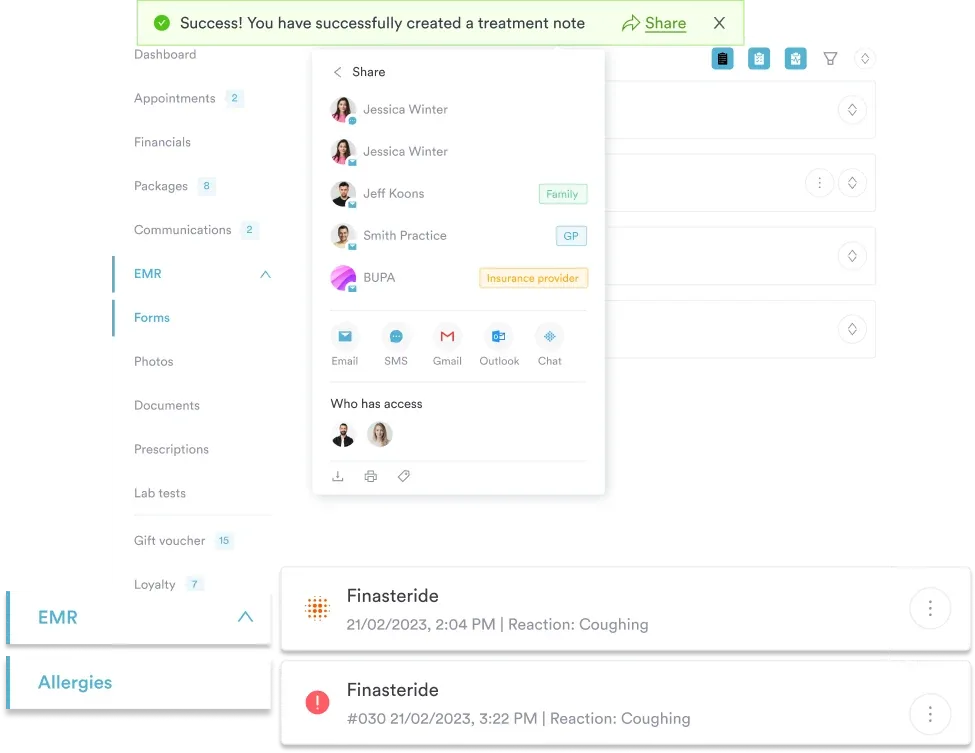
Pabau links the signed operative note to the claim, so coders can confirm ALND documentation, laterality, and diagnosis before 19302 goes out. That means fewer denials and less rework for the billing team.

The judgment call on 19302 is almost always the same one. Read the operative note and decide whether a full axillary dissection took place. If the note describes a sentinel node biopsy, 19301 plus 38500 or 38525 is the honest answer.
Fixing the code after a denial costs far more than reading the note carefully the first time. Set the check up once, at the point where the coder opens the claim, and the same decision stops coming back.
Book a demo to see how Pabau ties surgical documentation to claim submission, so 19302 goes out with the note that supports it.

Coding another malignant excision this week? CPT code 11606 walks through the lesion size and margin measurement that decide the code.
Coding blistering caused by another disease? bullous disorder from another disease requires the underlying disease to be sequenced ahead of it on the claim.
Coding a diaper rash diagnosis? diaper dermatitis diagnosis code is the billable code for irritant contact dermatitis localized to the diaper area.
Coding an abnormal mammogram result? ICD-10 code R92.8 explains when abnormal breast imaging findings belong on the claim.
Coding dermatitis caused by a chemical? chemical contact dermatitis code applies when a chemical triggered the dermatitis but the reaction type is unconfirmed.
CPT code 19302 is a partial mastectomy performed with axillary lymph node dissection in the same operative session. The code bundles the breast resection and the ALND into one reportable service. Axillary lymph node dissection is not separately billable when you report 19302.
CPT 19301 covers a partial mastectomy without axillary lymph node dissection. CPT 19302 covers the same resection with the dissection included. Use 19301 when only a sentinel node biopsy took place, and report that biopsy separately with 38500 or 38525. Use 19302 only when the operative note documents a full axillary dissection.
Generally no. CPT 38525 is bundled into 19302 under NCCI edits, because the axillary dissection already sits in the 19302 descriptor. Billing both codes triggers an edit and the secondary code gets denied. Check the current NCCI edit status before you try to override it with a modifier.
Medicare pays roughly $860 to $870 for 19302 at the national unadjusted facility rate. That figure comes from about 25.9 total RVUs and the 2026 conversion factor of $33.40. Your own payment depends on MAC locality and geographic adjustment, so check the CMS Physician Fee Schedule lookup tool before you bill.
Laterality modifiers come first, so append -RT for the right side or -LT for the left. Modifier -22 applies when the procedure is substantially more complex than usual and the note supports it. Modifier -51 applies when 19302 is reported with other procedures in the same session. Modifier -57 applies when the decision for surgery came at an E/M visit on the day of or day before surgery.
The operative note has to describe the axillary dissection as a performed step, not a sentinel node biopsy. Include the number of nodes removed, the laterality, and the level of dissection when the surgeon documents it. The pathology report should confirm receipt of axillary node tissue. Without that language in the note, the record does not support 19302.