HCPCS code E0198: Water pressure pad billing guide
HCPCS code E0198 is a water pad for a standard mattress HCPCS code E0198 is the ...

Last Updated: Oct 13, 2026

CPT code 12054 covers intermediate repair of facial wounds measuring 7.6 cm to 12.5 cm, including the ears, eyelids, nose, and lips.
Intermediate repair means the note shows subcutaneous tissue or superficial fascia closed along with the skin.
Multiple wounds in the same anatomical group are added together and reported under one code.
At 2026 rates, Medicare pays about $197 for the repair in a facility and about $391 in an office.
Pabau’s digital clinical forms capture wound length, closure layers, and the ICD-10 pairing while the patient is still in the room.
CPT code 12054 is the code for an intermediate repair of a facial wound measuring 7.6 cm to 12.5 cm. It covers the face, ears, eyelids, nose, lips, and mucous membranes. The closure also has to be layered, which means subcutaneous tissue or superficial fascia was repaired along with the skin.
Two details decide whether that claim gets paid. The first is the wound length, measured in centimeters before anything is closed. The second is the closure description, which has to name the deeper layer. Miss either one and the claim comes back denied, or downcoded to the lower simple repair rate.
The full AMA descriptor reads “Repair, intermediate, wounds of face, ears, eyelids, nose, lips and/or mucous membranes; 7.6 cm to 12.5 cm.” The code sits in the Integumentary System section of the AMA CPT code set, inside the Repair (Closure) subsection.
Which code you land on comes down to two variables. One is the measured length in centimeters. The other is the closure technique the clinician actually used.
Every code in the 12051-12057 series shares the same anatomical scope. They differ only by wound length, so the table below is the whole decision.
CPT 12054 sits in the middle of that range. A facial wound under 7.6 cm drops to CPT 12053 or lower, and anything past 12.5 cm moves up to CPT 12055. Measuring before closure is what makes that choice defensible later.
Intermediate repair means the closure involved subcutaneous tissue or superficial fascia as well as the skin. That extra layer is the test. Simple repair closes the skin in one layer and stops there, while complex repair goes further again with complicated preparation, extensive undermining, or retention sutures.
Flaps do not belong in that third row at all. Adjacent tissue transfer and flap procedures have their own series, 14000-14302. You report those codes instead of a repair code, not alongside one.
So a single-layer facial closure belongs in the simple series. A facial repair that needed complicated preparation moves up to the complex series.
Skin glue on its own counts as a single layer too. When tissue adhesive is the only thing holding the wound together, Medicare wants G0168 rather than a repair code from this series.
There is one exception worth knowing. A single-layer closure still counts as intermediate repair when the wound was heavily contaminated and needed extensive cleaning or removal of particulate matter. The note has to describe that cleaning for the claim to hold up.
Both directions cost money. Billing 12054 when the note describes only a skin closure is upcoding, and wound repair sits high on the Office of Inspector General’s audit list. Coding a layered repair as simple is the quieter version, and the practice never gets that difference back.
Surgeons comparing EMR options for plastic surgery practices should check how each handles operative notes and staged procedures.
Work through these in order, before anyone opens the fee schedule.
Aggregation is where this series goes wrong most often. Lengths only combine inside a group. A 5.0 cm facial wound and a 5.0 cm trunk wound stay separate, and each one gets its own code from its own series.
CPT 12054 carries a work RVU of 3.41, and that figure is the same wherever the repair happens. Practice expense is what separates the two settings. The values below come from the January 2026 release of the CMS physician fee schedule.
Geographic practice cost indices, known as GPCI, then adjust each component by locality. That is why two practices billing the same code in different states see different money for identical work.
At the 2026 conversion factor of $33.4009, CPT 12054 pays roughly $197 in a facility and roughly $391 in an office. Both figures are unadjusted national averages. Your locality moves them in either direction once GPCI is applied.
Medicaid programs and commercial payers set their own fee schedules, so neither figure predicts what they will pay. Look up your own locality in the CMS physician fee schedule tool before you quote a number to a patient or a payer.
The same repair pays about $194 more in an office than in a facility. The place of service code on the claim is what decides which rate you get.
Place of service errors are quiet and expensive. An office repair submitted with a facility code simply pays less, and nobody spots it until someone audits the remittances. The reverse is worse, because it creates an overpayment you have to hand back.
Six elements have to be in the record before the claim goes out. One missing element is enough for a denial or a downcode.
A structured note does most of that work for you. They prompt the clinician while the patient is still in the chair, which is the only easy moment to catch it.

Every 12054 claim needs a diagnosis code that names the wound and its site. The codes below cover most facial repairs, and site specificity is what carries medical necessity.
Reach for it last, because a vague diagnosis on a facial repair invites a medical necessity review.
When a note lacks the detail a code needs, query the clinician before reaching for the unspecified option. ICD-10 code S64.00XA follows that rule: assign it only after a laterality query comes back empty.
These codes also move. ICD-10-CM updates every October 1, and your Medicare Administrative Contractor can limit which diagnoses it accepts for repair codes through a Local Coverage Determination. Check the current status of anything unfamiliar in the CDC’s ICD-10-CM tool.
Most 12054 claims need no modifier at all. The five below cover the situations where one changes the outcome, and payer rules vary, so treat this as standard Medicare policy rather than gospel.
Repairing wounds in two anatomical groups on one day usually needs modifier 59 to stop the second line bundling. One of its XE, XP, XS and XU replacements can serve instead. Check the pair against the CMS NCCI edits first, then describe both wound sites clearly in the note.
Modifier 59 is not a way to force a line through. If there is no applicable NCCI edit for the code pair, appending it can trigger a review of its own. Payers track how often each provider reaches for it. Check the edit, then decide.
Cleaning and debriding the wound is usually part of the repair, not a second service. CPT treats debridement as separately reportable in three situations only.
Only then does a debridement code such as CPT 11042 belong on the same claim. Anything less, and the work is already paid for inside 12054.
Four errors account for most denials and post-payment findings on this code. All four start in the record rather than the claim.
Six lines, and most of them take a few seconds each.
The path is short. Your clearinghouse checks the format, the payer runs the code pair through its edits, then the diagnosis is measured against coverage rules. The line either pays or comes back with a reason code, usually inside two weeks.
Every one of those checks reads the note as written. That is why a rejection is worth opening the same week it lands, while the clinician can still remember the wound.
Billing for a facial repair is decided in the treatment room, not in the billing queue. By the time a coder opens the encounter, a missing length or a vague closure line is already part of the permanent record.
Practice management software like Pabau handles that in two separate places. Structured forms and treatment notes prompt for wound length, closure layers, suture detail, and the diagnosis while the encounter is still open. All of it saves into the patient’s clinical record, so nobody rebuilds the procedure from memory a week later. Batch submissions group many claims into one claim file, and one malformed record can hold up the batch. Two practices can bill the same encounter at a different visit level, and the note settles which was right.
The administrative half sits elsewhere. Pabau’s claims management tools validate the insurer and policy fields, submit the claim, and track its status afterwards. So a rejected 12054 line surfaces within days, rather than at month end when the clinical detail has gone cold.
Volume is what makes this worth fixing properly. A dermatology or plastic surgery team can close several facial wounds in a day across different clinicians.
One note template with no length field spreads the same denial across all of them. So dermatology software and plastic surgery software need those fields built in, not added by whoever remembers.
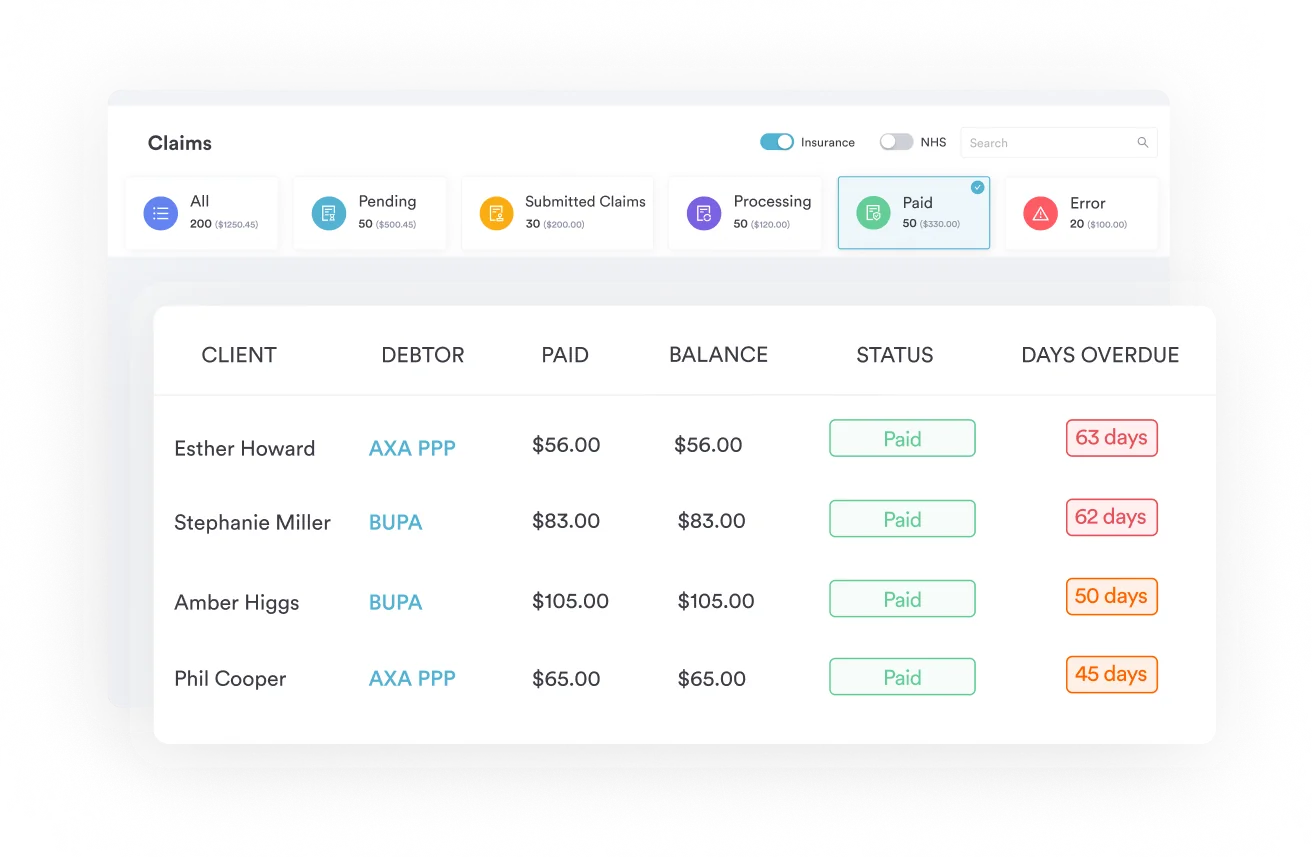

Pabau’s digital clinical forms capture wound length, closure layers, and the diagnosis at the point of care. Claims management then validates and submits the claim, so 12054 goes out complete the first time.

The money on a 12054 claim comes down to two lines in the note. With a length in centimeters and a named deeper layer, the claim stands up whether it pays at $197 or $391. Without them, no amount of appeal work puts the difference back.
So build the prompt into the note template instead of relying on anyone’s memory. The record comes out right the first time, and the practice stops paying twice for repairs it has already done. Book a demo to see how Pabau captures wound repair detail and gets the claim out the same day.

Need the complex repair equivalent? CPT 13100 covers complex repair of the trunk, where the preparation work goes well beyond a layered closure.
Repairing a wound below the neck? CPT 12032 handles intermediate repair of body wounds from 2.6 to 7.5 cm, with its own length bands.
Coding a wound that has already healed? S51.801S shows how the sequela character changes an open wound diagnosis.
Facial trauma alongside the laceration? S02.651K walks through a mandible fracture that failed to unite, and the detail its claim needs.
Coding bipolar disorder without a documented episode type? unspecified bipolar diagnosis code applies when a bipolar diagnosis is confirmed but the episode type is not documented.
Yes. CPT 12054 carries a 10-day global period, so routine follow-up for that repair is already paid for. A suture check or wound review inside those 10 days is not separately billable. An unrelated visit in the same window needs modifier 24 to be paid.
Sometimes. If the visit only covers the decision to repair the wound, it is part of the procedure and not billable. A significant, separately identifiable evaluation and management service gets modifier 25 on its own line. The note has to show that separate work.
No. Local infiltration and topical anesthesia sit inside the CPT surgical package, so payment for the repair already includes them. Only a separate anesthesia service delivered by another provider is reported on its own line.
Medicare allows 12 months from the date of service. Commercial payers are often tighter, sometimes 90 days, so check the contract before you assume. A denial does not reset that clock, which is why rejected claims need reworking the week they arrive.