ICD-10 code S61.201A: Open wound of left index finger without nail damage
ICD-10 code S61.201A covers a left index finger wound of unstated type ICD-10 co...

Last Updated: Oct 16, 2026
Billable Code Specific Code
S64.00XA is the billable ICD-10-CM code for injury of ulnar nerve at wrist and hand level of unspecified arm, initial encounter.
Let Pabau's smart automation suggest the right codes, reduce claim denials, and keep your practice compliant—effortlessly.
Automate repetitive tasks and focus on what matters most—your patients.
Reduce coding errors and ensure compliance with the latest regulations.
Clean claims, fewer denials, and faster reimbursements.
Powerful insights and reporting to help your practice thrive.
HIPAA compliant SOC 2 certified GDPR-compliant Trusted by 4,000+ clinics worldwide

ICD-10 code S64.00XA is a billable code for injury of the ulnar nerve at wrist and hand level of unspecified arm, initial encounter.
The 7th character ‘A’ means active treatment, so switch to ‘D’ for routine healing care and ‘S’ for a late effect.
Assign S64.00XA only when the record does not name the arm, because a documented side calls for S64.01XA or S64.02XA.
On an inpatient claim the code groups to MS-DRG 073 or 074, and it still needs a present on admission indicator.
Practice management software like Pabau submits S64.00XA claims through Claim.MD, then tracks status and denials in one place.
Coders reaching for this code usually want the same handful of facts. The table below collects them, so a pre-submission check takes seconds instead of a trip back through the tabular list.
Every value traces to the FY 2026 tabular list maintained by the CDC National Center for Health Statistics.
The 7th character marks the phase of care, and it shapes how a payer reads the whole claim. Under CMS ICD-10-CM coding guidance, injury codes take one of three values. A means initial encounter, D means subsequent encounter, and S means sequela.
For S64.00XA, ‘A’ holds through the whole active treatment phase. That includes the tenth visit, not just the first, as long as the provider is still treating the injury. Once treatment ends and the patient moves into routine healing care, ‘D’ takes over.
‘S’ is different again. It applies when a lasting consequence becomes the reason for the visit, such as chronic weakness or sensory loss in the hand.
Billing teams flag 7th character mismatches constantly, because the note and the claim end up telling different stories about where the patient is.
The classification tree explains a lot about which codes sit next to this one. S64.00XA sits six levels down, from the chapter to the specific code.
That ‘X’ in the sixth position is a placeholder, not a typo. S64.00 defines no 6th character, so the X exists only to carry the mandatory 7th one. Drop it and you submit an invalid code string, which a clearinghouse rejects before a payer ever sees the claim.
S64.0 offers three laterality options, and S64.00XA is the weakest of the three. ICD-10-CM guidelines require the highest degree of specificity the documentation supports.
So when the note names the affected arm, the laterality-specific code replaces this one.
Here is how it goes wrong in practice. A provider writes “right-hand laceration with ulnar nerve involvement” in the visit note. The superbill comes back blank, so the coder assigns S64.00XA. Under ICD-10-CM guidelines that is a documentation deficiency, not a coding shortcut.
The arm was identifiable from the clinical picture, so the query should have gone out first. Two questions settle the code, and they run in order.
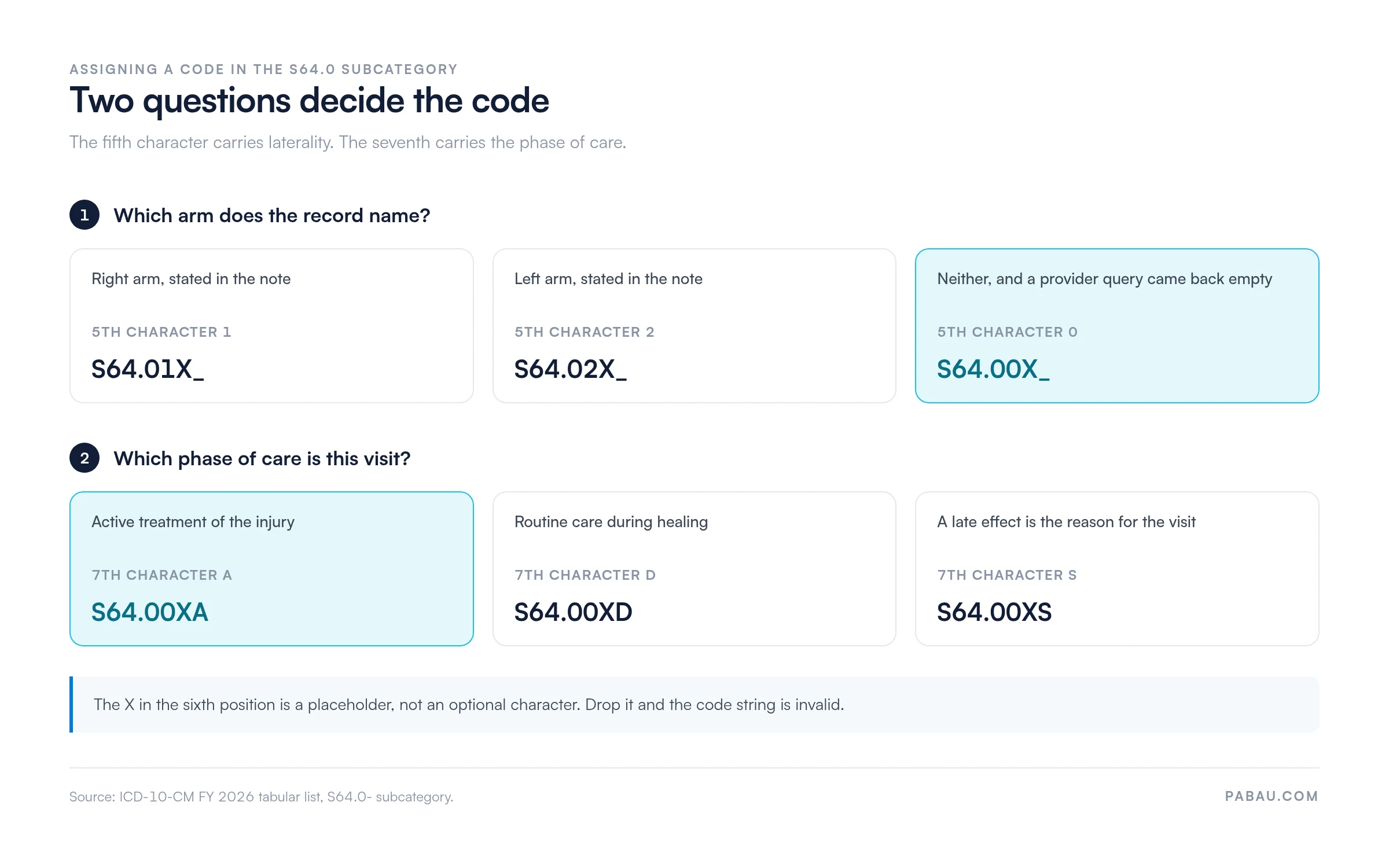
Flag any injury claim coded with S64.00XA for a documentation query before submission. Most payers expect laterality on peripheral nerve injury codes, so an unspecified code on a one-sided injury can trigger a medical necessity review. Settling the arm first avoids the rework.
Hand trauma rarely damages one nerve in isolation, so the S64 category matters as a set. Per the AAPC ICD-10-CM code reference, S64 spans the ulnar, median, radial and digital nerves.
The table below covers the entries that come up most.
Complex hand trauma with several nerves involved needs a separate code for each nerve. Never fold a combined ulnar and median injury into one unspecified code.
Sequence the most severe injury first, then work down. Pabau’s ICD-10-CM code index lists the full S64 range when you need an entry this table leaves out.
The main conflict is G56.2x. S64 carries no Excludes1 or Excludes2 note at the S64.00XA level itself, so the restrictions come from elsewhere in the chapter.
The injury chapter (S00-T88) carries an Excludes2 note for birth trauma. That applies to newborn nerve injuries recorded under perinatal conditions, and it has no practical effect on adult or pediatric cases after birth.
The distinction that does bite is traumatic versus non-traumatic. S64.00XA describes a traumatic injury. Ulnar neuropathy, a chronic or compressive condition such as cubital tunnel syndrome, falls under G56.2x in the nervous system chapter instead.
Excludes notes also change. Re-read the tabular entry for S64.00XA at every coding software update, because CMS adds and revises these notes in the annual release.
Anatomy, laterality, encounter phase and mechanism. Those four elements decide whether the claim clears medical necessity review or draws an audit. Each one has to come from the provider’s note.
Structured intake forms and note templates keep those four elements in the record at every visit. Practices that standardize the fields see far fewer coding queries weeks later.
Five checks catch most of what sends an S64.00XA claim back. None of them takes longer than reading the note again.
Work through those five and the claim goes out as a clean claim. Rework always costs more than the check does, and a denied injury claim tends to sit in aging for a month before anyone touches it.
S64.00XA groups to MS-DRG 073 or 074, both of which sit in the nervous system MDC. Per the CMS MS-DRG classifications, 073 covers cranial and peripheral nerve disorders with a major complication or comorbidity (MCC). DRG 074 covers the same disorders without one.
Which one applies depends on the principal diagnosis and on what else appears on the claim. Fracture or vascular injury codes can move the grouping somewhere else entirely, so never treat the DRG as fixed.
Most ulnar nerve injuries at the wrist never reach an inpatient claim. On outpatient and professional fee claims, the diagnosis drives payment through the CPT codes billed with it. Accurate S64.00XA assignment supports medical necessity for nerve exploration, repair and neuroplasty procedures.
Once the claim clears, the payer returns an 835 electronic remittance advice. That file tells the billing team which lines paid, which were reduced and which were denied.
S64.00XA is not on the CMS present on admission (POA) exempt list. Only S64.00XD and S64.00XS carry that exemption, so an inpatient claim reporting S64.00XA requires a POA indicator.
Assign “Y” when the injury was present at the time of admission. That is the usual case when the injury is why the patient came in. A nerve injury that happened during the stay, such as damage during a carpal tunnel release, takes “N” instead. That second case may also need a T code for the surgical complication.
Because ICD-9-CM never had a laterality distinction. Code 955.2 covered injury to the ulnar nerve in either arm, so it maps to all three ICD-10 laterality codes at once.
ICD-9-CM stopped being valid for US healthcare transactions on October 1, 2015. The crosswalk still matters for legacy record reviews and retrospective audit requests.
Per the ResDAC ICD coding resources, mappings between the two systems are approximate.
So a retroactive chart review cannot assign a laterality-specific code from ICD-9 data alone. Pull the clinical record and read it. Right, left or genuinely unspecified is a documentation question, never a mapping question.
When responding to a retrospective audit involving pre-2015 records, never assign S64.01XA or S64.02XA based solely on the ICD-9 code 955.2. Pull the original clinical note to verify laterality first. Incorrect specificity on an audit response creates additional liability.
Most practices assemble an injury claim from two or three places. The diagnosis lives in the clinical note, and the charge sits in a spreadsheet or a separate billing tool. Then someone retypes both into a clearinghouse portal. Every retype is another chance to drop the X out of S64.00XA.
Practice management software like Pabau closes that loop. Pabau’s software for billing teams pulls the recorded diagnosis and the service straight onto the claim form.
The S64.00XA line then matches the note it came from. A searchable ICD-10-CM library sits inside the form, and required-field checks hold the claim until membership and authorization details are complete.
From there the claim goes out electronically through Claim.MD in the US. The same screen returns real-time eligibility checks, claim status and 835 remittance postings, so nobody reconciles payments by hand.
Denials surface where the claim already lives, instead of in a separate inbox a week later.
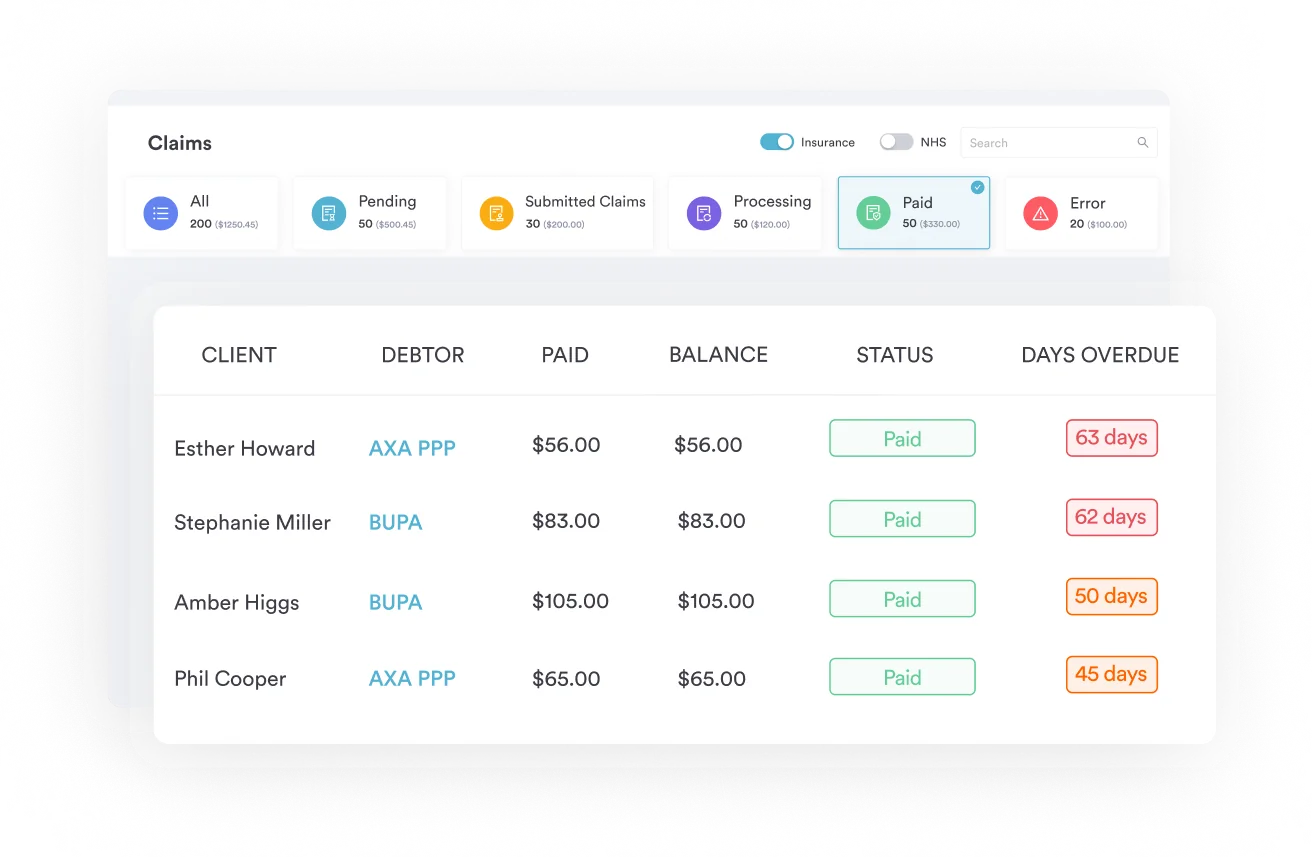

Pabau pulls the recorded diagnosis and service onto the claim form, then submits electronically through Claim.MD to thousands of US payers. Track status, work denials and post remittances in one place.

S64.00XA is the code you reach for when the record leaves you no better option. Treat it that way and it behaves. A query to the provider costs one message. A medical necessity review costs the whole claim and a month of aging.
The habit worth building is a small one. Read the note before the superbill, settle laterality and phase of care first, then pick the code. Coders who work in that order rarely see an S64 claim come back.
Want to see what that looks like when the note, the code and the claim sit in one system? Book a demo and we will walk a nerve injury claim through from documentation to remittance.

Need to understand how claims move from ICD-10 code to payment? Revenue cycle management in healthcare covers the end-to-end billing workflow from patient registration to remittance reconciliation.
Concerned about injury claim denials? Denial codes in medical billing breaks down the most common payer denial reasons and how to resolve each one.
Working with multiple injury codes on the same claim? How the superbill works in practice explains how to structure multi-code claims for clean submission.
Yes. A laceration that damages the ulnar nerve produces two diagnoses, so code the open wound from the S61 range alongside S64.00XA. Sequence the more severe injury first. The same principle applies when a fracture accompanies the nerve damage.
The two codes leave different facts undocumented. S64.00XA names the ulnar nerve but not the arm. S64.90XA names neither, so it applies only when the record does not identify which nerve was injured. Reaching for S64.90XA when the note says ‘ulnar’ is under-coding.
No. S64 codes stop at wrist and hand level. An ulnar nerve injury at forearm or elbow level belongs in S54.0-, inside the S50-S59 block for injuries to the elbow and forearm. Check the documented level before you pick the category.
No. The diagnosis code stays S64.00XA regardless of who pays. What changes is the paperwork around it. Workers’ compensation payers use their own forms, authorization rules and filing deadlines. Confirm those requirements before submission, because a late filing is rarely appealable.
Yes, when the ulnar nerve injury is the condition that occasioned the admission. In practice a wrist laceration or fracture usually holds that position instead, and the nerve injury becomes a secondary diagnosis. Sequencing follows the record rather than the nerve damage alone.