CPT code 63081: Vertebral corpectomy, cervical spine
CPT code 63081: official descriptor and procedure overview CPT code 63081 descri...

Last Updated: Oct 6, 2026
11426 is the CPT code for excision of a benign lesion, including margins, on the scalp, neck, hands, feet, or genitalia. It applies when the excised diameter is over 4.0 cm, and skin tags are excluded.
The excised diameter is the lesion plus the margin of normal tissue on each side, measured before closure. That makes 11426 the largest size tier in the 11420 series. Denials usually trace to a diameter that was never recorded, or to a scalp or neck lesion billed with the 11400 trunk codes.
Let Pabau's smart automation suggest the right codes, reduce claim denials, and keep your practice compliant—effortlessly.
Automate repetitive tasks and focus on what matters most—your patients.
Reduce coding errors and ensure compliance with the latest regulations.
Clean claims, fewer denials, and faster reimbursements.
Powerful insights and reporting to help your practice thrive.
HIPAA compliant SOC 2 certified GDPR-compliant Trusted by 4,000+ clinics worldwide

CPT Code 11426 applies only to the scalp, neck, hands, feet, and genitalia, while trunk and limb lesions use the 11400 series.
The excised diameter must exceed 4.0 cm, measured at surgery as the lesion plus the margin of normal tissue on each side.
Simple closure is bundled into 11426 and cannot be billed separately, but intermediate or complex repair and skin grafts may be reported in addition.
Medicare requires documented medical necessity under the applicable MAC’s local coverage determination for removal of benign skin lesions (for example L35498 or L34200). Routine cosmetic removal is not covered.
Pabau’s claims management software runs validation checks before you send a claim, so fewer 11426 claims come back for rework.
The American Medical Association publishes the official descriptor for CPT Code 11426.
It reads: “Excision, benign lesion including margins, except skin tag (unless listed elsewhere), scalp, neck, hands, feet, genitalia; excised diameter over 4.0 cm.” This is a full-thickness skin excision that extends through the dermis. It includes any required margin of normal tissue and leaves a defect that needs closure.
The procedure is distinct from shave removal, which does not extend through the full dermis. It also differs from destruction codes such as CPT 17110 and 17111, which use heat, cold, or chemical means rather than surgical excision. Billing a destruction or shave code for a surgical excision is a code selection error, and payers answer it with medical necessity reviews or downcoding.
Local anesthesia and simple (one-layer) closure are bundled into 11426 under the CPT surgical package. They cannot be reported separately. Intermediate or complex repair and skin grafts are not bundled and may be billed in addition when medically indicated and separately documented. Flaps work differently, because the adjacent tissue transfer codes already include the lesion excision.
The excised diameter is the widest dimension of the ellipse of tissue removed, measured at the time of surgery. Take it before the specimen goes into formalin, which shrinks tissue. It equals the lesion width plus the margin of normal tissue taken on each side.
Take a sebaceous cyst measuring 2.8 cm at its widest point, excised with a 0.7 cm margin on each side. Its excised diameter is 2.8 + 0.7 + 0.7 = 4.2 cm. That result exceeds 4.0 cm and supports CPT Code 11426. Had the surgeon taken a 0.5 cm margin on each side, the excised diameter would be 3.8 cm. That falls in the 3.1-4.0 cm tier covered by 11424, as the chart below shows.
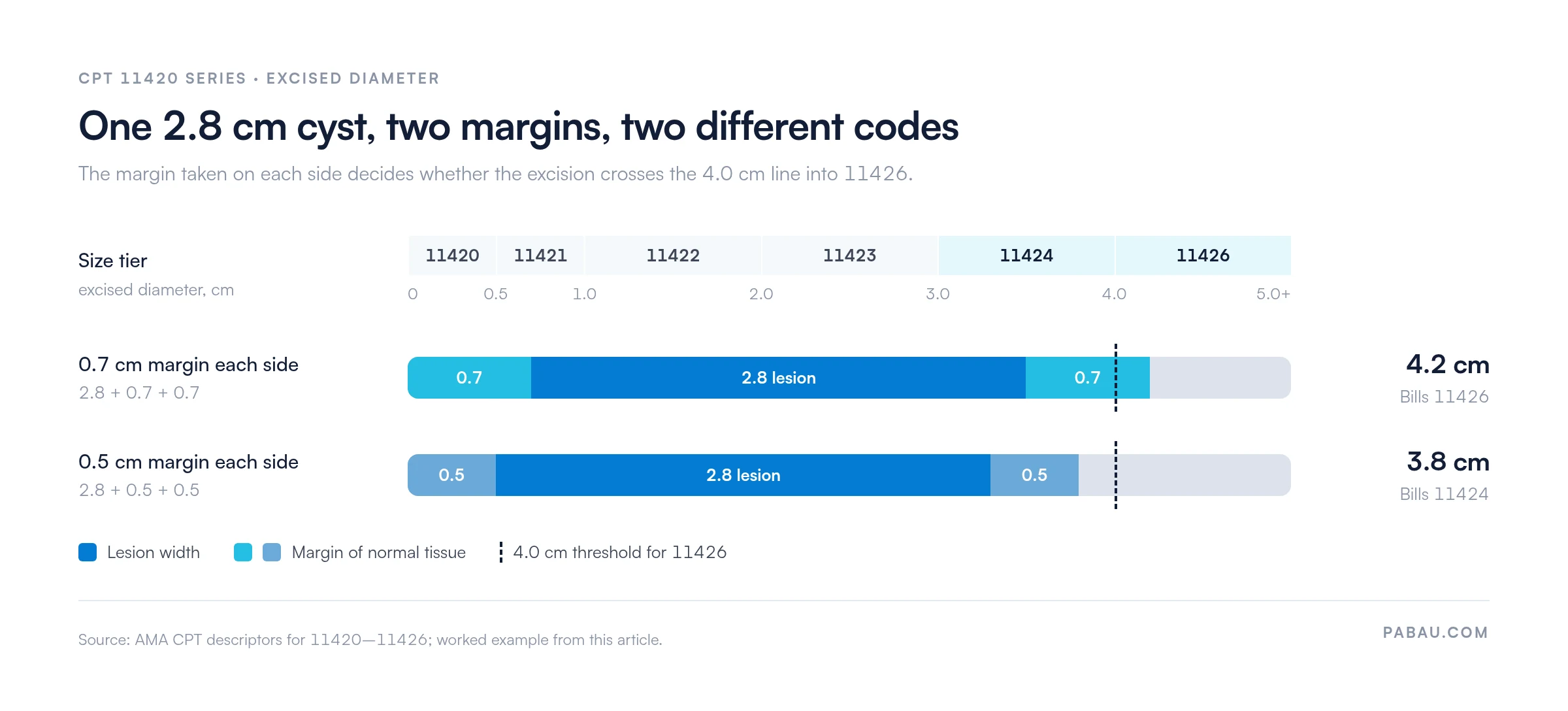
The operative note must state the excised diameter as a measured value, not an estimate. Phrases such as “large lesion” or “approximately 4 cm” are not sufficient. Auditors and payers look for a specific measurement recorded before closure. Missing or vague measurements are a frequent reason 11426 claims get downcoded.
The 11420 series covers five anatomical sites: scalp, neck, hands, feet, and genitalia. Selecting 11426 for a lesion on the trunk, upper arm, thigh, or back is an incorrect site-series assignment that frequently triggers denial or review. Those locations belong to the 11400 series.
The table below shows all three site-based series and their anatomical scope, which coders must distinguish before selecting any benign lesion excision code.
Routing a neck lesion through 11406 instead of 11426 is one of the more common errors in dermatology and plastic surgery practices. The anatomical site must be documented in the operative note to support whichever series is billed.
CPT Code 11426 is the largest-diameter tier in the 11420 series. Each code in the series maps to a specific excised diameter range. Choosing the wrong tier in either direction triggers audits, and repeated upcoding on Medicare claims can create False Claims Act exposure.
The 4.0 cm threshold is easy to apply once the specimen is measured, so 11426 errors usually start in the operative note. A diameter recorded at 4.1 cm before the incision, with no measurement of the excised specimen, invites questions from a payer auditor.
Measure the excised specimen on the surgical field before wound closure, not before the incision and not from the pathology report. Document the value in the operative note in the format: ‘Excised diameter: X.X cm (lesion Y.Y cm + margin Z.Z cm each side).’ This format answers the payer’s three questions in one sentence and reduces clarification requests by pre-empting the audit.
CPT Code 11426 bundles local anesthesia and simple one-layer closure into the procedure value. Reporting these separately produces a claim with an unbundling error, which payers reverse on receipt.
The following items fall outside the bundle and are handled as shown when documented:
Actinic keratosis removal is excluded from the entire 11400/11420/11440 series. Actinic keratosis is a pre-cancerous lesion, not a benign lesion. It is treated with destruction codes (CPT 17000 and 17003), or by excision coded according to the pathology result. Coding 11426 for an actinic keratosis is a coding error that most Medicare Administrative Contractor (MAC) local coverage determinations will deny.
The diagnosis code must support medical necessity for a benign lesion excision. Payers cross-reference the ICD-10-CM code against the procedure to confirm the clinical indication supports excision rather than destruction or observation. The CMS ICD-10-CM coding resources provide the official code files updated annually.
Site-specific ICD-10-CM subcategories matter. D23.4 (scalp and neck) versus D23.7 (lower limb including hip) must match the body site documented in the operative note. A mismatch between the diagnosis site and the CPT series frequently triggers denial or review.
Medicare does not cover benign lesion removal under CPT Code 11426 when the procedure is cosmetic. Coverage is governed by the applicable MAC’s local coverage determination for removal of benign skin lesions (for example L35498 or L34200). The record must document at least one qualifying indication, such as:
For Medicare patients whose excision may not meet medical necessity criteria, an Advance Beneficiary Notice of Noncoverage (ABN) must be issued before the procedure. Without an ABN, the provider cannot bill the patient if the claim is denied. The ABN must identify the specific service, explain why Medicare may not pay, and give the patient an estimated cost.
Medicare reimbursement for CPT Code 11426 is calculated from the Medicare Physician Fee Schedule (MPFS) using a relative value unit (RVU) model. Rates vary by geographic locality and are updated every January. The CMS Physician Fee Schedule lookup tool provides current payment amounts by HCPCS code and geographic area. The FastRVU 2026 RVU lookup also lists work, practice expense, and malpractice RVUs with locality adjustments.
The table below shows the 2026 national non-facility values. Facility rates are lower because the hospital or ASC separately bills practice expense costs. Verify current rates using the CMS fee schedule tool before including them in patient financial estimates or superbills.
Modifier selection for CPT Code 11426 depends on the clinical scenario. The AAPC CPT code reference provides current modifier guidance alongside the CPT descriptor. The table below covers the modifiers most frequently applied to 11426 claims.
Understanding medical billing fundamentals helps billers distinguish Modifier 59 (distinct procedural service) from the X-modifiers introduced by CMS under NCCI policy. Some MACs require XS, XE, XU, or XP in place of 59 for certain code pairs. Check the current NCCI edit tables for 11426 pairs before defaulting to Modifier 59.
CPT Code 11426 carries a 10-day global period under the CMS Medicare Physician Fee Schedule, based on the integumentary section global period designations. During those 10 days, routine post-operative visits related to the excision are included in the procedure payment and cannot be billed separately.
Services that can be billed separately during the global window include:
When multiple benign lesions are excised in a single session, each lesion is reported separately with its own CPT code and size-appropriate tier. Reporting all lesions as a single 11426 is incorrect, and payers reverse it.
The correct sequence is:
Clean claims on multi-lesion days need a billing system that puts each lesion code on its own line with its own modifier. Verify this capability in your practice management system before a multi-lesion session is scheduled.
Denials on CPT Code 11426 cluster around a consistent set of documentation and coding failures. Effective denial management workflows treat each denial category as a process problem with a fix upstream. For a broader reference on standard payer rejection codes, see the guide to denial codes in medical billing.
Run a monthly audit of 11426 claims using your clearinghouse’s remittance data. Filter for CARC 50 (not medically necessary), 97 (bundled into another service), and 167 (diagnosis not covered). The same CARC repeating across several claims points to a systemic documentation or code-selection problem.
Electronic claim submission via a clearinghouse reduces manual errors on CPT Code 11426 claims. It validates code combinations, modifier pairs, and diagnosis linkages before the claim reaches the payer. The medical claims clearinghouse converts practice-generated superbills into HIPAA-compliant 837P transactions. It then returns 835 electronic remittance advice (ERA) files when payment is posted.
ERA files carry the CARC codes from the pro-tip above, so the remittance doubles as your denial audit trail. A practice that reads them weekly spots a site-series or documentation pattern within days of the first denial.
The 11426 denials covered above share a root cause. The details the payer needs sit in the operative note, but they reach the claim by hand. A missing diameter or a mismatched site then travels straight to the payer.
Pabau, the practice management platform we build, keeps the operative note, the superbill, and the claim in the same patient record. Its claims management software runs validation checks before you send a claim. Incomplete claims are caught at your desk instead of coming back on a remittance.
Claims go out through Pabau’s Claim.MD clearinghouse integration to thousands of US payers. Eligibility checks run before the excision is scheduled, so your team knows whether an ABN is needed before the patient arrives. ERA files then post payments and denial codes back against the original claim.

Pabau’s claims management software runs validation checks before you send a claim and submits through Claim.MD to thousands of US payers. See how it handles 11426 claims for dermatology and skin practices.

CPT Code 11426 rewards the practice that measures before it closes. Record an excised diameter over 4.0 cm and confirm the site is the scalp, neck, hands, feet, or genitalia. Then write down the LCD indication.
Those three entries decide whether the claim pays at the 11426 rate or comes back downcoded. The trade-off is a minute of documentation in the procedure room against weeks of appeal work later.
Book a demo to see how Pabau carries the operative note through to a validated 11426 claim.

Need to understand how clearinghouse rejections differ from payer denials? Understanding the Claim.MD clearinghouse explains how 837P claims are validated before reaching a payer and what clearinghouse-level rejections mean for your workflow.
Want to see where excision coding fits in the wider billing cycle? Revenue cycle management fundamentals covers how excision codes fit into the billing and collections workflow, from patient encounter to paid claim.
Want to reduce claim errors before they become denials? Medical billing compliance outlines the documentation and process controls that keep integumentary and surgical claims clean across payers.
CPT Code 11426 covers full-thickness excision of a benign scalp, neck, hand, foot, or genital lesion with an excised diameter over 4.0 cm. Local anesthesia and simple one-layer closure are included. Intermediate or complex repair, skin grafts, and pathology processing are not included and may be billed separately when documented.
Excised diameter equals the widest dimension of the tissue removed, measured on the surgical field before wound closure. It includes the lesion width plus any margin of normal tissue taken on each side. A lesion measuring 2.8 cm with a 0.7 cm margin on each side produces an excised diameter of 4.2 cm, which qualifies for CPT 11426.
CPT 11426 applies specifically to the scalp, neck, hands, feet, and genitalia. Trunk, upper arm, thigh, and back lesions belong to the 11400 series. Face, ear, eyelid, nose, and lip lesions belong to the 11440 series. Using 11426 for a trunk lesion is a site-series error that frequently triggers denial or review.
CPT 11426 carries a 10-day global period under the CMS Medicare Physician Fee Schedule. Routine post-operative visits during those 10 days are bundled into the procedure payment. Unrelated E/M visits, return-to-OR complications, and staged procedures may be billed separately with the appropriate modifier (Modifier 24, 78, or 58 respectively).
Medicare covers CPT 11426 only when medical necessity is documented. The applicable MAC’s local coverage determination for removal of benign skin lesions (for example L35498 or L34200) sets the criteria. Qualifying indications include bleeding, itching, pain, recent enlargement, and inflammation. Cosmetic removal is not covered. Issue an ABN before the procedure when coverage is uncertain, so you can bill the patient if the claim is denied.
CPT 11423 covers excision of a benign lesion on the scalp, neck, hands, feet, or genitalia with an excised diameter of 2.1-3.0 cm. CPT 11426 requires an excised diameter over 4.0 cm. Both codes cover the same anatomical sites but represent different size tiers. CPT 11424 (3.1-4.0 cm) sits between them in the series.