



CCSD code G5100: Bypass of duodenum billing guide
CCSD code G5100 bills a bypass that leaves the duodenum in place CCSD code G5100...

Last Updated: Oct 16, 2026

CPT code 01992 describes anesthesia for diagnostic or therapeutic nerve blocks or injections in the prone position, performed by a different physician or qualified provider.
The code carries 5 base units. Payment equals base units plus time units, multiplied by the Medicare conversion factor, which varies by MAC locality.
Modifier selection is a common denial trigger. AA applies when a physician anesthesiologist performs personally, and QZ applies when a CRNA works without medical direction.
Practice management software like Pabau centralizes anesthesia documentation and holds a claim back from submission until required billing fields are complete.
CPT code 01992 covers anesthesia for a nerve block or injection performed in the prone position. It applies only when a different physician or qualified provider handles the block itself.
That’s a narrow definition, and missing either condition in the record is what sends most claims back before they even reach payment review. Here’s how the base units, modifiers, and documentation fit together so a claim clears on the first pass.
Official AMA description: Anesthesia for diagnostic or therapeutic nerve blocks and injections; when the block or injection is performed by a different physician or other qualified health care professional, prone position.
Two conditions must both be true for 01992 to apply. The patient must be in the prone position. The nerve block or injection must be performed by a provider different from the one delivering anesthesia. If either condition is absent, a different code applies.
CPT 01992 carries 5 base units, set by the American Society of Anesthesiologists (ASA) Relative Value Guide. Base units reflect the complexity, skill, and risk of the anesthesia service, independent of time.
Medicare and most commercial payers calculate anesthesia payment using this formula:
Because the conversion factor varies by MAC locality, never use a fixed dollar figure for billing decisions. Use the CMS Medicare Physician Fee Schedule lookup tool to find the current rate for your jurisdiction.
Qualifying circumstances are add-on codes that represent conditions significantly affecting the character or quality of anesthesia. They are reported in addition to CPT 01992 when applicable.
Payer policies on qualifying circumstances vary. Verify MAC-specific guidelines before reporting these add-ons, as some payers require separate documentation justifying the circumstance. Practices billing across multiple anesthesia codes can review IVF procedure billing codes for additional context on add-on code documentation standards.
Comparing practice management systems for medical teams is worth the effort before anesthesia time-unit billing becomes a spreadsheet job.
Modifier selection is where most 01992 claims fail. The modifier tells the payer who performed the anesthesia and what supervision arrangement applied. Using the wrong modifier is one of the top denial causes for this code.
CRNAs billing CPT 01992 without physician direction use modifier QZ on their claim.
When a physician medically directs that CRNA, the physician submits modifier QY and the CRNA submits modifier QX. Both claims then reflect the shared arrangement, and each receives a percentage of the full fee rather than 100%.
State law affects CRNA supervision requirements. Whether a CRNA may practice without physician direction depends on the state’s opt-out status under the CMS supervision requirement.
Confirm your state’s status before selecting QZ. Billers working across multiple CPT areas can cross-reference ADHD screening CPT billing for guidance on how modifier rules apply consistently across code families.
Run a modifier audit on your 01992 claims quarterly. Filter by denial code CO-4 (modifier required or invalid). If you see repeated QZ denials in states where physician supervision is required, switch to QX/QY pairing immediately to stop the bleed on those claims.
Medicare reimbursement for CPT 01992 is not a fixed dollar amount. It depends on three variables: the 5 base units, the time units recorded, and the anesthesia conversion factor for your MAC locality. The CMS Medicare Physician Fee Schedule lookup tool provides current locality-specific rates.
Commercial payer rates vary further. Some insurers apply their own conversion factors or cap time units at specific thresholds. Always verify in-network contracts before estimating reimbursement for prone position anesthesia services.
For broader procedure billing context.
Insufficient documentation is the second-most common denial reason for CPT 01992, after incorrect modifiers. Because both the prone position and the separate-provider arrangement are unique requirements of this code, they must each appear explicitly in the anesthesia record.
Maintaining HIPAA compliance requirements for anesthesia records means storing documentation securely and ensuring the record is retrievable for audit within the required timeframe. Practices that store records digitally reduce the risk of missing documentation at claims submission.
Four errors account for the majority of CPT 01992 denials. Each has a straightforward fix once billing staff know what to look for.
CPT 01992 does not exist in isolation. Billers commonly see the following codes on the same claim or the associated procedure claim. Understanding their relationships prevents unbundling and supports accurate co-billing.
For pain management practices also billing evaluation and management or coaching-related services. The AAPC CPT code lookup is useful for cross-referencing related codes in the 01990-01999 range.
Payers require an ICD-10-CM diagnosis code to establish medical necessity for anesthesia services. The following diagnoses are commonly submitted with CPT 01992 claims, reflecting the pain management and spinal conditions most often treated with prone position nerve blocks.
Do not state that specific ICD-10 codes are “required” without verifying your MAC’s local coverage determination. Use “commonly linked” as the standard when documenting diagnosis code guidance for billing staff.
These diagnoses turn up across pain management, physical therapy. They’re common where chronic low back or radicular pain doesn’t resolve with conservative care.
Cross-reference your submitted ICD-10 codes against your MAC’s local coverage determination (LCD) for nerve blocks and injections before filing. An ICD-10 code that is not listed in the LCD policy for your service area will trigger a medical necessity denial even when the CPT code and modifier are correct.
Anesthesia billing breaks down when the anesthesia record, the procedure record, and the claim live in three different places. A prone-position nerve block needs the position, the separate provider, and the modifier lined up before the claim goes out. A gap between systems is usually where that falls apart.
Pabau keeps the anesthesia record, the procedure note, and the claim in one client file, so nothing needs retyping between systems.
Its claims management software tracks every claim’s status from submitted through to paid. It also holds a claim back from submission until required fields, like provider details and authorization numbers, are filled in.
For a code like 01992, that means the prone-position documentation and the separate-provider attestation sit in the same record the biller pulls up before submitting. It isn’t buried in a system nobody checks until a denial comes back.
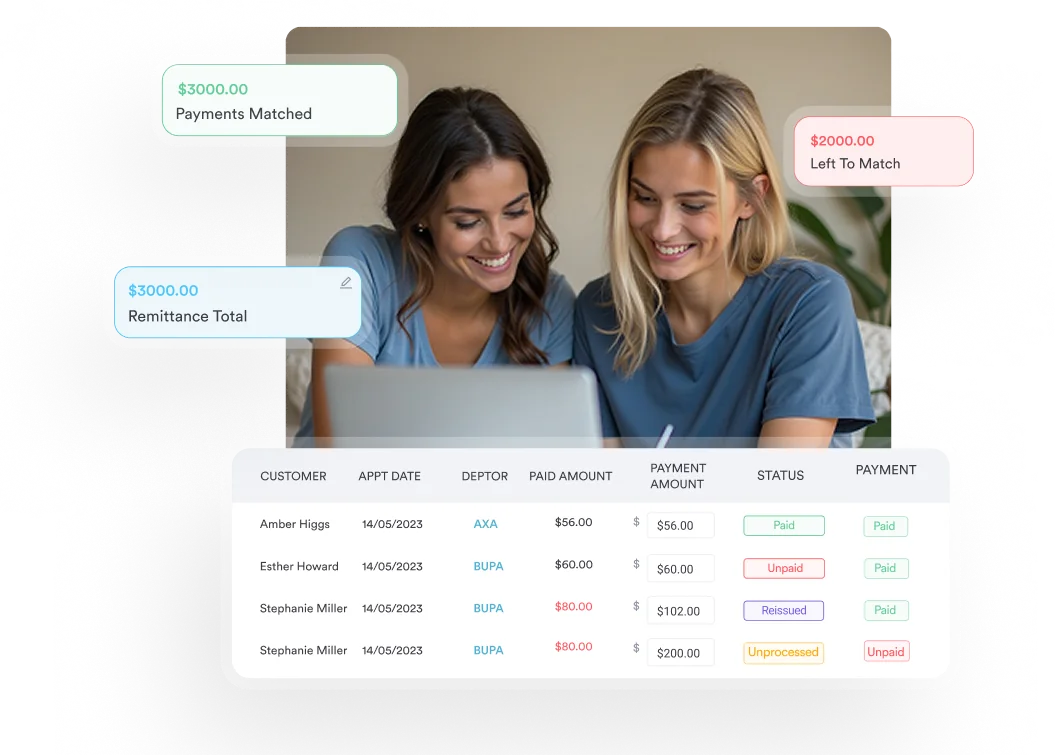

Pabau’s claims management software centralizes anesthesia documentation and holds a claim back until required billing fields are complete, so incomplete claims never reach the payer.

CPT code 01992 comes down to two requirements. Document the prone position, and name a separate provider for the block. Once both are on record, the modifier is usually the only variable left to get right.
Practices that build those two checks into their documentation habit, rather than catching them at claim submission, see fewer 01992 claims come back for correction. That habit costs a few extra seconds per chart against a week or more lost to an appeal.
Book a demo to see how Pabau keeps anesthesia documentation and claim status together, so a missing detail on CPT code 01992 doesn’t reach submission.

Billing airway supplies alongside an anesthesia claim? HCPCS code A4608 walks through the documentation Medicare expects for a transtracheal oxygen catheter.
Coding a cervical spine injury tied to a procedure claim? ICD-10 code S12.430B covers the documentation for a displaced C5 fracture with spondylolisthesis.
Need an ICD-10 code for a musculoskeletal pain diagnosis? ICD-10 code M77.8 explains when this enthesopathy code fits a claim outside the usual low back pain codes.
Also billing complex repair procedures for the same patient? CPT code 13151 breaks down the modifiers and reimbursement rules for complex facial repairs.
Billing a checkpoint inhibitor infusion this cycle? Durvalumab billing guide covers how a 1,500 mg Imfinzi dose converts to 150 billable units.
CPT code 01992 covers anesthesia for a prone-position nerve block performed by a separate provider, using standard base and time units. Monitored anesthesia care is a different service, providing sedation and monitoring without general anesthesia, billed under its own CPT codes and payer rules.
No. The code specifically requires a different physician or qualified provider to perform the block. If the same provider does both, bill the block under its own procedure code instead of 01992.
It depends on the payer and the setting. Many commercial plans require prior authorization for prone-position nerve blocks in an ambulatory surgery center. Check the payer’s policy before scheduling, not after a denial.
Pain management and interventional practices bill it most. They treat chronic low back and radicular pain, where prone-position lumbar and thoracic nerve blocks are common.
Sometimes. Bill modifier 25 only when a separately identifiable evaluation and management service is documented beyond the anesthesia encounter. Payers scrutinize this pairing closely.



